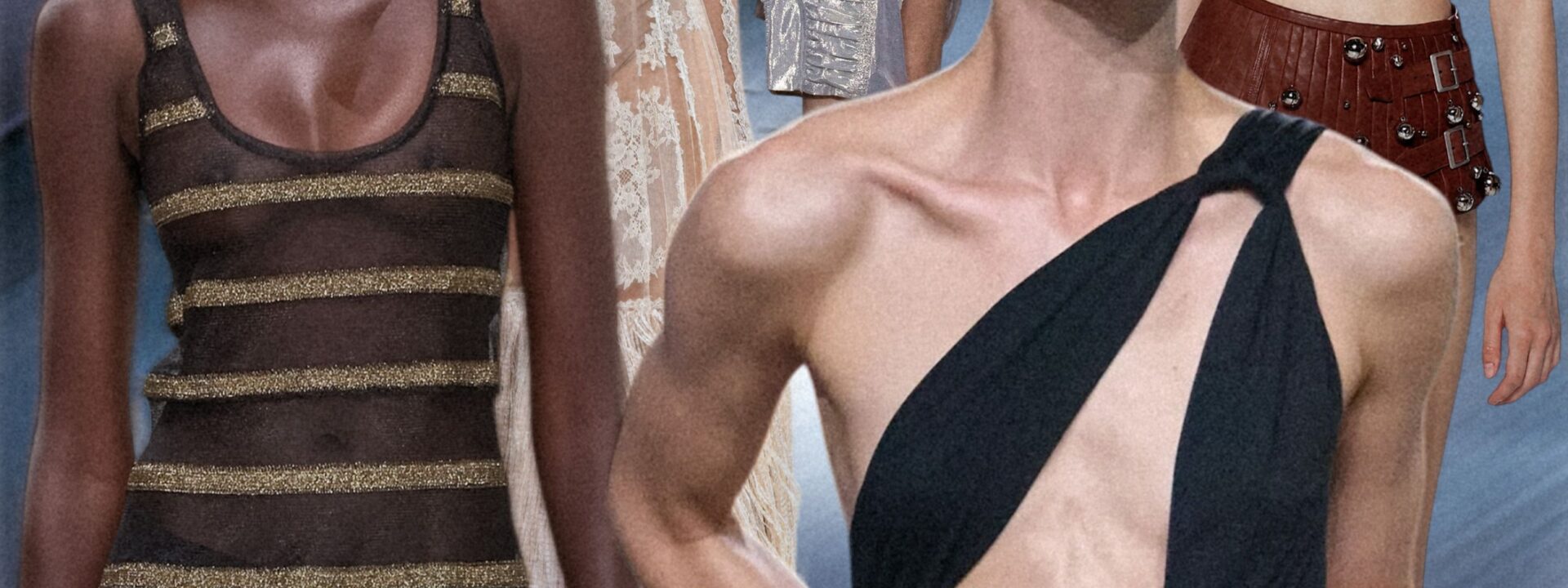
Bullet bras and high-cut briefs at Tom Ford. Corsets and garter skirts at Balmain. Skirts worn as belts at Ashlyn. And sheer organza on almost every runway. These are just some of the lingerie-inspired, transparent, and cinched pieces that flooded the Spring/Summer 2027 shows. But beyond the cyclical nature of sex appeal and its shifting role in fashion, this surge of skin brings something deeper into focus at a time marked by shrinking bodies: the relationship between GLP-1s and the runway.
Conversations about weight loss medications like GLP-1s can sometimes feel everywhere. GLP-1 sales reached $79 billion in 2025, according to Morgan Stanley Research, and the global market is projected to hit $190 billion by 2035. A June 2026 report from the Consumer Goods Forum and Bain & Co. forecasts that GLP-1 use will reach one in three Americans and one in eight Britons by 2030.
Against this backdrop, it’s increasingly hard not to see fashion trends through this lens. The visibility of skin—so-called “naked dressing”—bralettes, and contorting designs on the runway raise questions about correlation and causation. Are these trends directly responding to the rise in weight loss medications, as luxury customers try to show off their new bodies? Or are they mere coincidence, made more visible by the current climate?
The shrinking of clients’ bodies is clear, especially at the high fashion level, according to Paris-based fashion sourcer and luxury personal shopper Isabel Bazzani. “Couture houses have told me they’ve had to update client books they’ve held for years, because the body measurements on file no longer match,” she says. “Production is following suit, with larger sizes from luxury houses becoming more limited and smaller sizes being made in higher quantities.”
“Fashion is always a reflection of everything from cultural shifts to what’s going on in society, body ideals, attitudes toward the body, and how people choose to dress,” says Frida Tordhag, fashion analyst at trend analytics firm Heuritech. “It’s hard to generalize. These body trends have always gone in waves, and we’ve seen more women using GLP-1s, so they might dress differently.”
For Tordhag, the relationship is tenuous. “From our perspective and from the data we have, we cannot see a direct correlation between the rise of GLP-1s and runway trends,” she notes.
For others, it’s more nuanced. “We’re still going through all the trends as a team and trying to decode how this is playing out,” Krista Corrigan, senior retail analyst at retail intelligence platform EDITED, notes. She adds that confirming these correlations can be particularly tricky, though. “What could be a result of GLP-1s? Some of these trends, of course. But we’re making an inference, because it’s difficult to tie it back exactly.”
Even so, she sees signs of their influence. “We definitely saw a few things that indicate to me the influence of GLP-1 and Ozempic showing up on the runway.”
Design that flexes with the body
One way this shift can show up is through functional design. “While the headline narrative around GLP-1s usually centers on revealing, skin-baring fashion and bodycon fits, the real revolution is happening in how garments function,” Laura Yiannakou, womenswear senior strategist at trend forecaster WGSN, explains. “Around 40% of consumers who use weight loss medications prioritize comfort, as they deal with drug-induced side effects like temperature shifts, skin sensitivity, and extreme bloating.”
This includes design details that allow for adjustability, such as the crossed lacing at Miu Miu, zippers on skirts at Lemaire, and elastic hems at CFCL. “It’s why belts are having such a moment—not just as stylish accessories, but as essential tools for creating an instant, customizable shape,” Yiannakou adds. This was visible across runways: beBelted looks were supersized at Celine, cinched peplum waists appeared at Valentino, and trench coats were dramatically secured at Acne Studios. Corrigan points to belts and cinched-waist outerwear as SS27 trends that offer both adaptability for size fluctuation and the accentuation of smaller proportions. Demand for functionality is visible across retail data: arrivals of bottoms with adjustable waistbands more than doubled month-on-month in May 2026, while arrivals of belted bottoms were up 50% year-on-year, per EDITED. On the runway, self-tie fabric belts featured on wide-leg pants at Max Mara and adjustable Velcro fastenings secured skirts at Prada. Bra tops backstage at Balmain SS27. Photo: Acielle / Style Du Monde. Fabrics that support breathability and ease are also gaining traction. “We’re witnessing a movement toward what we call ‘rebound’ textiles, and fluid silhouettes,” says Yiannakou. This was present in the tempo pleats at Issey Miyake, or the wave-inspired silhouettes at Stella McCartney. Knits and yarn blends, like those at CFCL, erred on the side of practical. “To handle changing body proportions, designers are turning to high-recovery knits like Milano rib, bi-stretch wool blends, and heat-set pleats that offer structural integrity with reliable give and snap-back quality.” It’s in the silhouettes, too. Column dresses were fluid at Alberta Ferretti, with cutouts at Christopher Esber, and elongated takes at Fendi. The closing look at Ferragamo, worn by Anok Yai, saw the silhouette expressed in an embellished fashion — high-necked, with black and metallic paillettes reflecting light. Per WGSN retail data, the column silhouette has nearly doubled in dress market share, signaling demand for shapes that sit on the body with ease. Tordhag has also observed strong demand for voluminous silhouettes. “Everything from sorrel pants to drape dresses, fringe dresses and feathers are up,” she says. The mini trapeze dress was a strong feature across SS27 runways, from Loewe to Miu Miu and Ganni, while Heuritech data shows the silhouette increased by 31% year-on-year in China and 15% in Europe. A new way to show off the body. The change in silhouette and fabrication doesn’t mean the body is more concealed, though. Rather, it reflects an evolution in how the body is shown. “We see that the female body is being almost soft-launched in the fabric or in the shape.” “When we look at our data, what’s interesting is that we’re not seeing a straightforward shift towards tighter clothing,” says Tordhag. “We would expect bodycon or slim silhouettes to rise, but both in the US and Europe, they’re actually falling.” Bodycon dress arrivals are down 8% year-on-year in Europe, and 6% in the US, while slim pants are down 25% in Europe, 21% in China, and 20% in the US, per Heuritch data. And across the SS27 runways, it wasn’t about second-skin. The body was laid bare, via dramatic cutouts, lingerie, transparent and transluscent garments, to accentuate the form. Sometimes, it was overt, like at Gucci or Tom Ford. Others, it was more nuanced, via romantic cutouts at Chloé and delicate sheer pastels at Dior and Chanel. Tordhag describes this as a new form of sexiness: “We see that the female body is being almost soft-launched in the fabric or in the shape.” More bra tops at Jean Paul Gaultier SS27. Photo: Daniele Oberrauch / Gorunway.com. One interesting expression of this trend is the convergence of volume and transparency. In-store arrivals of see-through loose tops are up 30% in the US, per Heuritech. Tordhag notes SS27 collections from Alberta Ferretti, Bluemarine and The Attico that explore this interplay between lace, lingerie features and transparency across voluminous silhouettes. More broadly, sheer and soft fabrics are on the rise. Fine lace is up 41% in China and 19% in Europe, with dresses in this fabrication specifically up 49% in China, 37% in Europe and 19% in the US, per Heuritech. In-store visibility of chiffon and satin dresses is also increasing, as “naked dressing” pushes away from fishnet andMesh — both of which are in decline, according to Heuritech — and pulls toward a softer expression. Personal shopper Bazzani has also noticed this shift. This season, her clients are highly requesting Saint Laurent’s silicone-lace designs, as well as sheer dresses, tops and skirts from Chanel, and Hermès’s undergarment-revealing pieces. Lingerie as occasionwear was also a headlining theme this season, with Heuritech data reflecting its prevalence. Lace-trimmed camisoles are up 42% year-on-year in Europe and the US, and 59% in China. Tops with lace detail have also increased by 56% in Europe, 43% in the US, and 59% in China, while lace shorts are up 50% in the US. Lingerie-inspired dressing at Khaite SS27.
Photo: Hanna Tveite / Courtesy of Khaite. Bra tops were visible across the majority of runways, too. They were a fixture at Prada, cone-shaped at Jean Paul Gaultier, and fashioned from leather and silk scarves at Tod’s and Hermès, respectively. They were bandeau in style at Stella McCartney and Mugler, and styled over dresses and tops at Miu Miu and Marni. It’s hard not to draw correlations between the bra’s ubiquity on the runway and the rise of GLP-1s. With bras replacing tops, the body is increasingly visible. It puts abdomens, waists and arms in focus, drawing attention to the wearer’s figure. One insinuation is that those taking weight loss medications may want to show off their newly trimmed frames, especially at a time when thinness is so present in the cultural conversation. Still, the suggestion that the rise of lingerie details and sheer fabrics is in direct response to GLP-1s could be misguided. Belgium-based inclusive womenswear brand Ester Manas offers a case in point. Manas, known for radical size inclusivity, showed a SS27 collection made in partnership with Belgian underwear brand Primadonna, featuring sheer bodysuits and architectural bustiers. The same can be said of Di Petsa’s latest collection shown at London Fashion Week. While there was plenty of skin on display — transparent dresses, breasts covered merely by jewelry or a model’s hand, and plunging necklines — the brand is deeply rooted in inclusivity. Season after season, diversity has remained central to its runway, and this season was no different. “For me, it’s about showing the garments in the best way possible,” says Greek designer Dimitra Petsa. “Through size diversity, you can show different designs. I think body conscious silhouettes look amazing on fuller bodies.” In addition to Ester Manas and Di Petsa, designers like Rick Owens in Paris, Marco Rambaldi in Milan, and Collina Strada in New York kept inclusivity as a fixture on the runway. They continue to prove that skin-baring designs and body-conscious silhouettes are not exclusive to any one body. “I don’t think there should be one body type that represents fashion,” says Collina Strada creative director Hillary Taymour. “The world is full of different people, and fashion is much more exciting when it reflects that.”
Frequently Asked Questions
FAQs From Sheer Styles to Lingerie Are GLP1 Drugs Changing How We Dress
1 What are GLP1 drugs
GLP1 drugs are medications that mimic a gut hormone to curb appetite slow digestion and help with weight loss Theyre prescribed for diabetes and obesity
2 Whats the connection between GLP1 drugs and fashion
As more people lose weight quickly on these drugs their bodiesand how clothes fitchange fast Thats shifting what people buy how they shop and what they feel confident wearing
3 What does sheer styles have to do with this
Some people who lose weight feel more confident showing their bodies and gravitate toward sheer fitted or more revealing clothing they might not have worn before
4 Why is lingerie part of the conversation
Rapid body changes mean old lingerie no longer fits Many users are rebuying bras and underwearand some feel newly comfortable exploring styles they once avoided
5 Do GLP1 drugs really change how people dress
Indirectly yes The drugs change body shape and size and that changes fit comfort and confidencewhich all influence clothing choices
6 What are the benefits of this trend
More body confidence a reason to refresh wardrobes and fashion brands offering more inclusive sizing and adaptive designs
7 What common problems do people face
Loose skin shifting sizes midweightloss wasting money on clothes that stop fitting and feeling unsure about their new shape
8 How fast do sizes change on GLP1 drugs
It varies widely Some lose weight steadily over months others see faster changes Most people size down gradually rather than overnight
9 Should I buy a whole new wardrobe right away
No Buy a few versatile pieces in your current size and wait until your weight stabilizes before investing in a full wardrobe
10 Whats the best way to shop during weight loss
Choose adjustable stretchy or wrapstyle clothing shop secondhand or resale and prioritize fit over the number on the label
11 How do I handle lingerie during rapid weight loss
Buy a few wellfitting basics at each size look