Fashion’s tariff battle has moved from the customs desk to the courtroom once again.
On August 3, 25 Democratic-led states and their governors filed a complaint with the US Court of International Trade, challenging the Trump administration’s latest forced labor-related Section 301 tariffs. The complaint describes these tariffs as the administration’s third attempt to maintain a broad tariff system under the guise of labor enforcement. Earlier efforts under the International Emergency Economic Powers Act (IEEPA) and Section 122, which had kept a 10% duty in place for 150 days, were struck down.
For the fashion industry, this case arrives at an already tense moment. Last month, the United States Trade Representative (USTR) used Section 301 to impose 10% or 12.5% tariffs on imports from 60 economies, targeting trading partners the administration claims have failed to prohibit or enforce restrictions on goods made with forced labor. Additionally, the USTR has imposed a separate 25% tariff on certain goods from Brazil. Trump has also invoked Section 338 of the Tariff Act of 1930 to impose 50% duties on some Canadian imports, effective August 19, and a further Section 301 investigation into structural excess capacity is still pending.
Brands, retailers, and importers are still figuring out how to absorb, pass on, or plan around tariffs that now affect much of the global sourcing map. The new lawsuit raises the possibility of eventual legal relief, though certainty remains out of reach.
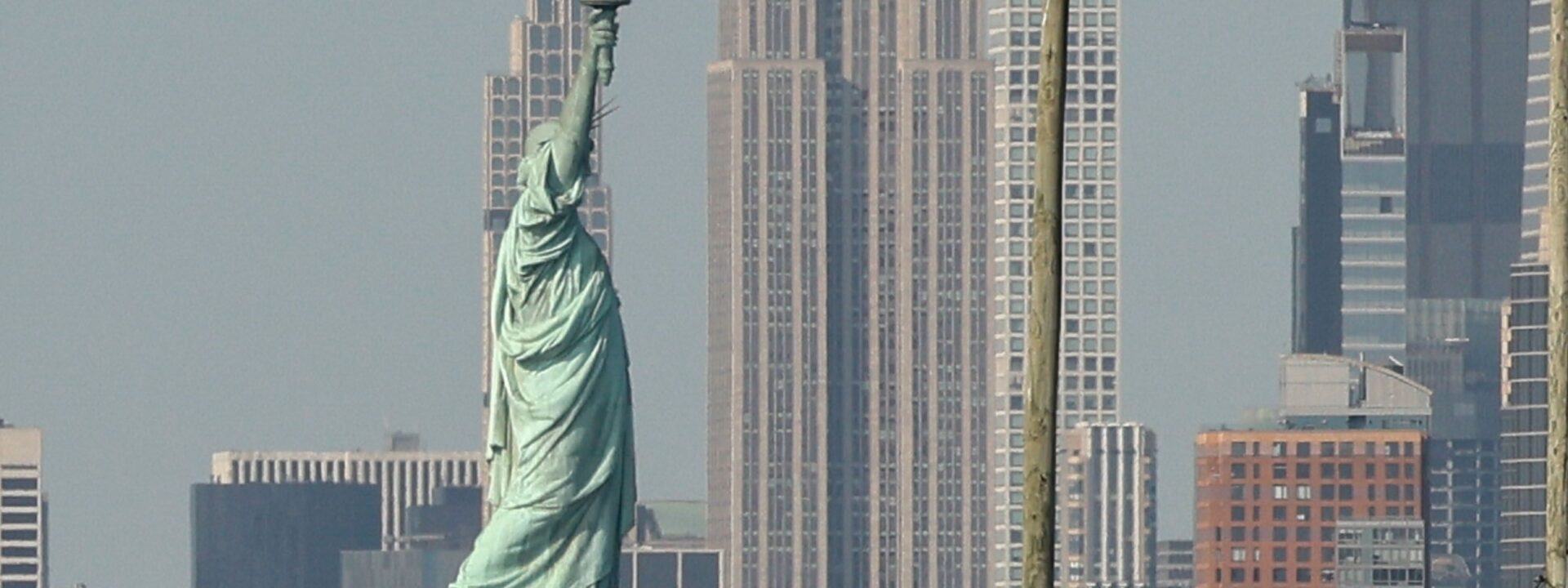
A coalition of 25 US states and commonwealths filed a lawsuit in the US Court of International Trade to block the Trump administration’s latest attempt to impose sweeping global tariffs of 10% to 12.5%.
Photo: Getty Images
The complaint argues that the USTR rushed its investigation: the review of 60 economies began in March and produced findings two and a half months later, a timeline the complaint contrasts with the China intellectual property case, which took more than eight months, and the Brazil investigation, which took a full year. The USTR then grouped those 60 economies into a few tariff categories, mostly 10% or 12.5%, without showing a clear link between each economy’s forced labor import enforcement and the rate imposed.
The states say forced labor is being used as a pretext, pointing to public statements from USTR and Treasury officials describing plans to use Section 122 and Section 301 to “ensure continuity” after IEEPA duties were invalidated and keep tariff revenue roughly unchanged.
Though that argument may resonate with importers, whether it will sway the court is a completely different question.
A broader legal front
The states’ involvement in the litigation changes the optics and, potentially, the injury argument, as the lawsuit expands the fight beyond importers seeking refunds. States can argue that tariffs flow through public procurement, vendor contracts, and budgets, giving the case a more visible trail of harm. Angela Gamalski, partner in Honigman’s regulatory department, is concerned with the larger institutional debate: tariff power rests with Congress, even when Congress delegates parts of it to the executive branch. “There has been an ongoing question in the last year — where is the legislative branch in all of this?” she says.
The lawsuit also broadens the constitutional frame. States are arguing that the administration has stretched delegated tariff authority beyond what Congress allowed. “The states coming to the court may ultimately force this issue,” Gamalski says.
Read More
What to Know About the New US Tariffs
By Jessica Binns
Still, the case is not a referendum on whether Section 301 can be used for tariffs at all. Nathaniel J. Halvorson, partner in Baker McKenzie’s international trade practice, says the essential issue is whether these particular tariffs fit the statute.
“Section 301 clearly contemplates tariffs, so the real questions are going to be about how the administration used that authority here and whether it satisfied the requirements Congress put around it,” he says.
Halvorson is cautious about how much weight the word “prThe word “etext” can only bear so much weight. “I hear it in public discourse, but in the courtroom, the question will be whether the evidence supports the conclusions the USTR drew, and whether the USTR followed the statute,” he says. He understands the instinct, given the progression from IEEPA to Section 122 to Section 301. But in his view, similarities between tariff regimes don’t settle the legal question. “The more important issue is whether the administration has independently met the requirements Congress set for Section 301.”
Containers at the Port of Rio de Janeiro in March 2026, when Brazil was among the economies included in USTR’s forced labor Section 301 investigations. USTR has since imposed new duties under the action, which is now the subject of a legal challenge from 25 states.
Photo: Getty Images
That distinction is crucial. Section 301 is a more established trade tool than IEEPA, and courts have historically given the government broad leeway in trade cases. Angela Santos, partner and customs practice leader at ArentFox Schiff, says the states’ complaint raises valid concerns, including the speed of the investigation and the mismatch between the forced labor rationale and the sweeping remedy. But she cautions against assuming that a legally vulnerable tariff action is certain to be overturned.
“All the trade lawyers I’ve discussed this with don’t think it’s legally sound, but that doesn’t mean it’s going to be struck down,” Santos says.
Relief is not a planning strategy
That uncertainty leaves fashion companies in a tricky spot: they may have reason to believe the tariffs are vulnerable, but they still have to pay them, price for them, and make sourcing decisions around them.
Halvorson says companies shouldn’t expect the litigation to resolve quickly enough to affect near-term merchandise flows.
“I certainly wouldn’t advise a company making sourcing or pricing decisions today to assume these tariffs are going away before its fall or holiday merchandise enters the US,” he says. “That’s part of what makes this difficult for companies: they have to make purchasing and pricing decisions months in advance while the legal rules governing the final landed cost can still be changing.”
For Silvia Curioni, founder and CEO of accessories brand Zipperly, the legal question is already narrower than the business problem. The states are challenging the forced labor tariff, which accounts for 12.5 percentage points of her Brazil exposure. A separate Brazil-specific action still leaves the country at a steep disadvantage compared to Italy, where Zipperly makes its bags. “Even in the best case, we go from 37.5% to 25%,” Curioni says. “Still much higher than Italy. It doesn’t change any decision we’ve made.”
Silvia Curioni, founder and CEO of accessories brand Zipperly.
Photo: Courtesy of Zipperly
Nor is Zipperly preserving its refund rights in the meantime. “I know I should,” Curioni says. “But protecting a refund you may never get requires time and expertise that a small team doesn’t have. Big companies have people whose whole job is this. We don’t, so it sits on the list until something breaks.”
Santos sees the legal challenge as credible, if not commercially actionable. While the courts may eventually narrow or strike down the forced labor action, she says, the administration may also reach for another tariff authority. For companies making purchase orders now, that makes legal vulnerability a poor substitute for planning certainty. “I would plan for the tariffs to remain,” she says. “I don’t think any practical company can eliminate the tariff calculation from their costing.”
Halvorson frames the shift in broader terms. Three different statutes, three different sets of conditions and limitations, but for companies, the lesson remains regardless of which one survives review. “Tariffs increasingly aren’t just a fixed cost to plug into a spreadsheet,” he says. “They’re a variable that can change during the lifecycle of a sourcing or purchasing decision.”Beneath the budget argument lies a more fashion-specific issue: who actually bears the cost of these tariffs. The complaint argues that broad tariffs don’t necessarily punish companies or countries linked to forced labor. Instead, they tax US importers, including those that have invested heavily in keeping forced labor out of their supply chains.
This is a particularly sharp point for fashion, where cotton, apparel, and footwear supply chains have faced ongoing forced labor scrutiny, especially since the Uyghur Forced Labor Prevention Act took effect. “A lot of these companies have invested so heavily in forced labor compliance, and they’re not being rewarded at all,” Santos says. “They’ve spent millions on supply chain diligence, programs, codes of conduct, and audits, and they’re treated just like everyone else.”
The lawsuit makes a similar argument: flat tariffs can leave the advantage of forced labor intact because compliant and non-compliant importers face the same duty, while companies spending more to keep their supply chains clean may struggle to absorb the extra cost.
Santos doesn’t expect this state complaint to be the last one. “This is probably just the beginning for 301,” she says, predicting more litigation, not less, as “the new normal for the next couple of years.” If the forced labor tariffs are struck down, she notes, the administration has other options. “They have alternative authorities in their back pocket, like Section 338, that they could use.”
For smaller brands, the problem is more urgent in the meantime. Curioni says litigation mostly adds uncertainty because winning a legal case and getting paid are not the same thing. “Winning and getting paid are two different moments, and they can be years apart,” she says. “A big company can wait. We can’t plan on a ‘maybe.'”
That means the commercial damage can happen long before a court ruling. A sourcing shift not made, a product not launched, a factory relationship not developed—none of that comes back with a refund.
“Maybe you get some duty back,” Curioni says. “You don’t get back the product you didn’t launch or the factory you didn’t open. That part is gone.”
Frequently Asked Questions
Here is a list of FAQs about challenging tariffs in court written in a natural and accessible tone
BeginnerLevel Questions
1 Wait can I actually sue the government over a tariff
Yes you can Tariffs are imposed by the US government and like most government actions they can be challenged in federal court if they violate US law or the Constitution However its not easy and there are specific legal hurdles you have to clear
2 Who is allowed to file a lawsuit to challenge a tariff
You have to have standing which means you have to be directly harmed by the tariff Typically this means US companies that import goods domestic manufacturers that rely on imported parts or trade associations representing those companies An individual consumer usually cant sue just because prices went up
3 Whats the main reason people use to challenge a tariff
The most common argument is that the President overstepped their legal authority The President doesnt have unlimited power to set tariffs they usually need to cite a specific law like the International Emergency Economic Powers Act or Section 301 of the Trade Act of 1974 Lawsuits often argue that the President didnt follow the rules required by those laws
4 If I win the lawsuit does the tariff go away for everyone
Not necessarily It depends on the courts ruling A court can strike down the tariff entirely or it can rule narrowly only helping the specific companies that sued Often courts issue a nationwide injunction but not always
5 Is there a specific court I have to file this in
Yes Tariff cases are almost always heard in the US Court of International Trade in New York Its a specialized federal court that handles trade and customs disputes Appeals go to the US Court of Appeals for the Federal Circuit
AdvancedLevel Questions
6 What is the Chevron Deference and why does it matter for tariff challenges