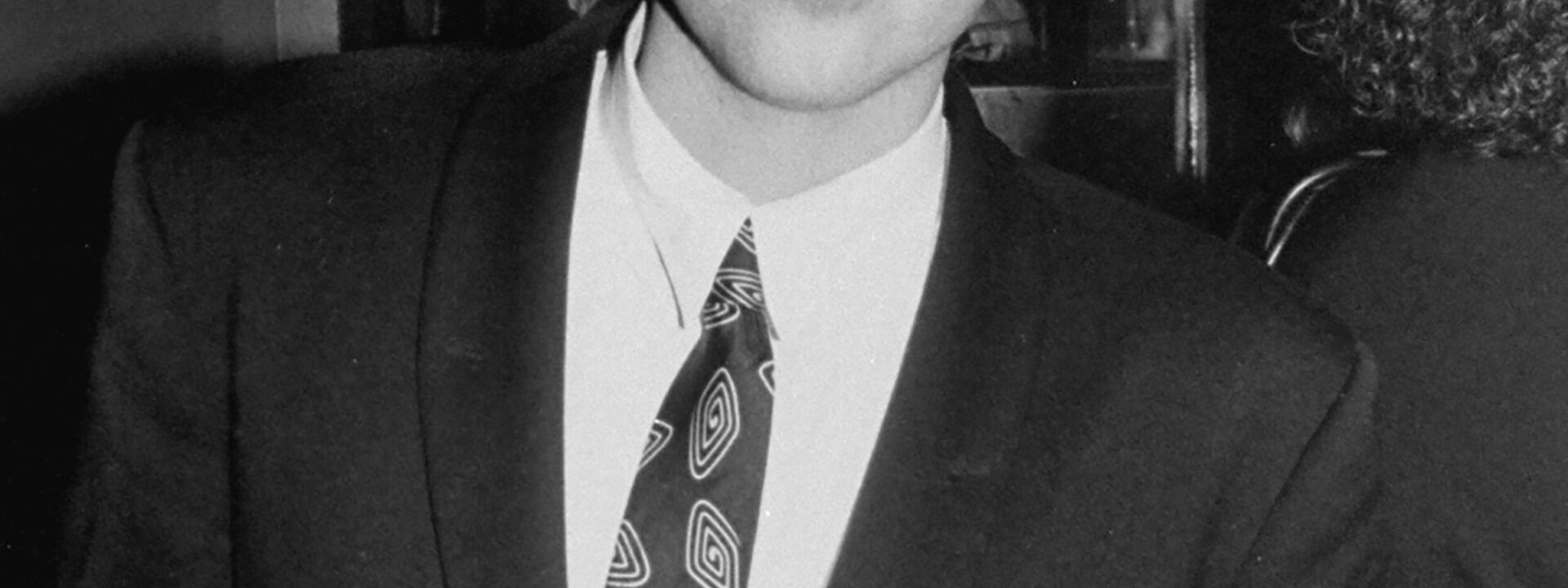
When I emailed Bret Easton Ellis to let him know that Vogue had chosen his first novel, Less Than Zero, for the third installment of its book club, he politely told me not to expect an interview. “I stopped two or three years ago from… putting myself out there,” he wrote. I pushed him, and he declined again. “I’m just done after 40 years of interviews. That’s all. It’s not hostile.” But then he added, almost in the same breath, “Of course, I can talk to you on the phone about Less Than Zero. I suppose I can break my own rules once or twice a year.”
Less Than Zero has a kind of magnetic pull—even on its author, it seems. I read it way too young—I think I was 14—and all the sex, drugs, and unsettling lack of emotion, the aimless driving around a menacing L.A., the final violence and horror have never left me. I hadn’t read anything like it, and I wouldn’t until I discovered the hypnotic, deliberate sentences of Joan Didion—another writer fascinated by Los Angeles’s darkness and dread. Didion left her mark on Ellis when he was a teenager, after he first read Play It As It Lays, Slouching Towards Bethlehem, and The White Album. He was also devoted to Ernest Hemingway back then, staying up all night reading In Our Time and The Sun Also Rises. “I was stealing from Hemingway and Joan Didion and, I guess, Raymond Chandler,” Ellis said about his early attempts at fiction: diary-like stories about him and his L.A. friends.
These would become a prelude to Less Than Zero, his novel about his 1980s L.A. world—shopping malls, multiplexes, parties, New Wave songs on the radio. He finished a draft as an undergraduate at Bennington College in Vermont, using a framing device where his protagonist, Clay, comes home from an East Coast college for Christmas break and falls back in with his old crowd: dissipated friends like Julien, Blair, Trent, and others. The story, such as it is, unfolds over four weeks with a mood somewhere between numbness and horror. The manuscript was quickly bought by Simon & Schuster, became a bestseller upon release, and Ellis, just 21, became a literary sensation.
In the following interview, which has been edited and condensed for clarity, I asked Ellis to revisit the earliest years of his writing career. We started by talking about the time after Less Than Zero was published, when he was living in Manhattan and hanging out with other writers of his generation, like Jay McInerney, Tama Janowitz, and various college friends.
Bret Easton Ellis: I really tried to stick to a nine-to-five writing schedule that matched friends who had actual jobs. I realized, “Oh, everyone’s at work today. So I’ll write and see them later.” I was very social at night, so I kept my writing for the day. That’s still true—except I’m not writing anything right now.
Vogue: How do you handle it when you don’t have a project going?
Not well! [Laughs.] I really don’t like it. I mean, it’s not a disaster. It’s not like my life ends—but I feel adrift without being anchored in a book. And books happen when they happen. You can’t force it, and I’ve learned over the years that unless you’re feeling the book, you won’t write it. My agent has said, “Come on, write a new novel. You live in L.A. All this crazy stuff has happened. There have been fires and everything.” And I just can’t do that.
What’s re-reading like for you? Do you ever do it? When was the last time you re-read Less Than Zero?
Re-reading is just too painful. I want to change everything. There comes a point when the book is done: You’ve reached the end of the road. Let’s move on. I did some readings in Europe for The Shards [Ellis’s 2023 bestselling novel, now a series from Ryan Murphy on FX]. I didn’t do anything in America—but when I was reading from it…In Europe, there were all these things I wanted to change. And I just don’t want to deal with that anymore. The last time I read Less Than Zero was probably 2008, when I was working on Imperial Bedrooms, which is the so-called sequel to Less Than Zero. It was hard to reread because the book really represents a younger version of myself. I would never write that book now, or I’d do it very differently. It just reminds me of being… How old was I? God, 1980. I can’t reread my work without being self-critical. There was also a point where I was distracted and bothered by the fact that Less Than Zero had become so popular—and that I hadn’t done a better job writing it. I have complicated feelings about all my books.
When did you first start writing?
When I was five. First, it was children’s books, and then I moved on to comic books. I drew my own comic books, and then I wrote my first novel in 1978. I was 13. That was my first full-fledged young adult novel, and I don’t want anyone to ever see it. [Laughs.] Then I wrote a second novel before Less Than Zero that was really just stealing from Hemingway, Joan Didion, and I think Raymond Chandler. I would type out long passages from In Our Time, The Sun Also Rises, Play It As It Lays, Slouching Towards Bethlehem, or The White Album. It was basically just inserting my name into something like A Movable Feast—taking a chapter and updating it to LA in 1981. With Less Than Zero, I finally found a voice that was interesting—which eventually became Clay. And because I had a car by then, I could move around more freely than ever before and pretend to be an adult. LA was very relaxed back then about checking IDs. So you could get into clubs early, and for some reason, you could order drinks, buy drugs, and drive to the desert or Palm Springs. All of that became the gateway that opened up and allowed Less Than Zero to be written.
I wrote the first draft in the winter of 1982 into 1983, kind of pulling everything together from the previous two and a half years. It’s really that simple. And then, of course, a few dramatic touches became important to me for the book’s narrative. But mainly, I wanted numbness to be a feeling, and I wanted to see if you could perfect a style that lets it seep out of the book you’re reading without being too obvious. I was fascinated by that. I was fascinated by Los Angeles, and I was fascinated by mimicking some of my favorite writers, and it all came together.
What else did you read as a child?
My parents had books all over the house, so I just picked them up. When I was five or six, I’d wonder, “What are all these paperbacks and hardcovers on my parents’ nightstands?” Even at six or seven, it was easy to pick up Love Story by Erich Segal. It was about 160 pages with big type, and I remember knowing there was a movie out, so I just started reading it. I also read a lot of kids’ books. I loved S.E. Hinton and Judy Blume, and I liked The Hardy Boys. I also enjoyed horror, sci-fi, and supernatural stuff, and I loved some of my parents’ popular novels. I picked up Robert Ludlum, Harold Robbins, Mario Puzo—you name it. I mean, in LA, we were all reading The Exorcist when we were about 10.
But then something happened when I was assigned Hemingway in school. I read In Our Time in about an hour, and I was blown away. I had never read anything like it, and then I went straight into The Sun Also Rises. I didn’t sleep. I was just a kid, so I went to school and took the quiz. But what happened was the dividing line between my youth and my adulthood. I realized that style sells the story. Style is really important. There’s something about Hemingway’s writing that pulls you into that world. And then when I was led to Joan Didion, I couldn’t believe she took the Hemingway style to an even deeper place. It seemed to…
Frequently Asked Questions
Here is a list of FAQs about what Bret Easton Ellis says about writing covering beginner and advanced perspectives
BeginnerLevel Questions
1 What is the main thing Bret Easton Ellis says about writing
He believes writing should be about creating a compelling stylish surface rather than explaining deep moral lessons or inner feelings He focuses on the what not the why
2 Does he think you need a detailed plot outline before you start
No Ellis famously writes without outlines He starts with a character or a voice and discovers the story as he goes which he says keeps the writing fresh and surprising
3 What does he mean when he says style is substance
He means that the way you writeyour sentences tone and rhythmis more important than the storys message For example the cold flat style of American Psycho is the point not just a way to tell the story
4 Why does he use so much description of brands and products
He says brands are a shorthand for character and status in a consumerdriven world Describing someones clothes or stereo isnt shallow its a precise way to show who they are and what they value
5 Does he think writers should be nice people
No He argues that to be a good writer you need to be willing to be badto explore dark selfish or politically incorrect thoughts without fear of judgment Good writing for him is often amoral
Intermediate Advanced Questions
6 How does he handle writing violent or unlikeable characters
He treats them with complete neutrality He doesnt judge Patrick Bateman or explain his trauma By refusing to moralize he forces the reader to feel the horror directly without the authors handholding
7 What is his biggest piece of advice for overcoming writers block
Stop trying to be honest or authentic He says writers block comes from overthinking and trying to find a deep meaning His fix is to just write a scene that entertains you even if it feels shallow or fake The block dissolves when you stop taking yourself so seriously
8 How does he feel about writing in the age of social media and cancel culture
He hates it He believes the current climate makes writers too cautious