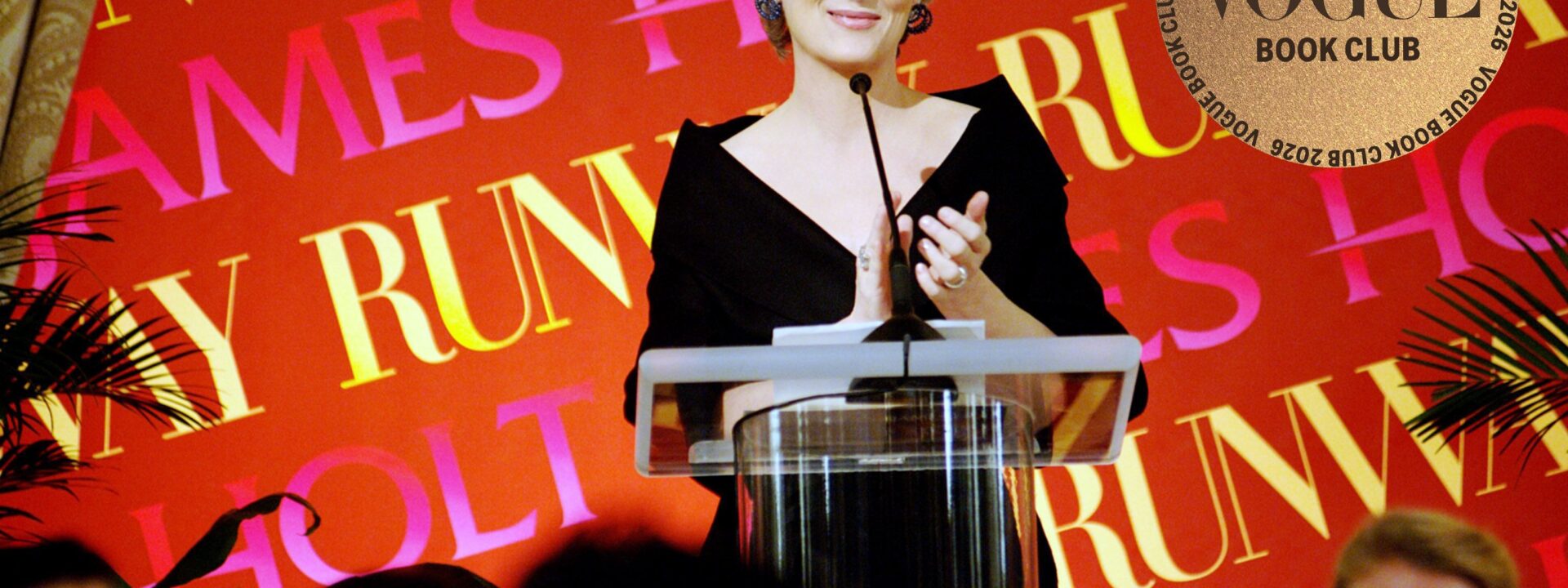
As a film, The Devil Wears Prada turned Miranda, Andy, Emily, and Nigel into iconic characters—like designer-clad Avengers, each with their own signature look and memorable lines (“That’s all,” “Can you please spell Gabbana,” “When I feel like I’m about to faint I eat a cube of cheese,” “Gird your loins,” etc.). But how much of that comes from Lauren Weisberger’s 2003 novel, and what was invented by screenwriter Aline Brosh McKenna and director David Frankel? We’re glad you asked.
Here’s a breakdown of how Miranda, Andy, Emily, Nigel, and the rest compare in the novel versus the film—and which version we think wins.
Andrea (“Andy”) Sachs, second assistant to the editor-in-chief of Runway
How she’s introduced:
In the film’s iconic opening montage, we first see Andy cheerfully putting on her not-so-great interview outfit, brushing her teeth without any glamour, and (gasp!) eating an onion bagel. In Weisberger’s original book, we meet her in the middle of the action as Miranda’s assistant, awkwardly driving her boss’s luxury convertible across town while wearing suede Gucci pants and Manolos. Both are recent college graduates—Book Andy from Brown, Movie Andy from Northwestern—with dreams of becoming a “real” journalist and working somewhere like The New Yorker. Book Andy is from Avon, Connecticut, and smokes constantly; Movie Andy doesn’t have a specific hometown or any particular bad habits.
Key differences:
Since film is a visual medium, Andy’s transformation feels much more dramatic in the movie than in the book. In the book, her first Runway-appropriate outfit is described as a “tweedy Prada skirt, black Prada turtleneck, and midcalf-length Prada boots,” given to her one night by a friendly fashion assistant named Jeffy. In the film, the look is a double-breasted black blazer with over-the-knee leather boots, both from Chanel.
In terms of attitude, Andy’s simmering anger at Miranda is much more present—and more constant—in the book than on screen. By humanizing Miranda (more on that later), the film ends up creating a different Andy too.
Who’s the better Andy?
This is a tough one, but I’d have to give the edge to Anne Hathaway’s film version. Sure, she could have learned a thing or two about fashion herself instead of making her lack of knowledge everyone else’s problem, but she’s much less of a brat about her job, has far simpler relationships with her friends and boyfriend (more on them later), and leaves Miranda on much better terms. (While Movie Andy simply doesn’t follow Miranda into a show, dropping her cellphone into a Parisian fountain when her boss calls, Book Andy leaves her job with a “Fuck you, Miranda. Fuck you.”)
Miranda Priestly, editor-in-chief of Runway
How she’s introduced:
In both the book and the movie, Andy first meets Miranda during her interview. “Since I’d never seen so much as a picture of Miranda Priestly, I was surprised to see how willowy she was,” Andy observes. “She had perfect posture—rare for a tall woman—and held her head high, with her pronounced chin proudly forward, in a way so natural it seemed almost forced. The hand she held out was feminine, soft, with the long, graceful fingers of a concert pianist. She had to look up to meet my eyes, though she didn’t stand to greet me. Her expertly dyed blond hair was pulled back in a chic knot, deliberately loose enough to look casual but still very neat, and while she didn’t smile, she didn’t seem particularly intimidating.” In the movie, on the other hand, we…You’re treated to a hilarious montage of Runway staffers frantically putting on makeup, swapping their clogs for heels, and generally panicking over their boss’s arrival at the office.
Key differences:
One notable thing about Book Miranda is her background. She’s described as one of 11 kids from an Orthodox Jewish family in London. Andy learns more from Google: “After saving the small bills her older siblings would slip her whenever they could, Miriam dropped out of high school at seventeen—just three months before graduation—to work as an assistant for an up-and-coming British designer, helping him put together his shows each season. After a few years of making a name for herself as a darling of London’s growing fashion scene and studying French at night, she landed a job as a junior editor at French Chic magazine in Paris… at twenty-four, Miriam Princhek became Miranda Priestly, swapping her clearly ethnic name for one with more flair. Her rough, cockney British accent was soon replaced by a carefully polished, educated one, and by her late twenties, Miriam’s transformation from Jewish peasant to secular socialite was complete.”
We don’t learn nearly as much about Miranda in the movie, other than that she seems American, has twins, and has at least one ex-husband. But we do get a more humanized version of her—especially in a scene where she opens up to Andy about her marriage troubles and the pain of watching her daughters lose “another father… figure.”
Who’s the better Miranda?
I mean, the film version is played by Meryl Streep, so it almost feels unfair to compare her to the book version, but… yeah, Meryl Streep’s Miranda Priestly’s Runway forever!
Emily Charlton, first assistant to the editor-in-chief of Runway
Photo: Courtesy Everett Collection
How she’s introduced:
Here’s what Andy thinks of Emily when they first meet: “It took just over half an hour before a tall, thin girl came out from behind the glass doors. A calf-length leather skirt hung from her hips, and her messy red hair was piled into one of those glamorous buns on top of her head. Her skin was flawless and pale, without a single freckle or blemish, and it stretched perfectly over the highest cheekbones I’d ever seen. She didn’t smile.” Movie Emily doesn’t smile either, immediately making a joke at Andy’s expense about HR having “an odd sense of humor” before waving her in for the interview.
Key differences:
Well, Blunt’s Emily is famously British, and her story arc is very clear (she wants to go to Paris / doesn’t get to go to Paris), while Book Emily’s goals are a bit more confusing. We know she wants power and a rich fiancé—maybe not in that order—and she sometimes becomes a sort-of ally for Andy. But their work-buddy relationship often takes one step forward, two steps back. I do love where the movie leaves Emily, though—hurt in both body and spirit, sure, but snootily agreeing to accept Andy’s stash of free Runway clothes.
Who’s the better Emily?
If you like them mean (and British), it’s Blunt. But there’s something endearing about Book Emily too, whose only real flaw seems to be taking her job too seriously.
Nigel Kipling, editor, Runway
Photo: Courtesy Everett Collection
How he’s introduced:
Stanley Tucci’s version of Nigel announces himself in the film with the unforgettable line, “Gird your loins” (and actually gets a last name), while the book version of Nigel is a bold, larger-than-life presence, somewhat like André Leon Talley. Andy describes him like this: “I turned just in time to see the man, who was at least seven feet tall, with tanned skin and black hair, pointing right at me. He had 250 pounds stretched over his incredibly tall frame and was so muscular.”He was so incredibly ripped that he looked like he might burst out of his denim… catsuit? Oh my god. He was actually wearing a catsuit. He seemed around thirty-five, though all the muscles, deep tan, and sharp jawline could have been hiding ten years or adding five. He waved his hands at me, motioning for me to get up from the floor. I stood, unable to look away, and he immediately turned to check me out.
Key differences:
Nigel—who seems to be a fashion editor—gets a much bigger role in the film than in the book, but it’s mostly a sad one, since Miranda screws him out of a great job to protect herself.
Who’s the better Nigel?
With all due respect to Stanley Tucci, I have to say Book Nigel wins. Sure, he’s pretty much a minor character, but at least that minor character is fun, secretly kind, and talks entirely in all caps. (For example: “KNEE-HIGH BOOTS? WITH A KNEE-LENGTH SKIRT? ARE YOU KIDDING ME? BABY GIRL, IN CASE YOU DIDN’T KNOW—IN CASE YOU MISSED THE BIG, BLACK SIGN BY THE DOOR—THIS IS RUNWAY MAGAZINE, THE FUCKING HIPPEST MAGAZINE ON EARTH. ON EARTH! BUT DON’T WORRY, HONEY, NIGEL WILL GET RID OF THAT JERSEY MALL-RAT LOOK YOU’VE GOT GOING SOON ENOUGH.”)
Nate/Alex Fineman, Andy’s boyfriend
Photo: Courtesy Everett Collection
How he’s introduced:
I’m not totally sure why Andy’s longtime boyfriend’s name changed from Alex to Nate in the movie, but in the book he’s described as a brand-new teacher at P.S. 277 in the Bronx, trying to figure out how to make a difference in the lives of a bunch of tough, cynical city kids. In the movie, though, we meet Nate while he’s using his chef skills to make Andy a fancy grilled cheese with Jarlsberg, which is definitely an improvement (if your priorities, like mine, lean toward tasty food).
Key differences:
I don’t really love either version of Andy’s boyfriend, but while a lot has been said about how Nate is secretly the real villain of the movie, I actually think Alex is much worse. He’s smug and self-righteous throughout the whole novel, even when Andy’s best friend is near death. I fully support Andy moving on from that jerk.
Who’s the better boyfriend?
No contest: annoying but self-aware Nate (“Andy, I make port wine reductions all day. I’m not exactly in the Peace Corps”) beats whiny, wounded Alex (“I’ve been around for the last year waiting to talk to you—begging, sometimes—and you haven’t been all that interested”).
Lily Goodwin, Andy’s best friend
How she’s introduced:
The book version of Lily has been Andy’s best friend since eighth grade and has a pretty cool backstory: abandoned by her hippie parents and raised by her strict grandmother, she’s a Russian literature PhD student at Columbia with terrible taste in men, working odd jobs to pay rent on her Harlem studio. The movie version, though, is just sort of… there? What a waste of Tracie Thoms’ talent.
Key differences:
We just don’t know much about Movie Lily, aside from the fact that she works in a gallery, likes designer purses, and seems really invested in Andy and Nate’s relationship. Book Lily, on the other hand, is kind of a trainwreck—her downward spiral, DUI, and hospital stay end up being the reason Andy turns her back on Runway. (The movie uses the classic trick of adding an ambiguously gay guy to Andy’s friend group to fill out her non-Runway world, but we learn even less about him—played by Mad Men’s Rich Sommer—than we do about Lily.)
Who’s the better Lily?
I have to give this one to Book Lily. She may be a mess, but at least she’s an interesting mess.
Frequently Asked Questions
Here is a list of FAQs about the topic Which characters from
Since you didnt specify a specific universe I have created a template using the placeholder This allows you to fill in the blank and get instant relevant FAQs
To use this Simply replace with your specific series
BeginnerLevel Questions
1 What exactly does Which characters from mean
It usually refers to identifying the main supporting or minor characters that fit a specific category theory or fan question
2 Why do people ask which characters instead of just looking at a list
Because the question is often about a specific trait role or plot twist For example Which characters from are actually villains is more specific than just listing everyone
3 Are we talking about movie characters book characters or video game characters from
It depends on the context Usually it refers to the primary canon but it can include spinoffs comics or games if the question specifies
4 Is it hard to answer which characters from are the most popular
No but the answer changes over time Usually the main protagonist or a fanfavorite side character tops the list For example in many series the main hero is the most popular but a villain like Darth Vader often wins
Intermediate Common Problem Questions
5 Why cant I find a clear answer to Which characters from are still alive
Because the timeline matters If the story has flashbacks time travel or multiple timelines a character might be dead in one scene and alive in another You need to specify when