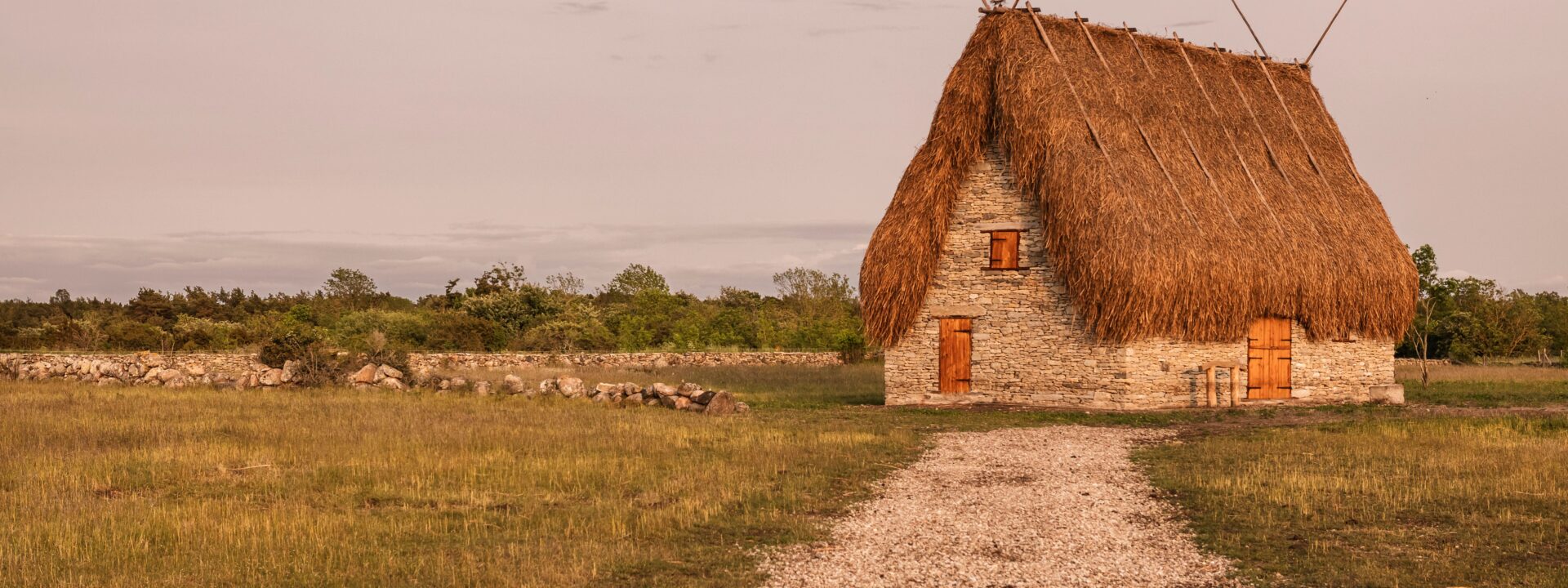
Last summer, Sibbjäns—a nearly 200-acre regenerative farm and hotel in southern Gotland, a sun-bleached Swedish island about 45 minutes by prop plane from Stockholm—had a soft opening for friends and family. The property had been the talk of the island for six years and counting, while the owners, two couples who are Swedish but not from Gotland (“a local told me it takes seven generations to become a Gotlander,” says Susanna Rönn, one of the owners, who has had a house on Gotland since 1994), worked on developing the estate.
Under their care, 18th-century limestone farm buildings were restored with traditional features like wooden gutters and dry-laid stone walls. They also added infrastructure suited to the Mediterranean-like climate, including a rainwater collection system, an irrigation pond, and showers that filter and reuse water in real time. Food on the farm is grown organically, right in sight of the hotel and restaurant, and the pool is kept clean with purifying aquatic plants instead of chemicals (it looks like a straight-edged, cloudy lagoon). Over the years, the sustainable vision for Sibbjäns became a deeper passion project, with no clear end in sight. By 2025, it felt like the right time to open and learn as they went.
Photo: Courtesy of Sibbjäns
Back to last June. The tennis court, set in a meadow behind a low stone wall designed to look like a ruin, wasn’t finished yet. Neither was the yoga hut, inspired by Gotlandish threshing barns. There weren’t enough staff to handle the hotel’s daily operations. “We had to bring in all our friends and family,” says Rönn. “The kids were running around working, and one of our friends, who’s a lawyer, was making the beds. We didn’t know what we were doing yet, but we loved it and didn’t want to turn guests away.” Her husband, Pontus Rönn, who handles everything at Sibbjäns, described that summer as “like a real-life Fawlty Towers, and I was Basil Fawlty.”
Photo: Courtesy of Sibbjäns
Photo: Courtesy of Sibbjäns
Then one thing led to another, and the King of Sweden showed up. He came with friends of friends for dinner, a low-key tagalong. As his group walked in, everyone in the dining room froze, mouths full, probably trying to figure out why the king was in the understated barn that houses the main restaurant.
Photo: Courtesy of Sibbjäns
“Sweden is such a small country,” says Susanna Rönn, by way of explanation. “There isn’t that much distance between people.” Sibbjäns kept quiet about the royal visit, but some guests eating that night didn’t. Another owner, Kina Zeidler, summed up the aftermath: “Things were already going well, but then they exploded.” By mid-July, just weeks after opening and with friends still helping with turndown service, Sibbjäns was fully booked.
Photo: Courtesy of Sibbjäns
Photo: Courtesy of Sibbjäns
Sibbjäns officially opens this month (the hotel currently takes bookings every day from June to August, and periodically in autumn and spring). After a year of testing the plumbing, the property has settled into a relaxed, high-summer-house-party vibe. The Farmhouse, the main hotel, sleeps 20 people in nine bedrooms, with cozy common rooms on the ground floor.
Photo: Courtesy of Sibbjäns
There’s a sitting room and a dining room, both with original tiled stoves, vintage Scandinavian furniture, and artwork on loan from the owners, whose nearby private homes are about five kilometers south, a bike ride away. A boot room has raincoats and natural rubber wellies for guests to borrow, and the communal kitchen is stocked with jars of almond-topped Drömmar cookies and silver dishes of caramels.
Photo: Courtesy of Sibbjäns
Photo: Courtesy of Sibbjäns
Through a courtyard garden and past the restaurant is the long, low-We built the Bunkhouse, a stylish but simpler type of accommodation with shared bathrooms like you’d find in a locker room. It has 13 limewashed bedrooms and is meant as an overnight crash pad for guests who come to spend an evening at the restaurant.
Photo: Courtesy of Sibbjäns
Unsurprisingly for a working farm, food production is the main focus of the day. As you walk through the gardens and greenhouses, you’ll see whiteboards covered in harvest schedules and staff crouched down, picking produce by hand.
Photo: Courtesy of Sibbjäns
There’s a large, open-air washing station in the middle of the property, near the restaurant, where vegetables and herbs are prepared for the kitchen. There are also fenced fields next to the hotel buildings, where about 80 Hånnlamb (or Gotlandic horned sheep) and 30 Mangalitsa pigs roam outside.
Photo: Courtesy of Sibbjäns
But beyond the practical side of things, there’s a strong feeling at Sibbjäns that food is how the owners take care of their guests. If you’re planning to bike to the beach in Hoburgen, a coastal area known for its stunning limestone sea stacks, someone will pack cinnamon rolls and flasks of coffee into a picnic basket.
Photo: Courtesy of Sibbjäns
Photo: Courtesy of Sibbjäns
If you mention you have a sweet tooth, the chef on the breakfast shift might suggest an off-menu stack of Swedish pancakes, crispy with butter, served with homemade jam and cream. If you become a fan of the local apple juice, bottles of it will appear in the Farmhouse fridge. You get the idea. In other words, if you’re someone who’s always thinking about your next meal, you and the management will probably see eye to eye.
Photo: Courtesy of Sibbjäns
At the time of writing, there’s still some minor work going on—for example, the thatched roof of the yoga barn needs to dry out before it can be installed, and the farm team is deciding which breed of chickens to add to the livestock. But in spirit, Sibbjäns is running at full speed. With the hotel and restaurant open, the owners have their sights set on new projects: stables for horses, an orangery, and a farm shop and bakery where outside visitors can buy groceries from the estate. “It won’t be fast,” says Rönn, “but our hope is that 200 years from now, what we’re building will still be standing.”
Frequently Asked Questions
Here is a list of FAQs for a new farm hotel on a Baltic island in Sweden designed for nature lovers
BeginnerLevel Questions
1 What exactly is a farm hotel on a Baltic island
Its a working farm that also offers accommodation You stay on a real farm surrounded by fields animals and nature located on one of Swedens beautiful Baltic islands
2 Is this place just for people who love hiking and camping
Not at all While its perfect for hikers its also great for anyone who wants peace quiet and beautiful scenery You can relax eat local food watch the stars and enjoy the slow pace of island life
3 What kind of animals can I expect to see
It depends on the season but youll likely see sheep cows chickens and maybe horses Wild animals like deer birds and seals are also common
4 Is the food at the hotel farmtotable
Yes very much so Most ingredients come directly from the farm or from other local producers on the island Expect fresh eggs vegetables and meat from the farm itself
5 Do I need a car to get there
A car is highly recommended The island is beautiful but the farm hotel is likely in a rural area and public transport can be limited It also lets you explore the islands beaches and forests on your own schedule
AdvancedLevel Questions
6 What makes this farm hotel different from a regular hotel in a city
The main difference is the experience Youll hear birds instead of traffic see the Milky Way at night and can participate in farm chores like feeding animals or gathering eggs Its about connecting with nature and slow living
7 Are there guided nature tours or activities included
Many farm hotels offer guided walks birdwatching tours kayaking trips to nearby islands or foraging excursions Check the specific hotels website as some include these in the price while others are extra
8 Whats the best time of year to visit for nature lovers
Late spring for wildflowers and baby animals Summer for long warm days and swimming Early