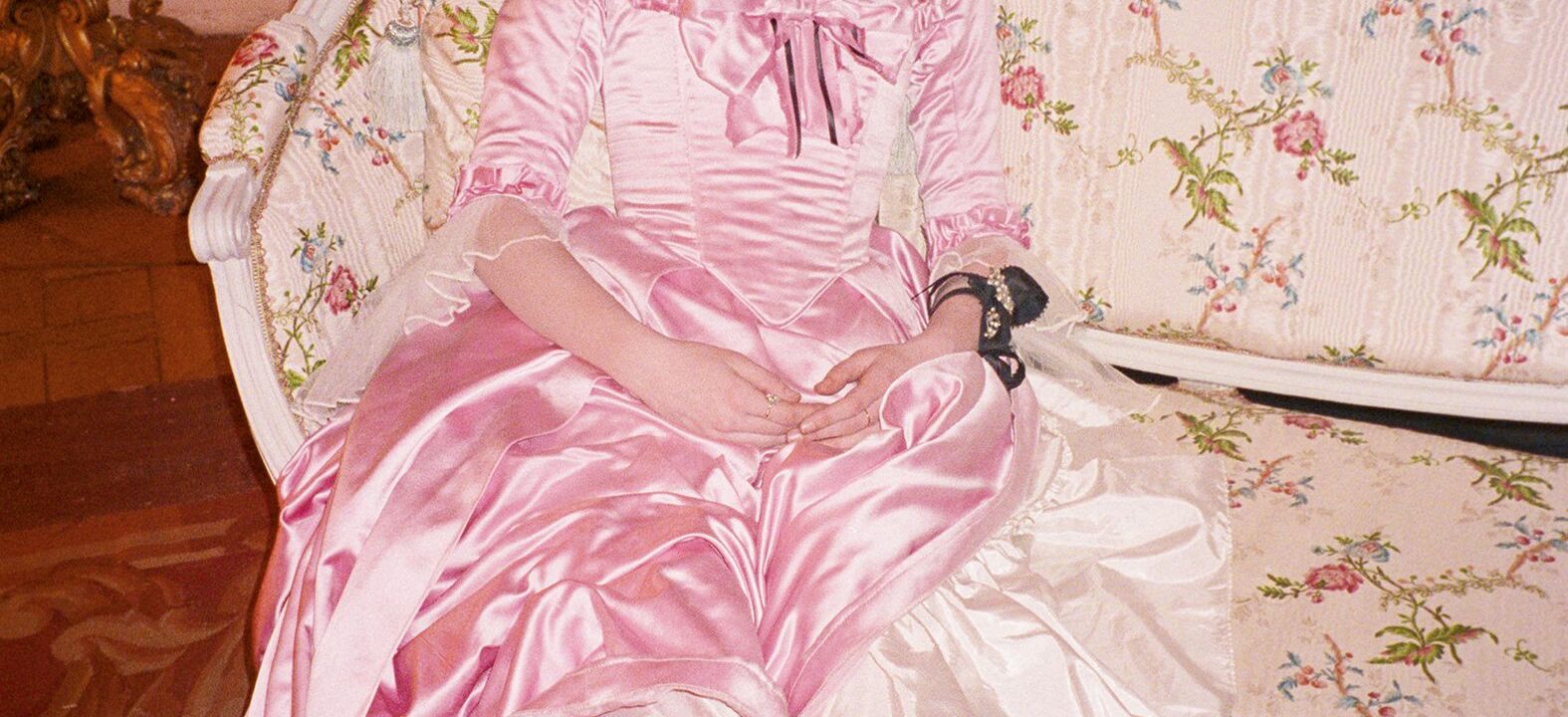
About 20 years ago, Sofia Coppola set out to make her third feature film, Marie Antoinette. She was given rare access to the lavish Palace of Versailles. With a cast that included Kirsten Dunst, Jason Schwartzman, and Rose Byrne, she filmed in the queen’s bedroom, the neoclassical Petit Trianon, its lush gardens, and the famous Baroque Hall of Mirrors. In these rooms, Coppola created her own version of the French queen’s life, building a visual world filled with frothy costumes designed by Milena Canonero, wigs that brushed the chandeliers, piles of Ladurée macarons, and Thierry Boutemy’s bright floral arrangements—all set to an indie sleaze soundtrack.
Today, a new book that captures all of this is announced: Making Marie Antoinette, coming from Coppola’s Important Flowers imprint this September. The book was put together by Andrew Durham, Coppola’s friend and longtime collaborator, who took photos on set. It includes a personal conversation between Coppola and Durham, as well as an oral history of the film’s production. Other anniversary events are also planned: a documentary, a theatrical re-release, and an exhibition.
Photo: Andrew Durham, from Making Marie Antoinette (Important Flowers, 2026). Courtesy of the artist and MACK.
Photo: Andrew Durham, from Making Marie Antoinette (Important Flowers, 2026). Courtesy of the artist and MACK.
“It brought me back to how fun this era was,” says Coppola. “We were living in Saint-Germain in Paris and getting to work in Versailles. Everyone had their guard down. Some of Andrew’s photos have been floating around for years—they’re online, they’re on fake T-shirts. It’s special to bring them together in one place.” (In fact, some of the most famous photos of the cast first appeared in the April 2006 issue of French Vogue.)
“The images are full of personal and intimate memories for me,” adds Coppola. “I met Thomas [Mars], my now husband, around this time. I love that Andrew ends the book with this image where I’m walking away, like that moment in Sixteen Candles.”
About a year ago, when Durham started putting this book together, he was at a screening of Marie Antoinette and heard someone in the audience say, “They don’t make films like that anymore.” “That comment really stuck with me,” he tells Vogue. “Sofia made such an effort to put all the artistry of her collaborators on the screen: the sets, the costumes, even the flowers. You don’t see that much anymore. Big-budget studio films seem to be made of computer-generated images, and smaller indie films have more of a mumblecore approach, less cinematic. Looking back at these photos reminded me how special and rare this was—and still is.”
The fact that the film was shot just before the iPhone came out was also a blessing in hindsight: “I think that made a big difference. What would have been an Instagram-palooza was relatively undocumented,” he says. “It worked out great for me!”
His own favorite shot? A photo of Al Weaver, Mathilde Favier, and an extra taking a cigarette break in costume, hanging out by the water cooler and chatting on their tiny flip phones.
“I still love seeing those photos of people breaking character, at the craft service table, with their headphones on,” says Coppola. “I have a big print of some of our extras in their wigs taking a photo at my house—and now, this scrapbook.”
Photo: Andrew Durham, from Making Marie Antoinette (Important Flowers, 2026). Courtesy of the artist and MACK.
Photo: Andrew Durham, from Making Marie Antoinette (Important Flowers, 2026). Courtesy of the artist and MACK.
On October 2, Sony will re-release a fully restored version of Marie Antoinette in the United States. “Restoration sounds so ancient, but it looks so alive. The colors are refreshed. I’m so excited,” says Coppola. “There’s a generation of people who never got to see it in theaters.”The theater audience, who have only seen it through clips on TikTok, never saw it as a big deal.
Photo: Andrew Durham, from Making Marie Antoinette (Important Flowers, 2026). Courtesy of the artist and MACK.
As Vogue’s Keaton Bell notes in the book’s extensive oral history—featuring cast, crew, and figures like Grace Coddington and Marc Jacobs—Marie Antoinette has become such a cultural touchstone that it’s easy to forget how divisive it was when it first came out. Coppola recently came across clippings of all her “terrible” reviews. One reads: A Royal Mess. Another blares: Lost in Sensation.
“Every single one was worse than the next,” she says. “I never actually read the reviews, but just the headlines were so bad! And… they were all written by men. I thought, ‘Were there any women reviewing movies?’” At the very least, serious film critics seemed to have little patience for anything frilly, feminine, or light. “That was a total offense,” she says. “I don’t think the people who come up to me now and tell me how much they love the movie really know that.”
She continues: “It got me thinking about the early 2000s again—how women were seen, how the tabloids treated them. It was a different time 20 years ago! I’m glad that [girliness] can be embraced now.”
Photo: Andrew Durham, from Making Marie Antoinette (Important Flowers, 2026). Courtesy of the artist and MACK.
Photo: Andrew Durham, from Making Marie Antoinette (Important Flowers, 2026). Courtesy of the artist and MACK.
Bell’s oral history, originally published on Vogue.com in 2021, has been updated for the book. It now includes perspectives from a new generation of artists influenced by Marie Antoinette, like Olivia Rodrigo and PinkPantheress, both of whom have made music videos in the film’s playful Rococo style. (Rodrigo’s “Drop Dead” video, directed by Petra Collins, was also filmed on location at the Palace of Versailles.)
A major theme throughout the book is the importance of staying scrappy, independent, and true to your creative vision. “I felt lucky that I was able to make exactly what I had in mind, even if it wasn’t a popular view or approach at the time,” says Coppola. “It will always be a good reminder to just follow your instincts about what you’re into, and trust that there are people out there who will connect with it.”
A documentary arriving this fall focuses on Coppola’s stubborn belief in her project. She has turned more than 80 hours of footage—shot behind the scenes by her mother, the late documentarian Eleanor Coppola—into Making Marie Antoinette by Eleanor Coppola.
Coppola and her mother, who died in 2024, started reviewing the material during the pandemic. “She really wanted to turn it into a film,” Coppola says. “Even though it was very hard to watch myself as a young director, it was interesting to see myself through my mom’s eyes. She loved the difficult moments, and she got me to open up in a way I wouldn’t with anyone else.”
“I think she wanted to show what creativity is really like,” Coppola continues. “Now I can appreciate that instead of feeling embarrassed: I can see myself fighting for my vision, even though I wasn’t yet confident enough to express myself. I can see the resistance. I hope it’s interesting for other young women directors. I have artist friends who’ve watched the rough cut and say they still have those same conversations—you have to make your point twice as much as a woman.”
Finally, to bring it all together, from September 22 through January 24, 2027, the Château de Versailles’ Petit Trianon will host a major exhibition exploring the film’s process, aesthetics, and broader cultural impact, with Cartier as the main sponsor. It’s a “total dream” for Coppola, who has already returned there to help plan it. The exhibition will feature Durham’s photography and pieces from Coppola’s personal collection.There will be costumes, a mood board, sketches, and of course, music.
Coppola is still very happy that the film keeps finding new audiences. “My daughter showed me these TikTok edits of hip-hop songs set to Marie Antoinette, and they’re really good,” she says. “I’m impressed by them! It’s fun to see that it’s still part of youth culture.”
“Young women, women, and gay men—these are the audiences I think about most,” she adds. “I hope people don’t get tired of Marie Antoinette, but every part of it is still really, really fun.”
Making Marie Antoinette (Important Flowers, 2026) by Andrew Durham will be published by MACK this September. It’s available for pre-order now.
Sony will re-release Marie Antoinette on October 2 in the US; Park Circus will release the film in November in the UK and Ireland; Pathé will release it in November in France.
Frequently Asked Questions
Here is a list of FAQs about Sofia Coppola marking the 20th anniversary of her film Lost in Translation
BeginnerLevel Questions
Q What film is Sofia Coppola celebrating the 20th anniversary of
A She is celebrating the 20th anniversary of her 2003 film Lost in Translation
Q Who stars in Lost in Translation
A The movie stars Bill Murray and Scarlett Johansson
Q What is Lost in Translation about
A Its about two lonely Americansan aging actor and a young newlywedwho meet in a Tokyo hotel and form a deep unexpected friendship
Q Did Lost in Translation win any major awards
A Yes Sofia Coppola won the Academy Award for Best Original Screenplay and Bill Murray was nominated for Best Actor
Advanced Deeper Questions
Q How is Sofia Coppola marking the 20th anniversary
A She participated in special screenings and QA events including a conversation at the Academy Museum There have also been rereleases in select theaters and special edition merchandise
Q Why does Lost in Translation still feel relevant 20 years later
A Its themes of loneliness cultural disconnection and the search for human connection in a busy world remain universal The films quiet moody style also feels timeless
Q What are some common criticisms of the film
A Some critics point to outdated or stereotypical portrayals of Japanese culture and the significant age gap between the main characters
Q What impact did Lost in Translation have on Sofia Coppolas career
A It cemented her reputation as a major auteur The Oscar win gave her creative freedom allowing her to make more personal films like Marie Antoinette and Somewhere
Q Are there any practical tips for watching the film for the first time today
A Watch it in a quiet setting with good soundthe music and whispered dialogue are key Try to view it as a mood piece about a fleeting moment not a traditional romance Also be aware that its a product of its early2000s cultural context