This story originally appeared in the December 2025 issue of Vogue Australia.
Guests hurried inside an unremarkable, stripped-bare office building in Paris’s Montparnasse. An autumn downpour had caught some without umbrellas, but the real rush was for the impending Comme des Garçons spring/summer 2026 show. Amid the frenzy, the brand’s staff calmly greeted each guest at the door, including Adrian Joffe, the label’s president and husband to its creative director, Rei Kawakubo.
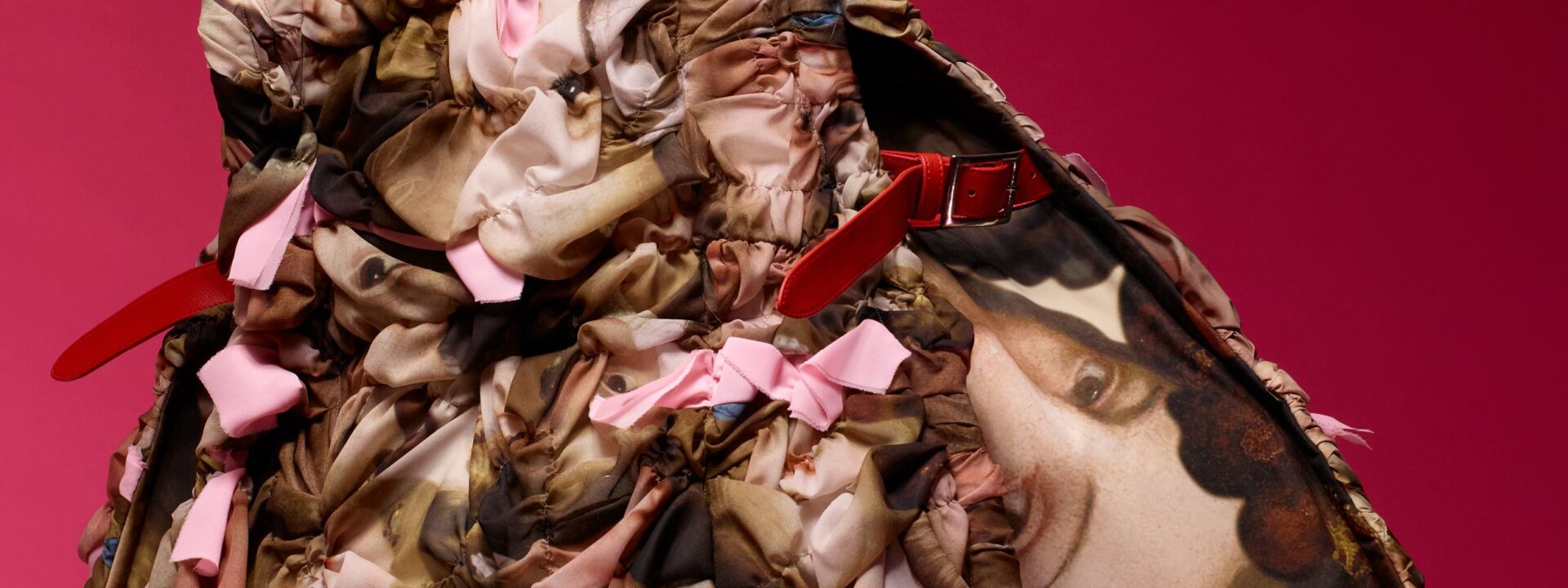
As the show began, models in Kawakubo’s creations floated onto the stage to the acapella vocals of Spanish experimental singer Fátima Miranda. The first look was an undulating, cocoon-like column that opened like a giant clam to reveal a jolt of Comme des Garçons red. This was followed by hessian, openwork crochet, and enclosed forms in calico and cotton, some tied in gargantuan knots. Other outfits resembled stacked cushions in domestic fabrics—upholstery, seed sacks, lace doilies, and cotton—a humble jumble in tender pinks. The collection, named After The Dust, felt like personal belongings hastily gathered in a dystopian future. One look featured columns like giant rolled-up table linens or carpets, one cantilevering from a model’s shoulder like a third arm. A bulbous form encircled another model’s torso, its raw hem flipped to reveal an interior the color of strawberry milk. Then came a pause, a near stillness, before a trio of finale dresses appeared, each paired with headpieces like flattened papal mitres, so tall the models had to dip their heads under a ceiling beam.
The effect was, as always with Kawakubo, potent, beguiling, and not immediately clear. Since she began showing in Paris in 1981, Kawakubo—or Kawakubo-san, as her staff call her—has been subject to more scrutiny, obsession, and citation than most other designers, living or dead. She first shocked the establishment with her disruptive black looks at the InterContinental, an affront to the glamour-obsessed ’80s. Then and now, she refuses to justify her work, rarely explaining it. Instead, she has earned immense respect and industry-wide deference, bordering on veneration. Today, Kawakubo leads an empire of over 200 stores—including one in Melbourne—17 sub-labels (many led by protégés like Junya Watanabe and Kei Ninomiya), and the high-concept, multi-brand boutique Dover Street Market, which first opened in 2004.
The inscrutable quality of her work can be experienced firsthand at a joint retrospective with the late Vivienne Westwood, opening this month at Melbourne’s National Gallery of Victoria (NGV). Titled Westwood | Kawakubo, it is an Australian first and will feature an unprecedented number of Kawakubo’s garments in the country, including nearly all of the 45 looks gifted by the label. More than 140 designs from both designers will be on display, sourced from the NGV Collection and loans from institutions like London’s Victoria & Albert Museum and New York’s Metropolitan Museum. Fashion students, casual followers, and industry insiders will have a rare chance to examine Kawakubo’s runway designs up close, including pieces from legendary collections like 1997’s Body Meets Dress—Dress Meets Body.
In Paris, after the show, details that fans hunger for—and that the label seldom provides—were revealed by Comme des Garçons staff at the brand’s Paris headquarters in Place Vendôme (the other is in Tokyo).In a long, low showroom, they revealed how the sense of happenstance and imperfection is, of course, meticulously crafted. Every piece was made perfectly before being washed, aligning with Rei Kawakubo’s line of inquiry for this collection. “I believe in the positiveness and the value that can be born from damaging perfect things,” she shared in a show note.
Kawakubo, alongside Adrian Joffe, was present in the room—unassuming yet unmistakable with her severe bob and head-to-toe black ensemble of a jacket and signature skirt. Buyers and press re-examined the looks, all quietly aware of her presence. At the center of the room, each look corresponded to a rack of clothing alongside it. These more accessible but no less inventive interpretations will be available in stores. Blazers, for example, are crafted in hessian with double sleeves, while a seemingly threadbare knit with open holes mimics hessian in color but not in fabrication.
The knit recalls a black jumper with gaping holes from one of the designer’s first collections in Paris in 1982. She presented it after moving her shows from Tokyo, where she was better known, twelve years after founding the label. What some saw as decay, she described as lace. “To me they’re not tears,” she said at the time. “Those are openings that give the fabric another dimension. The cut-out might be considered another form of lace.”
This exemplifies her contrarian spirit, which is innately punk—a sensibility she shares with Vivienne Westwood. It’s something she believes resonates in her work, as she shared in a rare interview with Vogue Australia. “Punk represents a rebellious spirit, which means to fight,” she says. “And I believe the best way to fight is through creation. That is why I always say my energy comes from my freedom and a rebellious spirit.”
For Kawakubo, who grew up in conservative post-war Japan, radical defiance has been a defining force in her career. This spirit is evident in collections such as Blood and Roses (spring/summer 2015) and Anger (autumn/winter 2024–25), of which she said, “I have anger against everything in the world.” Both collections will feature in the NGV exhibition.
Her refusal to accept norms has been crucial to her success, even if it has made the designer and her world feel unapproachable and relentless at times. For instance, Kawakubo oversees every detail in her idiosyncratic stores, which, with their roving, maze-like layouts, don’t adhere to conventional floor plans. Her largest retrospective—the Metropolitan Museum of Art’s 2017 exhibition Rei Kawakubo/Comme des Garçons: Art of the In-Between—saw her exhaustively construct a to-scale model of the final New York space in Tokyo. Nothing escapes Kawakubo’s exacting eye, from the materials used in shelves to the use of color. If some privately question her changes, they come to realize that “of course she is right,” as one employee expressed. No music is played in the brand’s boutiques, and each has an assigned color—Paris is red, Tokyo blue, New York green. Some are deliberately hard to find and seldom display actual clothes in the windows, bucking every rule of retail.
Despite this, she has built a global empire bringing in hundreds of millions each year and has attracted a devoted following unlike any other fashion house. At one of the Comme des Garçons boutiques in Paris, two male employees have worked there for decades. One fondly remarks that he is to the boutique what the Eiffel Tower is to Paris. Speaking in French, he says that when he encountered Junya Watanabe…Watanabe’s work resonated with him so deeply that it led him to collaborate with Comme des Garçons. As a Frenchman, he says he feels he has Japanese blood.
Comme des Garçons Look 21, from the “Blood And Roses” collection for spring/summer 2015, featured a sanguine hue—both unnerving and precise. Photographed by Simon Eeles.
Comme des Garçons Look 13, from the “Uncertain Future” collection for spring/summer 2025, hinted at hope using mesh and sheer overlays that allowed air to move through the garments. Photographed by Simon Eeles.
Transcending boundaries is a Kawakubo specialty. In her autumn/winter 2016-17 collection, “18th-Century Punk,” she flipped crinolines inside out and upside down, cutting openings to create ma—the Japanese concept of empty space—laying their construction bare on the outside. She reworked Lyon silks into articulated components resembling delicate yet strong armor, or cut them into countless 3D petals.
For “Smaller is Stronger,” autumn/winter 2025-26, she took a men’s pinstripe suit, deformed it, and recast it for women. She has said that conventional notions of beauty, gender, social mores, nationality, and class are “irrelevant” to her world.
Yet amid the solemnity and erudition, many overlook distinctly Comme des Garçons traits: joy and humor. Logos aren’t very Comme, but the Play line is instantly recognizable for its red heart by artist Filip Pagowski. The brand’s Rue du Faubourg Saint-Honoré store was originally hidden down not one but two courtyards, embodying wry humor and encouraging discovery. When Kawakubo saw her reception in Paris, she resolved to claim a place in the most famous shopping square: Place Vendôme. Today she stands there, one of the few non-French designers and founders of a non-European label. Kawakubo is having the last laugh.
As the world grows darker, people turn to renegades like Kawakubo for guidance on how to respond. Lately, she has taken on an unexpected role as a giver of hope in fashion. For “Uncertain Future,” spring/summer 2025, cartoonish bell-shaped skirts, like gorgeously twisted cream whips, were presented alongside tiered, stretched shapes resembling cakes with royal icing, prints visible through gauzy mesh—levity and lightness. “With the state of the world as it is, the future as uncertain as it is, if you put air and transparency into the mix, there could be the possibility of hope,” she shared at the time. Once again, she refused to be easily pegged, avoiding the expected and easily understood in a society hellbent on mass consumption. “Comme des Garçons is not in the business of making things that everyone understands,” Kawakubo says. “Whether what I make sells well or not is not the primary goal. People may think making new things every time is risky, but for me it is not a risk. Playing it safe and avoiding risks is what I think is risky for Comme des Garçons. I hope that might be the influence people feel.”
Her fearlessness also sets an example. “The most constant aim is trying to make something new, trying not to look at the past,” she says. “And it is incessant, because if you take a break from creation, you go backwards.” For “Return to the Source,” autumn/winter 2023-24, she sought a clean slate, imagining what it would be like if we began the world again. This idea of creating from nothing is one of her primary methods for sparking originality. “Every single time, I start from zero, from inside my head, not only with making clothes but in all aspects of Comme des Garçons,” she explains. “The external world, of course, can enter the process along the way.”
Comme des Garçons Look 20, from the “Neo Future” collection, autumn/winter 2020-21, saw Kawakubo describe herself as a “perpetual futurist.” The towering sil…Silhouettes and headdresses with a ceremonial feel could belong to yesterday, tomorrow, or an unknowable time and place.
Photographed by Simon Eeles, this is Comme des Garçons Look 1 from the “18th-Century Punk” autumn/winter 2016–17 collection, which reimagined 18th-century dress through a punk lens of revolution.
Kawakubo’s creative method—and part of what makes her indomitable—is her relentlessness. She describes it as an “imposing” process. “New values can only be found inside oneself, and I often think, no, it’s not this, and no, it’s not that. The search is inevitably extremely difficult, but this questioning is the most vital part of the process I’ve imposed on myself. It’s the basis of everything I do.” Kawakubo has said she suffers every time she creates.
The intensity and personal nature of this journey invite a deep connection with the seemingly elusive designer. The intimate feelings woven into her clothing help explain the powerful, close responses people have to her work. There is a generosity in this.
Fortunately for fashion, the devotion goes both ways. As enigmatic as Kawakubo is, she can be counted on for an tireless drive to create and shape the new, no matter the personal cost. “I want to find things I haven’t done or made before. And I am rarely satisfied with what I find,” she says. “The search is continuous, and satisfaction is a luxury I cannot afford.”
Unstoppable Kawakubo—a label that fits. Restless Kawakubo. “Without something new, there cannot be any progress,” she says. “Creation is what moves us forward. This pursuit is the foundation I built the whole company on.” Nearly six decades into her career, we will all eagerly await whatever she does next.
Westwood | Kawakubo opens at the National Gallery of Victoria with the NGV Gala on December 6, before opening to the public on December 7.
Frequently Asked Questions
FAQs Rei Kawakubo on Punk Courage and Comme des Garons
Beginner Definition Questions
Q Who is Rei Kawakubo
A She is the iconic Japanese fashion designer who founded the avantgarde brand Comme des Garons in 1969 She is known for radically redefining beauty and challenging fashion norms
Q What does the quote I believe the best way to fight is through creation mean
A For Kawakubo it means that the most powerful form of rebellion isnt destruction or protest in a traditional sense but the act of making something entirely new and challenging Creation is her weapon against convention
Q How is Comme des Garons related to punk
A While not punk in the literal sense of safety pins and leather Kawakubo shares punks core spirit a rejection of the mainstream a desire to disrupt and a commitment to raw unconventional expression Her work is conceptual punk
Q What kind of courage does her work require
A It requires the courage to be misunderstood to present ugliness as beauty to ignore commercial trends and to constantly question her own previous work Its intellectual and creative courage
Concept Philosophy Questions
Q If shes fighting through creation what is she fighting against
A She is fighting against complacency cliché and the established rules of fashion gender and beauty She challenges the idea that clothing must be flattering decorative or familiar
Q Can you give an example of how her designs show this fight
A Her famous 1997 Body Meets Dress Dress Meets Body collection fought against the traditional silhouette of the female body proposing a new distorted form that was both shocking and poetic
Q Is her work just about being shocking
A No While it can be shocking initially the intent is deeper Its about provoking thought offering new perspectives and exploring concepts like imperfection space and the relationship between body and cloth The shock is a byproduct of true innovation
Q How is courage different from rebellion in her context
A Rebellion can be a onetime act of defiance Courage for Kawakubo is a sustained