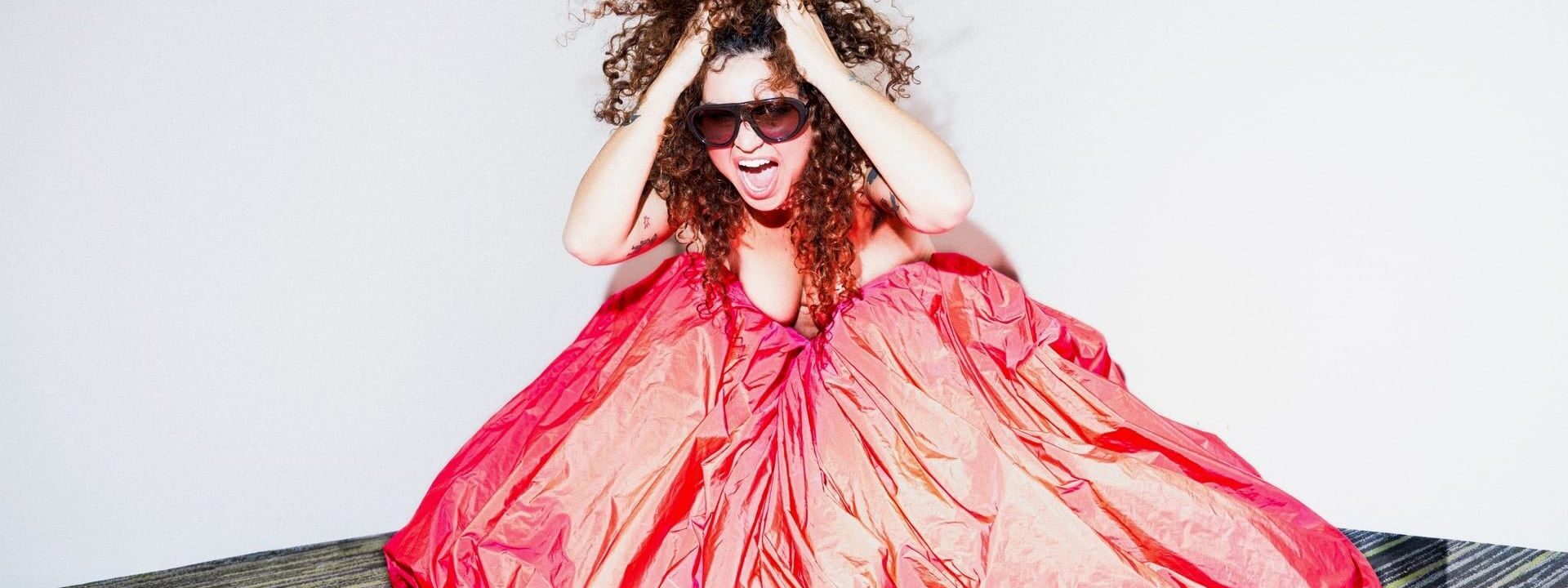
If Remi Wolf’s earlier records were kaleidoscopes of maximalist, funk-tinged indie pop and surreal lyrics, Mud marks a shift toward something more mature and grounded—quite literally, since the album cover shows the California-born singer-songwriter beaming through a mask of actual mud.
The year before had been a whirlwind: Wolf released her excellent second album, Big Ideas, and expanded her own tour by opening for Olivia Rodrigo, but she also went through a major breakup and ended up completely burned out. The seeds of the new record were planted during a two-week retreat in Nashville in late 2024, where Wolf set out to expand her creative world by writing with complete strangers. Nashville produced some sparks—including the euphoric, country-tinged standout “Champagne”—but it also made her realize she really needed to build her own sanctuary.
So Wolf assembled what she affectionately calls her “family band,” an inner circle made up of longtime collaborator Jared Solomon, her songwriter friend Jack DeMeo, and her sister-in-law Gigi. Together they retreated to a cozy log cabin in Big Bear, California, and later to the wide-open spaces of Joshua Tree, writing in living rooms instead of recording studios. Wolf took on the role of “house mom,” cooking breakfast and dinner for the group while they worked.
The goal was simple from the start: every track had to be sturdy enough to sing around a campfire with an acoustic guitar and three-part harmony, while still honestly reflecting Wolf’s emotional unraveling. (They also had to have impossibly catchy melodies—with Mud, Wolf proves once again that few artists have an ear for a hook like hers.)
But the real breakthrough came at Manhattan’s legendary Electric Lady Studios, where Wolf and her crew wrote “Covered in Mud” and the euphoric “Bottle,” unlocking a sonic world she describes as equal parts “emotional sludge” and “SpongeBob Ascension.” Across an album packed with heaters—from the raw, powerhouse belting of “Jamie” to the bruised, guitar-noodling confessions of “Guess”—Wolf charts her Saturn return through heartbreak, alcoholism, a breakdown, and back again, eventually finding an infectious, bone-deep joy that radiates from the wide-eyed wonder of “Moon So High,” featuring John Mayer, and the ecstasy of total surrender on “Covered in Mud.” As Wolf puts it: “There’s a freedom in being covered in mud and completely succumbing to how you truly feel.”
Vogue: Tell me a little more about the period when you started writing the album. From what I read, there were some pretty high highs and low lows, and it all began around the time you were wrapping up touring Big Ideas.
Remi Wolf: The first round of writing started in November 2024. I was still on the Big Ideas tour, but I had a short break, and I was feeling really exhausted, lost, and confused in my own life. I wanted to find a new musical path for myself, and writing has always been the most healing, therapeutic thing for me. I felt like I just needed to get in the studio and purge a lot of latent feelings I’d been sitting with for a while. So I decided to go to Nashville, which I’d never worked in before. I always want to approach a new project with a new vibe, so I went to Nashville for two weeks and wrote with a new person every single day. In that process, I met my friends Jamie and Hank. The very first day I was there, we wrote “Champagne,” which is on the record. They ended up becoming really, really good friends and worked on a lot of the album with me. That trip was like the first seedling of what the album could possibly be.
But when I started writing, I was just very fragile, exhausted, and vulnerable, so I decided I didn’t have the energy to be surrounded by anyone except people who were my honest-to-God best friends. In the process, we created this family band. Being surrounded by my best friBeing with them allowed me to be as fragile as I was without feeling insecure or strange about it. It sounds counterintuitive, but it was the most fun I’ve ever had writing an album. Even though the songs are deep and sad and I’m dealing with real issues, it was incredibly fun to write with them. It felt like an amazing, healing, cleansing process.
That family band spirit stayed with you through your travels—you all went to Big Bear, spent time in New York, and then took a final trip to Joshua Tree. How did those three different places—the lake, the city, and the desert—shape the final record?
Almost always when I’m writing an album, I deliberately want to get away from my daily environment because it gives you perspective and inspiration. With Big Bear and Joshua Tree, I wanted to leave LA but not go too far, and I really wanted to be in a house. I wanted it to feel like a homey experience where I could cook for everyone, hang out in a living room, and not have to drive to the studio every day. We’d all go to sleep at the same time and wake up at the same time. I’d make breakfast, I’d make dinner—I went full house mom. It created a really comfortable environment while we were writing these intensely emotional songs.
I chose Big Bear because at the time I was really drawn to the trees; I just wanted to feel grounded. We ended up writing in an actual log cabin. We wrote “I Won’t Cry” in that space under these really tall ceilings, and we recorded it in one take—my vocal was one take, too. I think the reason it sounds so vulnerable is because we were literally just playing it together in a room. And then Joshua Tree—I’d never been to the desert before, so being under that vast sky with all the stars was amazing. We wrote “Moon So High” out there, literally just looking at the moon. It was so high! [Laughs.] Then Electric Lady in New York is my home away from home. It’s a studio, but it really is a second home for me. Walking down the street in New York, you see the most random things you’ll ever encounter in your life, so I always love working there. But really, traveling around with my best friends was such an incredibly bonding, grounding experience. After being on the road for so long, I was craving a feeling of home and just wanted to feel like a normal person again.
You mentioned that Electric Lady was where you unlocked the sonic landscape of the album, especially this idea of it sounding “muddy.” What did that mean, exactly?
At Electric Lady, we wrote “Covered in Mud,” which is the title track. It felt so free but so real, and it had this storytelling element that I’d been trying to unlock for a while. Right after that, I was like, okay, I know the album is going to be called Mud. It just felt so right in that moment. Then two days later, we wrote “Bottle,” and writing those back to back unlocked this feeling that every song should have this kind of emotional, muddy tone to it, like you’re trudging through these feelings. To me, mud is a feeling you get from the music. And with “Bottle,” we unlocked what we like to call SpongeBob Ascension—I don’t know if you know that meme of SpongeBob rising through the sky with his headphones on? When we wrote “Bottle,” we were like, “Oh, this feels like SpongeBob ascending.” So we decided every song should feel like a SpongeBob ascension through time and space! [Laughs.] They had to fit those two parameters. Unlocking that midway through made the rest of the writing process so much more directed and easy.
How did the John Mayer collaboration come about? Was that really orchestrated over Instagram DMs?
I mean, I’ve been a fan of John for so fucking long—he was actually the first concert I ever went to, co-headlining with Sheryl Crow, who are both just my GOATs. We’d been communicating online for five years, and as soon as we wrote “Moon So High,” I knew that I wanted it to be a duet, and I knew that I wanted it to be John. I was cooking on that for two months, maI was manifesting it in my head, and then one day I just grew the balls to DM him. Luckily enough, he responded in two hours, and a week later we were in the studio. Working with him was fucking awesome. Looking at the credits, you were in charge of the art, you co-creative directed it, worked on package design, and co-directed the “Twiggy” video. What prompted you to take the reins so completely on the visual world this time? Yeah, I really took everything on this time. I’ve always been very involved in my creative, and I’ve always been a control freak, but because this album felt so deeply personal and vulnerable, I felt like I was the only one who could tell the visual story. Right from when we wrote “Covered in Mud,” I had a really strong image of what I wanted it to look like. I’d always wanted to fully direct videos, but maybe didn’t have the energy or time before, and this time I was just like, “I’m going to go for it.” I brought on one of my friends, Milo [Nicols], to be my sounding board and help me realize the visual language, and he was incredible. We’re kind of a yin and yang: he thinks about the visual world very symbolically with a really fine-art eye, and I’m kind of like a run-and-gun girlie, where I just want the vibes to be really palpable and strong. I wanted to put the trust in myself, and I’m so happy I did. I wanted to be covered in mud, and we fucking made it happen. I love the fact that you’re beaming on the album cover. It’s a breakup record and charts a lot of emotional turbulence, but it’s also a record about your Saturn return and that feels ultimately hopeful. You’re covered in mud, but you’re still smiling. Exactly. The record was just a year of me healing myself through making music. I went in feeling very lost, and I came out feeling so self-assured and grounded. That’s the beautiful thing about mud as a symbol: it’s dirty, grimy, and gross, but at the same time, there’s a real freedom in being covered in mud and completely succumbing to how you truly feel and owning your emotions. Plus, so many beautiful things grow from mud—flowers, trees, everything is born out of the dirt. I found this image online of a little kid who was head-to-toe covered in mud, but he was just beaming, so happy to be completely disgusting. That’s kind of how I felt, and I wanted that feeling for the cover. After this record, I really did feel like a newborn kid—fresh and happy. Do you think it will feel strange to get on stage and channel those difficult emotions again when you tour this record? I think it’ll be fun! I’m so stoked to tour this record. What I really want for my live show is to take people to emotional church. I want to create a space where people can really let it all go and feel free to scream, laugh, cry with joy, cry with sadness. Concerts are one of the only spaces we have left where we can all experience one thing together at the same time and just be present. I want to really milk the fuck out of that and create a space where people feel connected to each other and connected to themselves in a world where there are so many distractions. It’s my favorite thing about performing. And I don’t think it’s going to be hard to channel the feelings—they’re in my bones, and I’m ready to sing them. Some of those vocal arrangements, like on “Jamie,” sound like a serious workout. Are you going to have to do some heavy vocal maintenance on the road? Yeah, I always make it hard for myself! All of my songs are always so fucking technically difficult, and my vocal coach is constantly mad at me, like, “Why do you do this to yourself?” And I’m like, “I don’t know, I guess because I can!” [Laughs.] But as long as I warm up every day, I think I’ll be okay. Finally, how are you planning to celebrate when the album comes out? Are you getting the family band together? We’re playing a little show at the Fonda in LA and Webster Hall in New York, and the live band is pretty much exclusively made up of the people that I made the album with. We’re going tTo celebrate, we’ll play the record from start to finish. Luckily, almost everyone who worked on this album with me is completely sober too, so we’ll all just be happy to toast each other with non-alcoholic drinks. After that, we’ll probably find a hot tub somewhere in New York and soak together. This interview has been condensed and edited for clarity.
Frequently Asked Questions
Here is a list of FAQs about Remi Wolfs album Big Ideas
Beginner Questions
Q What is the name of Remi Wolfs new album
A The album is called Big Ideas It came out in July 2024
Q Who is Remi Wolf
A Shes an American singer and songwriter known for mixing pop funk soul and indie music into a colorful highenergy sound
Q What does gets down in the mud mean here
A Its a metaphor It means she explores messy raw and difficult emotions instead of staying polished or upbeat the whole time
Q Is this her first album
A No Her debut album was Juno Big Ideas is her second fulllength album
Q What genre is the album
A It blends pop funk soul rock and electronic music Its hard to put in one box
Q How many songs are on it
A There are 13 tracks
Q What are some standout songs
A Soup Motorcycle Toro Alone in Miami and Wave are fan favorites
Intermediate Questions
Q Why do people call it her triumphant album
A Critics praised it for being bold personal and sonically adventurous It showed growth from her debut and earned strong reviews
Q What makes the production stand out
A Its dense and playful Songs shift styles midtrack using live instruments synths and vocal effects to keep things unpredictable
Q What are the main themes
A Anxiety heartbreak selfdiscovery partying loneliness and learning to accept your own mess
Q Is the album good for casual listening
A Yes but it rewards close listening too The hooks are catchy but the lyrics and arrangements have depth
Q Does it have any slow or sad songs
A Yes Tracks like Alone in Miami and Wave are more introspective and slower than the upbeat singles
Q How does it compare to Juno
A