Words and photographs by Mustafah Abdulaziz
In 2012, I began “Water,” a photographic series exploring how global landscapes are changing under the pressure of water scarcity. Inspired by a UN statistic that half the world’s population could face water shortages by 2030, I focus on people who both struggle with and shape their environments. Organized into chapters, the project has documented cholera outbreaks in Sierra Leone; gender and water access in Ethiopia, Pakistan, and Nigeria; deforestation in the Amazon; industrialization along China’s Yangtze River; spirituality and pollution on India’s Ganges River; and the scale of storms along the coasts of Iceland and Cornwall.
It has also recorded the aftermath of hurricanes in the U.S. Gulf states of Texas, Louisiana, and Florida, as well as droughts in California—one of the world’s largest economies—and the historic drought in Cape Town, South Africa, which nearly became the first major city of the 21st century to run out of water. In Germany, where I now live, I documented the 2021 floods in Rhineland-Palatinate and North Rhine-Westphalia before spending a year examining climate change in the Arctic nations of Greenland, Canada, Norway, Sweden, and the United States.
The project looks at our collective, global choices and how they affect people living within strained systems. Water acts as a mirror—through the landscape, our behavior is revealed.
Baffin Bay, Canada, 2022
It is to the Far North that Berlin-based American photographer Mustafah Abdulaziz has turned his lens. For ten years, he has documented the impact of climate change on humanity, focusing extensively on water—an increasingly scarce resource across Asia, Africa, and the United States. The Arctic represents a new chapter in his exploration of a world on a path toward self-destruction.
In 2022, he traveled to Greenland, Norway’s Svalbard archipelago, Alaska, northern Canada, and Kiruna, the main city of Swedish Lapland. He returned with photos whose aesthetic echoes fantasy and folklore, blending black and white with color—as if recalling what once was, or perhaps never was except in our imagination, which still dreams of untouched wilderness far from civilization.
His images show no polar bears, northern lights, or snow-capped peaks. Instead, we see ice stained red with the blood of a seal hunted in Greenland. In Ilulissat, Greenland, he photographs the port cluttered with trawlers and docks piled with boxes of overfished halibut, destined for the other side of the world. In Alaska, he flies over the Red Dog open-pit mine, which taps the world’s largest zinc reserves and is North America’s most polluting industrial facility, capturing the greenish water of a lake carved into the heart of a excavated mountain. In Kiruna, 200 kilometers north of the Arctic Circle—where the ground is sinking due to an iron mine—he meets residents as the entire town is being relocated, following the discovery of a vast rare-earth metal deposit by Swedish company LKAB.
— “Horreur Boréale” by Anne-Françoise Hivert, Le Monde M Magazine (Paris), Issue 632
Record-low summer sea ice. Arctic Ocean, 2022
In the past, miners carried caged canaries underground. If the bird stopped singing, they knew toxic gas was filling the mine and they had to escape. Today, the Arctic is that canary—warning humanity about the state of our planet. Nowhere else are temperatures rising so quickly. Over the past forty years, warming here has been four times faster than the global average. And this is only the beginning; the trend is expected to accelerate in coming decades. The reason lies in Arctic amplification: as the global climate warms, sea ice and snow cover melt, reducing the Earth’s ability to reflect sunlight. This leads to more warming, creating a dangerous feedback loop.Snow is disappearing, which means less sunlight is reflected back into space. Instead, that heat is absorbed by the ocean. All scientific studies agree: by the 2030s, the Arctic could be free of sea ice in summer.
Arctic Ocean, 2022
The Arctic is the largest natural stabilizer of our climate system. Its white sea ice acts as a mirror, reflecting solar radiation. Yet each year, more of this ice vanishes. The loss of Arctic sea ice drives wildfires, droughts, polar vortex disruptions, intense rains, and heatwaves. We cannot afford to lose it.
Gateway to Arctic National Wildlife Refuge, Alaska, USA, 2022
Our vision of the Arctic is a dream built on prejudice and blind spots. It will become a nightmare if we fail to take the situation seriously and continue to treat nature as an endless resource. It is time to act.
Inuit hunting, Greenland, 2022
Lake Mead, Hoover Dam, Nevada, USA, 2015
Lake Mead, on the Colorado River, is the largest reservoir in the United States by capacity. Created by the Hoover Dam, it supplies water to California, Nevada, and Arizona, and the dam provides power to 29 million people. Rising demand and prolonged drought have severely lowered water levels. Since 1999, the lake has dropped 130 feet and now holds only 37% of its capacity. Lake Mead has become a key indicator of the broader water crisis in California. According to the environmental group Circle of Blue, each foot the lake falls reduces power generation by five to six megawatts. If water levels stay this low, emergency measures will be needed to prevent further decline. The dam can still operate but at reduced capacity. Lower water levels strain the machinery, and if they continue to fall, it could force the shutdown of generating units.
Wattamolla, Australia, 2017
Summer rain on permafrost, Alaska, USA, 2022
Construction of bridge over Ganges tributary, Bihar Province, India, 2013
Men bathe beneath a new bridge being built between Haijipur and Sonepur over the Gandak River, a tributary of the Ganges. New bridges are common along the Ganges as India connects cities once separated by the river. In Bihar, this bridge serves multiple purposes for nearby communities: bathing, a water source for cooking, and transportation. As the Ganges flows through densely populated areas, its role shifts from spiritual to essential.
Yangtze River, Chongqing, China, 2015
“Today the Yangtze River is two inches higher than it was in midwinter 1,234 years ago. In that time, five imperial dynasties have risen and fallen; Mongols, Manchus, British, and Japanese have come and gone; the Great Wall was built and the Cultural Revolution tore through; the Great Leap Forward and Reform and Opening transformed the nation; the Three Gorges Dam grew from a dream into China’s largest construction project. Yet through all this change, the Yangtze’s level is exactly two inches higher than in 763. Two inches in 1,234 years.”
— Peter Hessler, River Town: Two Years on the Yangtze (2001)
Glacier’s end, Brooks Range, Alaska, USA, 2022
Brooks Range, Alaska, USA, 2022
Nature’s first green is gold,
Her hardest hue to hold.
Her early leaf’s a flower;
But only so an hour.
Then leaf subsides to leaf.
So Eden sank to grief,
So dawn goes down to day.
Nothing gold can stay.
— Robert Frost, Nothing Gold Can Stay (1923)
Classic Club Golf Course, California, USA, 2015
Palm Springs and other cities in Coachella Valley were designed as green oases.In the desert, the emerald green grasses of luxury resorts that attract tourists and wealthy residents depend on a cheap and plentiful water supply. In 2015, the Desert Water Agency, which serves Palm Springs and surrounding areas, reported an average consumption of 221 gallons per person per day—far above the state average of 77 gallons.
“Why don’t you go on west to California? There’s work there, and it never gets cold. Why, you can reach out anywhere and pick an orange. Why, there’s always some kind of crop to work in. Why don’t you go there?” — John Steinbeck, The Grapes of Wrath (1939)
Uchiya Nallo, eight months pregnant, gathers water to brew beer for the village men to celebrate her upcoming birth. Konso Region, Ethiopia, 2013.
Though Uchiya, 29, is eight months pregnant and spends half her day climbing a mountainside carrying 20 liters of water (about 20 kg—the typical weight limit for a checked suitcase), she still worries about preparing beer for visiting guests after she gives birth. Studies in sub-Saharan Africa estimate that, on average, 10% of a water carrier’s daily calorie intake is spent carrying water.
“The road is very dangerous and I feel tired all the time. When I go to the river, I walk slowly there, and when I come back, I slowly walk up. I worry because sometimes I fall and hurt myself. I worry because I feel tired. Now I am almost ready to give birth and I walk slowly, but maybe I will have some problems—I’m not sure.”
Woman gathering water. Benue, Nigeria, 2015.
Mariam Bakaule lives on a hill in the Jarso valley in southwest Ethiopia. Like other villagers, she rises at dawn and walks more than two hours on steep, stony paths to reach the nearest source—a dry riverbed. There, she must dig in the sand with her bare hands to reach water and fill her container. This chore falls to women and girls.
“Bringing the water is not a simple task. This is the essence of women. Water and woman are synonymous here.”
The villagers cannot live near the water source because it is infested with malaria-carrying mosquitoes.
Hurricane Michael aftermath, Christmas Day. Panama City, Florida, USA, 2018.
“Parables are a teaching tool, like glass dioramas in natural history museums: you pass by, look, and believe that the taxidermy scene has something to teach you—but only through metaphor, because you are not a stuffed animal and do not live inside the scene. You observe from outside, rather than participating. Global warming twists this logic by collapsing the perceived distance between humans and nature—between you and the diorama. One message of climate change is: you do not live outside the scene but within it, subject to the same horrors you see afflicting animals. In fact, warming is already hitting humans so hard that we shouldn’t need to look to endangered species and imperiled ecosystems to trace climate’s horrible advance. But we do, saddened by stranded polar bears and struggling coral reefs. Even as we face crippling climate impacts on human life, we still look to those animals—in part because of what John Ruskin called the ‘pathetic fallacy’: we would rather not reckon with our own responsibility, and instead briefly feel their pain. In the face of a storm stirred by humans, and which we continue to stir each day, we seem most comfortable adopting a learned posture of powerlessness.” — David Wallace-Wells, The Uninhabitable Earth: Life After Warming (2019)
Seaweed and shrimp trawlers. Honghu, China, 2015.
Nile River. Egypt, 2018.
MUSTAFAH ABDULAZIZ
Women pull water from a 130-foot well in the desert. Tharpakar, Pakistan, 2013.
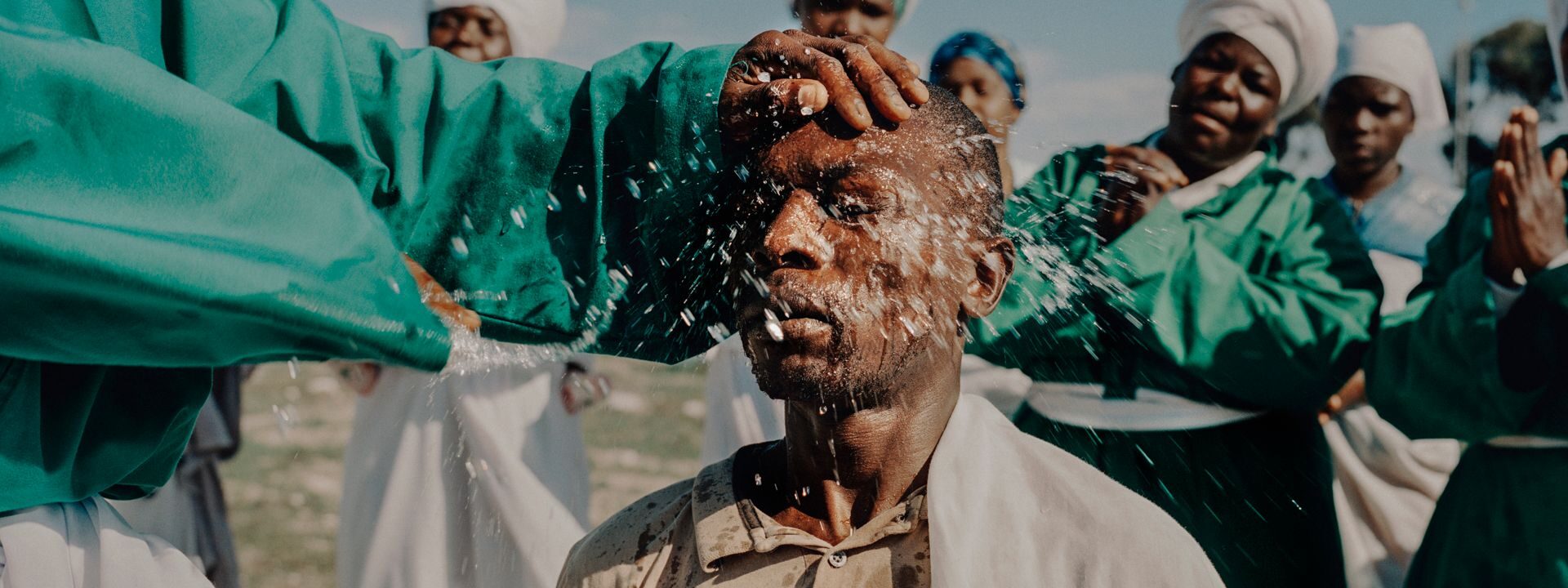
Sunday service, St. John Apostolic Church of the Whole World. Cape Town, South Africa, 2018.
It was 2018, and Cape Town was in the grip of a water crisis amid a historic drought. Lines formed for water in both townships and suburbs.At pump stations where water was rationed, the countdown to Day Zero stood at 95 days—the point when the city would run dry and become the first major metropolis of the 21st century unable to supply drinking water to its 4.4 million residents.
On the outskirts of the Western Cape, near reservoirs left hollow and harsh by desertification, I saw a group swaying in the distance, a mirage in a field of dust beyond the hood of my truck. I had come to this country to document a crisis.
I turned off the road and approached on foot, drawn by the sound of singing women dressed in teal and white. At the edge of the crowd, teenagers in pure white carefully prepared bowls of water. Beyond them, a man emerged from the scrub and sand, and he too was soon encircled by the group.
He said he had struggled with alcoholism and addiction his whole life. He didn’t give his name. In the blinding sun, we knelt in the dirt. Somewhere behind us, a suffocating drought stretched across millions of acres. A hot wind snapped the white cloth from his shoulders as a priest flung water from a shallow bowl across his face.
Coastal erosion due to climate change. Terrebonne Parish, Louisiana, USA, 2018
Gurnard’s Head. Cornwall, United Kingdom
“Who has known the ocean? Neither you nor I, with our earth-bound senses, know the foam and surge of the tide that beats over the crab hiding under the seaweed of his tide-pool home; or the lilt of the long, slow swells of mid-ocean, where shoals of wandering fish prey and are preyed upon, and the dolphin breaks the waves to breathe the upper atmosphere. Nor can we know the vicissitudes of life on the ocean floor, where sunlight, filtering through a hundred feet of water, makes but a fleeting, bluish twilight, in which dwell sponge and mollusk and starfish and coral, where swarms of diminutive fish twinkle through the dusk like a silver rain of meteors, and eels lie in wait among the rocks. Even less is it given to man to descend those six incomprehensible miles into the recesses of the abyss, where reign utter silence and unvarying cold and eternal night.
To sense this world of waters known to the creatures of the sea we must shed our human perceptions of length and breadth and time and place, and enter vicariously into a universe of all-pervading water.”
— Rachel Carson, “Undersea,” The Atlantic Monthly (September 1937)
About the artist
Mustafah Abdulaziz (b. 1986, New York City) is a photographer and director based between Berlin and London. For over thirteen years, his work has focused on the human impact of climate change, bringing vital stories to the public through large-scale installations worldwide. He is the winner of the Leica Oskar Barnack Award, a grantee of National Geographic, and a former fellow of the Alicia Patterson and Bertha Foundations. He contributes regularly to The New York Times, TIME, and Der Spiegel. His work is held in the Mercedes-Benz Art Collection in Stuttgart, the permanent collection of Apple, and the National Portrait Gallery in London. His first short film, Women Are Beautiful, debuted in Berlin in 2025.
Frequently Asked Questions
Of course Here is a list of FAQs about Mustafah Abdulazizs photography in relation to World Water Day designed to be clear and conversational
FAQs Mustafah Abdulazizs Photography World Water Day
Beginner General Questions
1 Who is Mustafah Abdulaziz and why is his work connected to water
Mustafah Abdulaziz is an American documentary photographer best known for his longterm project Water For over a decade he has been traveling the world to document the complex relationship between humanity and water making his work deeply relevant to the themes of World Water Day
2 What is his Water project about
Its a global photographic archive that goes beyond just showing rivers or oceans It focuses on how water shapes human life culture conflict and survival and how we in turn impact this vital resource It tells the story of our dependence on water
3 Why is his photography considered powerful for World Water Day
While World Water Day raises awareness with facts and figures Abdulazizs photos create an emotional connection He shows the human face of water scarcity pollution and access making a global issue feel personal and urgent
4 Where can I see his Water photographs
His work has been exhibited in major galleries and museums worldwide You can also explore a curated selection on his official website and the dedicated Water project site
5 Does he only photograph places with water problems
No His project shows the full spectrum communities struggling with drought and pollution but also those living in abundance cultures with spiritual connections to water and the sheer scale of its industrial and agricultural use Its about the complete story
Advanced Thematic Questions
6 What makes his approach to documentary photography unique
He employs a slow journalism method often returning to locations over many years This builds deep trust with communities and allows him to capture changes over time resulting in more nuanced and intimate stories than a short visit could provide
7 How does his work move beyond simple documentation
Abdulaziz is a master of composition and light He frames his shots to evoke specific feelingsisolation community scale or fragility A photo of a person collecting water isnt just