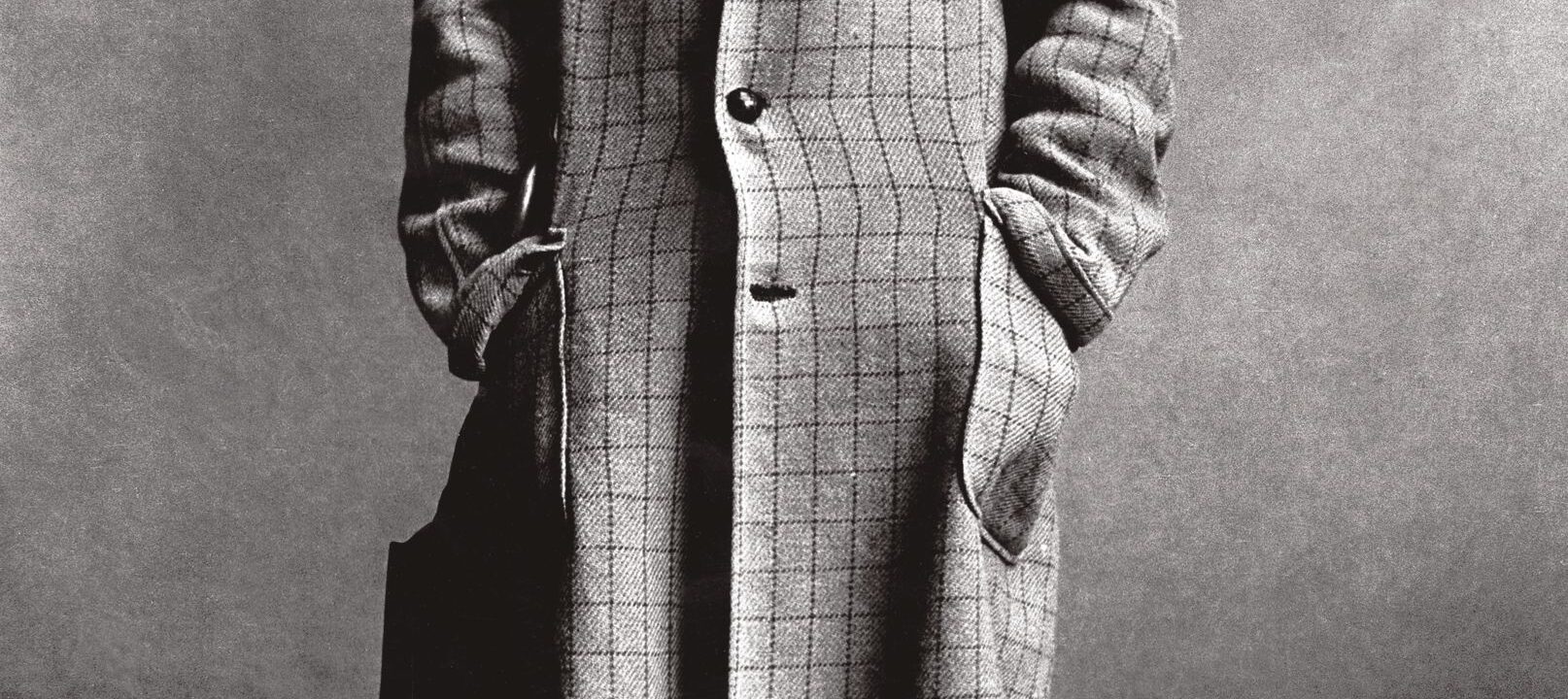
“Bow Ties and Poetry: Father’s Day,” by Tamasin Day-Lewis, first appeared in the January 2006 issue of Vogue. For more highlights from Vogue’s archives, sign up for our Nostalgia newsletter here.
“The past is a foreign country,” L. P. Hartley wrote at the start of his great novel, The Go-Between. That’s what strikes me every time I look at this photo of my father—the man I knew so well in some ways, yet not at all in others. He had already lived most of his life before I was even a thought in his mind, and his past was something I only heard about in the romantic, edited-down way parents tell their children about their own childhoods. For example, he remembered being a young boy in Ireland at the turn of the century, riding a bus in Dublin with his aunt Knos. “How to develop a beautiful bust,” read an ad in the magazine she was looking at. My father, not understanding what it meant or how it might affect the other passengers in a country known for its strict modesty, supposedly started chanting the line in a rhythmic way—an early sign that poetry ran in his veins.
This same aunt stepped in when my father was four, after his mother died tragically young. His father was so heartbroken that he left Ireland, taking his young son to England with Aunt Knos, who devoted herself to raising him. By the time my brother, Daniel, and I went back to Ireland with our parents for summer holidays as kids, Knos was in her 90s, living in a nursing home in Rathmines, Dublin, paid for by my father. It was our first stop after the miserable ferry ride across the Irish Sea from Liverpool.
As for losing his mother and how it affected him, our father never talked about it, and as children, we never thought to ask. We also didn’t imagine, when we were young, that we’d lose him by the time we were teenagers. Maybe if we’d known how little time we had with him, we would have dug deeper into his treasure chest of memories and gotten closer to his heart. But back then, the kind of openness our generation has with our own children hadn’t been invented yet.
In this portrait of my father taken by the great Irving Penn for American Vogue in 1951, he looks splendid in his bow tie. On the wrong person, that style could seem like a fussy affectation, but never on him. He saw the humor in it, the potential for looking a bit dandy. He loved clothes but knew where to stop—when elegance became too theatrical and screamed, “Look at me.” I can see now, even if I wasn’t aware of it at the time, that he always looked the part, like the distinguished man of letters he was. He was comfortable in his beautifully tailored suits and the shirts he bought from Turnbull & Asser—whom he called “Turnbull and Arsehole” throughout our childhood. The odd angle of the black umbrella swinging casually at his side makes me think that when Papa walked into Penn’s studio, Penn must have been struck, like everyone else who met my father, by how complete his image was. It wasn’t just that he was absurdly handsome and charismatic, but that he could only be what he was: an Irish poet.
The darker side is there too. The portrait casts a shadow over one side of his face, highlighting the strength and refinement of his profile while also suggesting something unknowable. He’s looking away from the camera, and Penn has captured that distant stare Papa used to have when he seemed to drift out of a conversation, as if some poetic thought or line was playing in his head and needed attention. We knew then not to interrupt. We also had to knock before entering his study, learning from an early age that the Muse might flee if we barged in while he was writing, breaking the invisible line from his head to his pen. Imagination and inspiration were as fleeting and unpredictable as Irish sunshine.
I have looked at this…I’ve taken photographs of Papa many times over the years, but there’s always been one that stands out—like a great novel I keep coming back to. Maybe it’s because it captures him in his prime, at 47, full of life, already successful as a well-known poet, publisher, and crime novelist writing under the pen name Nicholas Blake. That image helps me remember him healthy, rather than how he was during his last eighteen months, when cancer was slowly taking him down. The only thing the black-and-white photo doesn’t show is his strikingly piercing Aegean-blue eyes.
His study had wood-paneled walls, books from floor to ceiling, and a handwritten manuscript of a Wilfred Owen poem hanging beside the last drawing of my father’s hero, Thomas Hardy. My father had corresponded with Hardy when Hardy was very old. I was named after one of Hardy’s heroines—Thomasin Yeobright from The Return of the Native. After lunch, my father always ate the same thing: a bowl of cornflakes and a Penguin biscuit. Then Dan and I would climb onto him, one on each knee, and he’d read to us—everything from E. Nesbit’s complete works, A Little Princess, The Secret Garden, Andrew Lang’s fairy tales, Alice in Wonderland, C. S. Lewis’s Chronicles of Narnia, to his own brilliant children’s novel, The Otterbury Incident. When we went back upstairs to the nursery, it’s no wonder we lived in a world of imagination. We made up plays, wrote stories, drew, acted, and wrote poems. We never begged for the company, activities, or passive pleasures of computers and television that our children grow up with.
It was always hard to show my father what I’d written. I felt inadequate and embarrassed, even when I wrote a novel at age nine that my English teacher clearly saw as a sign of future talent. It only got worse as I got older and more self-conscious. I tried to keep my poems to myself. Still, he was my toughest and best critic when, in my mid-teens, I started writing essays about other poets and novelists and asked for his advice.
To my friends, he might have seemed serious and unapproachable at first. But my father had two tricks that would immediately reduce us to tearful laughter and put everyone at ease. The first was his “King Edward potato face”—a nearly impossible trick of squinting, sticking out his tongue, and puffing out his cheeks all at once. I have a photo of him doing this behind a sand dune in the west of Ireland, while everyone else looks straight-faced at the camera. The other trick involved pulling his red-and-white-spotted bandanna handkerchief from his pocket, rolling it up, holding it to the side of his nose, and winding it like you’d crank a windup gramophone. He’d make a shrill “kkkkkkkkkkkkkkk” noise until his face turned bright red and he looked like he might pass out.
My father died when I was eighteen and my brother Daniel was fifteen. If there’s a worst time to lose a parent, I’d argue this is it—during the painful shift from childhood to adulthood, when adolescence is causing its usual chaos. Not knowing a parent as an adult, not having them see your successes and failures, your falling in love and having children—it’s a kind of loss that never fully leaves you. Life isn’t really a series of chapters; it’s a continuous story. After the initial missing and grieving come the questions you wish you’d asked, the anger that the most important person in your childhood story left the plot too soon, and the feeling that you’ll never again have an advisor who acts completely and unconditionally in your best interest.
So this is the man who still makes me wonder about the unanswerable: If you had lived longer, would your influence have been strong enough to steer me away from the rough waters I tumbled into during my remaining teenage years and my twenties?The turbulent 20s? Those years when a father’s opinions—no matter how much you rebel against them or how unwanted they seem—can at least pull you back when things are spinning out of control.
I’m lucky to have his poetry, especially the poems he wrote for me and the one that was published after his death, which he wrote to me and my brother Daniel: “Children Leaving Home.” One stanza stands out, and it’s always made my brother angry. He feels our father was blaming us, saying we didn’t try hard enough to understand him.
I don’t see it that way. To me, it reads like a farewell, a blessing, and an understanding that there are places a child’s mind can’t reach—and that’s okay. Along with this photograph, it’s how I want to remember the most important man in my life, my father:
Forgive my coldnesses, now past recall,
Angers, injustice, moods contrary, mean or blind;
And best, my dears, forgive
Yourselves, when I am gone, for all
Love-signals you ignored and for the fugitive
Openings you never took into my mind.
Frequently Asked Questions
Here is a list of FAQs based on the topic From the archives Tamasin DayLewis remembers her father Cecil DayLewis designed to cover different levels of curiosity
BeginnerLevel Questions
1 Who is Cecil DayLewis
Cecil DayLewis was a famous Irishborn British poet He also wrote mystery novels under the pen name Nicholas Blake and served as the Poet Laureate of the United Kingdom from 1968 until his death in 1972
2 Who is Tamasin DayLewis
Tamasin DayLewis is Cecil DayLewiss daughter She is a wellknown food writer television chef and critic She is also the sister of actor Daniel DayLewis
3 What is the From the archives piece about
It is a recorded or written piece where Tamasin DayLewis shares personal memories of her father Cecil She talks about what he was like as a parent his personality and what it was like growing up in a creative household
4 Was Cecil DayLewis a good father
According to Tamasin he was a loving but complex father She remembers him as being warm playful and deeply interested in his children but also very dedicated to his work and sometimes distant due to his fame and writing schedule
5 Why is this story interesting to people who arent poetry fans
Its not just about poetry Its a human story about family memory and what its like to grow up with a famous parent It gives a personal behindthescenes look at a historical figure
Intermediate Advanced Questions
6 How did Cecil DayLewiss role as Poet Laureate affect his family life
Tamasin mentions that the role came with a lot of public duties and pressure It meant he was often away from home for official events and the family had to share him with the public It added a layer of formality to his public life that contrasted with his private playful side
7 What specific memories does Tamasin share about her fathers personality
She recalls him reading poetry aloud with great passion his love for the countryside and his habit of writing in a small study She also remembers him as being very witty and having a