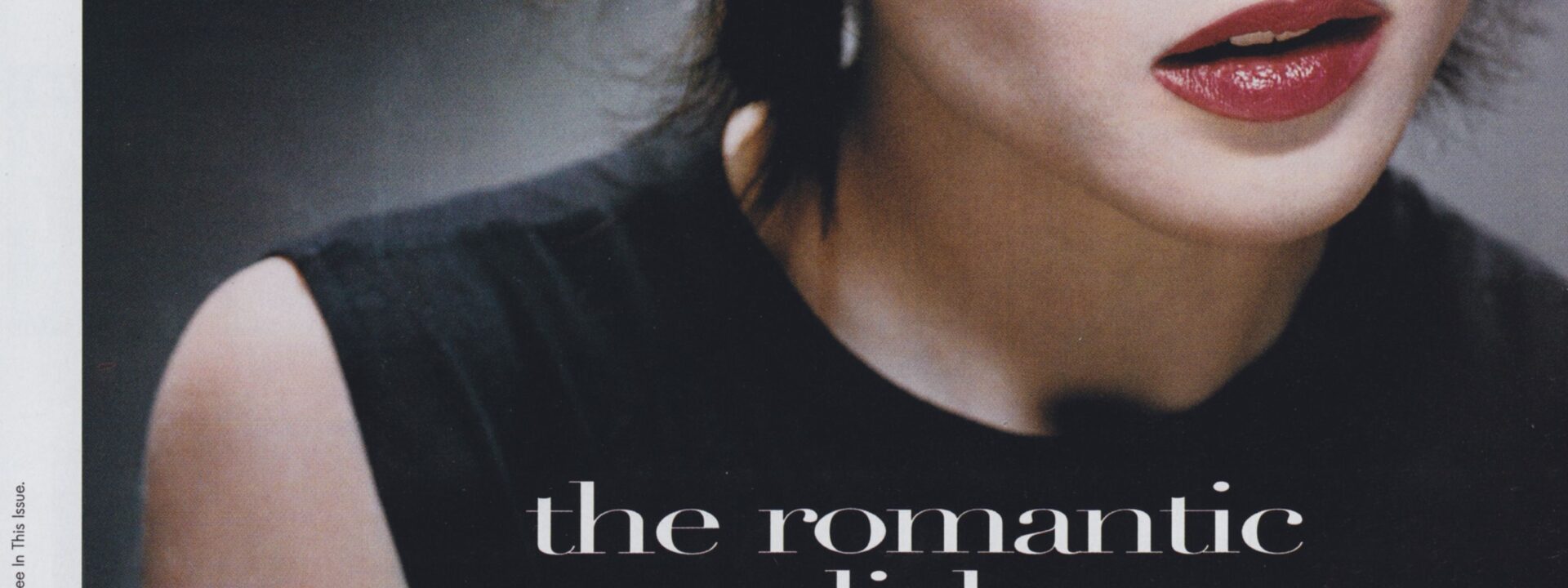
“The Romantic Englishwoman,” by Richard David Story, first appeared in the November 1997 issue of Vogue. For more highlights from Vogue’s archives, sign up for our Nostalgia newsletter here.
After years of moving through one century after another—starting with her debut twelve years ago as Lady Jane in the sixteenth century—Helena Bonham Carter finally has a role where she’s not just another piece of a costume drama, even if it is set at the turn of the nineteenth century. “I’ve worn hair extensions for sooooo long that I, too, had almost forgotten what I looked like,” says Bonham Carter. In a slip skirt, a tiny tight cashmere top, and boyishly short hair, she’s unrecognizable from the young woman she plays in The Wings of the Dove.
The hair, the corseted body, the satins, stays, buttons, and hats—she had become a cliché, an overly tufted velvet pincushion of an actress. (The upside, she says, was that these frocks-and-dull-suitors movies “pretty much guaranteed that I didn’t have to take my clothes off.”) Then came Woody Allen’s Mighty Aphrodite, which won an Academy Award for Mira Sorvino and pushed Helena Bonham Carter into the twentieth century. But her sharp, modern SoHo adulteress was just the start: In Dancing Queen (so far only released in England), she played a stripper (“a tart with a heart”); in Margaret’s Museum, she played—and I’m quoting her—a “snot-nosed whore.” This fall, Bonham Carter plays a frumpy, poetry-loving London spinster in Keep the Aspidistra Flying; a victim of motor-neuron disease opposite newish boyfriend Kenneth Branagh in The Theory of Flight; and Kate in The Wings of the Dove. In a strikingly visual and engaging adaptation, director Iain Softley has turned Henry James’s difficult, intellectual novel into an elegantly modern and psychologically dark story of love and betrayal, with Bonham Carter at its center. Set in London’s drawing rooms and Venice’s canals, The Wings of the Dove may earn the 31-year-old actress her first Academy Award nomination.
“I personally don’t think I deserve it,” says Bonham Carter matter-of-factly, stubbing out a cigarette and flopping onto a couch the afternoon before Dove gets its big send-off at the Toronto International Film Festival. “It’s not my best work, and as an actress, you intuitively know those things.” Others would disagree, including Softley, who says no one else could have so perfectly captured Kate’s “sense of Machiavellian scheming and gamine innocence.” He even says it was “a tribute to how strongly we felt about having Helena that we were able to overlook the fact that she might be seen by some as a period-piece stereotype.”
It’s odd that she ended up there, considering how Lady Jane‘s director, Trevor Nunn, discovered Bonham Carter—she’s the great-granddaughter of British prime minister Lord Asquith—after seeing her face in an ad for stereo equipment nearly fifteen years ago. “Back then I had all the confidence that comes from immaturity and arrogance,” she says. “I was quite academic, and I resented not going to college.” By the time Merchant and Ivory cast her in A Room with a View, she felt isolated and even more insecure, which might explain why she still lives at home. And why is that? “Comfort, continuity, the sense of balance that home gives me about my work.” One journalist suggested, in a piece Bonham Carter deeply dislikes, that it might have to do with her father being paralyzed and in a wheelchair for seventeen years (her mother is a French-Spanish psychotherapist).
Though she prefers not to talk about her life offscreen—especially her relationship with Branagh—she does say she recently bought a flat not far from her parents. She still hasn’t moved in. “Some would say I haven’t yet developed my more feminine, domestic side,” she jokes. “I desperately want to learn how to cook, pick out a couch—all those things that other people do.”People go on and on about it, but I can’t even commit to a dinner date a week from Tuesday.
For years, Bonham Carter has been typecast, especially in America, as the perfect English aristocrat. After A Room with a View came out in 1986, she spent her entire Today show interview talking about the horrors of the English class system. A publicist warned her to be careful—the American public eats this kind of thing up. Use it to your advantage. Bonham Carter finds the whole thing pretty funny. Even though her great-grandfather on her father’s side was a prime minister, he was also middle-class and from the north of England. “They routinely give every prime minister the title of ‘lord’ as a sort of going-away gift after they leave office.” (Her grandmother was the Liberal figure Lady Violet Bonham Carter.)
Over the past seventeen years, Bonham Carter has made twenty films, played Marina Oswald on American TV, had guest roles on Miami Vice, and recorded an audiocassette of The Children’s Garden. “It’s been a good and very profitable career,” she says, adding, “and I like the lifestyle and the money.” Still, the ill-fated Mary Shelley’s Frankenstein (on whose set she met the then-married Branagh, the film’s co-star and director) is about as close as she’s come to a big-budget Hollywood movie.
What she also hadn’t done—until The Wings of the Dove—is anything as graphic and sexual as her completely nude scene with Linus Roache at the end of the film. “I started laughing uncontrollably the first time. Here I am completely naked, and I have to look cool and sexy while sensually unzipping Linus’s pants and trying to pull them off him. All this in a room with six other people, and suddenly I thought, What the hell am I doing!” Director Softley remembers the moment a bit differently. “She turned to me at one point and said, ‘Iain, please, just remember: One day I’m going to watch this movie with my granny.'”
Frequently Asked Questions
Here is a list of FAQs about the archival episode of The Romantic Englishwoman featuring Helena Bonham Carter
General Background
1 What is From the Archives The Romantic Englishwoman
Its a special documentary or archival program that revisits the 1975 film The Romantic Englishwoman This particular episode focuses on Helena Bonham Carters reflections and insights about the movie
2 Is this a new film or just a commentary
Its not a new film Its an archival piecelikely a TV special or bonus featurewhere Helena Bonham Carter discusses the original movie its themes and its legacy
3 Who is the Romantic Englishwoman in the film
The title refers to the main character Elizabeth played by Glenda Jackson Shes a bored upperclass wife who gets caught up in a dangerous romantic fantasy
4 Why is Helena Bonham Carter talking about a 1975 film
Shes a huge fan of the film and its star Glenda Jackson Bonham Carter often cites this movie as a major influence on her own acting career especially for its complex female lead
Content Insights
5 What does Helena Bonham Carter say about the films themes
She highlights the films exploration of fantasy vs reality female desire and the dangers of romanticizing a mundane life She praises how the movie avoids a simple happy ending
6 Does she talk about the acting in the film
Yes She deeply admires Glenda Jacksons performance calling it raw intelligent and fearless She also discusses Michael Caines subtle menacing role
7 Are there any behindthescenes stories in the archive
The archival episode likely includes clips from the original production and Bonham Carter sharing context about director Joseph Loseys stylelike his use of mirrors and shadows to show character psychology
Practical Viewing Tips
8 Where can I watch this From the Archives episode
Its often found as a bonus feature on DVDBluray releases of The Romantic Englishwoman or on streaming services that carry the film with extra content