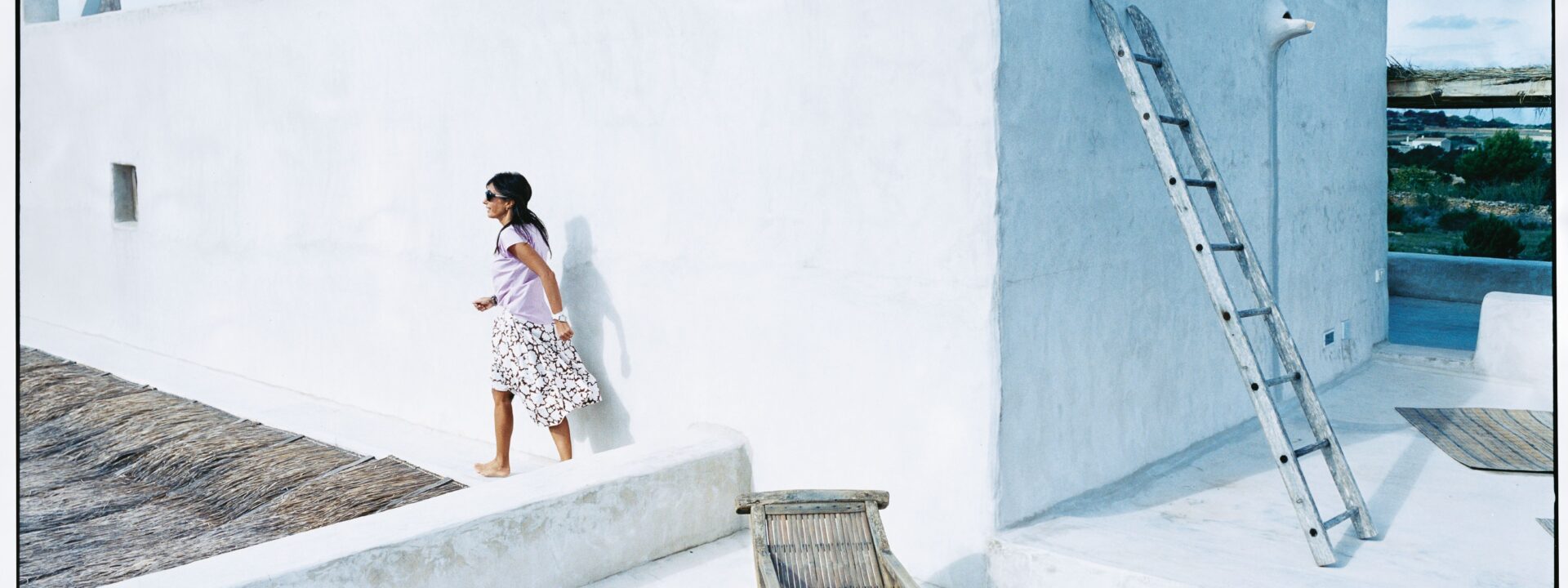
“Everything Goes” by Hamish Bowles was first published in the January 2004 issue of Vogue. For more highlights from Vogue’s archives, sign up for our Nostalgia newsletter here.
Consuelo Castiglioni uses the fitting phrase “hippie chic” to describe the style of Marni, the fashion house she founded with her husband, Gianni, just over ten years ago. It quickly became a must-have brand for bohemian fashion lovers. For Marni’s summer collections, Consuelo brought her unique vision to looks that blended ethnic and vintage elements with interesting cuts. Marni’s prints, which have the charming feel of 1920s wallpaper designs—or, this season, 1950s homemaker china patterns—have become instant collector’s items. Under the Castiglionis’ guidance, Marni has also reimagined and modernized what fur could be—an affordable high-fashion piece, a whimsically colored accessory—showcasing their family ties to the prestigious business Gianni’s grandmother started in the 1940s, which still produces many of the furs for fashion houses from Fendi to Prada.
But for the Castiglionis, hippie chic goes far beyond their Milanese fashion world. Consuelo, who was born in Switzerland and has a delicate, pale beauty, met the charming Gianni when they were both students spending the summer at Forte dei Marmi, a traditional Tuscan beach resort. Since then, a life of adventurous travel, sun, sea, and sand has shaped their lives together. Summer holidays spent exploring the wilds of Corsica in their 50-foot Hatteras fishing boat gave them a love for unspoiled island living, which led them to Formentera in the summer of 1996. “The first time we arrived,” Consuelo remembers, “the port was so tiny, with its three palm trees, that I said, ‘Now we are in Africa!'” The couple fell in love with this windswept stretch of land in the Mediterranean, off Spain’s eastern coast.
The Castiglionis soon discovered that wanting a house there was one thing, but making it happen was another. The people of Formentera are a spirited island community who, over the centuries, have fended off invading Romans, Phoenicians, and Moors, only to now face an influx of jet-set adventurers, aging hippies, teenage ravers, and German naturists. Their deep pride in their home has led to strict zoning laws and a natural reluctance to sell. Gianni spent months biking around the island—thirteen miles long, with hilly ends connected by a narrow strip of land, featuring a long stretch of beach on one side and sheltered rocky coves on the other—making endless cold calls at houses to see if anyone would give in. Eventually, he convinced a local farmer to part with a field. Like all cultivated land on the island, the property is bordered by low walls of orange stone and adobe, and dotted with ancient fig trees so wide that their branches are propped up by thin clusters of twigs. The site also offers uninterrupted views of Es Vedrà, the white rocky mountain on the southern tip of Ibiza, the island’s glamorous neighbor.
Given the freedom to build the house they wanted, the Castiglionis avoided the local style of dark farmhouses with tiny shuttered windows—homes turned inward to protect against the island’s fierce winds, harsh summer heat, and bleak winters. Instead, they wanted a place that embraced these elements, where indoor and outdoor spaces flowed together seamlessly. “Gianni wanted something really open—to be able to see through the house,” says Consuelo, “and in the summer I want lots of light coming in.” She laughs, adding, “We wanted a kind of Flintstones thing!”
A major inspiration came from a trip to Yemen, where she was amazed by the adobe high-rise cities rising from the desert like ghostly Art Deco Gothams. That influence led to the design of the house’s dizzying staircase. With its shallow steps and striking lack of a railing, it’s clearly not something to attempt after a fun evening of drinking Hierba.The toxic local liqueur aside, the main living room has French windows that stay open all summer, so when you arrive, you’re greeted by the terraces and the pool beyond. Deep loggias wrap around every side, shaded by palm-frond roofs that feel like Robinson Crusoe’s cabin, and they’re furnished as extra living space for the warm months. Bright pink bougainvillea and electric-blue morning glory climb the columns, adding vivid splashes of color, while Javanese four-poster beds and rattan sun loungers are stacked with soft mattresses and cushions in Marni prints. Other fabrics in the house were picked up in India, Egypt, and Kuwait, where Consuelo bought a Bedouin tent that will soon sit among the fig, persimmon, and pomegranate trees—and the darting lizards—in the gardens.
At first, the builders were puzzled by a brief that called for techniques suggesting an imperfect, human touch. On an early site visit, Consuelo was horrified to find that the loggia’s columns “were perfect” and that the vast, pale roof terraces had been paved with shiny new bathroom tiles, in the practical local style. “In the beginning they really didn’t like our ideas at all—that we wanted things to be deliberately ‘mal hecho’ [poorly made], as they called it. Then I think they thought the effect was rather nice, and finally they started bringing their other clients to see it.”
The furnishings reflect the family’s travels around the world, from which they always return loaded with inspiration. “I love to shop!” laughs Consuelo, who found the geometric-patterned wool carpets piled in the sitting room, for instance, in the remote Moroccan villages of Zagora and Merzouga; those on the terraces were brought back from Turkey, and the brightly colored straw mats in the kitchen and bathrooms came from Zanzibar. The new French doors, which were frankly too brand new, were limed to age them, while ancient Moroccan ones studded with huge nail heads were used indoors. The passion clearly runs in the family; daughter Carolina, 22, who’s studying the business side of fashion, brought a wooden kayak back from Bali, and son Giovanni, seventeen, spends lazy summer afternoons playing Bantumi, a backgammon-like game with seed-pod counters, which he discovered on Zanzibar. For Consuelo, there’s no better way to spend a summer day than browsing the local hippie markets for handmade jewelry and accessories, hoping to find one more treasure. “I always find something that becomes a starting point for an idea,” she says with her wry smile, always dreaming of Marni.
Frequently Asked Questions
Here is a list of FAQs about the article From the archives Escape to Formentera with Consuelo Castiglioni
General Questions
Q What is this article about
A Its a look back at a past photo shoot or fashion feature that took place on the Spanish island of Formentera It focuses on Consuelo Castiglioni a famous fashion designer known for founding the brand Marni
Q Who is Consuelo Castiglioni
A She is an Italian fashion designer She is best known for creating the fashion house Marni in 1994 and leading it for nearly 20 years before stepping down in 2016 She is famous for her quirky unconventional and artistic approach to clothing
Q Where is Formentera
A It is a small island in the Mediterranean Sea It is part of the Balearic Islands located just south of Ibiza and belongs to Spain
Q Is this a new interview or a recent story
A No The phrase From the archives means the story is a rerelease of an older article or photo set Its a vintage piece that is being shown again to readers
Style and Content Questions
Q What kind of fashion is shown in the article
A Based on Castiglionis style and the location you can expect to see relaxed bohemian and artistic clothing Think flowing silhouettes unique prints and a mix of high fashion with a laidback island vibe
Q Why pair a highfashion designer with a beach destination like Formentera
A Formentera is known for its natural beauty crystalclear water and hippiechic atmosphere It creates a beautiful contrast between the raw nature of the island and Castiglionis refined intellectual fashion designs
Q Is the article just about clothes or does she talk about her life
A Usually in these types of archival pieces there is a mix You will likely see photos of her wearing the clothes and the text often includes her thoughts on style her creative process and how she feels about the location
Q What is the vibe of the photos