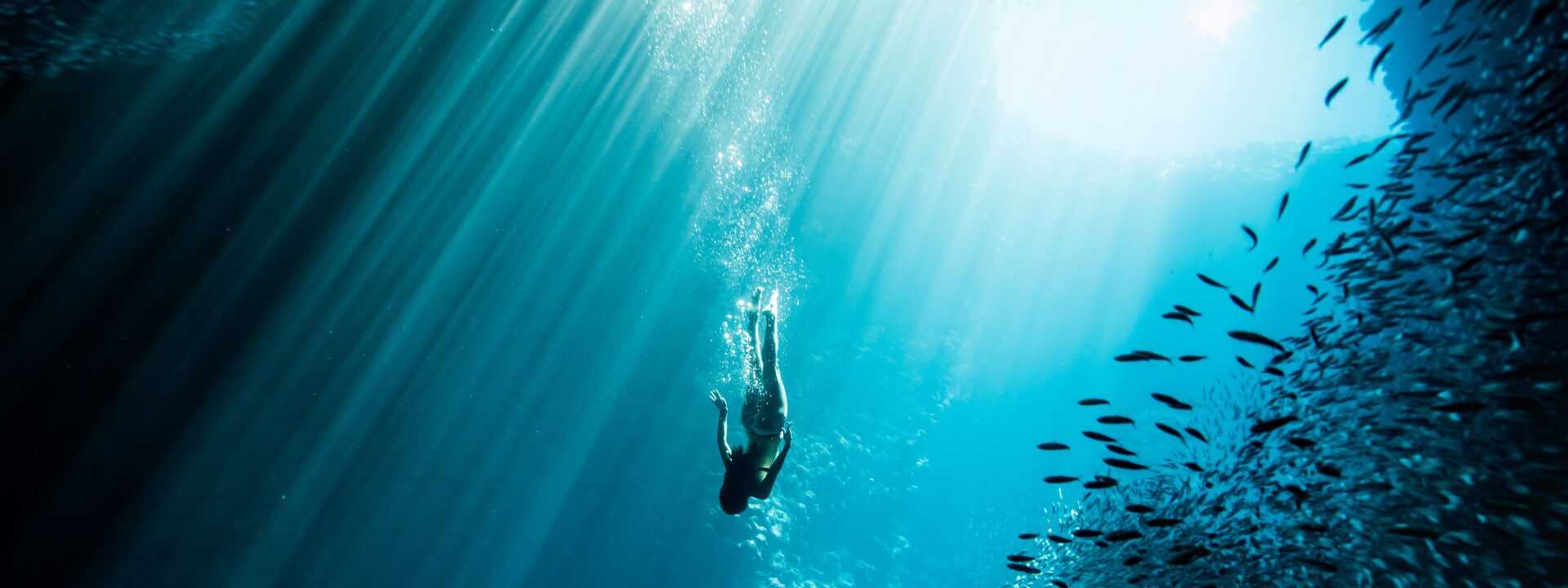
I was floating face-down in the swimming pool at Fiji’s Matamanoa Resort, eyes closed, breathing through a snorkel, when my freediving instructor’s voice drifted faintly through the water. “Dobrina… Dobrina? We’re done. You can come up now.” I’d been there for nearly three minutes.
This was part of my freediving certification, an exercise to trigger the “mammalian dive reflex”—the body’s automatic response the moment our faces hit the water. Also known as the Master Switch of Life, it slows the heart rate by about 25%, conserving oxygen and allowing for longer breath-holds. As author James Nestor puts it, “it turns us into efficient deep-sea-diving animals.”
Another effect of this switch? It relaxes both body and mind into a meditative state. So much so, in fact, that I tuned everything out and drifted to the far side of the pool, completely missing my instructor calling me for a full minute.
Normally, my mind is always racing, chasing a finish line that keeps moving. But in that pool, under the glistening Fijian sun with ocean waves lapping at the nearby beach, the moment I submerged my face and focused on the rhythmic sound of my own breathing, my thoughts went completely still.
Freediving—descending underwater on a single breath—has been practiced for millennia, mostly by coastal communities gathering food or, like Japan’s pearl divers, harvesting treasures. In many cultures, it’s also a spiritual practice connecting people to the sea. In South Korea, the haenyeo, some women in their 70s, still dive without modern gear, relying solely on their breath-hold.
Today, freediving is attracting a new wave of wellness seekers looking for calm, focus, and better lung and heart health. Celebrities have noticed too—Orlando Bloom dedicated an episode of his Apple TV series To The Edge to freediving. As people search for an antidote to data-driven, tech-heavy wellness routines, elemental activities like recreational freediving are gaining ground. In 2023 alone, the International Association for the Development of Apnea (AIDA) issued 35,000 new certifications—a number that nearly doubled in 2024.
Freediving is as much about body awareness and physical skill as it is about tapping into natural instincts and learning to be fully present. “It’s a journey of self-discovery,” my instructor Trevor Neal told me one breezy afternoon after practice. Humans are deeply connected to the ocean, even if we don’t live in it.
Amniotic fluid and seawater share striking chemical similarities—one study calls it the “ontogenetic recapitulation of the prebiotic seas.” In the 19th century, French doctor René Quinton found that blood plasma and seawater are 98% the same. We’ve all seen videos of babies swimming underwater; infants up to six months old have a natural dive reflex that makes them hold their breath. We carry amphibious traits—all life began in water—and freediving can help awaken them.
On my first day in the pool, I could barely hold my breath for 40 seconds. But after a few hours of breath-hold exercises and relaxation techniques, I easily reached a minute and a half the next day. What amazed me most was the deep calm and self-awareness my body found—something no meditation practice had ever given me.
“Freediving is about having control, and then letting it go,” explained Neelam Raff, a freediving instructor and owner of Liquid State Freediving School in Fiji. “Once you dive, you can’t change the water or the wind. What you can change is how you handle your emotions, your anxiety, your breath. A good freedive is where…”A private four-course dinner celebrating the flavors and culinary traditions of Hawaii.
Matamanoa Resort, Fiji
Photo: Chris McLennan
This adults-only private island retreat features 47 guest rooms and beachfront villas, each with ocean views and a private plunge pool. Its open-air spa, set in a breezy treehouse where treatments are accompanied by the sounds of wind and waves below, is easily one of the most relaxing wellness spaces I’ve ever experienced.
The resort reopens in March after a full renovation, but one thing will stay—its on-site diving school. Known throughout the Mamanuca archipelago as the place to learn free diving, Purple Turtle is run by husband-and-wife duo Trevor and Emma Neal, both certified diving instructors with decades of experience. Their course blends safety skills and technical knowledge with a profoundly calming environment. Thanks to Trevor’s straightforward approach, I doubled my breath-hold time in just one day and reached a level of mental stillness I never thought possible.
Frequently Asked Questions
FAQs Free Diving as The Ultimate Wellness Reset
Q1 What exactly is free diving and how is it different from scuba diving
A Free diving is the practice of diving underwater on a single breath without the use of breathing apparatus like scuba tanks Its about breath control mental focus and connecting with the underwater world in silence Scuba diving relies on equipment to breathe for extended periods while free diving is about using your bodys natural capabilities
Q2 Im not an athlete Can I really try free diving
A Absolutely While elite free divers push extreme depths recreational free diving is accessible to most people Its less about physical prowess and more about learning proper breathing techniques relaxation and listening to your body Beginners start in shallow calm water
Q3 How can holding my breath underwater possibly reduce stress Isnt it stressful
A It seems counterintuitive but thats the reset The practice forces you into a state of profound mindfulness You must calm your mind slow your heart rate and focus completely on the present moment This triggers the mammalian dive reflex a physiological response that conserves oxygen and induces calm The silence underwater is a powerful antidote to digital noise
Q4 What are the main wellness benefits of free diving
A Benefits include
Mental Sharpened focus reduced anxiety and improved mental clarity from intense mindfulness
Physical Increased lung capacity improved cardiovascular efficiency and enhanced body awareness
Emotional A deep sense of peace accomplishment and connection with nature
Q5 Is free diving dangerous Whats the biggest risk
A Like any sport it has risks but they are managed through proper education and never diving alone The primary risk is shallow water blackout which can occur near the surface due to a rapid drop in oxygen This is why the cardinal rule is always dive with a trained buddy who can monitor you and assist if needed
Q6 Do I need a lot of expensive gear to start