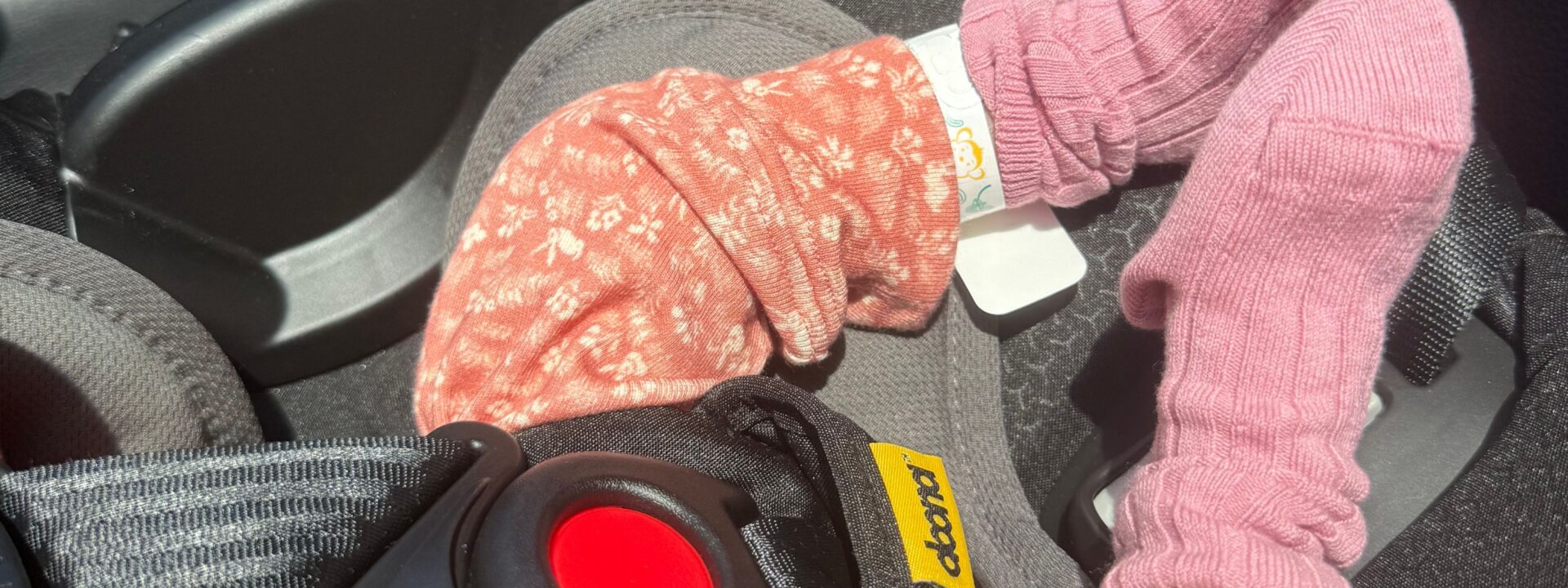
It was a mild November morning, and I was kneeling beside an exam table, just off a red-eye flight. A frozen grin of nervous excitement was stuck on my face while my eyes filled with anxious tears. I was holding the hand of a woman I had met in person only twice. I’m known for making friends quickly—in airport terminals, at veterinary offices—but this was the fastest I’d ever gone from first coffee to a gynecological procedure. In that moment, as we watched the ball of cells our doctor had already told us could someday become a girl shoot across the dark ultrasound screen like a UFO on a mission, I had an overwhelming urge to tell her I loved her. Babies and dogs can pull that out of you fast.
Present and direct, with a mane of impressively obedient curls and the strong, sinewy body of someone who is actually good at yoga, the surrogate had stirred something in me the moment we were introduced. My husband was out of town, so I had brought my mother to meet her and her partner. We sat in a coffee shop in Cobble Hill holding our matchas like props while we talked—about our lives, her children, the reasons she wanted to take this “journey,” as they love to call it in fertility medicine. After we left, my mother nodded approvingly, then one of us said something I can’t remember and we fought so hard we took separate cabs back into Manhattan. Nothing like staring motherhood in the face—no matter how much you’ve wanted it or for how long—to make you instantly regress into a sulky 14-year-old with the needs of an anxiously attached toddler.
In the months before the embryo transfer, as I got to know our surrogate and learned to trust her, the feelings I expected to have somehow weren’t there: namely jealousy that this woman could do for a child—for my child—what I could not. Carry her safely in her body, use her form to feed and house her, regulate the baby’s ever-evolving nervous system with steadiness, heart, and breath. Instead, I felt a different kind of jealousy—toward the baby, for the chance to be tucked inside someone who radiated such safety. I could just tell she knew how to steer an SUV in the snow.
After the transfer, which was as brief as a child’s strep test and infinitely less dramatic, the doctor told us he would do a pregnancy test in 10 days. We could feel free to test at home before then, but many “intended parents” found that more anxiety-inducing. I didn’t want to admit that I had already been calculating the odds of success day and night using various search engines, trying to understand the probability, how much to start imagining, how thrilled to be. Unlike most of life, where I have marched on expecting it all, we had learned to be cautious and measured on the subject of children, to know that this doesn’t happen for everyone, no matter how smooth each step is, no matter how many podcasts one’s doctor has been on.
But five days later, our surrogate, now back home in a state that was already getting snow, texted me a photo: a pregnancy test, the kind you’d see in a teen movie, a white plastic stick with a blaring pink plus sign. If I hadn’t already been lying down, I would have hit the floor, felled by a proprietary blend of shock and gratitude.
So now, all there was to do was wait. Track milestones, keep calculating, try not to let ourselves become too attached to this person who was really just an idea. My husband was better at the waiting, but he hadn’t spent the last 12 years circling the fertility drain, and he offered as many hopeful assurances as he could without making false promises. During this period he did a lot of funny voices for the dogs.
Powerless and unable to feel the physical changes that signal a growing fetus, I horrified friends and family who follow the Jewish superstition against buying things in advance, and I started shopping.
I couldn’t define exactly what I wanted, but I knew it when I saw it: clothing that was playful but didn’t lead with too much wink-I’d be lying if I said I hadn’t been thinking about this part. My first job out of college was at a children’s clothing store in Tribeca, working the register with my friends Isabel and Joana in a dusty but fancy boutique across from the Thom Browne store. If you were wearing Thom Browne and had a baby, you probably shopped with us too—for tiny wide-waled corduroy overalls, little conductor’s caps with Victorian button details, spectator boots, and understated prairie dresses. Once, we sold a pile of cashmere baby tank tops to Gwyneth Paltrow for baby Apple.
So I already had a sense of baby fashion—that it could delight and surprise. That’s why, when I started browsing the open market, I was confused. Yes, we’d encouraged a bit of British-street-urchin style at our old shop, but when had babies—especially girls—become victims of the cottagecore industrial complex? Who decided every girl should look like she’s about to milk a cow? And in what world would I want my daughter wearing something called a baby bubble that, however cute the name, looked like the ruffled backside of a 2004 Pussycat Dolls costume?
As I started telling mothers I knew about the pregnancy, I asked them how and where they dressed their babies. Lucky to know several very stylish women whose taste wouldn’t allow for either a smocked strawberry skirt with eight layers of ruffles or a tee that says “str8 chillin,” I was pointed toward brands that seemed to treat children’s fashion with the amused dignity I wanted. Some favorites emerged: Molo, La Coqueta, Charco. I couldn’t define exactly what I wanted, but I knew it when I saw it: clothing that was playful without leading with too much wink-wink cuteness. Most of all, I wanted garments that let her personality develop and express itself, rather than announcing an identity she didn’t have yet.
Collage by Phoebe Ward
As items arrived, I’d let myself look at them wistfully for a moment, sometimes showing one to my father (“wow, small” was all I got), then placing them in a cardboard box in the basement where they piled up. Things are just things, and I knew logically that no amount of buying—clothes, ’80s abstract crib sheets, homemade Holly Hobbie quilts—could prepare me for what was coming. Even my own desire, my long-standing and no-longer-patient readiness, hadn’t prepared me. But she was preparing herself inside our surrogate’s strong, healthy body, and as the clothes stacked up in the box, so did a sense that she was becoming real. These would be her clothes. She would be a person we helped dress, who made an impression on the world based on our choices, until she was old enough to do it herself.
My mother and I have always done some of our best communicating and most bitter arguing around fashion. Shopping trips with her—whether at tag sales or New York City designer discount stores Daffy’s and Century 21—are some of my most treasured childhood memories. Not only did she care about my taste (and shape it, through her sweetly unorthodox ideas about what looked good on a baby with six chins), she also instilled in me a sense that what was precious wasn’t always what was popular, what was valuable wasn’t what was expensive, and what was beautiful was in the eye of the beholder. That children had a right to behold.
By month seven of the pregnancy, the cognitive dissonance of my experience—I was on a book tour, boarding and deplaning, in and out of borrowed outfits, with three tracks of extra hair permanently attached to my crown—was starting to feel insane. “If I was pregnant, would I be doing this? How about this? And this?” I asked myself almost hourly. The answer was that I had no idea. But, like the low rumble of a train a few stations away, I felt her before I heard her, sensed herBefore I saw her, I wished she might arrive just a little faster. That’s when things took a turn, both joyful and obsessive: through a botched Poshmark search for a Sonia Rykiel bejeweled Domino bag (a purely selfish purchase), I discovered the world of Rykiel Enfant. The clothing was simply perfect. Charming yet goth, as if it belonged to a very small mime with a busy social life. The pieces had a wonderfully French quality, built on the idea that a child can be a tiny eccentric Left Bank woman: stripes, knits, color, wit. Sophistication and whimsy. She was growing inside our surrogate’s strong, healthy body, and as the clothes piled up in the box, so did the feeling that she was becoming real.
What other great minds had embraced baby clothes, approaching them with enthusiasm and intelligence rather than as just a licensing deal to push conspicuous consumption? There was Junior Gaultier: a nautical striped dress with the faintest hint of black-and-red polka-dot tulle peeking out from under the skirt. A billowing tank top covered in what looked like neon spaghetti. Then Pierre Cardin—who started his children’s line in 1968, not a bad year (and so the mom jokes begin!). A knit shorts romper with thick candy stripes of lime, watermelon, and berry, and that telltale C embroidered on an oversized tummy flap. An early ’80s snowsuit with geometric quilting. In those moments, my desire wasn’t to bend her to my will—though the mod knit yellow Paco Rabanne minidress with a collar of severe silver studs comes pretty close—but to give her options and offer her something my mother had offered me, something that had lent childhood its most magical moments: the chance to develop her own taste, to curate her world, to express her moods.
Parcels piled high—clothing so tiny it could fit into a FedEx envelope—and arrived at my parents’ PO Box in quantities that embarrassed me, as if I were running a pre-internet Spice Girls fan club and receiving membership packets from around the globe. I obsessively explained—and tallied—the cost. “All of this, together, costs less than one new thing at Bonpoint!”
The waiting was harder to accept. As the clock wound down, something that had once been theoretical became urgent. I studied the ultrasound images like a ghost hunter, looking for any signs—of who she might be, of what she might already know. In one, I swore she was almost winking at the camera. But in the daytime, I knew it was just a bit of contrast, a trick of the light.
It had occurred to me she might come early, but it had never occurred to me she would come late. Our Airbnb in a state not our own, just down the road from where our surrogate lives, ran out, and we hadn’t bothered to check if it was booked for the next two weeks (it was, by frat boys on vacation). As we passed her due date, the days became liquid and squishy, too long and without any form. My out-of-office alert went up, seeming to mock my certainty. In the hours when I’d usually impose focus and structure, I scurried deeper down my vintage baby rabbit hole, scouring for ’80s Esprit—ditsy florals and mismatched stripes—and accidentally falling for a Dior nightgown covered in sailboats, as if she was planning a long nap on Nantucket (she could have been, for all I knew). Twelve days. “Action needed, buyer replied to offer.” A Kenzo Jungle coat in felted brown wool with an orange mandala embroidered on the hood, for the potential Burning Man dude inside of her. Scans, assurances about a normal heartbeat and some babies just coming in their own time. The sense that I was looking for her everywhere but the one place she might be.
And then, 13 days late, in the face of a solar eclipse and a meteor shower, she announced herself. I sat on a hospital bed, between the legs of a woman I hadn’t known a year ago, waiting for a glimpse of this person I had been waiting for with something related to patience, but also none at all. I was so focused on our surrogate—in awe at her concentration, her period of quiAnd then came what sounded like a roar—I didn’t think to look down until I heard our baby cry. I saw her face, gasping just like she did. Her eyes, wide and unfocused, took in the light and shadow, blinking quickly. “Talk to her,” the midwife said. “Say hello.” “Hello,” I said. “I’m your mama. You…you look nothing like I imagined, but exactly right. We’ve been waiting for you, do you know that? It was so kind of you to come.” And I meant it. Like a kid unsure if their classmates would show up to the birthday party, I was shy and dizzy with joy. She seemed to lock her gaze on me. Just as someday I hope she’ll lock her gaze on herself in the mirror, point to her Cacharel dress in soft liberty florals, and say, “Mama, I don’t want to wear this today.” Maybe never. They’re hers to love or hate, want or reject. It’s all hers now. But for now, she wriggled in my hands, slippery as a seal, naked as the day she was born.
Frequently Asked Questions
Here is a list of FAQs based on the topic of Lena Dunham becoming a mother and her unique preparation story
Beginner Questions
Q Who is Lena Dunham
A She is an American writer director and actress She is best known for creating and starring in the HBO series Girls
Q What is the main news here
A Lena Dunham has become a mother She shared the news and the story of her unique journey to motherhood
Q Did she give birth to the baby
A No Lena Dunham did not carry the baby herself She became a mother through surrogacy
Q What is a surrogate
A A surrogate is a woman who carries and gives birth to a baby for another person or couple who want to become parents
Q Why did she use a surrogate
A Lena has a chronic health condition called endometriosis This can make it very difficult or unsafe to carry a pregnancy Using a surrogate was a way for her to have a biological child without risking her own health
Q Is she married
A She is married to musician Luis Felber They got married in 2021
Intermediate Questions
Q What makes her preparation story unique
A Her story is unique because of the deep creative and emotional ways she prepared for motherhood She didnt just buy baby clothes she prepared her mind her art and her relationship for the new arrival
Q Can you give an example of how she prepared
A One example is that she and her husband Luis wrote a song for the baby It was a way for them to connect with the baby and express their feelings before the birth
Q How did she prepare her home
A She focused on creating a calm and peaceful space This included setting up a nursery and making sure her home was ready for the new baby and the surrogates needs
Q What is endometriosis
A Endometriosis is a medical condition where tissue similar to the lining of the uterus grows outside of it It can cause severe pain especially during periods and can affect fertility It is a chronic condition
Q Did she face any criticism for using a surrogate