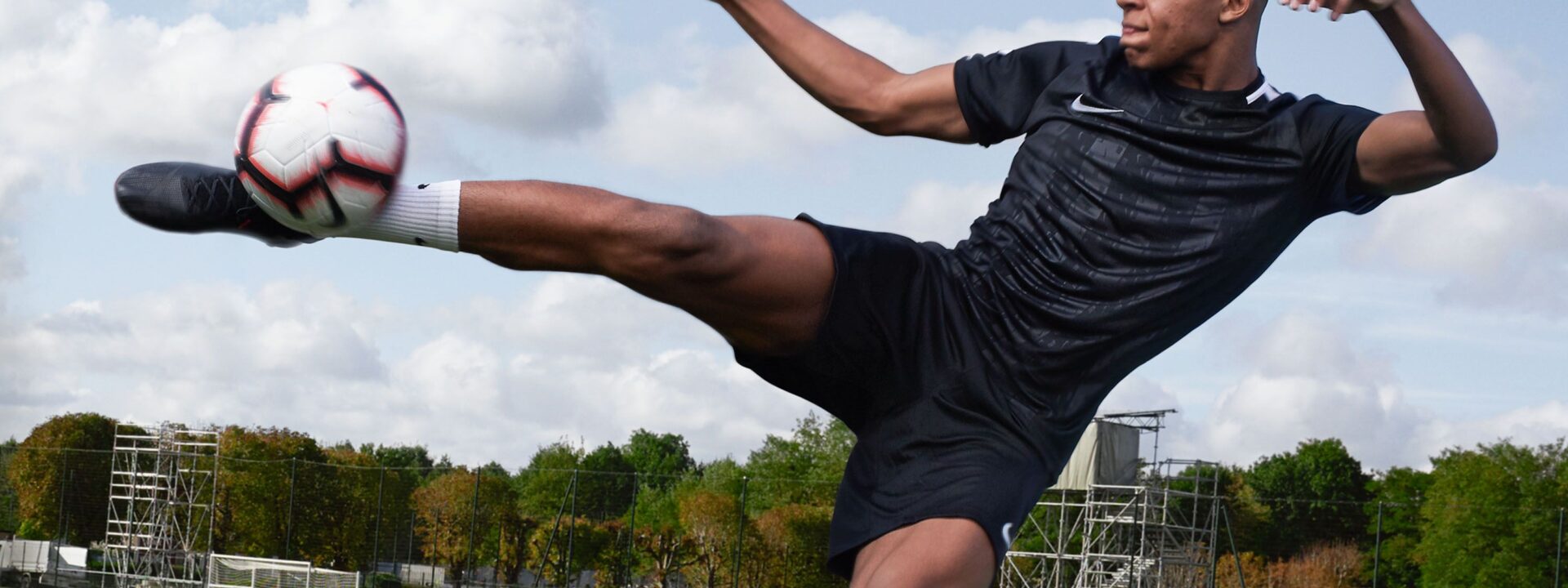
Shortly after Kylian Mbappé left Nike’s ambassador program, the sports giant reported a 5% year-on-year revenue drop for Q1 2027. On Thursday, it also announced upcoming layoffs and a geographic reorganization, while shares fell 6%, leaving Nike stock at its lowest level since 2013.
In recent years, Nike has lost major athletes such as Lamine Yamal, Harry Kane, and Ousmane Dembélé to rival brands, reflecting its weakening dominance in the performance sportswear market. “As for Mbappé, we had some great moments and he was an important part of Nike football. We’re proud of what we achieved on and off the pitch, and we wish him much success as he moves on,” new CFO Dave Denton said on an investor call this week.
The sportswear giant announced the end of their relationship last month, closing nearly two decades of sponsorship that began when Mbappé was just nine years old. That same day, On — founded in 2010 as a challenger running brand — announced its entry into the soccer market, positioning Mbappé as both an ambassador and a guiding force for its product development. (According to The Athletic, Mbappé will receive equity as part of the deal with On.)
Kylian Mbappé is the standout talent for On’s soccer venture and will receive equity as part of his deal.
Photo: Juergen Teller via On
As of now, On does not sell soccer boots, though Mbappé has already teased a prototype in matches. Retired soccer legend Thierry Henry is the brand’s director of soccer and has been working behind the scenes on the product and go-to-market strategy since late 2025. On will also enter golf in 2027, expanding its reach further. This is a familiar playbook: the brand launched its first tennis-inspired sneaker in 2020 with Roger Federer — a former Nike poster boy — and later built the category into one of its fastest-growing.
Some pundits are declaring the end of Nike’s grip on the athlete marketing space, while others predict a shift toward a more varied sector. Nike, while still the largest sports brand in the world, is less comfortable than it once was. Over the last five years, the share price has fallen roughly 75.6%, including a 48.3% drop in the last year. Last month, it left the S&P 100, an index measuring the market performance of major large-cap US companies, after 18 years.
Insights company Kantar says that in 2026, Zara knocked Nike off the top spot on its global brand-value leaderboard, BrandZ. However, Nike remains the winning choice for consumers in eight of the 11 markets measured. The issue is that where Nike once could dominate through innovation, athlete endorsements, and cultural influence, consumers now have more meaningful alternatives, with offerings from On, Hoka, the Amer Sports portfolio (which includes Arc’teryx and Salomon), Vuori, Alo Yoga, Lululemon, and New Balance, which gave tennis player Coco Gauff her own shoe silhouette. Against a backdrop of economic uncertainty, consumer priorities have shifted.
Tennis player Coco Gauff wears her own New Balance x Miu Miu collaboration.
Photo: Chaumont and Zaerpour via New Balance
More broadly, the sector as a whole has been radically upended. “The sportswear reappraisal has entered its second act,” says Anita Balchandani, a senior partner at McKinsey. “In 2024, investors rotated out of the incumbents and into the challengers; by 2026, they had repriced the challengers, too.”
Of course, ambassadors are just one part of the story. For Nike specifically, issues such as revenue decline in China and a drastic pullback from wholesale to focus on direct-to-consumer selling in recent years have hurt sales. “Nike’s recent issues and stock decline, in our view, are less about losing some high-profile athletes and more about having products that are innovative and fresh — versus relying on legacy franchises — and having an attractive presentation at both its own stores and at retail partners,” says Cristina Fernández, a senior research analyst at Telsey Advisory Group. “As NNike’s products have struggled to sell, while other brands with new technology, a fresh look, or a more grassroots approach have gained market share across different regions. Nike told Vogue Business that Hill, who became CEO in 2024, has cleared out unhealthy inventory, reset the marketplace, and created more room for a new line of Nike performance products and innovation. Nike is also simplifying its retail offerings, investing in premium retail experiences, and strengthening its wholesale partnerships.
Still, Nike’s association with exceptional athletes remains a key test of its relevance, consumer sentiment, and brand equity — all metrics Hill should be working toward as part of his ongoing brand turnaround. Is Nike worried about competitor brands taking its stars? “We like competition and always have. Nike was built to compete,” says Mary Remuzzi, Nike’s VP of corporate communications. “Athletes have more choices, which means every day we have to earn the right to be their choice through epic innovation, incredible products, and an unmatched connection to sport. Competition makes Nike better, and our focus remains where it has always been: serving athletes.”
Playing to win
Cristiano Ronaldo was one of several superstar talents fronting Nike’s Rip the Script World Cup 2026 campaign.
Photo: Nike
Part of Hill’s plan so far has been a return to competitive sports marketing, implicitly positioning Nike as the winner’s brand. From the outside, the storytelling has doubled down on a highly competitive mood. The loud-mouthed cameos from former soccer players Zlatan Ibrahimović and Eric Cantona in Nike’s World Cup hero film Rip the Script reflected this, echoing an older, more arrogant vision of Nike from the ’90s and 2000s. It also featured Mbappé, Ronaldinho, Francesco Totti, Cristiano Ronaldo, rapper Central Cee, and even Kim Kardashian. According to Launchmetrics, the campaign generated a media impact value (MIV) of $46 million. Hill reported that by the start of the tournament, Nike had already sold 2.5 times as many kits compared to the same period for World Cup 2022.
“Nike’s brand is at its strongest when it leads with the athlete and lets culture build around them,” says Launchmetrics CMO Alison Bringé. “That’s exactly what worked at the World Cup, where soccer players came first and cultural figures amplified the story.” As Bringé sees it, Nike must give its athletes a sense of ownership, treating them as co-authors of the brand for success. This messaging shift was necessary. “Nike’s historic advantage has narrowed,” says Ellie Thorpe, director at Kantar’s BrandZ, noting that its point of difference in the US, Germany, and Japan has eroded. “Brands that lose this often maintain demand for a while, because people still know and trust them. The danger comes later, when consumers start seeing competitors as being more innovative, more exciting, or more culturally relevant.” For Thorpe, renewing this proposition of difference doesn’t necessarily mean more athletes, but more compelling athlete stories instead, where the players have influence and creative input — not just a standard sponsorship. Whether this works will depend on its agility and willingness of brands to adapt to a market that’s completely changed in the past decade.
Courting talent
Some experts argue that Nike will never return to what it once was. “Other brands are being far more aggressive in their marketing and recruitment efforts,” says Neil Saunders, managing director of Globaldata’s retail division. “On top of that, athletes like the innovation at brands such as On, and have embraced [that] in a way that they didn’t previously. Nike, while still huge, has lost some of its cool factor, which has pushed athletes into the arms of other brands.” Athletes have become more discerning over their partners. Federer left Nike in 2018 after 24 years with the brand, stepping on board with Uniqlo, and then On, where he inked a partnership comprising a reported 3% stake in the compathat would almost triple in value. This was a milestone moment that cemented a shift within the brand-athlete ecosystem. Now, sports stars grow alongside the brands.
Beyond financial return on investment, sports stars want to see their own personal brands develop at the same time. Since Nike’s roster of athletes is so large, it can be harder for the athletes it represents to stand out. “With some stars, they want to feel like they are the top pick as opposed to being part of a roster of elite sports stars,” says Reece Crisp, buying and creative director at concept store LN-CC, which stocks Nike and works with the brand on partnerships. “With the emergence of new brands, they can attract big stars by offering them the keys to the brand.” In essence, disruptor brands give athletes only-child treatment, which is appealing in a crowded market.
Nike was a pioneer in signing up rising talents including Tiger Woods (pictured after winning the US Open in 2000), Michael Jordan, and Cristiano Ronaldo.
Photo: Getty Images
“When your roster is that big, a lot of talent starts to feel like a line item rather than a partner,” says Charlie Weir, founder of sports marketing agency We Are Ninety. “The DTC [direct-to-consumer] era made that worse, because the focus moved to the consumer funnel and away from the relationships that built the brand.”
More broadly, Nike needs to address its regional presence so that prospective talents around the world can see potential in partnering with the brand. “While Nike remains the world leader in sportswear with a comfortable lead over the second largest player Adidas, it needs to defend scale and profitability in its largest and most mature markets — Europe, China, North America — while scaling in key growth markets — Latin America, India, South East Asia,” says Marguerite Le Rolland, Euromonitor’s head of apparel and footwear.
Noting Nike’s intended focus on running, soccer and basketball, Le Rolland suggests leaning on large upcoming tournaments — such as the next NBA league games or the 2028 Olympics — as launch platforms, investing in a few high-profile athletes and their products while spending less on mega-stars. Alternatively, she suggests, Nike could double down on smaller emerging athletes and niche sports. College name, image and likeness deals, as well as fast-growing sports — pickleball, paddle, and women’s soccer and basketball — are where fans form loyalties early,” she says, noting that both On and Hoka earned credibility through runners and specialty stores as opposed to star athletes.
Indeed, Nike has a track record of identifying talent early, having caught Michael Jordan, Tiger Woods, and Cristiano Ronaldo all on the cusp of their rise. “At a time where — particularly in soccer — there is more of a focus on academy players than ever before, the key is finding the right talent and getting them on board early,” says Crisp.
Innovation drives prestige
If Nike intends to attract fresh talent by making them integral to a product’s lore, this means embracing totally novel designs for the athletes to put their stamps on. The problem? Nike, industry insiders agree, has been relying too heavily on retro styles and its legacy since the early 2020s. This perhaps explains Hill’s recent push in the running segment — a more forward-thinking category than the brand’s legacy classics — where new developments have already shown positive improvements. The company has also been deliberate in unwinding its previous reliance on legacy franchises, such as the Dunk and Air Force 1 shoes. In June, the CEO noted Nike Running as a bright spot, following five consecutive quarters of double-digit growth.
Still, competition remains strong, and this is mirrored in the secondary as well as primary market. “Challenger brands across running and beyond have seen some of the fastest trade growth on our platform in recent years — a clear sign that both athletes and consumers are spreading their attention well beyond the traditional handful of leaders,” says Brendan Dunne,StockX’s senior director for customer community and engagement. “For Nike, the opportunity is less about recreating the market of the past and more about competing in this new environment where athletes have more leverage, more options, and greater control over their own brands.” Erling Haaland was the face of Nike’s neuroscientifically designed shoe. Photo: Nike. Misha Sher, an athlete marketing specialist and founder of One of Not Many, agrees: “Being the automatic choice for every great athlete is a different proposition now that there are more credible brands to work with.” He argues that Nike can return to its leader status, provided it keeps delivering products athletes want and consumers choose. Whether Nike can bring back that ‘just do it’ energy will determine its future and the caliber of athletes in its stable. The stakes are high. “Elite sport performance is one of the few genuinely scarce things left. There is no AI shortcut, no medicine, or aesthetic surgery that can create an elite athlete,” says Edward Campbell, president of marketing agency General Idea. “It will continue to gain in importance.”
Frequently Asked Questions
FAQs Can Nike Win Back Its Athletes
1 What does winning back athletes mean for Nike
It means getting star athletes who left Nikeor signed with rivals like Adidas New Balance or Pumato come back and represent the brand again
2 Which athletes has Nike actually lost
Big names include Stephen Curry Kyrie Irving and several track stars who followed Usain Boltera deals elsewhere Nike has also faced competition for rising stars in soccer and basketball
3 Why do athletes leave Nike in the first place
Common reasons bigger paychecks elsewhere more creative control over their own shoe lines equity or ownership stakes better personal treatment or frustration with Nikes corporate decisions
4 Can Nike realistically win these athletes back
Yes but its not easy Nike has deep pockets global marketing power and unmatched distribution That said athletes who left for ownership deals or personal brands may never return
5 What advantages does Nike have over rival brands
Scale prestige and exposure A Nike deal can make an athlete a global iconthink Michael Jordan or LeBron James Few brands can offer that level of reach
6 Whats Nikes biggest weakness in these negotiations
Nike has a reputation for controlling deals tightly and not giving athletes equity Rivals like Adidas and New Balance now offer ownership stakes and more flexible partnerships
7 Has Nike ever successfully resigned an athlete who left
Yes Nike has resigned athletes in the past after brief stints with other brands though its often quieter than the original departure It usually happens when the rival deal underdelivers
8 What would Nike need to change to attract athletes back
Offer more equity allow athletes to build their own subbrands improve personal relationships with talent and move faster on NIL deals for college athletes
9 What is NIL and why does it matter here
NIL lets college athletes earn money from their name image and likeness Nike can sign college stars earlybefore rivals dowhich builds loyalty and makes them more likely to stay pro
10 Are shoe deals really that important to athletes
Yes Beyond money