This morning at 10 AM, I attended the first New York screening of Melania at the Regal Essex Crossing theater in Manhattan. No advance screeners were provided, and many mainstream press members were reportedly barred from last night’s premiere at the Kennedy Center. The theater was quiet, with only about ten people present. Most seemed to be journalists, like myself, taking notes throughout the film. Outside, one reporter was interviewing attendees.
Acquired by Amazon MGM Studios for $40 million, Melania focuses on the First Lady’s approach to her image and public perception during the 20 days leading up to President Donald Trump’s second-term inauguration. The film arrives in theaters at a tense moment in the U.S., with political tensions running high following ICE’s presence in Minneapolis and the killing of two American citizens during protests. Its release coincided with a National Strike—no work, no school, no shopping—in solidarity with Minnesota and other areas facing ICE-related violence. Nationwide protests are planned for this weekend, with support from celebrities and brands.
This contrast was evident in the documentary, which largely avoided politics. It extensively covered Melania’s outfits and the renovations she oversaw during the first term, such as the White House tennis courts and bowling alley. Set to songs by the Rolling Stones and Michael Jackson (Melania’s favorite), the film shows the First Lady traveling between New York, Mar-a-Lago, and Washington, D.C. She meets with the Secret Service to discuss inauguration logistics and Zooms with France’s first lady, Brigitte Macron, to talk about Melania’s child well-being initiative, Be Bette. The documentary includes clips of her watching news about the Los Angeles fires and meeting with a Hamas kidnapping survivor, but these moments feel secondary to the inauguration’s pomp and circumstance, which dominates the second half. Before the credits, a list of Melania’s accomplishments flashes on screen.
The film highlights how deeply Melania Trump, a former model, is embedded in the fashion industry, much like previous First Ladies. Fashion photographer Ellen von Unwerth shot the movie poster and a series of glamorous portraits of Melania to promote the film. The opening appears to recreate a scene from The Devil Wears Prada, following Melania’s snakeskin Louboutin heels as she boards a private plane from Mar-a-Lago to New York and enters an elevator in Trump Tower. The first part of the film heavily emphasizes fashion, featuring Melania’s stylist Hervé Pierre—who designed the black and white gown she wore to last year’s inaugural ball—and New York designer Adam Lippes, who dressed her for the inauguration.
Despite this fashion focus, the documentary offers little insight into the reasoning behind her clothing choices or the messages she aimed to convey. Instead, it concentrates on the garments themselves: their construction, fit, “straight” and “sharp” details, and how good the First Lady looked in them.
“I’d imagine it comes down to just what looks good and what she likes,” says stylist Bailey Moon, who served as Dr. Jill Biden’s fashion advisor during her time as First Lady, commenting on Melania’s style. “There’s no deeper meaning to it. And to me, there is no strategy. She’s a clothes horse; she likes clothes. When she likes a dress, she likes a dress. It doesn’t matter where it comes from.”
However, in a charged political climate—which has only intensified during the first year of Trump’s second term—many people do care where the clothing worn by those in power comes from (Moon included; it’s why he avoids working with brands that engage in certain practices).Fashion is, first and foremost, a business. However, for brands, aligning with a political administration is not a simple choice of opting in or out. Experts agree that remaining neutral is nearly impossible.
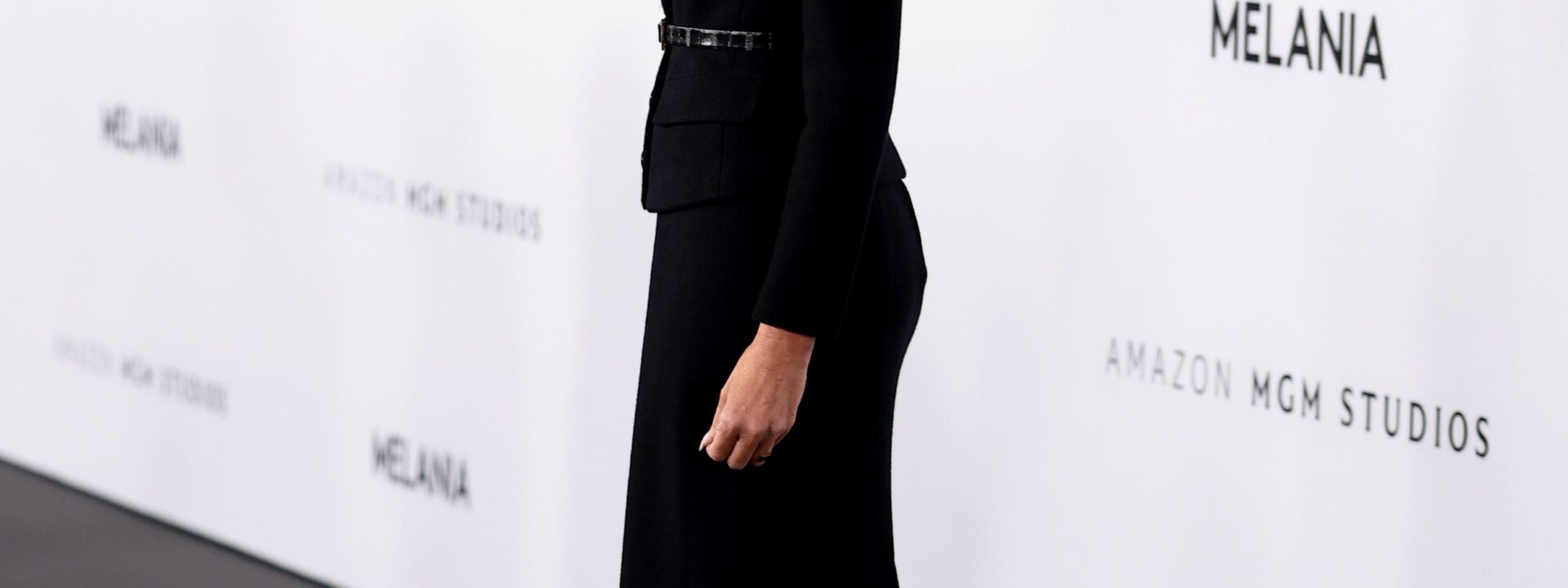
At last night’s Kennedy Center premiere, Melania Trump wore a black skirt suit from Dolce & Gabbana, a brand she has frequently chosen during her time in the White House, including for her official portrait. The look was not coordinated by the brand. (Dolce & Gabbana declined to comment, as the designers and CEO were in Miami for an upcoming exhibition.) Other notable attendees included Trump ally Nicki Minaj in Schiaparelli, along with Republican figures such as RFK Jr., Pete Hegseth, and Kelly Loeffler.
Melania’s choice of a buttoned-up skirt suit stood out, especially compared to the glamorous gown she wore in her photoshoot with von Unwerth. It aligned with the sharp, polished image she has maintained throughout Trump’s presidency—a term often used to describe how she prefers her clothing to look.
When Melania wore Adam Lippes, a lesser-known American designer, at the inauguration, it sparked speculation about whether she would champion more American and emerging labels, especially given Trump’s emphasis on American manufacturing.
Throughout Trump’s second term, the First Lady has indeed worn more American designers, including Ralph Lauren, Thom Browne, and Proenza Schouler, alongside Lippes, who also dressed her for the Military Parade. However, she has largely remained loyal to European fashion houses, wearing Givenchy for the 48th annual Kennedy Center Honors and Dolce & Gabbana for the Congressional Ball, among other events.
All designers contacted by Vogue Business either declined to comment or did not respond. One explained, “We approach dressing Mrs. Trump as we would any other client, so we don’t discuss it publicly.” Another noted that because the First Lady purchases her looks like any other very important client (VIC), they could not comment.
Treating Melania as “any other client” is significant, as brands dressing public figures typically do not do so. For example, a look worn by former First Lady Michelle Obama would receive a PR push. However, active political figures are often handled differently. A publicist with experience dressing politicians explained that not publicizing looks worn by officials in office is standard practice. “That’s from my KCD schooling,” he said. “When McQueen dressed royals, we didn’t send press releases. It’s tacky.” He followed the same approach when New York mayor Zohran Mamdani and his wife wore his clients’ designs.
Additionally, Melania has been a long-standing client of many luxury brands, even before her husband’s presidency. Many of her looks are likely acquired through VIC managers rather than brand PR representatives. One stylist estimates that at least 80% of Melania’s outfits are purchased from stores like Saks and Bergdorf Goodman.
“Those VIC managers and top store associates have their own agendas with their clients,” the publicist noted. “It’s not necessarily the design team seeking out Melania; she has probably been shopping at Dior and Ralph Lauren for years.”There is likely some connection there. You can’t simply deny a long-term client of over 15 years access just because you disagree with their politics, they argue.
Brands have limited control over when their clothing appears on administration figures, including Melania Trump. Reflecting on being with a brand during Trump’s first term, Moon notes, “She would wear things and we would just kind of be like, ‘ugh, okay,’ and you don’t do anything about it because you can’t stop a customer from buying your clothes.” Especially in this second term, if a brand unsupportive of the administration sees the First Lady in its designs, the safest response is often to stay silent. “People are afraid to speak out critically; from a business perspective, they worry about being targeted, reprimanded, or taken down in some way,” Moon explains.
Many designers who have publicly addressed dressing Melania cite her role as First Lady as the reason, stating they would dress any First Lady of the United States. When Ralph Lauren dressed her for the 2016 inauguration, the brand said: “The Presidential Inauguration is a time for the United States to look its best to the world. It was important to uphold and celebrate the tradition of creating iconic American style for this moment.” Ralph Lauren has dressed presidents and first ladies from both political parties for decades.
Similarly, in 2016, Thom Browne stated: “Out of respect for the position of the First Lady, I would be honored to design for any First Lady of the United States.” While he didn’t dress her during Trump’s first term, she wore Thom Browne on July 4th, 2025. Browne’s team did not respond to a request for comment. Designers like Diane Von Furstenberg and Tommy Hilfiger also expressed that she “deserved respect” and that designers should be “proud” to dress her due to her status.
However, in the second term, designers have grown quieter. Remaining silent about dressing political figures may be an attempt to appear neutral. But not everyone in the industry believes neutrality is still a viable choice. This is why many publicists, stylists, and brands declined to comment for this article, while others spoke anonymously.
“This wave of supposed neutrality has to end,” one publicist says, acknowledging the complexity of dressing politicians. He recently declined to dress a politician in brands he represents—not due to political disagreement, but because he recognized the delicate balance and didn’t want to involve his clients without careful thought. “This was after discussing with my brand clients that politics are tricky,” he explains. That same politician later wore the brand after thorough consideration.
“Image is a crucial part of the political theater we see every day,” Moon observes. For brands dressing figures whose politics may conflict with their own, it becomes a question of morals versus money. “At what cost do we advance or restrain the brand based on moral alignment—because we are in the business of selling clothes,” Moon adds. For example, Lippes told Vogue Runway last year that post-inauguration sales were the “three best weeks of his career.”
Those behind the scenes distinguish between brands that actively participate through gifting or custom designs and those whose items are simply purchased; it’s a matter of active versus passive involvement with the current administration. “There will come a time when we all have to reflect on what we were saying and what we were doing.””I’m concerned about the state of politics and democracy,” the publicist says. “And I think I would be so ashamed to work for a company that acts that way. It’s just not right.”
Frequently Asked Questions
FAQs Melania Trumps Fashion Choices and a Potential Second Term
BeginnerLevel Questions
1 Why do people care about what Melania Trump wears
As a former First Lady her clothing is seen as a form of nonverbal communication People analyze her choices for messages about her priorities her support for her husbands agenda or her personal brand much like with other public figures
2 What is fashion diplomacy
Its the strategic use of clothing to send diplomatic or political messages For example wearing a designer from a specific country can be seen as a gesture of goodwill or support for that nations industry
3 Could her fashion really affect politics
Directly no But it can influence public perception generate media coverage and subtly highlight certain issues or values which can contribute to the overall narrative of an administration
4 What did her fashion communicate during the first term
It often emphasized independence high fashion and sometimes contained symbolic choices that sparked widespread debate about her message and role
Advanced Analytical Questions
5 How might her style evolve in a second term compared to the first
Analysts might look for a shift from a more detached haute couture style to one that appears more unifying or traditionally supportive Alternatively she might double down on a distinct independent silhouette to maintain her separate brand
6 What specific issues could she highlight through her clothing
Past examples include wearing white to symbolize womens suffrage In a second term she could use fashion to draw attention to initiatives related to childrens wellbeing veterans or American designers and manufacturing
7 How does her approach differ from other modern First Ladies
Melania Trumps fashion has often been more aligned with highend European luxury brands and avantgarde styles whereas others like Dr Jill Biden or Michelle Obama more frequently used their platforms to spotlight emerging American designers or accessible brands
8 What are the risks or criticisms of her fashion choices
The main criticism is that extremely expensive or overtly luxurious clothing can seem out of touch during times of economic hardship Choices perceived as cryptic or combative can also dominate news cycles in an unhelpful way for the administration