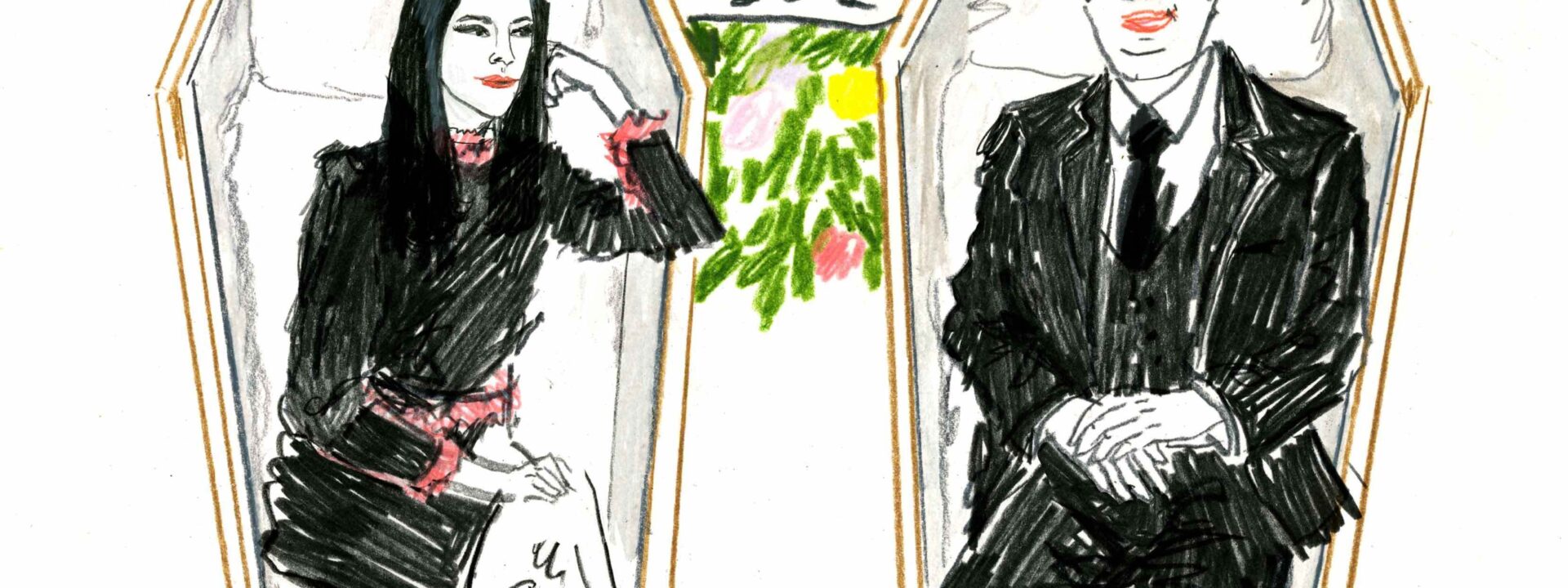
In 1948, Vogue published its 658-page Book of Etiquette, edited by Millicent Fenwick. It was full of how-tos, dos and don’ts, and the proper manners for all kinds of situations. But as Fenwick wrote in the introduction: “Etiquette is based on tradition, and yet it can change.” About 75 years later, Oh, Behave! is a new monthly Vogue column where experts weigh in on today’s ever-changing social rules.
Death has a way of turning even the most socially confident people into nervous wrecks. Suddenly, the rules that guide every other part of modern life disappear. Is black clothing required at a funeral? Is it okay to send a condolence text? And if you run into someone who’s grieving at a dinner party, should you mention their loss—or let them pretend, for one night, that nothing has changed?
For this month’s Oh, Behave!, Vogue talked to two New Yorkers with very different views on death. Bill Villanova is the president of Frank E. Campbell, Manhattan’s most famous funeral home, where everyone from Jackie Kennedy Onassis and John Lennon to Joan Rivers and Whitney Houston made their final stop. And Jill Kargman, who looks at death from a completely different angle. The novelist, essayist, and creator of Odd Mom Out has always loved a glam goth style—think Morticia Addams with more jokes—and recently wrote and starred in Influenced, now streaming on Apple TV, a satire of influencer culture and social performance. Her essay collection Sprinkle Glitter on My Grave, which explores life, death, and everything in between, is being turned into a film.
One believes pets are welcome at funerals. The other thinks wearing jeans to a funeral “is like giving the finger to the coffin.” Both agree you should definitely put your phone away at a funeral. Here, they answer Vogue’s biggest questions about mourning etiquette.
Vogue: Is the all-black funeral dress code non-negotiable?
Jill Kargman: For me, yes. I don’t judge people who don’t do it, but I wear black on a Tuesday if it’s 74 degrees out. So I’m definitely wearing it to your funeral. There’s actually a line in Moonstruck: “I’m wearing a red dress to your funeral.” I say that about my enemies. But maybe you could wear red-soled Louboutins and have a little red on their gravesite?
Bill Villanova: You can never go wrong with conservative attire for a funeral. If it’s a darker color like gray or blue, besides black, that’s certainly acceptable. Funerals and celebrations of life aren’t really the time to make a personal statement.
Is wearing jeans to a funeral ever acceptable?
Kargman: Ew. No. Denim is like saying “I dare you” to the corpse. What was that quote from Karl Lagerfeld? Sweatpants are a sign you’ve given up. Jeans at a funeral is like giving the finger to the coffin.
Villanova: I believe there’s a time and place for everything. If we were having a destination celebration of life on a ranch, jeans would obviously be more than appropriate. But I wouldn’t suggest jeans are suitable for a funeral in New York City.
Are logos—even on all-black—acceptable for funeral attire?
Kargman: I’m not a logo person in general. I feel like they should pay you to wear a huge logo. If it’s really subtle and small, maybe. But that’s true in general and at a funeral. I’m sure some corpses would love it if you showed up in a full fashionista look to honor them. But I just don’t think it’s a time for flash.
Villanova: Logos are everywhere, and funerals are no exception. Some designers are so iconic that their clothes and shoes are recognizable without a logo. Maybe less is more. I’d always avoid wearing something provocative to a funeral.
Should one think about modesty while mourning?
Kargman: I dress like George Washington, and I have EdwardianYou don’t have to wear a collar or anything formal, but you should put those cans away. You shouldn’t have cleavage next to a corpse.
Villanova: We always hope people make good choices and don’t turn the funeral into something about themselves. It should be about the person they’re there to honor. People should be cautious.
Is it practical or disrespectful to wear sunglasses indoors at a funeral?
Kargman: I don’t have an opinion on this—and I usually have strong opinions. I think some people wear sunglasses as a shield because they cry a lot. But I feel it’s important to be honest and show your grief. I personally wouldn’t hide behind glasses, but I wouldn’t judge someone who does.
Villanova: People don’t want to be seen crying. I wouldn’t wear sunglasses indoors. I’d want you to see my eyes, and I’d want to see yours. That’s appropriate and respectful.
What’s the etiquette for bringing children to funerals?
Kargman: My middle child, Ivy, is very morbid and was like a real-life Wednesday Addams. We went to our family cemetery in Queens in the pouring rain, and she said, “Why are all these flowers here? They’re all dead.” I said, “Well, people bring them when they’re alive. It’s life compared to death.” And she said, “When you die, I’m going to sprinkle glitter on your grave because you’re fabulous—and it’s very hard to clean up.” So now I actually want people to sprinkle glitter on my grave because she’s right. It’s impossible to clean up.
Villanova: Children know more than we think. As long as a child is old enough to ask questions and be curious, they can take part. I’ve talked to people in their twenties and thirties who say it’s their first funeral. Is it because no one in their family ever died, or because they were kept away and never allowed to be part of this important event? Funerals are something the whole family goes through together. I think it’s important.
Can you ever bring a pet to a funeral?
Kargman: If it’s the deceased’s dog, why not? But if it’s barking, I’m not sure that’s great for the mood. It depends on the pet. I mean, if you have an emotional-support hedgehog, maybe it could stay home.
Villanova: I’ve seen pets of the deceased come to services. I’ve seen dogs come in and lie down near the casket, paying their respects too. Sometimes they seemed more attentive and solemn than some of the people who came.
Is it rude to skip a funeral if you lost touch with the deceased but were once close?
Kargman: Not at all. I think funerals are for the living. If you’re not connected to the deceased’s family in any way, you can have a private moment of mourning for that person. You should always follow your own moral compass and intuition.
Villanova: There’s nothing better than seeing an old friend of the person who passed away come to the service. We lose touch with people all the time. If you lost touch with someone, it’s okay to go. It’s a sign of respect and love.
Can you attend the reception but not the service?
Kargman: Yes. I think especially in New York, people who go to Frank Campbell know that. There are shivas, celebrations of life, memorials—all kinds of ways to show grief. You do what you can and try to support people. But whatever you do, I think you should also write a condolence letter.
Villanova: There’s no reason you can’t. You might not be able to attend the service, but you can come to the reception. You made the effort to show up.
What’s the etiquette for being on your phone during a funeral?
Kargman: Absolutely no phones in a funeral home. Absolutely not. This is a time when it’s essential to disconnect and focus on the moment. It’s about honoring this person.You don’t want to be scrolling through pictures of the Kardashians, jewelry, laughing babies, or a show like Heated Rivalry while your deceased uncle is right in front of you.
Villanova: We remind people to silence their phones because the service isn’t about the person attending—it’s about the person they’re there to honor. If you need to take a call, step out of the area.
If you see someone who’s grieving out in public, is it better to mention their loss or let them have a night off from it?
Kargman: I always mention it. Otherwise, it becomes the elephant in the room. Even just a gentle squeeze on the arm and a simple, “Thinking of you. Glad to see you out. You’re so strong.” Something like that. When my dad died, some people never said anything, and it bothered me. It’s much nicer to acknowledge someone’s pain.
Villanova: A simple, gentle acknowledgment can be appropriate. Maybe a slightly longer hug. You don’t want to overdo it, but take social cues and read the room.
Can you still send flowers if the funeral announcement asks for donations instead?
Kargman: I do both. Lately, I’ve been sending a Diptyque tray with a candle and snuffer, so someone can light the candle each day and think of the person. Instead of flowers—which die and leave you with dead flowers reminding you of life’s fragility all over again—I tend to send that gift set.
Villanova: People send flowers out of habit. Sometimes they do both—make a donation and send flowers too. Any kind of expression matters. It’s a way of acknowledging the loss.
Are there any flowers that just shouldn’t be sent as condolences?
Kargman: I think ugly ones. Here’s my hot take: I hate orchids. They look like vaginas on stems, and there’s something cold about them. I also don’t like calla lilies—just not my taste. And of course, those penis plants—anthuriums. No thanks.
Villanova: I can’t say there’s an inappropriate flower. Sometimes people skip cut flowers and send a plant or a small tree that can be taken home and planted. Whatever the flower—whether it’s an orchid or a rose, muted or bright—connecting with the family is what matters.
Is there a time limit on sending condolences?
Kargman: Better late than never. Some people freeze up because they don’t know what to say, so they say nothing. Then months go by, and they feel guilty. It’s okay to write, “I’m sorry this is nine months late, but I didn’t know what to say.” Just be honest and human. You always remember who reached out. After my father passed, some people never contacted me. It’s not that they’re dead to me, but I’ve lost interest in them. The people who do reach out—you feel connected to them forever.
Villanova: No, there’s no expiration date. We all hear news at different times. Acknowledging it when you find out is appropriate. A condolence is always appropriate, no matter when.
Is it okay to send condolences by text, or does grief still require a phone call?
Kargman: No. I got a few texts, and both were from people I had written long condolence letters to, and it just felt weird. As a follow-up, you could say, “Thinking of you.” I personally use Highnote because it feels like a middle ground between a text and a physical letter. But I always send a letter.
Villanova: I still believe in phone calls. Family members will appreciate the call, even if they can’t answer right away. It’s meaningful. It’s not a text or an emoji. Make the call.
What’s the etiquette around posting funeral attendance on Instagram or social media?
Kargman: Oh my God, I didn’t even know people did that. I would never. It doesn’t seem like the right time or place for a quick snap.Taking selfies while wearing your black veil.
Villanova: Don’t take or post pictures of the person who died or their close family. They’re going through one of the hardest times in their lives. We shouldn’t turn someone else’s loss into content for our social media.
What’s the right way to post memorial photos of someone who has passed away?
Kargman: I’m all for it. I think it’s a beautiful way to remember them.
Villanova: If you’re posting out of love and genuine sadness, and sharing a nice memory, that can be totally fine. But ask yourself what you’re hoping to get out of it. Are you posting because you’re grieving—or because you want the death to be about you?
Is liking a memorial post on Instagram enough?
Kargman: No. I think you can like it and also leave a comment with your condolences. But if you’re close to the person, you should always write a letter. If you only know them through Instagram, then liking and commenting is probably enough.
Villanova: I don’t think that’s enough. Leave a thoughtful message. Share a memory. A broken-heart emoji is too simple. It feels too much like a transaction. We’re better than that.
What’s the right way to text someone on the anniversary of a death?
Kargman: I think it’s really thoughtful. That day is very hard for the person grieving, and a text is like an olive branch. When you’re unsure, always go with the thoughtful choice. If you feel like doing it, follow that instinct. It always helps a mourner feel a little better knowing someone remembers.
Villanova: Remembering the anniversary of someone’s death is a big deal. Any kind of acknowledgment means a lot. Remembering the person who died is a kind and loving thing to do.
Frequently Asked Questions
Here is a list of FAQs about the Vogue etiquette piece featuring Jill Kargman and the President of Frank E Campbell covering the dos and donts of death
BeginnerLevel Questions
1 What is this Vogue article actually about
Its a guide on how to behave respectfully when someone diescovering everything from what to say to a grieving friend to how to dress for a funeral
2 Why would Vogue write about death etiquette
Because manners dont stop when things get hard The article focuses on handling death with grace style and compassion which is a core part of social etiquette
3 Whats the number one do when a friend loses someone
Show up The biggest mistake is staying silent because youre afraid of saying the wrong thing A simple Im so sorry is perfect
4 Whats the biggest dont at a funeral
Dont use your phone No texting no photos and definitely no taking a call Its a time to be fully present
5 Is it okay to bring food to a grieving family
Yes but think practical Skip the casserole that needs to be returned in a specific dish Bring disposable containers gift cards for delivery or easytofreeze meals
IntermediateLevel Questions
6 What should I actually say to someone who is grieving
Avoid platitudes like Theyre in a better place or Everything happens for a reason Instead say something honest like I dont know what to say but Im here for you or share a specific happy memory of the person who died
7 Is a text message okay instead of a card
A handwritten note is still the gold standard A text is fine for a quick checkin but a card shows you took time and thought For very close friends a card is expected
8 What should I wear to a funeral in 2024
Black is still classic but its not mandatory Wear something dark respectful and modest The key is to be quiet in your clothingnothing flashy tight or attentiongrabbing
9 Should I go to the funeral if I wasnt close to the person who died
Yes