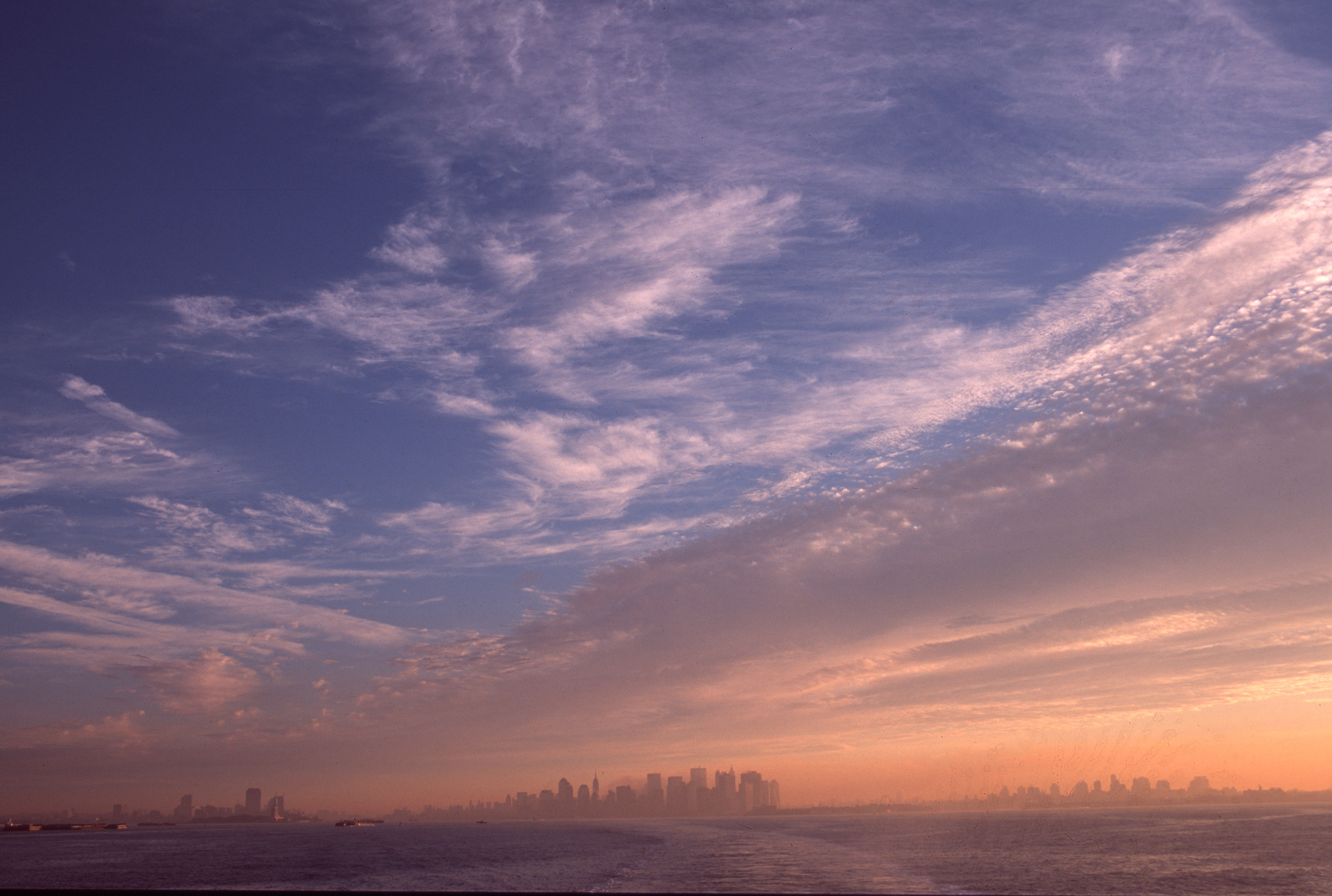
We lived in Northampton, Massachusetts. I had just started my second year as a visiting writer at Amherst College, and our first child, our daughter Livia, was only seven weeks old. September 11 was a Tuesday. I had no classes that day, and our first babysitter was supposed to arrive late in the morning to spend the day and get to know us. I woke before my husband, James, and before the baby—not early, since we had been up during the night—and went to the kitchen to make coffee. I turned on the radio, NPR. The local station often played music because it was cheaper than airing national shows, but they carried the 9 a.m. five-minute national news. The report said a “light aircraft” had crashed into the North Tower, which was unexpected because visibility was so good. They didn’t know more. But then the second plane hit while the news was still on air, and the five-minute newscast grew longer and longer. “Wake up, wake up,” I called to my husband as I ran back down the hallway to our bedroom. “Something terrible has happened.” Though we didn’t yet know exactly what had happened, we knew at once that it was monumental. By the time Argelia, our new babysitter, arrived, Livia was washed, dressed, and fed. At the back of our railroad apartment, the radio blared; at the front, in the living room, CNN ran the same footage over and over. Argelia sat in front of the television and wept. Her father had been killed in the Mexico City earthquake in 1985 when she was a child, and watching the footage, she relived that experience. James and I wept too, uncomprehending—the flames, the smoke, above all the people jumping. Those images remain seared in my mind: faced with the choice between the burning building and hurling themselves to certain death, they chose to jump. A pyrrhic choice, but a choice. We had just returned from New York the previous day. We had been there for our friends’ Sunday wedding, with the reception at an elegant club in Midtown. Livia wore a white dress with blue ribbons that my mother had saved from my infancy. She was very popular among the aspiring grandmas, who all wanted to hold her. The actor Sam Waterston, also a guest, amiably stroked her head. At one point James hastily changed her diaper on a table in a niche in the library, a transgression we laughed about afterward. After supper, we danced with Livia in our arms. The bride and groom beamed throughout, so happy. We were all young and full of hope. We drove home on the morning of Monday, September 10. After harrowing hours in front of the television—the third plane crash, in Pennsylvania; the towers falling, one after the other; the constant replays of the same horrifying footage; the pervasive chaos—we turned it off and went for a walk. Unaware of global events, Livia had grown restless, and so had our dachshund. Argelia, meanwhile, wanted to learn Livia’s routines; they would be alone together before long. Wandering the Northampton streets felt surreal: shops were shut, few people were outside, and the town was wrapped in an eerie calm. We were surrounded by the aggressively glorious blue sky, the brilliant sun, and birds singing, oblivious. September 11 was just the beginning. In the days after, nobody knew whether to expect more attacks, and if so, where they might come from. The murderous anthrax scare that began just a week later provoked such alarm that when mist came from the ceiling vents in our Amtrak car, we worried it might be lethal. Only weeks later, in December, the infamous Al-Qaeda shoe bomber tried to ignite his bomb-lined sneakers on board an American Airlines flight using matches; mercifully, the other passengers overwhelmed him. I had just brought out a book of novellas: The Hunters was published in early August when everyone was still on vacation, so my New York event was scheduled for Thursday, September 13. Needless to say, it was canceled. Like much of life at that time, all book events were canceled. At first it seemed there might never be book events again. It seemed, in the urgent, awful, inescapable presIn those days, it felt impossible to return to fiction; the form’s rambling, prosaic nature seemed like an indulgence we couldn’t afford. During national mourning, we instead read the New York Times’s Portraits of Grief with growing despair—endless columns of short obituaries for the victims of the attacks, published daily for three months. All the while, we longed for simpler times when sitcoms felt watchable. Poetry stepped in: only lyric poetry, it seemed, could truly capture the moment: “Defenceless under the night / Our world in stupor lies; / Yet, dotted everywhere, / Ironic points of light / Flash out…”
Before our daughter was born, I had been working on a new novel. Set in contemporary New York City, it followed a group of college friends starting their careers as journalists and writers. They were fictional, but their concerns somewhat mirrored my own and those of my friends. I struggled with the tone, which kept slipping into satire more sharply than I wanted. The characters were privileged, their ambitions often shallow, but I felt it was crucial to find compassion for them despite their flaws and mistakes.
After 9/11, I couldn’t bring myself to continue that book. For a month or two, I avoided writing entirely. I had plenty of excuses: the baby, teaching, the constant anxiety, the resulting exhaustion. Livia was opinionated from the start and refused a bottle, even of pumped milk. It was breast or nothing—she’d scream for hours rather than give in, which made teaching days difficult. Our new little family just kept going: “The first six months are tough,” my mother said about parenthood, “and then it gets easier.” But what about the world? What kind of world had we brought our child into? What had happened to us, who had felt so young and hopeful dancing at a wedding on September 9?
Around us, everything kept spinning, all stability suddenly unstable: our young program administrator and his wife abruptly moved to the San Juan Islands, thinking that if the world was going to end, that’s where they wanted to be. A childhood friend from Australia, a successful young lawyer living near Ground Zero, quit her apartment that day, never returned, and left for Hong Kong, abandoning all her belongings. Old friends surprisingly shifted politically to the right, suddenly becoming vocal patriots (though in time most, but not all, would shift back and deny their rightward turn). I read in the newspaper about someone who disappeared on 9/11—not because they died, but because they chose to vanish. They used the tragedy as cover, a way to escape the life they no longer wanted. Like a grain of sand in an oyster, that story stayed with me.
When I finally tried to write again, I started a historical novel set at the Clarke School in Northampton, the country’s oldest school for the deaf. Helen Keller was a student there in the 1890s. I planned to set my story just after World War II. I forget the exact premise, but it seemed distant enough from the present to feel manageable. Unfortunately, it also felt completely irrelevant. My husband, usually supportive in the early stages of my work, said it read like an after-school special. Grateful for his advice, and barely even sorry, I gave it up.
What then? How to move forward? A few months into this strange new world, after more hesitation, I picked up my abandoned manuscript. I saw my characters—Marina, Danielle, Julius—from a new perspective: the world had punished their entitled naivety, and now I felt an unforced, genuine compassion for them. Their pre-9/11 ambitions and desires were no less shallow, of course, but suddenly their smallness seemed touching rather than corrupt, and it stirred a tender nostalgia. Didn’t we all wish we could escape the darkness and return to gossip and frivolity? To know that for them—as foFor all of us, life’s heavy truths were waiting just ahead, making our privileges brief, limited, and doomed. When I imagined Marina’s cousin Bootie, arriving in New York City from upstate, full of ambition, seeing their world from the outside, wanting to join it and eventually wanting to destroy it—then I finally understood my characters and their conflicts. I threw out the incomplete first draft and started over from the beginning. I write by hand in graph paper notebooks: I began a new one—the book that became The Emperor’s Children—making slow progress in the small gaps between family and teaching. (The chapters in The Emperor’s Children are short for this practical reason.) Months passed slowly: By spring 2002, a fragile normality had taken hold in the wider world, like green shoots after a forest fire. My undergraduate students were deeply reassured by the rhythms of college life; they clung eagerly to routine and academic demands, which seemed solid compared to the flimsiness of everything we’d taken for granted. We too lived by routines, those of our baby and our dog: Baby Livia finally slept through the night; several times a day we took long walks with her in the BabyBjörn and our sturdy dachshund on a leash. Argelia, young, in love, and irresistibly hopeful, was by then expecting her own baby. As spring turned to summer, we prepared to leave Northampton for our permanent home in Washington, D.C., a city irrevocably changed in the meantime. Because it was inevitable, we all walked forward, step by step, into life, and over days, months, and years, a new version of “normality,” driven by the life force itself, spread and deepened, until that terrible time was relegated to memory. But much of what America and the world have suffered in this quarter century is inextricably intertwined with that history. In a matter of hours, the course of our lives was changed. The Emperor’s Children, I’ve always said, is a book about the time before, set in what proved to be the last months of a kind of privileged innocence. But it’s a novel I could only have written after 9/11 had taken place—after that innocent time, with its troubling carelessness about global society’s profound questions, had come to an abrupt end. A story demands an ending; significance only emerges then, and that ending can change our understanding of everything that’s come before. For my fictional characters, 9/11 brought the novel (almost) to a close. In life, however, our story is still being written, and the ultimate meaning of that dark chapter a quarter century ago, or of the one we’re now living through, won’t be fully understood for a long time.
Frequently Asked Questions
Here is a list of FAQs about the experience of starting a novel about the time before in the days after September 11
1 What does the time before mean in this context
It refers to the period in history prior to the September 11 attacks For many writers it represents a lost era of innocence or a specific cultural moment that felt fundamentally different from the post911 world
2 Why did the author start writing this novel specifically after 911
The attacks created a sharp dividing line in history Writing about the time before became a way to process the sudden change preserve the memory of that earlier era or explore the contrast between how things were and how they became
3 What is the main benefit of writing about a past era right after a major historical event
It provides immediate perspective The writer can capture the specific textures moods and assumptions of the pre911 world while the memory of that world is still fresh and the contrast with the present is painfully clear
4 Is this considered historical fiction
It can be If the novel is set in a specific identifiable past period and explores the social and cultural details of that time it fits the genre However it might also be literary fiction that simply uses the past as a setting
5 What is a common problem when writing about the time before after a traumatic event
A major problem is romanticizing the past It is easy to portray the pre911 era as a perfect innocent time which is rarely accurate The challenge is to show both its comforts and its flaws
6 How do you avoid making the before time seem boring compared to the dramatic after
Focus on the internal lives of the characters The drama of the before time comes from personal relationships small joys and everyday conflicts The lack of a massive historical event does not mean a lack of human stakes
7 Can you give an example of a practical tip for capturing the feeling of the time before
Use specific sensory details that are now obsolete or changed Think about the sound of a dialup modem the smell of a specific brand of cigarette or the way people used paper maps These small anchors make the era feel real