Words and images by Johanna Berghorn
Do the people who actually live in Cannes hate the festival? Last May, photographer Johanna Berghorn went to find out – without a plan, without her voice, and without a single word of French. She came back with a series of portraits of the people the cameras never point at.
I lost my voice on day one. Completely. Gone. I arrived in the evening, dinner was loud, I talked over too many people, and woke up the next morning with nothing. Not a great start to a festival where the plan was to photograph people and ask them questions.
It was my first Cannes after having my baby. I never actually stopped shooting, not for a second, but something shifts from the outside the moment you become a mother. She has a kid now, she’s probably not as available, probably not as into it. I had fewer bookings than usual, and I felt it.
A friend told me what friends tell you when they love you: do something for yourself. Make a personal project. You used to do that. She’d also just talked to someone who swore that the people who actually live in Cannes can’t stand the festival. Too loud, too much, in the way of everything. I had more time than usual. I had a question. And I had a strong urge to just shoot, the way I used to.
Documentary work is how I got into photography in the first place, and I hadn’t done anything like it in years. So with no voice and the French of a confused tourist, I typed a question into Google Translate and walked around Cannes holding up my phone like a little sign. The phone was going to do the talking either way.
I asked the man cleaning the streets, a taxi driver, the cook and the lifeguard from the Ritz Carlton. I asked the couple with their tiny tailoring shop, who get the stylists of huge stars walking in during the festival and barely sleep for three weeks and love every second of it. They made me stay and drink something with them, sent me off with gifts, and couldn’t quite believe someone had come for them and not the dresses. I asked a security woman on her break. I asked women who had come to the beach for the day and clearly weren’t going anywhere – settled in, dug in, watching the scene unfold like it had been staged for them. I asked three women on the beach with their dogs, dressed up for the occasion, picnic packed, who told me they do this every year just to come and watch.
I asked Francesca, who had picked this particular morning for her first swim of the year and dressed for it like the camera was already there. She talked in cinema, gestured in cinema, posed as if she’d been preparing for exactly this her whole life. Something about a former life as a ballerina, I think (my poor French couldn’t keep up with her fast one). But it didn’t matter anyway. She was clearly enjoying her very own Cannes moment.
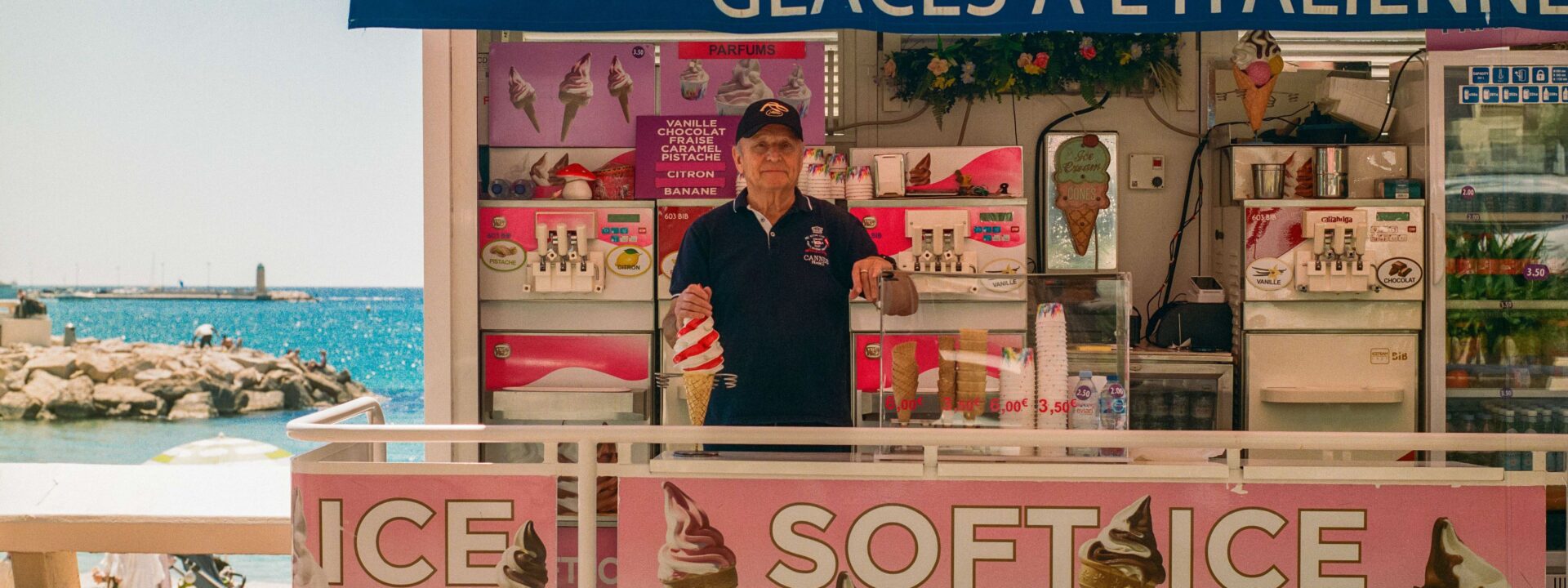
I asked François, the man selling soft serve from one of those little pointed huts along the Croisette, who I walked past every morning and ended up having a daily little chat with, which somehow became my favorite part of the trip. François has probably handed a coffee or an ice cream to half the people who’ve ever come to Cannes. He’s also, by far, the festival’s most devoted fan: day one he sent me away with a stack of brochures about the area, day two with an official merch cap. He felt like part of the whole thing. And he was.
I asked the flâneurs, of which there are many in Cannes during the festival, drifting up and down the Croisette with the kind of slow, deliberate walk of someone who very much hopes to be looked at, and who, you suspect, planned the outfit for exactly that. And I asked the ones who weren’t walking at all, who had claimed their spots along the Croisette, watching the spectacle unfold and quietly enjoying being part of it.
I expected the answer my friend’s friend had described. Nobody gave it to me. Every single person I spoke to loved the festival, was excited by it, and, above all, proud of it. The street cleaner, who didn’t want his face shown because he was on the clock, told me he likes what it brings.It brings something special to the city, and he feels proud to play his part in it. Jiyan, from the tailoring shop, was exhausted but glowing. He called it the busiest and most beautiful weeks of the year, proudly pulling up photos of last year’s red carpet dresses he had helped make. By the time I left Francesca, she was practically running her own premiere. And François, scooping soft serve from his little hut, was surely the proudest of them all.
I know twenty-five people isn’t a proper study. But the answer was the same every single time, and after a while, I stopped expecting anything different.
What I came back with wasn’t the answer. It was them. The ones working through the night so a dress is ready by 6 a.m. The ones sweeping the streets before the city wakes up. The ones scooping soft serve at the same little hut every morning. The ones who live there year-round, watching the whole circus arrive and leave, and somehow finding it wonderful.
The real stars of Cannes.
P.S. I got my voice back on the last day.
Frequently Asked Questions
Here is a list of FAQs based on the article The Real Stars of Cannes by Johanna Berghorn
BeginnerLevel Questions
Q What is The Real Stars of Cannes about
A Its an article that shifts the focus from Hollywood celebrities to the real hardworking people behind the scenes who make the Cannes Film Festival happensuch as projectionists drivers and caterers
Q Who is the author Johanna Berghorn
A She is a journalist who likely attended or reported from Cannes Her piece highlights the often invisible labor that supports the glitz and glamour of the festival
Q Why does the article call these workers the real stars
A Because without their skill and dedication the red carpets premieres and parties simply couldnt function They are essential yet rarely get recognized
IntermediateLevel Questions
Q What specific jobs does the article highlight
A The article typically focuses on roles like film projectionists chauffeurs and restaurant or catering staff
Q What is the main benefit of reading this article
A It gives you a deeper more human perspective on a major cultural event It helps you appreciate the teamwork and logistics behind a worldfamous festival rather than just seeing the celebrity photos
Q What is one common problem these workers face
A A lack of public recognition and respect They work incredibly long hours under immense pressure but the media and public often ignore their contributions entirely
Advanced Practical Questions
Q How does the article challenge the typical star narrative
A It reframes success and importance Instead of equating star power with fame and wealth it argues that true star power lies in reliability craftsmanship and the ability to make a massive event run smoothly
Q Can you give an example of a practical tip from the article
A The article implies a tip for event organizers always treat your support staff with dignity and gratitude A simple thank you or a fair wage can make a huge difference in morale and performance
Q What is the deeper lesson about work and recognition