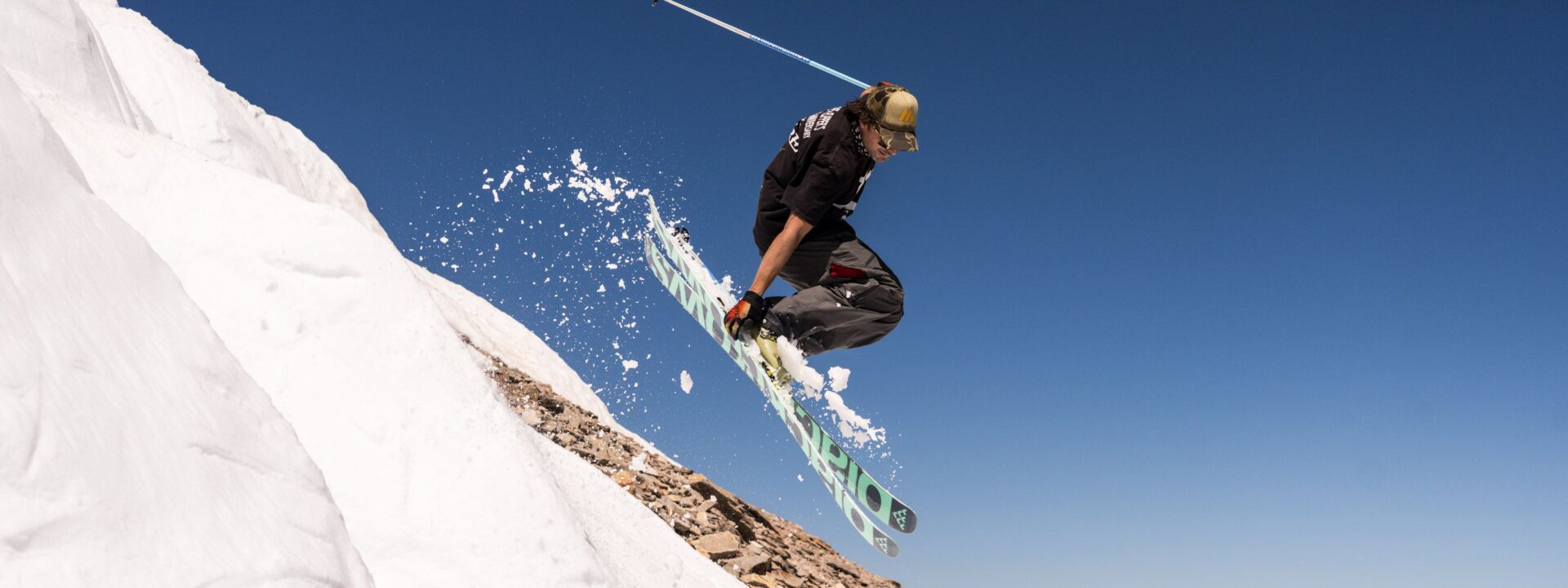
In May 2011, I drove five hours from Los Angeles to Mammoth Mountain by myself because no one I knew in LA wanted to ski. I had recently moved from New York. I work in fashion, so my life is all about deadlines, photo shoots, and special events. But skiing is my escape. It’s the thing that makes me feel most like myself, and I could do it more easily from Los Angeles than I could from New York. I just needed someone to do it with.
Someone in town recommended a restaurant called Novatos. It was one of those local spots where everyone seemed to know each other. I sat alone at the bar and ordered dinner. Three men were sitting next to me. One of them was named Bernie.
I wasn’t looking for a relationship. Honestly, I wasn’t even looking for romance. I mostly hoped to meet a local friend—someone who loved the mountains and might want to ski. Bernie drove snowcats for Mammoth Mountain. To skiers, snowcats are almost mythical. They’re the giant machines you see grooming the mountain at night, moving through the darkness under the lights. Before he left, he handed me his phone number. “Come back next season,” he said. “I’ll take you for a ride in the snowcat.”
Bernie was just someone who “belonged in the mountains.”
The next day, I texted him and asked if he wanted to ski. His response surprised me. “It looks cold,” he said. “I don’t ski if I have to wear a coat.” I remember thinking: What kind of mountain guy doesn’t ski if he has to wear a coat? I convinced him to meet me for a drink before I drove back to LA. We met at a place called Rafters. I was the only person there. When he walked in, he looked at me and said, “I didn’t remember what you looked like, but my friend said he would meet you, so I thought I would too.”
We had a drink. I drove home. End of story, or so I thought. The next day he called. “If you come back this weekend,” he said, “I’ll give you a lift ticket and cook you dinner.” You don’t have to ask a skier twice. The next weekend, we were riding a chairlift together when Bernie asked about my ski ability. I brushed him off. “I’ll be fine,” I said. Then he asked if I wanted to ski through the terrain park. I told him I didn’t ski jumps. A few minutes later, he casually skied into the park and started doing tricks. I remember staring at him. Wait. You’re that good? That was the moment I realized this wasn’t some fair-weather skier who avoided coats. This was someone who belonged in the mountains.
Not long after, Bernie left for Australia, where he spent northern summers chasing southern winters. When I dropped him at the airport, he looked at me and said, “Don’t find another mountain man.”
Five days later, I saw on Facebook that he seemed to have an Australian girlfriend. I figured that was that. For the next several years, our relationship lived in the background of our lives. We’d run into each other. My fashion career took me all over the world. Bernie’s skiing took him all over the world. Most of our conversations weren’t about romance. They were about where we’d been and where we were headed next.
Then, in 2014, I got a text. Bernie was coming to Los Angeles for a wedding. People from Mammoth often crashed at my place when they were in town, so I immediately responded. “You can stay with me.” At the time, I wasn’t even sure if he was bringing a girlfriend. A few phone calls later, we were catching up for hours. When I told him I was heading back to Mammoth that weekend, he suggested we meet up. This time, we were both single.
Because I was older than Bernie, I was unusually direct about what I wanted. Not long after we got together, I told him that I wanted a child. I wasn’t interested in being in a relationship just for the sake of it. If we were going to spend our time together, I wanted us to be moving toward something. I remember telling him that.I told him that if either of us ever felt like we didn’t see a future together, we needed to say so. Neither of us knew exactly where things were headed, but we both knew we were serious about each other. And I kept liking what I saw.
We ended up spending the next 11 years together. It wasn’t a typical relationship. Bernie lived in Mammoth. I lived in Los Angeles. For most people, a five-hour distance would have been a deal breaker. For us, it just worked. We never sat down and planned some unconventional arrangement. He had a career, a community, and a life in Mammoth. I had a career and a life in Los Angeles. Instead of forcing one of us to give up what we loved, we found a way to keep both.
One of the moments I knew I loved him came after a fight. We went to bed angry. The next morning, I apologized. “So am I,” he said. And that was it. The argument disappeared so completely that I honestly can’t remember what started it. We just moved on.
Sometimes I went to the mountains. Sometimes he came to the beach. Sometimes we traveled somewhere completely different. The funniest part is that Bernie apparently decided we were living together before I even knew it. One day we were standing in a surf shop in Venice when he casually called me his girlfriend. I remember thinking, Wait. Your girlfriend? Then he mentioned that he lived with his girlfriend. Again: Wait. You live with your girlfriend? He looked at me like I was the crazy one. Of course we lived together.
By 2018, we had a son, Alex.
If our relationship seemed unconventional, our parenting arrangement probably looked even more so. Alex lived mostly with me in Los Angeles and went to school there. But Bernie wasn’t a distant father. Not even close. Even when we were apart, he was still part of every day. Most evenings ended with a FaceTime call. We’d call after school, after sports, from the car, or before bed. As Alex got older, the two of them started playing Roblox together.
I handled school. Bernie handled the mountains. I signed up for basketball, baseball, soccer, camps, teachers, conferences, and schedules. Bernie taught Alex to ski, mountain bike, and camp. Our ski mornings reflected our personalities. Bernie would wake up early and get everything ready. I’d stay in bed and jokingly yell, “Is the coffee ready?” “Yes.” “Are the skis in the truck?” “Yes.” “Is Alex ready?” “Yes.” Only then would I finally get up. It became one of our family jokes. Bernie drove a giant Tundra loaded with gear. There were skis, bikes, snowmobiles, remote-control cars, camping equipment. There was always another reason to go outside. He was endlessly curious. He read constantly. He loved movies. He loved ideas. Sometimes he’d argue the opposite side of an issue just because he enjoyed the conversation.
On April 24, 2026, Bernie went skiing with friends. The week before, he had been talking about hiking Bloody Mountain, one of his favorite backcountry routes. Bernie was born with familial hypercholesterolemia, a genetic condition that causes dangerously high cholesterol levels. He managed it carefully. He took medication and exercised constantly. He lived healthier than almost anyone I knew. The night before his ski trip, he helped Alex with math homework. They talked about the next day. Everything felt normal.
The following afternoon, I got a text from one of Bernie’s closest friends. “Call me ASAP.” I knew immediately something was wrong. When you’re with someone who spends a lifetime skiing mountains and chasing adventure, you learn to recognize certain kinds of phone calls. I called. The first thing I asked was, “Is he alive?” The answer was no.
Bernie had a heart attack while climbing Bloody Mountain.He was skiing in the Rocky Mountains. His friends called for help. They did everything they could—search and rescue came, a helicopter arrived. But nothing changed the outcome. One moment he was skiing with friends. The next moment he was gone. He was 45 years old.
The hardest thing I’ve ever done was tell Alex. I picked him up from school. I brought his two favorite stuffed animals. I took him to a quiet stretch of beach we didn’t usually visit. I wanted that place to belong to itself—not to become forever tied to the worst moment of his life. When we sat down, he looked at me and asked if he was in trouble. I remember thinking how much I wished that was the problem. Instead, I had to tell him his father was gone. I told him that his dad’s heart gave out while he was doing something he loved. Alex kicked the sand.
The weeks that followed felt impossible. And yet, somehow, we kept going. Eventually, Alex and I went back to Mammoth. I was terrified—not of skiing, but of everything skiing stood for. For years, Bernie was the one who put on the boots, buckled the helmets, organized the gear, and led the way. I was afraid the mountain would feel empty without him. But something unexpected happened. Alex clipped into his skis and took off. We met up with some of Bernie’s closest friends—people who had known him for decades. By the third or fourth run, Alex looked back at me as if to say: I’m okay. You can go now. And he spent the rest of the day skiing with his father’s friends. Watching him disappear down the mountain was heartbreaking, but it was also one of the proudest moments of my life.
For Bernie, says Amber, “there was always another reason to get outside. He was endlessly curious. He read constantly. He loved movies. He loved ideas. Sometimes he’d argue the opposite side of an issue just because he enjoyed the conversation.”
Photo: Christian Pondella
A few weeks after Bernie died, I sat down with Alex and asked him what he wanted to do for Father’s Day—our first without him. He immediately started making a list. He wants to go to Hurricane Harbor. He wants to stay at Great Wolf Lodge. He wants to go to Disneyland. He wants to go to Japan. The list keeps growing. Every item on it sounds like an adventure.
Bernie would do something a hundred times until he got good at it. We called it “the montage.” The name came from the old ski films he made with his ski buddy roommates, and of course movies like Rocky and The Karate Kid, where the hero keeps trying something over and over until he finally gets it right. That was Bernie’s approach to almost everything. In the last couple of weeks, Alex decided he wanted to learn how to whistle. For days I kept hearing strange sounds around the house. At first I thought they were coming from a TV or a video game. Then I realized they were coming from him. He wasn’t just trying to whistle. He was practicing. Exactly the way his father would have. We’ve also started fishing. Neither of us really knows what we’re doing. We were out there for four days without catching a single fish, but Alex didn’t want to quit. Instead, he wanted to try different bait. Watching him, I started laughing. Bernie would have done exactly the same thing.
Amber Feld is a fashion publicist and consultant whose clients include Nick Fouquet, SPRWMN, Alice + Olivia, and Xirena.
Bernie and Alex together on June Mountain, California, January 1, 2021.
Photo: Christian Pondella
Frequently Asked Questions
Here is a list of FAQs about the concept of Dont Look for Another Mountain Man which typically refers to a mindset of avoiding the search for a perfect rugged or idealized partner and instead focusing on selfsufficiency or accepting reality
BeginnerLevel Questions
1 What does Dont Look for Another Mountain Man mean
Its a phrase that warns against chasing a fantasy partnerlike a rugged selfsufficient mountain man archetype Instead it encourages you to stop searching for someone to rescue you or complete you and focus on building your own strength and independence
2 Is this about actual mountains or camping
No its a metaphor The mountain man represents an idealized tough and selfreliant person The phrase is about relationships and personal growth not outdoor survival
3 Who would use this advice
Anyone who feels stuck in a cycle of looking for a perfect partner to fix their problemsespecially people in dating those recovering from a breakup or individuals who feel they need someone else to feel whole
4 Whats the main benefit of following this advice
You stop wasting energy on an unattainable ideal You become more selfsufficient confident and realistic about relationships which often leads to healthier connections when they do happen
5 Does this mean I should give up on finding love
No It means you should stop searching for a savior or a perfect archetype You can still want love but you approach it from a place of strength not desperation or fantasy
AdvancedLevel Questions
6 How is this different from just settling or giving up
Its the opposite of settling Settling means accepting less than you deserve out of fear This mindset is about letting go of a fantasy that doesnt exist so you can see real people clearlyand choose someone who is actually compatible not just a stereotype
7 What if Ive already found a partner who fits the mountain man ideal
Then the advice doesnt apply to you The phrase is specifically for people who are searching for a fantasy If you have a healthy real relationship you dont need to look anymore