This June, for Midsummer, traditional celebrations of the summer solstice across Europe included flower crowns, maypole dances, and people dressed in embroidered folk costumes. Around this time of year, the back-to-the-land look of peasant skirts, headscarves, and floral patterns often shows up in fashion. But now, a distinctly folk-inspired style is also making its way into home decor.
It blends the sweetness of delicate patterns with a hint of darkness rooted in ancient traditions and mythical stories. Think cottagecore, but with a slightly witchy edge. Picture hand-painted walls, vintage wooden furniture, intricate floral decorations, candlelight, and objects full of symbolism.
Midsummer celebrations have ancient roots and began as a pagan practice in Europe. Like many folk customs, they are deeply tied to nature and rural life. “All the pagan traditions in Europe were especially strong in farming communities,” says UK-based artist Cesca Dvorak, who creates home textiles inspired by her Polish heritage. Poland, she notes, is “really rich in its folk culture and customs.” Growing up, Dvorak spent a lot of time at her grandparents’ house, surrounded by Polish paintings and textiles. “As I’ve gotten older, I’ve leaned more into exploring the country’s traditions,” she says.
Photo: Emi O’Connell
Cesca Dvorak in her studio.
Photo: Emi O’Connell
Her Polish Folk Dance print—used on cushion covers and rugs—shows rows of simple figures in traditional dress, holding hands as if dancing in circles. The style is inspired by Polish papercutting, a craft that developed in farming communities where people used sheep shears as scissors to make home decorations. Using those shears, Dvorak says, led to “very bold and graphic types of decoration.”
Dvorak also features flowers, which appear in traditional Polish rugs, dance costumes, and painted house decorations. Both folk dancers and floral motifs are part of her latest collection of wool rugs, A Daze Without End, made in collaboration with London-based Shame Studios.
Rugs by Cesca Dvorak in her A Daze Without End exhibition in London.
Photo: Tung Walsh
Photo: Tung Walsh
Another element of traditional Polish folk design is the pająk, a handmade, colorful chandelier made of straw and paper, hung in homes to bring good luck. Polish artist Karolina Merska specializes in creating pająki and showed a striking maroon one at the recent exhibition “Honest Craftsmanship: The Impact of Polish Heartbeat” during Copenhagen’s 3 Days of Design.
Karolina Merska’s studio filled with pająki.
Photo: Ola O Smit
Utah-based interior designer Meta Coleman, meanwhile, draws on her Bavarian roots when decorating homes—from painted cabinets to traditional wooden heart-shaped cutout chairs and floral textiles. “My mom is German, and I spent my summers in Germany with my family. There’s a lot of folk art there—I grew up surrounded by it. To me, it feels like home.”
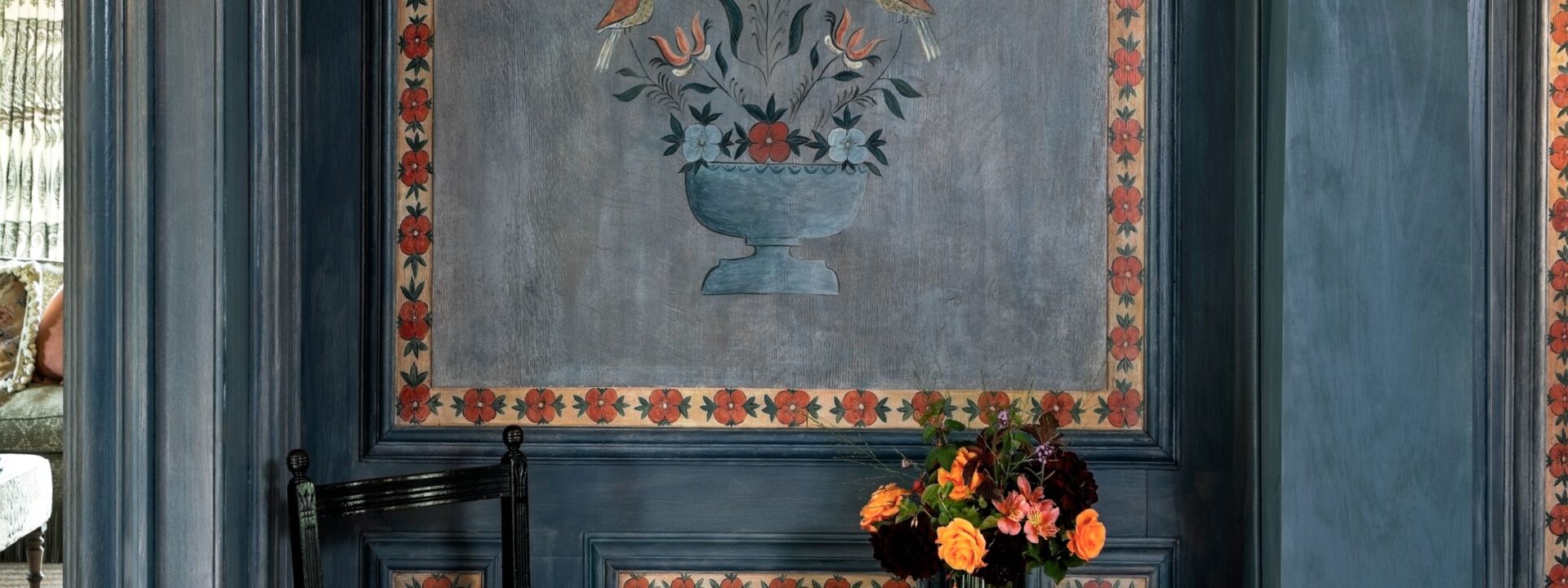
When designing her new studio, Coleman brought in these references through hand-painted walls with imagery inspired by vintage European fabrics—including flowers, animals, and figures in traditional folk dress.
Hand-painted walls and furniture are a key part of the folk aesthetic. British artist Tess Newall is known for her decorative, often floral murals. In a Swedish country house, she painted an oak-paneled entrance hall in a blue and red scheme inspired by Swedish folk painting, and referencing the wild poppies growing in the nearby woodlands.
A cabin bed painted by Tess Newall at Frampton Court.
Photo: Courtesy of Tess Newall
Newall also paints furniture, from cabin beds to dressers, to complete the look. And in the garden of her English country home, she transformed a 1920s wooden bowtop wagon—also called a vardo or gypsy wagon, traditionally used as homes by traveler communities in England—with intricate, richly painted flowers inspired by European folk patterns.
“Folk decoration is rooted in a sA strong sense of place and belonging, with cultural traditions and storytelling passed down through generations,” says Newall. “I love the humanity in it.”
Wallpaper designs by Tess Newall.
Photo: Courtesy of Tess Newall
Photo: Courtesy of Tess Newall
Elsewhere in the English countryside, twin sisters Liv and Dom Cave-Sutherland create decorative ceramics and homeware inspired by a mix of influences—from British church weathervanes to Eastern European peasant blouses. Their work is “almost always rooted in history and traditional craft,” says Liv. “Our inspirations often fall under the broad umbrella of folk art. We’re not especially interested in ‘high art.’ We believe the anonymous working-class craftspeople of the past deserve to be celebrated, and that folk art shouldn’t be stuck in the past.”
An ongoing collaboration with cult perfume brand Ffern—which released a custom scent for the pagan festival of Beltane in May—led the sisters to recently create a platter and an urn painted with decorations that symbolize the renewal of spring and Celtic fire festivals.
A ceramic plate by Liv & Dom for Ffern.
Photo: Leia Morrison
Pagan and folkloric symbols and imagery are central to the work of Laura Benson, an artist based in Birmingham, Alabama, who makes paintings, candleholders, and home objects. Her work is filled with animals, mythical creatures, castles, angels, and demons. Folklore, says Benson, “is rooted in the landscape—it shows up in the everyday rituals of life. Folk practices and stories came from small communities.”
Because her grandmother was interested in documenting the family tree and ancestry, Benson ended up researching ancient Irish culture and found she was “deeply drawn” to Irish folklore. “My first piece connected to folklore combined the story of the church grim—black hounds buried outside churches to protect against demonic forces—with the Celtic ritual of Beltane and the creation of a protective bonfire.”
Sceadwe candleholders by Laura Benson.
Photo: Courtesy of Laura Benson
Benson’s “Vegetable Lamb” sculpture tells the folktale of the Vegetable Lamb of Tartary, a mythical plant thought to grow sheep as its fruit. Meanwhile, her “Sceadwe” candleholders—the name comes from the Old English word for “shadow”—feature dark, winged demon figures. For her, these represent a “thin place,” which in Irish folklore is a threshold between the physical world and the “otherworld” of dreams or the afterlife.
Mythical and folkloric creatures appear in Petra Palumbo’s new tile collection, aptly named “Folklore.” The white tiles feature illustrations of centaurs, dragons, griffins, jackalopes, and the sea monster Kraken, among others. Palumbo is especially drawn to the “mysticism” of the Scottish Highlands, where she lives.
Jackalope tile design by Petra Palumbo.
Photo: Courtesy of Petra Palumbo
Centaur tile design by Petra Palumbo.
Photo: Courtesy of Petra Palumbo
Meanwhile, Tess Newall painted figures from folklore in a mural for a bathroom designed by Greco Deco at an Elizabethan manor house in southeast England. Alongside dragons and mermen, there is the Green Man—a foliage-covered character rooted in historic English folklore and celebrated by modern pagans, believed to symbolize seasonal renewal.
Meta Coleman insists that folk aesthetics are culturally specific and international, and they have to feel right for you and your home. “With the homes I design, I want each space to feel honest. So we make sure it’s inspired by where the client lives. If I have a project in New England, we might take some inspiration from folk art in New England.”
Meta Coleman’s studio at home.
Photo: Chaunte Vaughn
While there are many different versions of folk aesthetics, Coleman sees a common thread of “simplicity and honesty.” Historically, it often meant painting directly onto walls or inexpensive furniture just for the joy of decorating, she says. These days, it’s a way of “bringing personality back.”into your home.
With folk culture’s emphasis on natural materials, community, and a way of life tied to the land, it’s easy to see why this style feels more appealing than ever—especially as we deal with the overwhelming presence of AI and digital burnout. A folk-inspired interior feels like a place where emails can’t reach you. So no matter where you are in the world, it might be time to welcome a little nature and tradition through your door.
Frequently Asked Questions
Here is a list of FAQs about creating a home filled with folklore this summer
BeginnerLevel Questions
Q What does a home filled with folklore actually mean
A It means decorating and living with items colors and traditions inspired by folk tales myths and regional crafts Think handpainted pottery woven textiles nature motifs and items that tell a story
Q Is this just for people who live in the countryside
A Not at all You can bring folklore into any home even a city apartment Its about the style and feelinglike using a handknitted blanket displaying a carved wooden spoon or hanging a wreath of dried flowers
Q How is this different from cottagecore or rustic decor
A Folklore decor is more about specific cultural stories and symbols while cottagecore is a broader romanticized rural aesthetic Folklore often has deeper older meanings behind the patterns
Q What are some easy ways to start this summer
A Start small Add a few embroidered pillows a ceramic mug with a folk pattern or a garland of dried lavender and cornflowers You can also swap out your regular tablecloth for one with a traditional print
Advanced Questions
Q How can I incorporate folklore without making my home look like a museum or a theme park
A Focus on a few key highquality pieces rather than covering every surface Mix folk items with modern furniture Choose a consistent color paletteearthy reds deep blues and natural greensto tie everything together
Q What are the most common symbols in European folklore decor and what do they mean
A Common symbols include the Tree of Life the Sun the Rooster and the Spiral Flowers like the rose and the cornflower are also popular
Q Can I create folklore decor if I have no craft skills at all
A Absolutely You can buy authentic pieces from artisans online or at local markets You can also fake it creativelyfor example print out vintage