Imagine you’re a woman who gets things done: directing films, painting, running a business, raising children, advocating for human rights, working as a sound engineer, or cooking as a chef. You want clothing that carries you through the day in comfort and style—effortless, distinctive fashion that helps you define your taste and express who you are. If that sounds like you, you’re probably a Rachel Comey customer.
STAND BY YOUR WOMAN
Models Stephanie Cavalli and Mia Kwon in Comey’s new collection.
This year marks the brand’s 25th anniversary, making Rachel Comey something of a unicorn: a fully independent, woman-led label that has grown from a tiny, cult-followed business into a nimble empire. It now includes women’s daywear, denim, bags, shoes, jewelry, and more, with four stores in California and New York and a fifth opening soon on Christopher Street in Manhattan’s West Village. The new location will be more than just a shop; it will host rotating exhibitions curated by the arts nonprofit Soft Network, along with events for the brand’s book club and lecture series. While some labels sell a lifestyle, Rachel Comey assumes her clients already have one and want a wardrobe as dynamic and creative as they are. “She makes us look like interesting women doing interesting things,” says fan Zadie Smith. This approach has proven successful. Since founder and designer Comey made her cautious New York Fashion Week debut just days before 9/11, many trendier local labels have come and gone. But Comey has thrived, honing her unique jolie laide aesthetic with its unconventional colors, silhouettes, and emphasis on texture. She understands her customer and has stayed in tune with her clientele as the brand has grown. Today, amid a sea of quiet luxury lookalikes, she feels more one-of-a-kind than ever.
DENIM DIARIES
Mia Kwon in Rachel Comey.
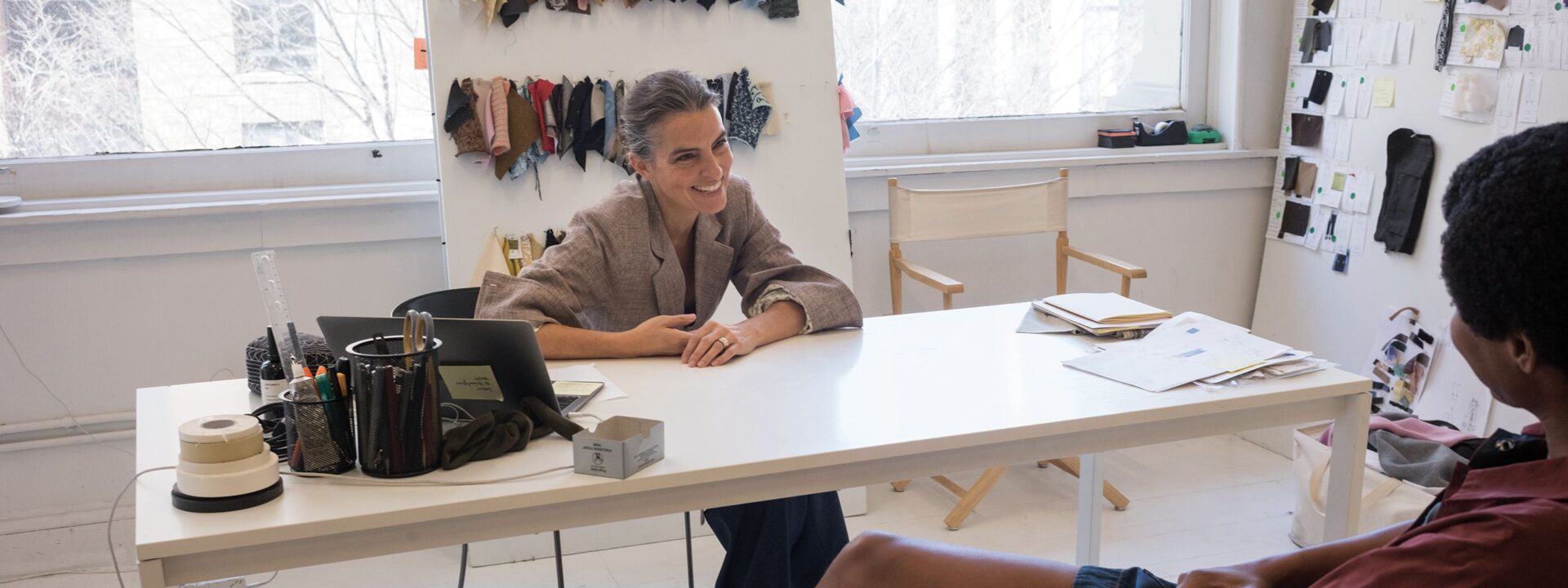
“I do wonder now if it’s better that I never had a ‘moment’ early on,” reflects Comey. We’re at her studio in NoHo, a hive of activity: downstairs, a styling session for the fall 2026 collection; up here on the fourth floor, nearly every inch is filled with patternmakers, fabric bolts, designers bustling about, and racks upon racks of clothes. It’s still a hands-on operation. Comey, 53, has been reminiscing about her even scrappier early years launching the brand. Raised in Connecticut, she studied art at the University of Vermont before trying her hand at various roles—working at a gallery, set design, styling. In New York City, she moved in bohemian circles that allowed for creative experimentation. With no formal fashion training (and not much informal either), she decided to produce a line of shirts. Initially, Rachel Comey was a men’s brand; but as Comey shifted debt between credit cards and juggled day jobs, that changed. (One early gig was creating mood boards for Louise Trotter, now at Bottega Veneta, when Trotter led womenswear at Gap.) “Six years—then we turned a profit,” Comey says. “After that, we started to grow, slowly. But that way, I got to learn.”
“Her sense of clothes as a way to showcase a woman’s identity, rather than dictate it—that felt radical,” notes Jen Mankins, whose beloved Brooklyn boutique, Bird, was among the first to carry Rachel Comey. “It just felt smart.”
Model Birgitt Doss in Rachel Comey.
“You know you can always sell something like a nice navy sweater. But if you want to throw something more experimental into the mix, that’s still Rachel,” says Laura Reilly, founder of the fashion Substack “Magasin.” She adds that a whole new generation of Comey fans has emerged online—and what they find in the brand isn’t so different from whatRachel Comey’s original Gen X customers are charmed by her enduring style. “The way she’s held on to that sense of style without it ever feeling dated is truly remarkable. Novelty is so expected and demanded now, but she just stays true to her vision.”
Comey has often been ahead of the curve. She was early in featuring women of varying shapes on her runway, and her commitment to using models of a certain age is long-standing. For example, before 40-something Stephanie Cavalli opened Matthieu Blazy’s debut Chanel couture show, she was modeling for Rachel Comey.
Casting is just one example of how Comey has navigated the shifting terrain of 21st-century fashion largely on her own terms. She’s unpredictable in her choice of collaborators—like octogenarian artist Joan Jonas—and she pops on and off the Fashion Week calendar. When she does present, her events often feel like happenings.
Comey recalls her decision in 2013 to scrap a catwalk show in favor of an intimate supper-club-style presentation in Brooklyn’s hard-to-reach Red Hook neighborhood, despite PR advisors warning, “You cannot leave Manhattan, and you can’t do a dinner—people are too busy.” A seat at a Rachel Comey dinner—complete with cabaret from Justin Vivian Bond or Tracee Ellis Ross as emcee—became a coveted invite, not only for fashion insiders. You might find yourself seated across from Cindy Sherman, Debbie Harry, Maggie Gyllenhaal, or Zadie Smith. “We can get so siloed off—fashion over here, writers over there—I thought it would be interesting to let people mingle,” Comey explains. Some guests were friends; others were artists she admired and simply cold-called, operating on the idea that if you feel connected to someone’s work, chances are the feeling is mutual. Zadie Smith attests to this: “When I get dressed, my first priority is not to look sexy or pretty or skinny or young—I want to look cool. And to me, Rachel’s clothes are a shortcut to that. They’re clothes for me to enjoy.”
Women designers often get criticized for being too practical, too focused on features like pockets to conjure any fantasy. The Rachel Comey brand rebuts this claim. Not that the designer doesn’t prioritize functionality. One reason she sees the 2014 opening of her first store in Manhattan’s SoHo as a milestone is that it allowed her to better understand her clientele. “Seeing customers shopping in real-time, getting the sales reports… It was mind-blowing,” she says. “Who is she? Where is she going? What is she doing? What does she need? How do I problem-solve for that—if she has to give a speech and she’s standing a long time—what are those shoes?”
“But at the same time, I was also putting the pieces together in terms of where I wanted to go with the aesthetic,” Comey continues. “Part of my job, on top of problem-solving, is to offer propositions that are surprising and delightful—a sharper shoulder, or a fabric that’s a little bit of a challenge, something ‘off’ in some way. Try this.”
Walk into the Rachel Comey store in SoHo and you will not encounter a utilitarian wardrobe, but rather an audacious sense of color, pattern, form, and texture. In her early years in New York, Comey also dabbled in costume design, and her collections retain a touch of theatricality—she’s not afraid of a dramatic flourish, and her clothes seem to be waiting for a strong character to step into them. This is a type of aspirational fashion. Smith mentioned a particular black sweatshirt.She owns it; she says she puts it on almost every day, and in doing so, turns into “somebody who looks like they might be up to something interesting.” That’s the vision Rachel Comey sells: You are the woman you dream of being.
Styled by Rei Kawauchi for hair and Romy Soleimani for makeup.
Produced by Ian Crane.
Frequently Asked Questions
Of course Here is a list of FAQs about Rachel Comeys label and its 25th anniversary designed to sound like questions from real customers and fashion enthusiasts
About Rachel Comey Empire Builder
Q Wait Im confused Is the brand called Rachel Comey or Empire Builder
A The official name of the fashion label is Rachel Comey Empire Builder is the name of the celebratory collection and campaign she released for her 25th anniversary Its a theme not a rebrand
Q Whats the big deal about her 25th anniversary
A Staying independent and artistically driven in the fastpaced fashion industry for 25 years is a huge achievement It highlights her commitment to her unique vision quality and building a direct relationship with her community without being part of a large conglomerate
Q What does fiercely independent actually mean for a fashion label
A It means Rachel Comey owns and controls her company She isnt answerable to outside investors or a parent corporation which allows her to make creative decisions based on her vision and values rather than just sales targets She sets her own production pace and retail strategy
The Empire Builder Collection Aesthetic
Q What does Empire Builder refer to
A Its a metaphor It celebrates the empire she has builtnot of stores but of ideas a loyal customer base and a distinct creative world over 25 years The collection features themes of travel utility and pieces designed to last
Q What kind of clothes does Rachel Comey design
A Shes known for intelligent playful and slightly unconventional designs Think architectural silhouettes unique prints interesting textiles and clothes that balance artistry with wearability Its fashion for creative independentminded people
Q Can you give an example of a signature piece
A Absolutely Her sidezip pants and pintuck blouses are iconic Her clogs and blockheel shoes are also hugely popular and have a cult following for their comfort and distinctive style
Shopping Practicalities
Q Where can I buy Rachel Comey clothes