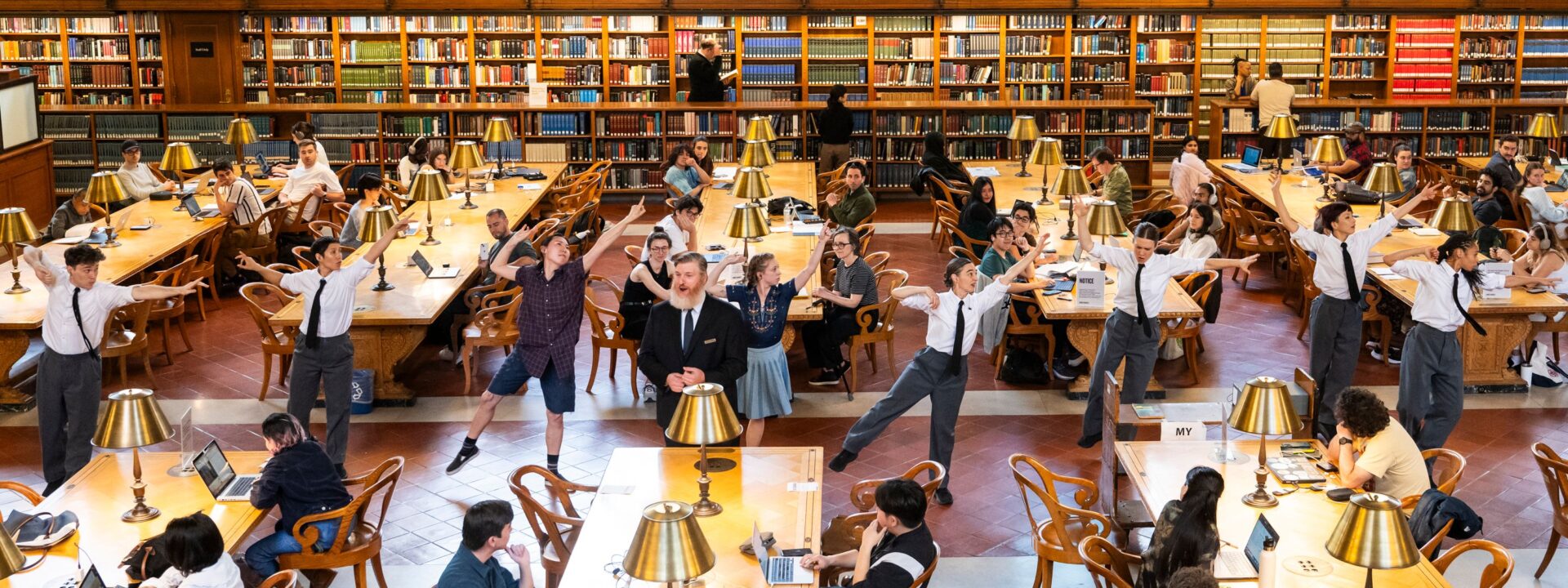
I’m crying in the majestic Rose Reading Room at the New York Public Library.
It’s a busy weekday afternoon, and an imposing bearded man is singing “people who need people are the luckiest people in the world” in a booming voice. It bounces off the ornate, gilded ceilings 52 feet above, echoing down the showstopper of a room that stretches for two city blocks. Every face in the nearly full room is turned toward him, yet no one is shushing him or frantically calling security. It’s a song that, until this moment, meant nothing to me—a self-described misanthrope—and now I can’t stop crying.
This is part of Lunch Dances, an extraordinary live performance choreographed by Monica Bill Barnes and written by Robbie Saenz de Viteri. It roams throughout the stately Stephen A. Schwarzman Building of the New York Public Library, transforming it into a site of unexpected connection. After an acclaimed, sold-out run last year, the free, hourlong lunchtime show—embodying Monica Bill Barnes & Company’s mission, since 2013, to “bring dance where it doesn’t belong”—has returned for just a few weeks this month and next. (The March performances are sold out, but tickets for April will be released in the coming weeks; I recommend signing up for the company’s mailing list for updates. Also worth noting: two lucky standby attendees were allowed to join the group.)
Drawing its title from Frank O’Hara’s Lunch Poems, a 1964 collection famously written during the poet’s lunch breaks at the Museum of Modern Art, the performance showcases the breadth of the library’s research collections. It weaves materials from its vast holdings and building lore into a profoundly moving hour of stories about fictional library patrons. It’s nothing short of a slice of magic in the heart of Midtown in the middle of the workday.
Here’s how it works: About 15 of us follow the lithe, smiling, silent Barnes—who plays a library page delivering materials to researchers—while wearing wireless headphones that let us hear the narrator and the music. (Think of a silent disco, but with others doing all the dancing.) The narrator, the dapper Saenz de Viteri, tells the story and gives directions while pushing a rolling cart with a small console of knobs and buttons. We all weave around actual library visitors, including many tourists (who seem understandably more confused than anyone). Signs in each room alert patrons to possible distractions during specific performance times, and staff ensure foot traffic doesn’t impede the show—but once people see the dancing, they quickly step aside and start watching themselves.
The performances meditate on love, joy, sadness, grief, and disappointment, revealing a deep undercurrent of longing within the often isolating act of research. Because, as the show asks, where else in New York can you find so many people quietly searching for something in one building? As the narrator puts it, “People come to the library because they have a question.”
In the map room, we are introduced to Nell, hunched over a 1961 map of Greenwich Village. With her fingers, she traces the streets; we’re told how they come alive in her memories. Here, she can still walk by the businesses she grew up with, even though they’re long gone and an illness has left her unable to use her legs. “Hands up if you know what it’s like to have your life cut in half,” the narrator says.
Barnes moves with sly, elastic precision—half librarian’s efficiency, half vaudevillian wink—sliding between tables, flicking her wrists, and letting small, buoyant steps bloom suddenly into full-bodied sweeps of motion. Her company’s dancers mirror that playful but exacting style, bursting forth in often very tight spaces. Together with the wry, poignant narration,In ordinary moments, simple gestures become quietly powerful theater. The audience also becomes part of the performance. At one point, we walk quickly down a main hallway on the first floor, hands raised, earning curious glances from passersby—a small crowd of us, wearing headphones, rushing through the New York Public Library with exhilarated, joyful faces. (Full disclosure: Ten years ago, I worked part-time as a marketing copywriter for the library; during the show, you might pass the informational signs I wrote for each collection room.)
The reactions of those who accidentally cross paths with the performance add to the experience as well. In a long hallway, two people deep in lively conversation notice the dancing, then quickly gather their things and hurry into a side room. Others who unintentionally find themselves part of the scene stand awkwardly, watching us watch them. Many—seasoned, unflappable, busy New Yorkers—make a point of not watching, or pretend not to, holding out as long as they can before finally pulling out a phone. (We in the audience, however, are politely asked to keep our phones away.)
All these surprises, and the blurring of performance and reality, start to change how you see everything. In one room, I become convinced that an entire table of people—what seems to me a perfectly cast group of typical New Yorkers—are part of the show. A woman helping a child with homework, others looking at e-readers, watching videos, taking notes, typing on laptops, earbuds in. I’m sure they’ll all stand up at some point and join the performance.
It turns out they aren’t part of the act. But then again—aren’t we all? And shouldn’t we join in?
Frequently Asked Questions
Of course Here is a list of FAQs about the Lunch Dances event series at the New York Public Library designed to sound like questions from real attendees
General Information
Q What exactly are the Lunch Dances at the NYPL
A They are free midday dance events held in iconic library spaces A DJ plays music and people are invited to dance move or just enjoy the atmosphere during their lunch break
Q Is this a performance I watch or do I actually dance
A You dance Its a participatory event not a staged show The library becomes a stage for you
Q Where in the library does this happen
A Its typically held in the stunning Rose Main Reading Room or the majestic Astor Hall transforming these usually quiet spaces
Q When are these dances held
A They are usually scheduled on select weekdays around lunchtime Check the NYPL website or events calendar for specific dates
Practical Details
Q Is it really free Do I need a ticket
A Yes its free and open to the public Some events may require a free ticket for crowd management which you can reserve online in advance
Q What should I wear
A Wear whatever youre comfortable moving in Most people come in their work or everyday clothes The focus is on fun not fashion
Q Do I need to bring a partner or know how to dance
A Not at all You can come alone with friends or with coworkers There are no steps to learnjust move to the music however you like
Q Can I bring my lunch
A You cant eat in the dance areas but you can enjoy your lunch elsewhere in the library before or after dancing
Experience Atmosphere
Q Im shy Is it okay if I just watch
A Absolutely Many people stand at the edges and soak in the incredible sight of a library turned dance floor Youre welcome to participate at your own comfort level
Q What kind of music do they play
A It varies by event but its generally upbeat accessible music from different eras and genres