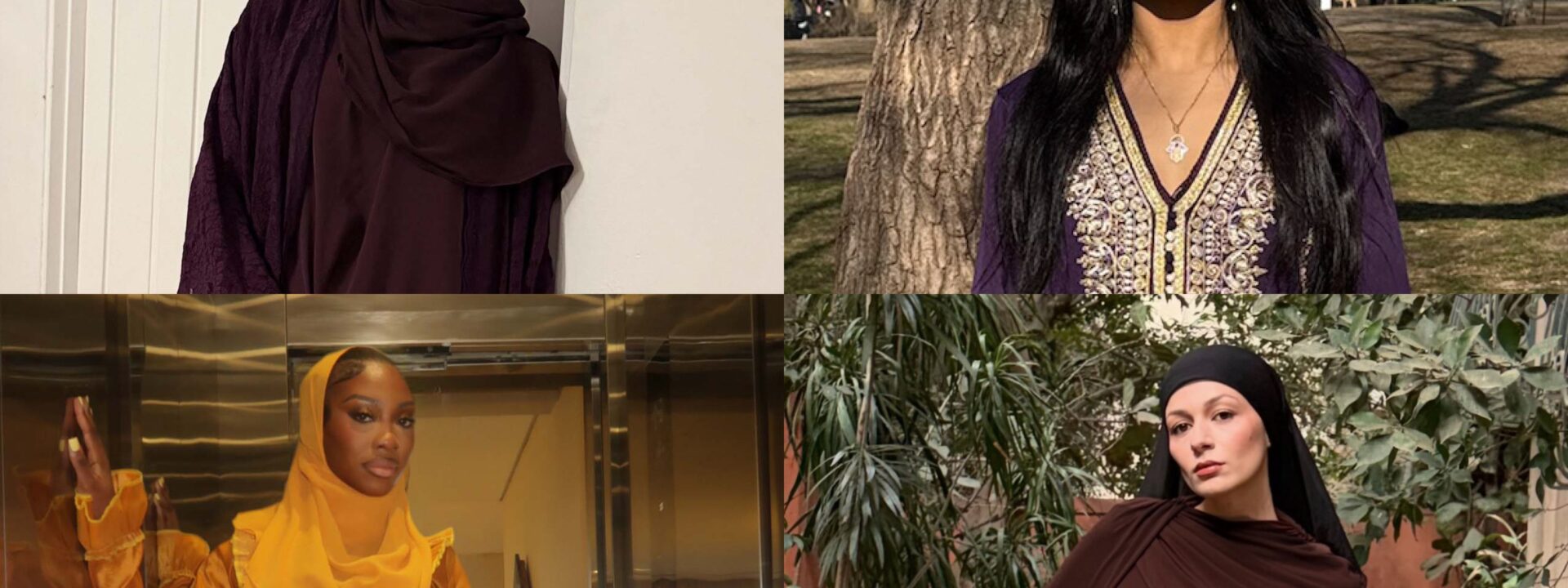
The rituals of getting dressed can feel almost sacred—quiet, repeated gestures that mirror the structure and intention of religious practice. It’s a private ceremony, a prelude to the public one.
In Islam, the connection between adornment and devotion is clear. On Eid, which marks the end of Ramadan’s month of fasting, Muslims follow the teaching of Prophet Muhammad to wear their best clothes. This isn’t just about appearance—it’s about embodying purity, gratitude, and dignity. Here, cleanliness and beauty are outward signs of the inner transformation that takes place over Ramadan.
Last Eid, I dressed with Islam’s spiritual vocabulary in mind. I wore a maroon abaya with a pomegranate motif—a fruit mentioned in the Qur’an as a symbol of abundance and closeness to Jannah—along with a matching hijab. (For contrast, I paired it with Maison Margiela Tabi boots.) My clothing felt more than customary; the fabric, color, and symbolism connected me more deeply to the day’s meaning.
That feeling was shared by four stylish Muslims I spoke to recently. For each of them, dressing for Eid was not about vanity, but an expression of recognition, joy, and fulfillment. Here, they share their fashion philosophies and Eid traditions.
Noor Elkhaldi
Edited in Tezza with: Cocoa
Photo: Courtesy of Noor Elkhaldi
I have a very large immediate family, so my favorite part of Eid is whenever we can all be together. It’s Sunnah to wear your best clothes, so I try to choose something that reflects that. I also make sure I’m freshly showered and smell nice.
This year, I’m wearing a long, rich brown dress by Khanum’s with a draped overlay across the chest and down one arm, a black crinkle chiffon hijab from Vela Scarves, and a sage green Prada Cleo shoulder bag (which I “borrowed” from my sister). I’ll also have on my favorite Coperni platforms—they probably won’t show much, but I need the height, and they’re surprisingly comfortable for six-inch heels.
Abayas have always been around, but they’ve really had a moment these past few years, and I love to see it. My favorite look, though, was in 2022, when I wore a Palestinian thobe my sister brought me from Gaza, where my family is from. It felt special to wear something from my homeland.
Lately, I’ve become a procrastinator—I don’t start thinking about my outfit until a few days before Eid, sometimes even the night before. Once I decide on the outfit, I move on to the hijab, shoes, bag, and jewelry. I don’t overthink makeup; I usually keep it simple unless I have extra time, which I rarely do since I’m almost always running late on Eid.
Tia Adeola
Edited with PrettyUp
Photo: Courtesy of Tia Adeola
This is actually my first Eid observing Ramadan again since I was about 13, which makes this year feel especially meaningful. Growing up, Eid was always a big moment in my family. My mum would dress my sister and me in full Nigerian attire: iro, buba, gele, with a hijab layered over it. Looking back at those photos now, there’s something beautiful about that blend of culture and faith.
Some of my favorite memories are just the feeling of togetherness—getting ready as a family, the morning excitement, and the sense of occasion. There was always so much intention in how we dressed and showed up for the day, and that’s something I’ve carried with me.
Growing up, my mum dressed my sister and me for Eid, so this year feels especially meaningful—being able to choose my own look, not just as an adult, but as a designer whose world revolves around dressing and storytelling through clothing. This year, I started with—I started with the outfit and built everything around it. I considered how the silhouette of my dress worked with my hijab, then added jewelry and glam in a way that felt cohesive yet effortless. It’s less about being overly styled and more about feeling aligned, comfortable, and present for the day.
This Eid, I’ll be wearing a more modest Tia Adeola dress with soft ruffles and a sculpted silhouette. The neckline is lower, but I’ll style it with a hijab that drapes to offer coverage while still letting the design shine. A hijab is always my Eid essential, especially when praying with my family or at the mosque—it becomes more than just a styling choice. As a designer, it was important for me to feel aligned with both my faith and my creative identity, finding a balance where modesty doesn’t limit expression but enhances it.
I’ve noticed a beautiful evolution in abayas over the past few years. When I went to the mosque as a child in Nigeria, they were often very understated. Now, there’s so much more exploration—color, embroidery, structure, even subtle waist definition. It’s been exciting to see modest fashion expand this way, offering more versatility and individuality while still honoring tradition and modesty.
Eid mornings have always been about my siblings. When we all lived together, it was a joyful chaos of waking each other up (none of us are morning people) and the smell of my dad making coffee. Even now that we’re older and living on our own, we’ve kept that tradition. My siblings sleep over the night before Eid so we can share those moments together. Each of my siblings is their own person, and this is one of the few days of the year when, with my parents, we move completely as a unit. Seeing them all walk through New York in their best traditional outfits brings me so much joy. Praying in Washington Square Park is always my favorite Eid memory: the vibration of everyone peacefully praying together, the sound of birds flying overhead, and the city waking up around us. It feels surreal.
When it comes to getting ready, I’m not a planner, but I usually choose my Eid outfit at least the day before. From the jewelry to the belt to the layers of the kaftan, there are several elements that require more thought than an everyday outfit. I always start with the color of my dress and build the look from there.
I think this year might be my best: I’m wearing an Algerian kaftan from my parents’ hometown, Oran; my grandmother’s jewels—her Hand of Fatima necklace is something I wear almost daily, but on Eid I choose a larger, more ceremonial version—and plenty of black kohl around my eyes. I love honoring my ancestors on this day. One of my great-grandmothers had long, black hair and always wore heavily kohl-lined eyes, both as a beauty ritual and a form of protection, while the other always wore bold, colorful dresses and big jewels. This look feels like a conversation between the two of them.
What I continue to notice most about Eid outfits is a sense of timelessness. They never feel too trendy—more like a moment of sharing heritage and culture through style. Every Muslim in New York seems to do that in their own distinctive way, and that’s part of the beauty of this city.
This year, I actually ordered my abaya earlier in Ramadan, which was a nice change from the last two Eids. I think I prefer planning ahead to avoid the chaos and closet explosion that comes with last-minute decisions. I always decide on the outfit first, then add makeup and jewelry last.
This Eid, I’m wearing an RS Archive purple lace abaya and underdress, layered over a vintage Prada spring 1996 skirt, Fanci Club boots, and a Margiela bag. For my hijab, I’m wearing a Vela scarf in the shade Deep Berry.Honestly, I don’t usually go for an abaya as my Eid outfit, but when I saw this particular shade of purple, I knew I had to have it. It was perfect because I wanted something simple, and a matching abaya set is just that. Of course, I had to add my own touch—I’m a little extra like that—so I brought in a pop of green with the skirt and boots to make it feel more like me.
I’ve really noticed and loved the trend of wearing cultural outfits; a few Eids back, I wore a traditional Palestinian thobe. I truly enjoy seeing people from all cultures dressed in their own traditional wear—there’s something really special about it. I’d love to put together a Puerto Rican look for a future Eid.
Frequently Asked Questions
Of course Here is a list of FAQs about Four Fashionable Muslims Share Their Eid Outfits designed to sound like questions from real readers
General Beginner Questions
Q What is Eid and why do people dress up for it
A Eid is a major Islamic holiday marking the end of Ramadan or Hajj Dressing in new or special clothes is a tradition that signifies celebration gratitude and joy for the occasion
Q Do you have to wear traditional cultural clothes for Eid
A Not at all While many wear clothes from their cultural heritage modern Eid fashion is incredibly diverse The key is to wear something special modest and that makes you feel festive
Q What does modest fashion mean for Eid outfits
A Modest fashion generally means clothing that covers the body in a loose nonrevealing way For many Muslims this includes long sleeves hemlines at least to the knees or ankles and higher necklines Its about expressing style while adhering to personal faith principles
Q Where can I find inspiration for Eid outfits
A Look everywhere Social media Muslim fashion bloggers and influencers online boutiques specializing in modest wear and even mainstream stores The article featuring four different people is a perfect example of diverse inspiration
Style Shopping Questions
Q Im on a budget How can I put together a great Eid outfit without spending a lot
A Focus on one statement piece like a beautiful embroidered top or a fancy hijab and pair it with simpler existing items in your wardrobe Accessorize with jewelry or a nice bag Also shop sales after Eid for the next year
Q Can men be fashionable for Eid too
A Absolutely Mens Eid fashion can include tailored kurta sets wellfitted thobes in modern colors or fabrics stylish kufis and sharp coordinated outfits Grooming and goodfitting clothes make a big difference
Q How do I choose colors for Eid
A Theres no rule Many opt for bright celebratory colors like emerald green royal blue or gold