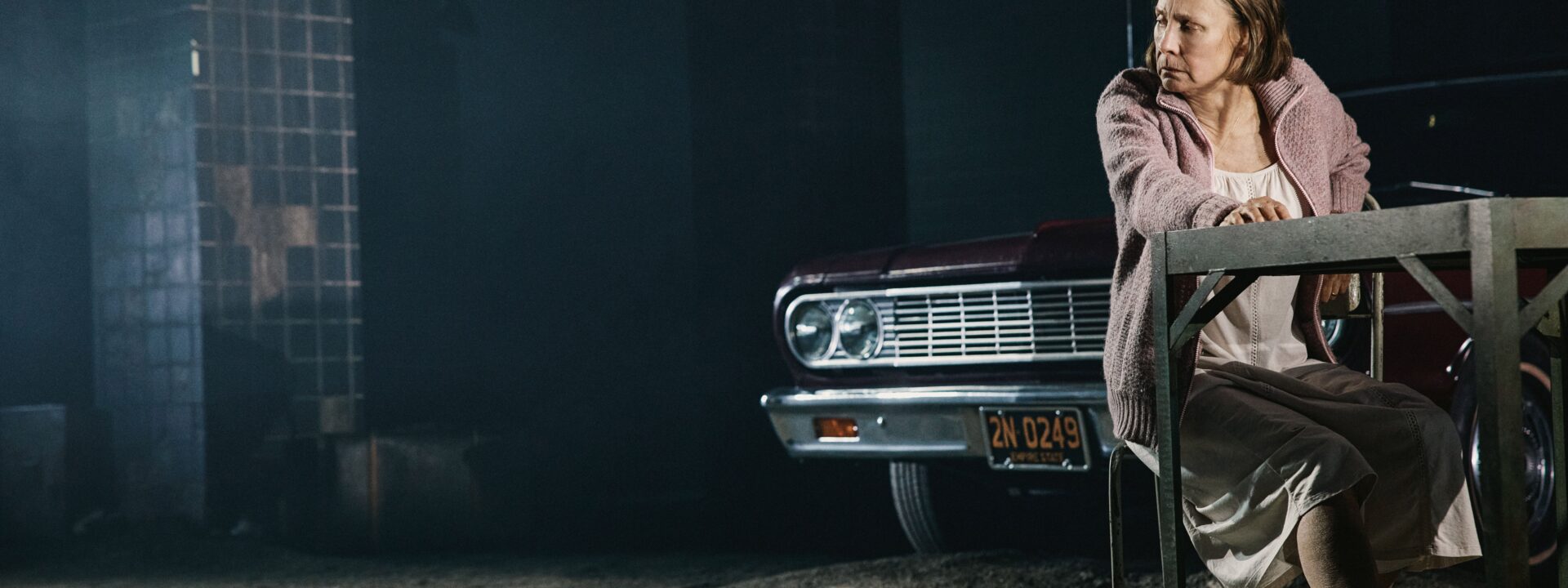
Laurie Metcalf’s longest career break in her 50 years on stage was the three-year gap between the pandemic closing her Broadway show Who’s Afraid of Virginia Woolf? and her return in 2023’s Grey House. A founding member of Chicago’s esteemed Steppenwolf Theater Company, she has built an impressive career with two Tonys, an Oscar nomination, and four Emmys. Now, Metcalf is taking on one of America’s greatest plays, Death of a Salesman, which opened the same day Big Mistakes, a Dan Levy comedy starring Metcalf, premiered on Netflix.
Arthur Miller’s 1949 masterpiece is an intimate drama, yet Metcalf and co-star Nathan Lane command the vast 1,600-seat Winter Garden theater with sheer talent and presence. Still, it’s a demanding play, and Metcalf tells Vogue it’s one of the first times she’s used a microphone onstage. “I’m so old-school that I’ve only just started wearing a microphone. This is the first time I’ve relied on one to do the heavy lifting. Without it, we’d have lost our voices by now.”
This lavish production is a career milestone that Lane and director Joe Mantello have envisioned since the ’90s, bringing Metcalf on board about a decade ago. Since then, it’s been a waiting game, navigating schedules, and—following Metcalf’s strict rule—avoiding any other performances of the play.
On the eve of her two major premieres, just months after starring in Samuel D. Hunter’s Little Bear Ridge Road this Broadway season, Metcalf spoke candidly to Vogue about playing roles written for her by generational fans, the joys of being miscast, and what helps her feel at ease in front of a camera.
Vogue: How do you hold onto the idea of playing a role for 10 years?
Laurie Metcalf: The first thing I did was write in my calendar, “Do not see a production of Salesman.” I didn’t want anything stuck in my head. I wanted to approach it fresh, even though it’s a 75-year-old play. I’ve never seen it—ever. I knew it was a bucket-list role I’d age into—and past [laughs]—so I always avoided it. Beyond that, I wasn’t pulling it out to read every month. I waited until our four-day workshop, once the cast was set, to really dive in. Luckily, I had about a month off to learn the lines. Nathan brings so much to it eight times a week, but even for me, memorizing took forever.
Is there a process to getting on the same page when playing a married couple?
It took us a while in rehearsals. We joked about it—Nathan is very sentimental as a person, and I’m the opposite. We wondered about our physical dynamic. I kept thinking, why would I be touching you? We’ve been married this long—get away from me. He felt differently, so we found a happy medium.
You’ve said theater is where you’re most comfortable. What is it about the stage versus being in a room with a camera?
Cameras are awful. I never want to be in a room with a camera. Starting in theater, that’s where I feel at home. Theater is freeing because it’s not recorded. I feel braver, more spontaneous. I can do anything in front of an audience and feel in control. I know where I want the laughs, the pauses, the emotion—it’s all mapped out in rehearsal. In film and TV, I’m often looking at the script in the hair and makeup chair on the day, feeling unprepared. I’m lucky if I bring any depth to it.When everything feels fast and new, was it easier on a show like Roseanne, which was filmed with a live audience? Across all my years on Roseanne and The Conners—which adds up to about 16 years—I never got used to the cameras being there. I always had to push through feeling intimidated. Sure, there’s an audience, but there are also four moving cameras right in front of them. I just never adjusted to it, and I never will.
There have been two projects where I felt less of that pressure with a camera in the room: Big Mistakes and Getting On. In those cases, most of the time, it was a handheld camera operated by someone who was right there in the scene with you. I wasn’t always sure where they’d be or what they were capturing—maybe me, maybe my scene partner—and that took away the stress. It’s all mental, really. Some actors like knowing their best side or understanding the lighting and technical aspects, but I’ve never figured that out and don’t want to. I prefer when the camera operator is in the mix; it feels more spontaneous, messier, and looser. You’re not hitting a mark; you’re overlapping.
What was it about Big Mistakes, or working with Dan Levy, that helped you feel at ease?
I didn’t know he was going to shoot it that way. It was a bonus when I arrived and learned he was using this looser style. Beyond that, it was just him. I’m such a fan that I wanted to be in the room with him, see how he works, and do scenes opposite him. I didn’t even really need to read the script. He’s very funny and writes generously for all the actors. He knows how to set the tone for the show and the atmosphere behind the camera. Everyone feels included. I’m speaking for the cast, but I know the whole crew has his respect. You feel very protected by him.
Given your unsentimental approach and having played so many roles—especially in a repertory company—were there any parts where you felt miscast?
I’ve been miscast a lot. Back in the early Steppenwolf days, I was always miscast because there weren’t many plays with five, six, or seven 20-year-olds, so I’d end up playing a 14-year-old or a grandmother. But I think all that miscasting made us stronger actors; we had to find a way into those roles. The most recent time I felt very miscast was in Virginia Woolf. Physically, I wasn’t the typical casting for that role—emotionally, maybe, but an actor can usually find their way into the emotional side. I felt I had to find my own path into that character. Part of me thinks… We did nine previews, and it closed when Broadway shut down due to the pandemic. I feel like I did it, but I regret that it never found an audience because it was getting there. It was already very, very funny, and mentally, I had just cracked the third act. I knew what my key into it was going to be, but I never got to do it because the run was cut short. Yeah, I was definitely miscast in that.
I wouldn’t have expected you to say that. I’d think at this point in your career, if you felt you weren’t right for something, you could have turned it down. Did director Joe Mantello have to convince you?
No, I wanted to do it because I saw it as the ultimate challenge: to find a different approach. If the character isn’t a woman who can immediately seduce men with her looks or sex appeal, how does she wrap them around her finger? Does she even manage it? So I had to find my own way in, through humor and flattery. It was a different kind of siren—more like a predator in that sense.
If the opportunity came up again, would you revisit that role?
I think we missed our moment. The right time would have been right after the pandemic, going straight into it. I think it’s been a little too long now. We don’t need someone this old for it.Martha was one thing. But then there’s something like “Little Bear,” which was actually the first role ever written specifically for me. It fit like a glove.
Was it strange to read those lines and think, “This writer knows exactly how I’m going to play this”?
“Little Bear” was perfect for me, mostly because Sam Hunter captured my sense of humor. It’s a bit of a generalization, but it’s that very dry, Midwestern style, and that ran all the way through the play. I like to play against sentiment, and that was another strong quality “Little Bear” had—it was completely unsentimental, yet you still end up caring about the characters. I didn’t know Sam. I didn’t know if he’d ever seen me on stage or what he’d seen me in. I wondered, what is he basing this on, that he could write a character for me? That was the odd part—realizing, so this is how you see me. That’s interesting. I guess I appreciated that he thought my particular style, my sense of humor, my unsentimentality, was worthy of an entire character. That’s what I appreciate.
Did that make you want to commission more roles for yourself?
Some of my favorite playwrights are ones I’ve worked with over the past ten years, when I did a flurry of plays. I nag them once in a while—like, Lucas Hnath, what do you have? Bruce Norris, Sharr White, Levi Holloway, who did “Grey House.” They all happen to be men, but anyway, I think everything starts with the writing. So when you click with a writer, that’s instant gold—especially if they can be in the room with you, as all those writers were.
What’s it like working with people like Sam or Dan—fans from a different generation who are now writing for you?
I don’t know where they know me from. I hope it’s not just from TV. But it’s incredibly flattering that these people—whatever their age—whom I’m such a big fan of, want to work together. I mean, my God.
Frequently Asked Questions
Of course Here is a list of FAQs about Laurie Metcalfs Laurie Metcalf Has Something to Say designed to sound like questions from a real audience
General Beginner Questions
Q What exactly is Laurie Metcalf Has Something to Say
A Its a live solo stage show where the acclaimed actress Laurie Metcalf performs a series of dramatic monologues Its not a traditional play with a plot but a curated collection of character pieces
Q Is it a comedy or a drama
A Its primarily dramatic and thoughtprovoking though Laurie Metcalfs brilliant acting often finds moments of dark humor and humanity within the intense material
Q Do I need to be a super fan of Laurie Metcalf to enjoy it
A Not at all While fans will appreciate seeing her immense talent up close the show is designed to be a powerful theatrical experience for anyone interested in acting storytelling and complex human emotions
Q How long is the show
A It typically runs about 90 minutes without an intermission
Q Who wrote it
A The monologues are written by different playwrights The show is conceived and curated by Laurie Metcalf and her creative team including director Joe Mantello
Content Themes
Q What are the monologues about
A They cover a wide range of topics and perspectives You might encounter a character grappling with grief political tension family dysfunction personal regret or societal observations Each piece presents a distinct person in a moment of crisis or confession
Q Is there a connecting story or theme between the monologues
A There isnt a narrative plot connecting them However the pieces are often curated to create a thematic journey exploring ideas like truth memory responsibility and the human condition from different angles
Q Is the content appropriate for all ages
A The show deals with mature themes and includes strong language Its generally recommended for adults and mature teenagers
Q Can you give an example of one of the monologues
A While the specific pieces can change past examples include a woman recounting a disturbing encounter on an airplane a character wrestling with a family secret or someone delivering a fraught public testimony
Practical Advanced Questions