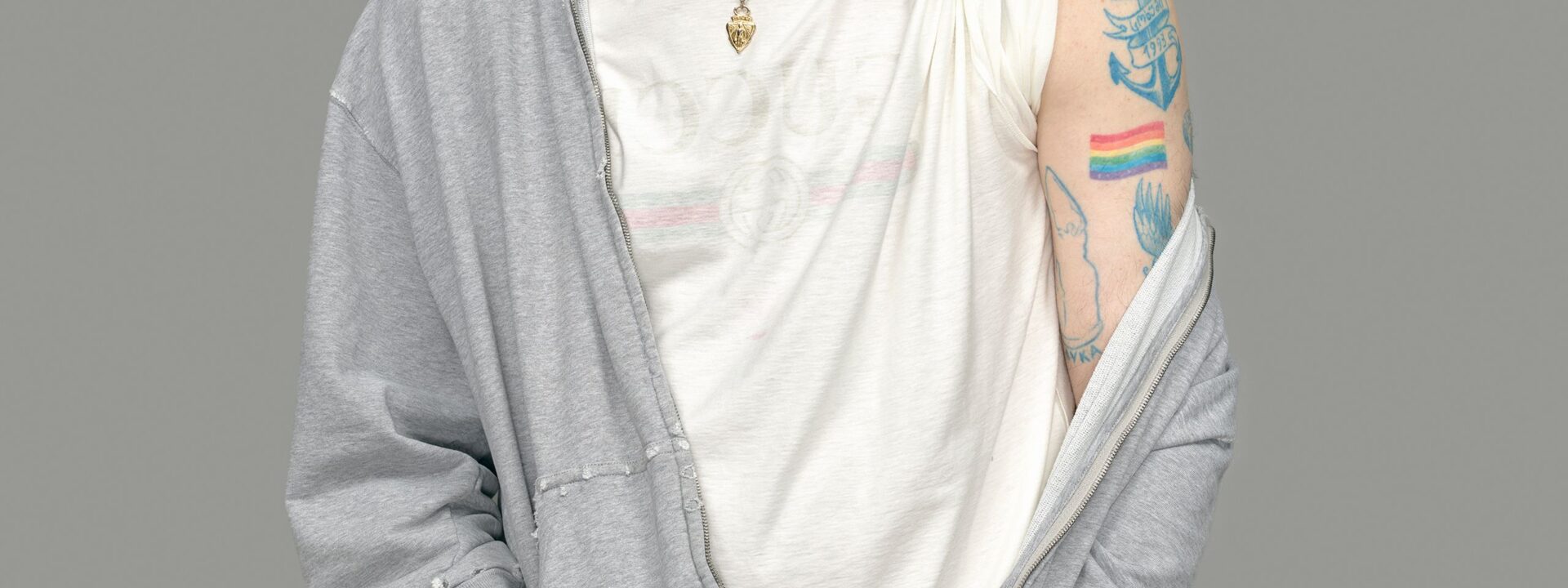
On a bright, crisp February morning in Milan, the day before a crucial show, Demna—once the leading iconoclast of French fashion and now the artistic director of Gucci—walks through his offices with a surprisingly calm air. “Obviously, I’m a bit stressed—but I feel good,” he says, glancing around a studio decorated in a style unmistakably his own. Leather sofas sit near full-length windows, and patchwork curtains by artist Pia Camil line the wall. A decade ago, when Gucci moved into this sleek complex on the industrial Via Mecenate, the brand reasserted its reputation as something like the Italian sports car of fashion—a streamlined, leather-bound machine with a bold, eccentric edge—an image that has since become embedded in popular culture. “My cousin, who is 16 and spends her life on Roblox, heard I was going to Gucci and said, ‘Do you know Gucci is a word we use a lot to describe a certain state of mind? If you feel Gucci, it means you want to be crazy, meet people, and be out there,'” Demna says. He smiles and adds, “I want to make people feel Gucci tomorrow.”
Demna Gvasalia, as he was born in Georgia (he dropped his surname at the height of his rise at Balenciaga five years ago), is now 45—an age when designers often arrive at the mature version of themselves. Yet his voice seemed fully formed a fashion era ago, in 2014, when he co-founded Vetements, just months before being named Balenciaga’s artistic director, further expanding his influence. “It made him the most influential designer of the decade,” says Alexandre Samson, a fashion historian and curator at Palais Galliera in Paris. “He created characters that were very clear and reflective of an Eastern, post-USSR youth culture with no money, which looked to, admired, and despised the Western world.” Demna saw that this ambivalence—both covetous and critical—could speak to the social-media-driven capitals of the West as well. “It was a very strong take, mixing logo mania with deconstructive patternmaking skills and sportswear,” Samson says. It was intensely personal too, and has remained so through years of reinvention since.
In the studio, Demna wears loose black Adidas trousers, a black T-shirt with the logo of the heavy metal band Slipknot, and black Gucci mules—an example of the flowing, baggy silhouette he defined. When he was young in bourgeois Europe, his personal style was often seen as provocation: he was chased out of restaurants and had food thrown at him. Since then, it has become a key template for mainstream luxury taste.
When Demna took over Gucci last summer, after a decade leading Balenciaga, the move was received much like Long John Silver winning control of the Hispaniola. The brand had drifted for a couple of years; his arrival promised to set it rocking on the waves again. “He has this complete I-don’t-give-a-fuck-ness about what he does, and he knows how to garner attention, how to make a moment. He has a very good tap on the cultural conscience,” model and influencer Vivian Wilson tells me. “He designs what he wants,” says Kim Kardashian, a longtime friend and muse of Demna’s. “He’s just so unapologetically himself.”
What was less certain was whether Demna’s style of attention could suit such a large and mainstream brand. Gucci is the crown jewel of Kering, the luxury conglomerate, and in a year of industry downturns, it has become a charged bellwether too. (The company’s fate is so tied to Gucci’s success that the brand’s CEO tells me she weaned herself off checking hour-by-hour global sales figures in bed.) “The team have a big responsibility, because they are handling a mega brand,” says Luca de Meo, Kering’s CEO. “Handle with care!” Demna, who trained in the Antwerp school, seems ready for the challenge.Known for his sharp, biting wit and love of provocation, Demna was a master of conceptual fashion. (One early Vetements collection even featured what looked like yellow dishwashing gloves.) There was a worry that his restless style might not survive the pressure of Gucci-level success. At least, that was the fear. But in the studio, Demna surprises me by saying that since arriving, he has let go of his conceptual approach in favor of something more immediate and sensual.
“Gucci is a very pragmatic brand—it’s all about the product. It’s freeing not to have to overthink a dress just to make one you love,” he says. “Fashion should be more intuitive and emotional—either ‘I hate it’ or ‘I love it.'” For his first Gucci show, he presented a capsule collection called “La Famiglia” as a film, exploring what he calls the brand’s core characters, inspired by its 1970s looks. His pre-fall collection, meanwhile, paid tribute to the sexy, polished styles that defined the house in the ’90s under Tom Ford.
On this particular day, the collection he’s about to show is his take on Gucci in the present: his own vision, linking him to a generation of Belgian conceptualists—like Matthieu Blazy and Pieter Mulier—who found a new sensuality at major heritage brands. (So far, the moves seem to be working: while it’s too early to see major sales effects, store traffic has risen since the first capsule collection dropped.) From a rack holding a few pieces set to appear on the runway the next day, Demna pulls out coats that look like fur but are actually shearling—a common agricultural by-product—cut on a bias and stitched with muslin, making them feel as light as a windbreaker in your hand.
Lightness is everything to Demna now—lightness and speed. When he arrived at Gucci, he found that all the studio’s prototypes were sewn off-site. One of his first changes was to create an on-site atelier, so garments could be made faster—more industrially—and edited not on paper but in three dimensions, with pins and scissors. Demna picks up a couple of classic handbags that he’s also made lighter and more supple, and shows off two stunning dresses on mannequins—one purple with a classic Gucci pattern, the other shimmering in gold sequins. Beyond these displays, his studio is oddly empty, as if it too has been put on a lightness regime. Demna seems to suddenly notice the emptiness.
“I don’t want to show you too many things,” he says with a playful smile. “I want the show to be a surprise.”
Many people trace Demna’s touch—if not his sensibility—to the four spirited years he spent early in his career at Maison Martin Margiela, overseeing the women’s ready-to-wear collections. “He absolutely understood the process and the thinking behind the whole brand: the idea of repurposing”—Margiela, like Demna, was known for using vintage pieces as a starting point—”and also the idea of playing with society,” says Samson. At Vetements, Demna applied these methods to his own style. There were hoodies with raised or pointed shoulders, oversized jackets. As a self-conscious young man, he had worn oversized clothes to hide himself; now, he began reshaping the typical body into new and unusual forms, with thrilling results. “At the time, there was really nothing else happening in Paris,” says Julien Charrier, who started as an intern at Vetements in 2016 and is now Demna’s chief of staff. “He was bringing something completely out of the box—very fresh, very young, very street-culture.” Within a year, the label was being worn—or imitated—by Jared Leto and Ye, then known as Kanye West. “He was always just so cool,” says Kardashian, who met Demna shortly after Vetements launched, before there was a storefront, and spent hours simply trying things on.In 2016, Demna held his first show for Balenciaga, while continuing to design for both labels for years. He found success with hits like the chunky Triple S sneaker and the wide-collar Swing shirt, but he also explored geopolitical themes. In March 2022, after the Russia-Ukraine war began, his show featured models walking through a snowstorm in yellow and blue. Within three years, the brand had doubled in size and surpassed a billion dollars in sales. In 2019, The Washington Post praised Demna for “changing what we consider fashion.”
When I first met Demna late that year, he was living in the woods of Switzerland with his husband, musician Loïk Gomez. He told me Paris had become too distracting, too claustrophobic, and too overwhelming. In Switzerland, he saw almost no one, but every day before work, he put on high boots and an overcoat and went hiking in nature, like a figure from a Caspar David Friedrich painting. He was planning to revive Balenciaga’s long-dormant couture line and had started thinking about the body in new, poetic ways. “I’m no longer on the dark side of the world,” he told me then.
That didn’t last. A few months later, the COVID-19 pandemic plunged the world into darkness. The remote Swiss woods turned out to be an oddly perfect place to ride out the lockdown, but his couture debut was delayed by a year. Meanwhile, the brand’s provocative moves seemed to pile up. In 2022, Balenciaga cut ties with Ye, one of its most prominent and loyal supporters, after he made posts widely seen as antisemitic on social media. (In January of this year, Ye apologized in a full-page ad in The Wall Street Journal.) Just weeks later, the brand and Demna faced public backlash over an ad campaign that featured children, dressed in the kids’ line, holding teddy bear bags that had been shown on the runway. To many, the bears looked like they were wearing BDSM gear. Sharp-eyed viewers also noticed that another ad, for the spring 2023 collection, which showed a messy desk, seemed to include a page from the Supreme Court opinion in United States v. Williams, a case about child pornography.
The fallout was severe. Close celebrity partners of Balenciaga, including Kardashian, reconsidered their ties to the brand. (“That was never an issue with him,” Kardashian tells me. “Once we investigated and saw where things happened, we felt comfortable moving forward.”) Soon, Demna issued a public apology. “It was inappropriate to have kids promote objects that had nothing to do with them,” he wrote. “As much as I would sometimes like to provoke a thought through my work, I would NEVER have an intention to do that with such an awful subject as child abuse that I condemn.”
“Provocation is like humor, and humor can’t be stupid,” he tells me now, when I ask if the experience made him rethink the role of provocation in his life and work. “It requires a kind of nuance. Provocation is stupid when you’re the only one laughing.”
Demna had decided to leave the Swiss woods. “After a while, I got so bored there,” he tells me. “Boredom is such a scary and tricky thing for a creative person—I always want to discover new things.” He and Gomez moved to Geneva but eventually ended up back in Paris, stimulated but as restless as ever. “I love Paris, but it only works as a long-distance relationship for me,” Demna says. “I lived there for 15 years, which is the longest I’ve been in one place in my life. But I didn’t like what fashion started to become while I was living in Paris full-time: safe, boring, beige, wannabe bourgeois, flat, superficial—all the things fashion shouldn’t be.” With the idea of living in Paris part-time, he found a new balance.It was the best kind of Paris life, and he and Gomez kept searching for a second home. They ended up in LA—the city where Demna had proposed to Gomez and a place he had always dreamed of living in. They bought a 1950s bungalow and started getting involved in the local scene. To this day, Demna told me, he has a much more active social life in California than in Europe.
“It’s radically different, culturally speaking,” he tells me. “Modernity is there. It’s not for no reason that Silicon Valley happened in California: there’s something about feeling more free in your head about how we do things, how we dress, how we express ourselves. In Europe it’s much more conservative.”
When he took the job at Gucci, he moved from Paris to Milan (“Also Europe, but a very different mentality, and so industrial in terms of fashion—I love it”) but kept Los Angeles as his second base. “People always say, ‘Oh, I get why you’re there—you want to be far from fashion,'” he says. “I’m like, ‘Actually, no—there I’m really in the epicenter of thinking behind how we use fashion.’ Whereas in Italy, what I have is the product, the heritage, the history, the manufacturing—all those things that don’t exist in LA.”
“It’s a pretty good balance,” he adds. “Gucci needs both.”
Backstage at his first show, Demna moves up and down the model lineup, which curves along a hallway crowded with hairdressers and security personnel. “The feeling when someone falls in love with someone? I have it now,” he tells me. “I’m also worried about one million things—the shoes, the sweat—but we can’t control these things, so worrying is useless, apparently.” He grins. “I read that somewhere.”
The show will be held in the Palazzo delle Scintille, a large hall in Milan that Demna turned into a venue for Gucci. He was inspired by the Uffizi Galleries in Florence, the house’s historical and spiritual home, and, with the Uffizi’s permission, had some classical statues there replicated. They line the edge of the Palazzo’s inner hall, which descends coliseum-like steps to a long central corridor that will serve as the runway. “We built a museum for the show, basically,” Demna says. “My idea was to put Gucci back into the spotlight of the Italian Renaissance.” There were, of course, other goals too. As guests take their seats in the Palazzo delle Scintille, someone whispers, “There are so many supermodels here.”
True enough. The cast includes Kate Moss, Karlie Kloss, and Gabbriette, but also figures not used to the runway, like the rappers Fakemink and Nettspend. (“I invited, in the cast, people that I always wanted to meet,” Demna explains to me.)
As the house lights go down, a bright beam appears down the runway. The model Charlie Jones steps into it, wearing a high-collar sleeveless white dress and carrying a classic black Gucci bag. The dress is tight and revealing enough to show a tattoo on the upper thigh. (“It’s the most body-conscious I’ve ever been,” Demna says. “I’ve had a really good therapist for 10 years and, finally, I’ve started to like myself.”) Jones, a trans man, walks briskly with a cross-step, followed by a gym-built man in white pants and a similar shirt. The show, like all of Demna’s at Gucci, mixes men’s and women’s looks. “I think the idea of splitting fashion by gender is very old—I think there’s a systemic glitch in this,” he says. When the muscleman walks past, somebody cries, “Wow.”
Uncharacteristically for Demna, who at Balenciaga was known for his loud, intense presentations, the show blooms into poetic sequined dresses and male models who walk barefoot. “It’s very romantic, very like Botticelli, almost like they came off the painting in a way,” he exclaims.plains. “It’s a different kind of beauty than I’ve ever explored—more classic, but pushed and exaggerated.” When Moss appears to close the show in a black, backless sequined dress, a cheer erupts: an old vision is reborn.
In 1993, Demna’s family fled their hometown of Sukhumi, Georgia, under the threat of ethnic cleansing, and settled in Tbilisi. One of his first jobs, at age 17, was translating Reuters copy for Georgian TV, and since then, he has rarely managed to escape the news. (On September 11, 2001, as horrific reports streamed in from New York, it was young Demna who provided simultaneous translation for Georgian audiences.) Nor has he stayed long in one place.
That restlessness, paradoxically, has helped ground him in his new professional home. The aptly named Guccio Gucci, the brand’s founder and the son of a straw-hat maker, opened a shop on Florence’s Via della Vigna Nuova in 1921; by the late 1930s, he was making handbags. From the start, the brand winked at its own self-invention: Gucci’s crest didn’t feature a soldier, as an aristocratic one would, but a figure carrying two luggage bags aloft. Guccio’s son Aldo helped push the company into belts, shoes, and gloves, and excelled at industrial improvisation. Faced with wartime shortages, the house made handbags with bamboo handles. By 1960, it had opened a shop in New York; soon it was in London, Paris, and LA. It moved into ready-to-wear fashion and soared into the 1970s alongside celebrities like Grace Kelly and Jackie Kennedy. In 1974, Elton John, writing about his transatlantic travels in British Vogue, could refer to passengers on the SS France as “Gucci-Pucci” and be understood.
What followed, for two decades, was enough intrigue, subterfuge, betrayal, and assassination for a Jacobean play: a series of struggles among Gucci family members formed the basis of the 2021 movie House of Gucci, culminating in the murder of Maurizio Gucci and the brand’s takeover by what later became Kering. Tom Ford, then unknown, was named creative director in 1994 and within a year was credited with sparking the brand’s first extraordinary renaissance, moving away from bourgeois-brown fashion to a sexy, shocking new look. A second renaissance came in 2015, with the whimsically androgynous flair of Alessandro Michele.
“Personally, I’m in need of a silhouette,” Demna says, “and in September I will dare myself to show it.”
With Michele’s departure in 2022, the house fell back into disarray. Revenue dropped 21 percent in 2024; in just the first half of the following year, it fell another 25 percent. Sabato De Sarno, the creative director, parted ways with the brand in 2025, and Gucci had three CEOs in two years. Last fall, Kering appointed one of its most powerful leaders, Francesca Bellettini, as Gucci’s president and CEO. Her mandate, she tells me one afternoon over coffee at the Milan Four Seasons, was immediately clear: “I know a lot of people say Gucci is like the phoenix, going up and down and rising from the ashes,” she says. “No.” She shakes her head. “We need to go up with normal growth—and stay up.”
Demna was Bellettini’s first big idea. “I knew him from Balenciaga, which he had already decided to leave,” she says. She saw a fit and pitched the idea to him over dinner. “He was like, ‘I can do it,'” she recalls. Just one thing: he wanted to study first.
“I didn’t know much about Gucci—I knew the movie, you know?” Demna tells me. “I knew Alessandro, and I knew Tom Ford from fashion TV when I was, like, 13… but to understand the brand, I had to know what Gucci stood for beyond those three things.” Over the following weeks, he made visits to the Gucci archive in Florence, with spy-like secrecy. “I saw the whole world,” he says. “Homeware. Chairs. Umbrellas.”A roulette wheel. And on top of that, the most incredible collections.” He shrugs. “I was seduced.”
Demna suggested to Bellettini that he put together a presentation to organize his ideas. “I need to convince you and myself that we can do this,” she recalls him saying. It was during the holidays, and he and Gomez were in Los Angeles. “On the day I finished,” Demna says, “I showed it to my husband.” (Demna sometimes calls Gomez his “fashion therapist.”)
“My husband looked at it and said, ‘It gives me a FOMO feeling—I want to be that or I want to have it,'” Demna recalls. That idea clicked. “I thought, that’s what my vision of Gucci is—creating this FOMO,” he says. “The chic, the elegance, the Italian-ness of it. The dolce vita, but in a nonchalant way. There’s a bit of humor to it, but it’s not sarcastic. It’s fun, quite punk in a way—like, ‘I like myself, and I don’t care what other people think.’ There’s something daring about it—it’s flamboyant. It’s confident. You know who you are.”
The Los Angeles fires started that night. Demna left with nothing but his passport and his laptop: he hadn’t backed up his presentation. “I sent it to Kering, and I thought: This is my vision… And if they don’t like it, I might as well know that now.”
But Bellettini understood what he was proposing: a freedom possible only in a house whose history was rich in product. “What he was explaining as a liberation was the fact that the brand doesn’t come from a couture maison,” she recalls. “There isn’t a Cristóbal Balenciaga, an Yves Saint Laurent, a Christian Dior, to whom you’re always going to be compared.” When Demna presented his plan to François-Henri Pinault, the chairman of Kering, he was hit with questions. “François-Henri wanted to be sure,” Bellettini says. “And Demna was so precise in his answers that he said, ‘Okay, done.'”
In general, Demna’s creative day starts slowly—a self-protective routine of discipline that he says he learned from Marc Jacobs, for whom he worked at Louis Vuitton over a decade ago. In Milan, he takes the morning for himself. He has coffee and a smoothie with his husband. He meditates. He cuddles his two Chihuahuas and takes them for walks with Gomez. “We talk about stuff that isn’t fashion,” he says. “I want to have this moment that’s about my family, my husband, and me. And us as a couple. And our life.”
At noon, he reports to work at the office, where he’s usually scheduled straight through to 8 p.m. He rarely takes more than a 15-minute break. “It’s intense, but I love it, because when I’m in the flow of working, I’m quite fast in making decisions,” he says. “We manage a lot for a brand this size in one day.” In the evening, he returns home and cooks dinner with Gomez—or, rather, alongside Gomez, who follows a different diet. (“He’s gluten-free. I’m vegan,” Demna says. “Sometimes it overlaps, but”—he smiles—”it’s hard to be gluten-free in Italy.”) In Los Angeles, they go out for dinner most nights, but in Milan this “ritual,” as Demna calls it, is their life.
“We cook, we watch stand-up comedy on YouTube, listen to music,” he says. They go out for dinner at most once a week, usually on the weekend, after walking through the city. “I don’t really have a lot of social life in Milan,” he says. “I’m always going to be this rebellious person, but now I live this Gucci life professionally.” His rebellion, in the Gucci way, has taken on bourgeois tones.
We’re drinking ginger-lemon kombucha at a banquette table in the Campbell Bar in New York’s Grand Central Station. Demna is in the middle oDuring a two-week stay in New York, after preparing two looks for the Met Gala, he is now getting ready for a bigger mission in the city. In a few days, Gucci will present its cruise collection in the middle of Times Square, and Demna has been exploring the city for research and inspiration.
“I’ll go to vintage stores, bookstores. See some art, get some cultural impact,” he says. The process involves both collecting images as references for his collections and buying vintage pieces to use as physical canvases—”raw material” that he can cut and pin. “It’s very hard sometimes to start making a jacket from scratch, especially when it comes to tailoring and shapes,” he explains. “I need to have material that has good details and good proportions that I can cut and Frankenstein into the shapes I want to get to.”
Shape has been heavily on Demna’s mind as he works on his September collection. After carefully understanding Gucci stage by stage—starting with the basics of La Famiglia and moving on to the sexy Fordian club style of his first Milan show—he feels ready to present a Gucci that draws on the house’s history but is his own. In fashion terms, this means coming out with new silhouettes: specific combinations of form, proportion, and mood that, like the boxy Chanel jacket or the Dior hourglass dress, will be recognized as the signature of his vision for the brand.
“Personally, I’m in need of a defined Gucci silhouette, and in September I will dare myself to show it,” he says, and signals for a second kombucha. “It’s about centimeters, it really is,” he says. “It’s about proportion. And I want to do something that I also haven’t done before, which”—he smiles—”limits the possibilities.”
He started with the mood: “What is the feeling I want to give so a person can be like, ‘I feel Gucci’?” In consultation with Gomez, acting as his fashion therapist, he began listing all the qualities he wanted his new Gucci silhouette to project. Facing the blank page on his laptop one day, with his deadlines for the September runway drawing ever nearer, he wrote:
Sharp, Confident, Chic, Bold, Rich, Eccentric, Hot, Sexy, Cool.
“Sharp as in not wobbly, not round: There is no cocoon shape at Gucci,” he explains. “Sexy and hot: They’re not the same. You can be completely covered and feel hot, but you can’t be sexy. For sexy, you need to show some body. Gucci needs to have both.”
One by one, he worked through his words, using them to define what the silhouette was and wasn’t. In the spring, he went to one of his favorite vintage men’s tailoring shops in Rome. “It has the most meticulous selection of jackets and coats in Italian men’s tailoring—I half-emptied the store,” he says. “We’re using those pieces when I work the silhouette, in defining the shoulder line and the sleeve shape.”
A few days later, I meet Demna in the 23rd Street studio where he is holding fittings for the New York show. The show’s fashion concept expresses his mercantile turn. “I call it GucciCore,” he tells me. “Like hard-core, but also the essence, the base, of the aesthetic”—in other words, “staples” that customers can reliably find in a Gucci shop.
“For example, this is a very important piece for me,” he says, pulling from the rack a red women’s double-breasted jacket, his version of the classic peacoat. “I was afraid to work on it, because I don’t like peacoats: How could I make one that I really liked?” The answer to the question became a kind of key: If he could make a Gucci peacoat that he loved (“It’s the fit, the proportions of the collar, the size and positioning of the buttons, the length”), then he could extend his point of view across worlds of merchandise. The other kAnd perhaps his greatest—if quietest—innovation at Gucci so far—was about sizing. Traditionally, fashion is designed for tall runway models, then adjusted up or down into standard sizes, often losing the proportions that make clothes fit well. “It doesn’t consider the body type,” Demna says. “If someone is shorter and more muscular, he’s going to look like a dork.” At Gucci, he’s developing a completely new sizing system so that a look holds together whether you’re tall and slim or short and stocky. In the meantime, many cruise collection pieces come in three different fits: a small, a medium, and what might be called a Demna fit—the baggy proportions he’d choose for himself.
During fittings, Demna sits at a table at one end of the studio. An assistant brings him an energy bar and a bowl of nuts. A tall male model appears in a jacket, sunglasses, and flowing black pants. “I’m not sure about this one,” Demna says. He takes off the sunglasses, walks over to a rack of pieces, considers alternatives, and eventually picks a long coat. The problem with the jacket, he explains, was that it looked somehow unconvincing. “That’s my big thing—to find the authenticity.”
The night of the show is clear and cool: a New York City spring caught in the hourglass of Times Square. Smoke drifts in from the street corners, giving the Midtown canyons an eerie feel. By 8:10 p.m., guests have started arriving on Gucci’s walled-off gray carpet. “Being at Gucci, he can dream as big as he wants, right?” Kardashian tells me. “He can say ‘I want a show in Times Square’ and pull it off.”
Demna is with Gomez in a sushi restaurant on 47th Street that’s been taken over as the show’s backstage. In one hand, he holds a Starbucks cup; in the other, a big red apple, as if nodding to the city. The floor is marked with lineup tape for the models, and large screens near the entrance show street footage from cameras and drones. Demna moves closer, stares at the footage in wonder for a moment, then heads out with Gomez into the cool air of the square.
Imaginary Gucci ads are playing across nearly 50 billboard-size screens, plus more than two dozen at sidewalk level. Every celebrity arrival—from Mariah Carey in a crisp white Gucci coat to Lindsay Lohan in a black leather outfit, Playboi Carti in shiny python trousers to EsDeeKid in a shimmering black jacket and baggy silver jeans (and his signature balaclava)—draws cheers from onlookers gathered on sidewalks and street corners. A few minutes past nine, the screens all dim. Charlie Jones, again in the first look—this time holding an apple in a deceptively simple black suit—makes his way through the crowd.
In the early hours of the previous night, when Times Square was as quiet and empty as it would ever be, the Gucci crew had gathered for their only rehearsal. Everyone wore earphones so the music, curated by Gomez, wouldn’t echo through the square. Now, with full sound and all 50 big screens tracking the runway movement with nervous, all-seeing attention, the effect is haunting. Suits in various shades of power come down the runway. The red peacoat appears paired with black pants. There are bikers in leather, Venuses in shearling. Tom Brady swaggers in an asymmetric black jacket and matching leather trousers. (For all the show’s diversity in age and look, it still centers on slender or gym-built bodies.) When Paris Hilton appears with a black fur-like coat slung over the shoulder of a sunflower yellow Gucci-patterned summer dress with a high lavallière neck—hot, not sexy—every phone in the audience seems to lift up.
For much of his career, Demna was known for shows that built toward an unsettling climax, but the effect here is the opposite. The sequence culminates as Cindy Crawford, at 60, dressed in a high, shoulder-less dress of long black feathers, takes the final walk, as slowly and as gracefully as ever.Just like the traditional Italian evening stroll, known as “la passeggiata,” there’s a long, suspended moment where all of Times Square falls silent, as if the whole place is holding its breath.
Later that night, the party moves to the Gucci Mansion, a townhouse with a courtyard on Madison Avenue that’s been turned into a showcase of Gucci’s history. On the first floor, a jazz singer and a quartet perform a scat version of “It’s De-Lovely.” Upstairs, in a private karaoke room, guests are trying their hand at 50 Cent’s “P.I.M.P.” The basement is a billiards lounge decked out in red—red carpet, red curtains, red walls. Tucked away, a fortune teller reads palms by lamplight.
Demna arrives after midnight and settles into the courtyard, which is packed with smokers and guests enjoying the cool night air. He’s surrounded by well-wishers and in a cheerful mood. “I’m relieved it’s over, because it was really complicated,” he says, still holding his Starbucks cup, as if the evening’s Gucci energy has carried him along without pause. “But a lot of people told me it was 12 minutes of forgetting whatever was on their minds before.” He smiles. “I love that.”
In this story: hair by Esther Langham; makeup by Aaron de Mey; manicure by Raphaël Park Charles.
Fashion photographs produced by Starkman & Associates.
Frequently Asked Questions
Here is a list of FAQs about Demnas work at Gucci written in a natural conversational tone with clear and direct answers
1 Wait I thought Demna was the guy at Balenciaga Is he actually at Gucci now
Yes he is Demna was appointed as the Creative Director of Gucci in March 2025 He still runs his own label Balenciaga but hes now splitting his time to lead Guccis design team
2 What kind of new life is he bringing to Gucci Isnt the brand already a giant
Gucci is a giant but it was going through a rough patchsales were down and the brand felt a bit repetitive Demna is shaking things up by bringing his rulebreaking aesthetic to Gucci That means youll see less of the classic romantic Gucci and more of his signature style oversized silhouettes streetwear influences and a focus on realism and everyday clothing
3 Im not a fashion expert What does rulebreaking actually mean in this context
In fashion rules are things like evening wear must be glamorous or luxury brands only use expensive fabrics Demna breaks these by making couturelevel clothing look like its from a thrift store using unconventional materials or turning everyday objects into highfashion items Hes questioning what luxury is supposed to look like
4 What was his first collection for Gucci like
His debut collection shown in May 2025 was a major statement It featured sharp tailored suits with exaggerated shoulders distressed denim and his famous puffer jackets but all with a Gucci twistlike the brands iconic green and red stripes woven into the fabrics He also introduced a huge Gucci logo belt that went viral blending his streetwear vibe with Guccis heritage
5 Will he completely change the classic Gucci look I know and love
Hes definitely pivoting the aesthetic but hes not erasing the past Hes taking Guccis codeslike the bamboo handle the horsebit and