The lights dimmed just as dessert arrived. Servers came out of the kitchen carrying softly glowing lantern boxes through the dark room, each topped with jewel-colored treats. Around the shared tables, conversations paused as traditional Vietnamese court music filled the space.
While Huế’s June arts festival was happening thousands of miles away in central Vietnam, another tribute to the former imperial capital was taking shape at the WSA Building in downtown Manhattan: a love letter to Vietnam’s richest and most meticulous food traditions.
This dinner was the eighth installment of Ăn Cỗ, the Vietnamese banquet series run by Thu Pham Buser and Taylor Buser. The name means “attending a feast,” and over the past few years, the couple has built a loyal following in the city by highlighting regional Vietnamese cuisines rarely seen on American restaurant menus. Earlier dinners explored the floating markets of the Mekong Delta, Vietnam’s islands, and its jungle areas. This latest edition, focused on the former royal capital of Huế, was their most ambitious yet.
“Huế is the culinary innovation capital of Vietnam,” Thu, a chef and food stylist, told me. “The central region has given us so many of our national dishes.” For centuries, cooks, artisans, and craftspeople flocked to the imperial city, where the royal court rewarded the most impressively elaborate techniques and presentations.
Taylor, dressed in a chestnut-colored traditional áo dài, introduced each course throughout the night, while you could catch glimpses of Thu directing her staff in the open kitchen, wearing wide-legged blue and red pants. The dinner started with a trio of Huế’s signature bánh dumplings, the kind they would pick up “walking through a little Huế market”: translucent shrimp-filled bánh bột lọc, pillowy purple ube bánh ít trần stuffed with mung bean, and silky banana leaf-wrapped bánh nậm, served with fried shallots, charred scallion oil, and chili nước mắm sauce.
The dumplings looked almost too delicate to touch. Most of the recipes Thu used were meant for home kitchens, not for 300 diners over five nights. Scaling them up meant weeks of testing doughs that, she admitted, “do not cooperate easily.” In total, her team handmade about 2,500 dumplings. To make them, she recreated a scene from her mother’s restaurant when she was a child, setting up what she affectionately called a dumpling factory with four staff members. “One person would slice the dough, the next would flatten it, a third would fill it, and a fourth would close it,” she recalled, describing the assembly-line rhythm she used to watch her mother and aunts cook together.
Next came a bánh ép tapioca crepe, a chewy street snack layered with lemongrass grilled beef, papaya, and pungent pineapple mắm nêm sauce, followed by a bright salad of fermented shrimp, crispy pork belly, green mango, and galangal-limeleaf crackers. The room grew louder as cocktails were refreshed and guests shared their favorite bites. Across from me sat a man in a Knicks jersey who told me he and his wife had been to almost every dinner. The series had inspired them to book a trip to Vietnam. In a conversation with Taylor, he pointed out a particularly lively corner of the room. A couple dozen friends were reuniting after attending a wedding together in Vietnam, choosing Ăn Cỗ as a way to relive their celebrations abroad.
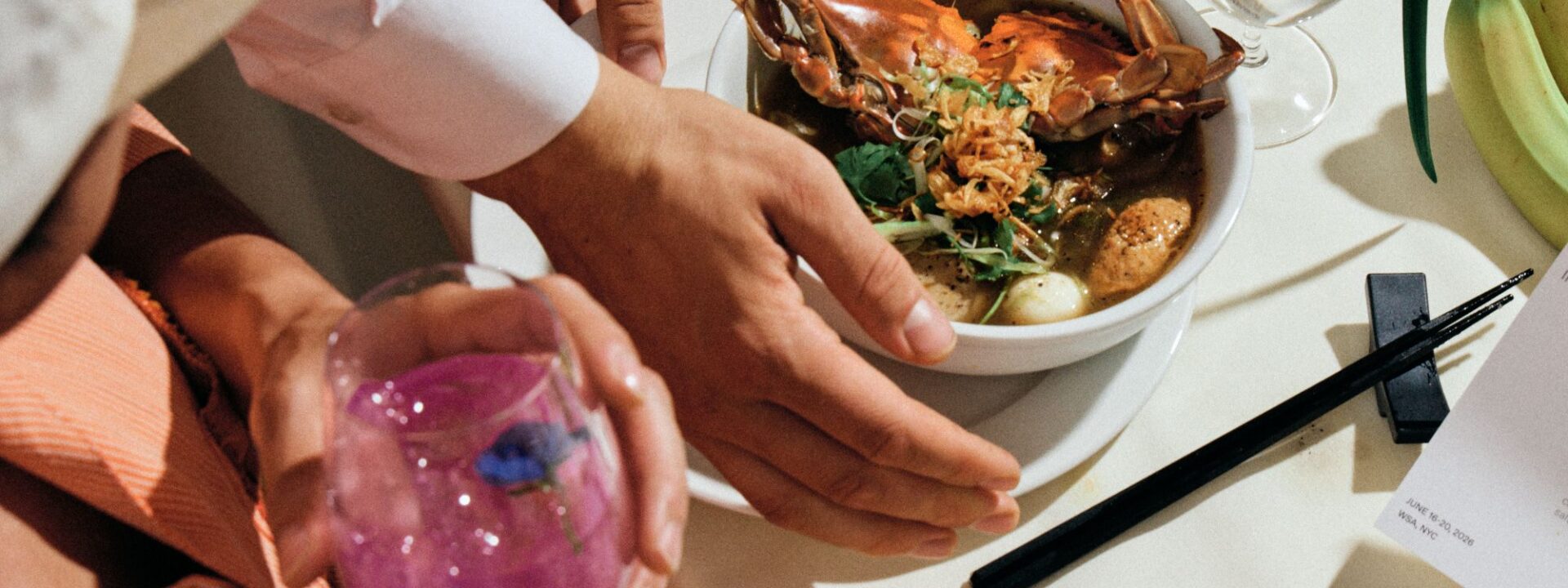
The heartiest course, bánh canh bột xắt, brought hand-cut rice noodles in a blue crab broth with crab cake, quail eggs, Vietnamese coriander, and green peppercorn—plus hand wipes and plastic gloves. Like almost everything else on the menu, the noodles were made entirely from scratch. Thu’s team hand-cut about 65 kilos of noodles, one of many marathon prep sessions done in pursuit of authenticity. “It was a”It was a labor of love,” she said.
The handcrafted details went far beyond the plate. The crystal-shaped paper lanterns that cast a warm amber glow on each table were made in Huế and shipped to New York. A large screen showed footage the couple filmed during a recent research trip to Vietnam, where they learned from family artisans and sourced specialty ingredients.
The lantern dessert at the end of the night also came from that trip. The couple had lit lanterns during an evening boat ride on Huế’s Perfume River. “Since Huế is such a quiet city, there was something so soulful about watching them drift away,” Thu said. Taylor was inspired to recreate that feeling for the dinner, spending months prototyping illuminated lantern boxes while Thu perfected the desserts they would hold.
Photo: Isa Zapata
Photo: Isa Zapata
“It’s so many sleepless nights,” Taylor added. “If we didn’t know why we’re doing it, it would be really hard. But we just feel this fuel.” He’s leaving his full-time job to focus on Ăn Cỗ. “If there’s one thing in life,” he said, “you’ve got to follow your own vision, your own passion.”
Servers carried those glowing lantern boxes across the room, each holding three dessert soups inspired by Huế’s riverside chè stalls: sweet corn with salted coconut cream, purple yam with tapioca pearls, and perhaps the most surprising of the evening, candied pork crackling wrapped in pandan-flavored tapioca dough. The Busers organized the entire menu as “a day in Huế,” ending where many evenings in the city do, among the colorful vendors along the river.
Then the music grew louder again. A classic Vietnamese ballad played, and diners at several tables started singing along in spontaneous karaoke—exactly the kind of joyful gathering the series was named for.
Frequently Asked Questions
Here is a list of FAQs about the article In New York a food stylist creates a joyful feast inspired by Vietnams imperial city written in a natural conversational tone
BeginnerLevel Questions
1 What is this article about
Its about a food stylist in New York who made a big happy meal The meal was inspired by the food from Hu the old imperial capital of Vietnam
2 Who is the food stylist
The article focuses on a food stylist A food stylist is someone who arranges food to look beautiful for photos videos or special events
3 What is so special about the food from Hu
Hu was Vietnams capital for a long time so its food is very fancy colorful and complex Its known for tiny beautiful dishes like bánh bo and bún b Hu
4 Why did they call it a joyful feast
The article describes the meal as being full of bright colors fresh herbs and lots of different flavors It was meant to be a happy sharingstyle meal that brings people together
5 Is this a restaurant or a onetime event
It sounds like it was a special private dinner or a photo shoot project not a permanent restaurant The food stylist created it to celebrate the flavors and culture of Hu
IntermediateLevel Questions
6 What does a food stylist do differently from a regular chef
A chef cooks for taste and service A food stylist cooks for the camera They care about color texture and how the food will look in a photo or video They often use tricks to make food look perfect
7 What specific dishes from Hu were mentioned in the article
Typically articles like this highlight dishes like bánh khoái nem li and ch The exact dishes depend on the article but they are all small intricate and very photogenic