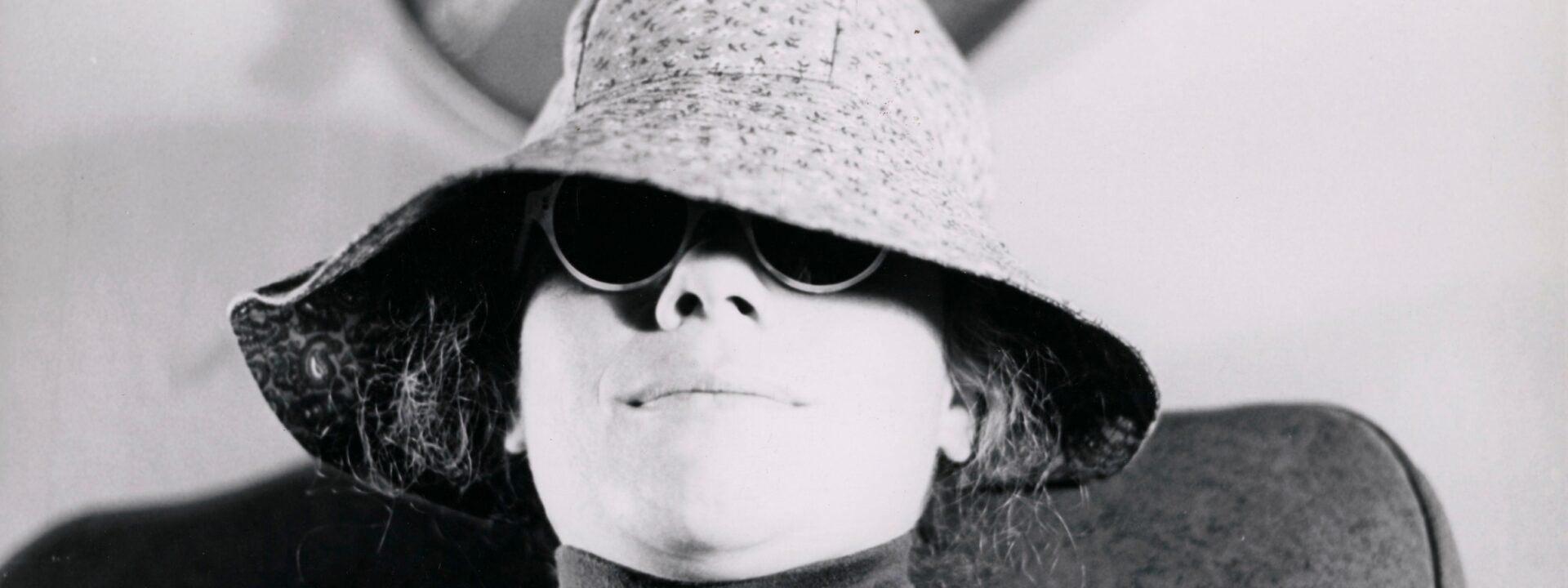
Within seconds of meeting me, artist Gladys Nilsson, 86, insists on helping me carry my suitcase over the threshold and into her home. She’s lived in a handsome brick house with Craftsman-style interiors in Wilmette, just north of Chicago, since 1976 with her husband, artist Jim Nutt, 87. The two met in 1960 when both were students at the School of the Art Institute of Chicago.
Art is everywhere—paintings, sculptures, masks, piles of papers and books, work by the two of them or their friends, plus plenty of souvenirs from decades of travel. “Stuff gets put down and it stays there and we ignore it,” Nilsson says with a deadpan delivery. Eclecticism suits them.
Nilsson and Nutt rose to fame in the late 1960s as two of the six members of the Hairy Who, a group within the Chicago Imagists. They showed funky, figurative artwork that ranged from cartoonish and whimsical to irreverent and absurd. Though the group only exhibited together for a few years, their impact on the art world was huge. They were seen as the “hot” counterpart to New York’s “cool” Pop movement.
I’ve come to visit Nilsson as she prepares for the biggest show of her career: a retrospective, aptly titled “Gleefully Askew” (after a 2019 artwork of the same name). It opens July 19 at the Crocker Art Museum in Sacramento, then travels to the Madison Museum of Contemporary Art in Wisconsin. The show includes more than 100 works made over the last 60 years, including watercolors, acrylic paintings, collages, and drawings. “It’s big,” she tells me, her blue eyes widening.
Nilsson’s stylized figures—brightly colored with wonky features and proportions, surrounded by a sense of merry chaos—are a constant in all her work. She places them in situations that might seem ordinary at first, perhaps from her fascination with everyday people-watching. But she fills these scenes with micro-dramas. Her figures cavort, cuddle, frolic, and make mischief.
While Nilsson doesn’t call her characters self-portraits, they are, of course, reflections of the person who made them—her wry humor, her perspective as a woman and a mother—and they’ve aged along with her. Planning for the Crocker show, “I was interested in looking at [the span of my work] because of how I’m using myself as a reference point for how the figures look, how the women have changed over the years,” Nilsson says. Where they were once sprightly, they now droop and sag a little.
“Gleefully Askew,” almost a decade in the making, is curated by Francesca Wilmott, who first discovered Nilsson’s work as a graduate student at SAIC. The Crocker setting is significant. Nilsson exhibited there in 1969, during the eight years she, Nutt, and their young son lived in Sacramento, after Nutt got a teaching job at Sacramento State College (now California State University, Sacramento). “Her time here was transformative. It allowed her to disentangle from the Hairy Who identity and assert herself as an individual, independent artist,” says Wilmott. “She was sending works from Sacramento to São Paulo, to Mexico City, to the Whitney, to Chicago for major exhibitions.”
One of Wilmott’s goals with this retrospective is to broaden our understanding of Nilsson beyond just her Chicago roots. “I wanted to assert her as an internationally important artist who can transcend all of these different categories that are often placed upon her work as a watercolorist, or for making purely feminine art. She is challenging and subverting a lot of those notions.”Kenberg Photography.
Nilsson was born in May 1940 and grew up on Chicago’s North Side as the only child of working-class Swedish immigrants. From a young age, she loved drawing and reading. She enjoyed Black Beauty, the Nancy Drew series, and the Little Lulu comic books about “a feisty little girl in a red dress,” as Nilsson describes her. She even gave the figure in her Gigantica paintings Lulu’s curly hairstyle. (In an essay in the extensive Gleefully Askew catalog, published by Hirmer in August, Nutt calls Nilsson’s first Gigantica painting from 1964 “the most ambitious work she had ever attempted.”)
Nilsson’s father worked at a small-appliance factory on Chicago’s South Side, and her mother was a waitress. “My mom thought a woman could be a beautician or a secretary,” Nilsson says. “There was no way in hell I was going to do either.” But her parents let her go to art school at SAIC, which still amazes her today.
When she enrolled in 1958, SAIC was a fairly traditional school, and it took time for her to develop her own style. “You went to still life class, you went to model class, and you just followed that very classical approach,” she says.
A breakthrough came when she painted a scene from the lunchroom, based on a real encounter with a group of gossipy students she didn’t like. The feedback from a teacher left her confused. “He said I had no business painting a painting like that in art school because it was too personal,” Nilsson tells me. “And I thought, This is the first time I have ever done anything that was so satisfying”—the first time she had made a painting based on something she felt, rather than something she just saw. (Decades later, when Nilsson returned to SAIC to teach watercolor and drawing, the first thing she’d tell her students was that their personal point of view was essential.)
Hoofers, 1963, ink on paper, 11 x 8 1/2 in. Courtesy of the artist, Garth Greenan Gallery, New York, and Parker Gallery, Los Angeles.
In 1962, she graduated and gave birth to her and Nutt’s son, Claude. Crucially, it was during her pregnancy that Nilsson gave up oil paints (which used toxic turpentine) and embraced watercolor. Traditionally seen as soft and feminine, the material gave Nilsson a whole new way to challenge expectations. Watercolor, she tells me, is “totally different from all the other materials just because of the nature of what it is and how it’s supposed to be used.” She chose thick paper that could absorb layer after layer of pigment to get the shading she wanted. “You can attack, depending on your surface.” She also loved the contrast between transparency and opacity that watercolors offered.
Then, in 1966, Nilsson, Nutt, and fellow SAIC alumni Art Green, James Falconer, Suellen Rocca, and Karl Wirsum joined together for a group exhibition at the Hyde Park Art Center on Chicago’s South Side. They called themselves the Hairy Who—an inside joke that started when Wirsum asked “Harry who?” as the group discussed Chicago art critic Harry Bouras.
The Hairy Who was more of a loose collective than an art movement. They were a group of quirky friends who wanted to have fun with their art while also taking it seriously. Each member had their own style. Nilsson’s work—inspired by the density of Max Beckmann’s paintings, the magical realism of Paul Klee and Hieronymus Bosch, but also Star Trek and the Popeye character Olive Oyl—might have been called the most feminine of the group (though she wasn’t the only woman; Rocca was the other), but she dealt with loud, bawdy content just like the others.
I asked Nilsson about any challenges she faced as a woman artist. “I found it was more about the material I was working with,” she says. “Watercolor? Not serious. Paper? Not serious. Funny? Not serious. That whole kind of thing, rather than: Well, she’s a woman. Not serious.”
She thinks Chicago being a smaller art town had something to do with the scene’s relative…The acceptance of women artists has evolved over time. Nilsson recalls visiting New York City in the early 1970s with visionary dealer Phyllis Kind, who represented many Chicago Imagists—including Nilsson—at her galleries in Chicago and New York. Nilsson would tag along with Kind on studio visits. “I heard them talking about all the bias they faced because they were women,” Nilsson says. This surprised her. “I was afraid to speak up and say, ‘Oh, I don’t know about that. That wasn’t my experience.’”
The Big Green Man, 1972, acrylic on canvas in artist’s frame, 86 1/2 x 74 1/2 in. Museum of Contemporary Art, Chicago. Gift of Dr. and Mrs. Peter W. Broido, 1985.29. Photo by Nathan Keay. Courtesy of the Museum of Contemporary Art Chicago/Art Resource, New York.
Nilsson’s 1973 exhibition at the Whitney Museum in New York was a turning point—not just because she was one of the first women to have a solo show there. She displayed 11 medium-to-large acrylic paintings, along with six small acrylic paintings framed in ready-made embroidery hoops. This selection showed that Nilsson was “eager to demonstrate her technical range,” writes Wilmott in the catalog.
Another major moment came in the 1990s, when Nilsson, then in her 50s, began experimenting with collages. Drawing on her skill with scissors—first developed as a child carefully cutting out paper dolls—she started using personal snapshots and old issues of Vogue, a magazine she says she’s been subscribing to “for what seems like a hundred years.” A few years later, she also began adding clippings from art history books.
Just like in her paintings and drawings, the figures in her collages have uneven features and appear in surreal settings. They become psychological explorations, “a kind of Rorschach test,” Wilmott says. They’re also easier to handle and have been a lifeline when working on larger pieces—like after a 2013 hip replacement or during the pandemic—became too difficult.
Big Birthday Gladys, 2010, watercolor, gouache, and collage on paper, 40 × 60 in. Collection of Gladys Nilsson. Photo: PD Young.
Nilsson takes me up to her studio on the third floor of her home. Her large painting Big Birthday Gladys, which she made in 2010 for her 70th birthday, is waiting for us. It has all the hallmarks of a Gladys Nilsson work: a crowd of lively characters, packed tightly together, haphazardly lighting candles and balancing cakes, their limbs going every which way. As a lovely little touch, Nilsson placed a tiny photograph of herself at age three in the bottom-right corner of the painting. She doesn’t like to play favorites, she says, but this is probably the most satisfying artwork she’s ever made. “It’s the one that a lot of people want, of course, but I say it’s mine. I gave it to myself.” Though she’s letting it go temporarily for the retrospective at the Crocker.
Preparing for the show has made Nilsson realize how much she’s accomplished in her career. “Anytime I start thinking about it, it’s like, I did a whole bunch of stuff! It’s not all the same thing. I had a lot of adventures, and I’m still having new adventures with what I’m doing,” she says. Since 2014, she has shown with Garth Greenan Gallery in New York, and in the last two years—while in her 80s—she’s created three large wall drawings for the Colby Museum of Art, the Art Institute of Chicago, and the Menil Drawing Institute. And the recognition keeps coming: In 2024, she received an Anonymous Was a Woman award.
“I think a lot of younger artists—not just women artists, but many different artists—see her as a trailblazer,” Wilmott says. Nilsson has never let expectations of what a woman artist from Chicago, working mainly in watercolor, should be dictate her practice or her life.
Nilsson acknowledges her talent—a mix of natural creative drive, a sharp understanding of art history, and a willingness to experiment—but really, it comes down to entertaining herself. “I just have fun with it,” she says, “and, happily, someone else might feel the same way.””Out of it.”
“Gleefully Askew: A Gladys Nilsson Retrospective” is on display at the Crocker Art Museum in Sacramento, California, from July 19 to November 29, 2026.
Frequently Asked Questions
Here is a list of FAQs about Gladys Nilssons art and the retrospective written in a natural conversational tone
Beginner Questions
Q Who is Gladys Nilsson
A Shes an American artist from Chicago best known for her wild colorful and often funny watercolor paintings She was a key member of the Hairy Who art group in the 1960s
Q What is so unusual about her art
A Her figures are twisted stretched and packed together in strange dreamlike scenes They look like cartoon characters mixed with folk art and she uses bright clashing colors that feel both playful and a little unsettling
Q What is the Hairy Who
A It was a group of six artists from Chicago who showed together in the 1960s and 1970s They made weird psychedelic cartoonlike art that was totally different from the serious minimal art popular in New York at the time
Q Why is this retrospective such a big deal
A Even though Nilsson has been making art for over 50 years she never got a major museum show like this one This exhibition finally gives her the full attention and respect her unique work has always deserved
Q Where is the retrospective happening
A Its currently on view at the Art Institute of Chicago
Intermediate Questions
Q What makes her watercolors so special
A She uses watercolor in a very bold untraditional way Instead of soft washes she layers intense opaque colors and uses tiny detailed brushwork She can make a single painting feel crowded and chaotic yet every inch is carefully controlled
Q What are the main themes in her work
A People relationships and the strange drama of everyday life She paints women men and animals interacting in awkward funny and sometimes tense ways Its about the weirdness of being human
Q How did the Hairy Who group influence her
A The group encouraged her to be fearless They all shared a love for comic books advertising and outsider art and they pushed each other to ignore the art world