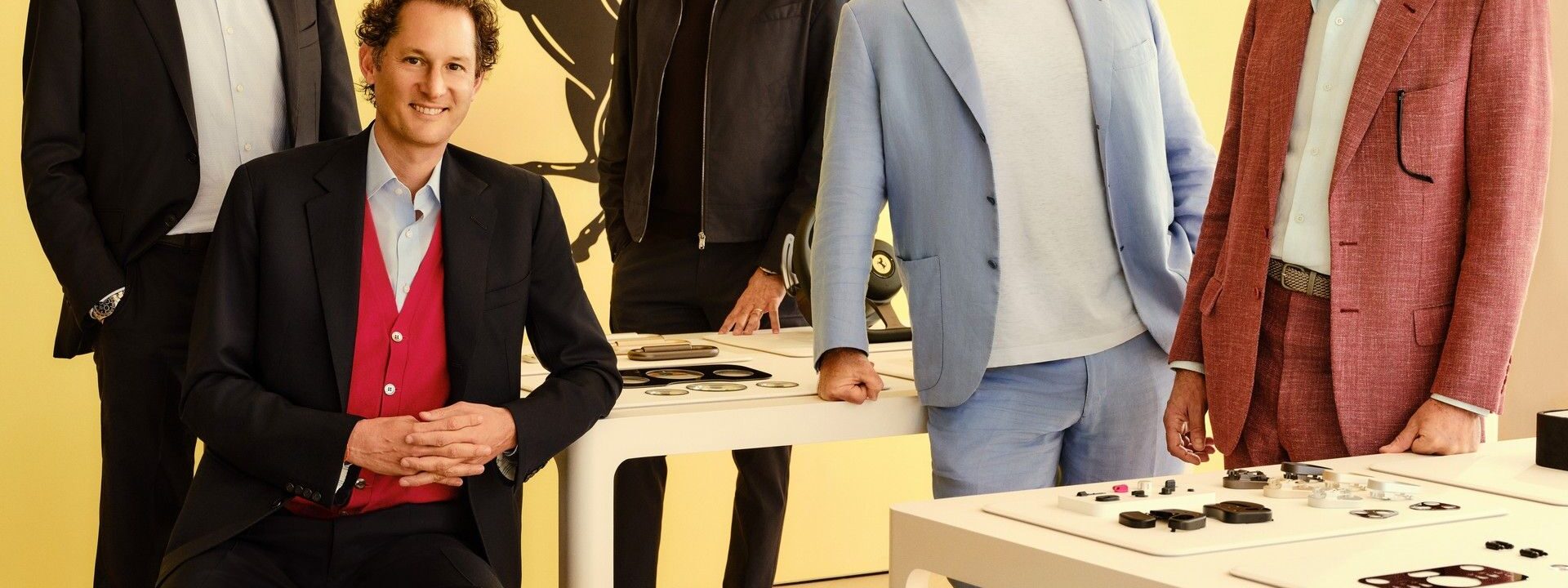
I’m not a car person, but even I can see that the Ferrari Luce is likely to set a new standard for car design.
That’s thanks, in part, to who Ferrari chose to partner with on its first electric car: Sir Jony Ive and Marc Newson, the former Apple designers whose creations set the industry standard for tech devices through their work on the iPhone, MacBook, and Apple Watch. Ive and Newson, whose creative collective LoveFrom has worked with brands like Moncler and Airbnb, brought an outsider perspective to car design. Rather than reinventing the wheel, their approach will be instantly recognizable and intuitive to anyone who’s used an Apple device.
The rollout of the Luce is coming in phases. First announced in October, this preview brought media to San Francisco to see the interior, displayed separately from the car itself, which will be fully unveiled in May. According to Ferrari CEO Benedetto Vigna, this approach is meant to draw focus to the 120 individual components—the dashboard, the steering wheel, the rectangular cassette with the Ferrari logo that serves as the car key—before the full model is revealed. Each piece is made of glass and aluminum instead of typical plastic and polycarbonate, and digital displays are balanced by real buttons and dials you can press. One of the more innovative details is a handle beneath the center console screen, which allows the driver to pull the screen in and offers a place to rest their wrist while navigating.
“One of the founding assumptions I never understood was why, if the power source is electric, does it follow that the interface must be digital?” Ive told reporters during the preview. “That’s a bizarre and lazy assumption.”
Two paddles behind the steering wheel let the driver shift gears in a fluid motion, providing a more visceral driving experience that’s often missing from engineless cars—a feature that has turned purists away from making the switch. But with the Luce, Ferrari isn’t really looking to convert anyone to the altar of electric; it’s aiming to tap a new market. Even without seeing the finished product, it’s easy to notice that the Luce (which means “light” or “levity” in Italian) is designed to be an accessible vehicle that can reach beyond collectors and enthusiasts. It’s also a sign Ferrari is moving with industry demands: last year, Italy announced $700 million in subsidies for electric vehicle purchases, in line with the EU’s 2050 climate targets.
While perhaps more accessible to a new demographic, Ferrari’s electric cars will be just as exclusive as its other models. Ferrari sells roughly 13,000 cars a year, with clients for the rarest models vetted and made to wait years for their custom deliveries. It sits at the top of the luxury car pyramid, and the moves it makes—especially in new areas—will have a ripple effect.
Ive, Newson, and Ferrari’s chief design officer, Flavio Manzoni, sat down with me after the preview at LoveFrom’s studios to discuss how the partnership came together and how good design will always be democratized. The conversation has been condensed and edited for clarity.
Vogue: Your work is likely very sought after—how do you decide who to partner with for new projects? Did Ferrari approach you to say, “We need your help designing an electric car”?
Jony: I think there are some relationships that transcend individual projects, and that’s the case with Ferrari. When we started, we didn’t really know exactly what the right thing to work on would be. We just did it for the love of working together. It was entirely about collaboration—that’s where I think we like to do things, don’t we? Where we know we’re going to learn, and we just like the people. It was the opportunity to do something new and to learn.
Marc: And the right project had to materialize organically, which it did ultimately.
Vogue: You’re not native to the car industry. What did that outsider perspective allow you to bring to this project?What does an outside perspective bring to this project?
Jony: We all agreed that bringing in an outside viewpoint was a very interesting and often original way to approach this. Ferrari certainly has no shortage of expertise, but this project was unusual on many levels. If you’re creative, the barriers between different fields are artificial. We love designing, whether it’s with Leica, Moncler, or a car with Ferrari.
Marc: The challenges are obviously different—the scale, materials, and processes vary. But there are so many similarities. The concept of cross-pollination between industries is more prevalent and relevant now than ever.
Jony: The Apple Watch is a good example. In 2011, there wasn’t really a “smartwatch” category, and there was a lot of skepticism about its value. But it’s a product that sits uniquely between technology and fashion, and it’s now the most successful watch in the world.
Marc: The functionality of that product has evolved in profound ways no one could have anticipated. You can start in one place and end up somewhere completely different. I don’t know if that will be the case with this Ferrari project, but it may take us in an unexpected direction.
Jony: The most important thing is how you work—your attitude and curiosity. I’m far more interested in learning than being right. Many people we’ve worked with just want to be right, but we have no interest in those arguments.
Vogue: Flavio, how did working with LoveFrom shape this project for Ferrari?
Flavio: In Ferrari’s history, collaborations with car design experts were common. But this is different. We were very curious about the outcome of tackling a project like an electric Ferrari with a totally different perspective. Yesterday, Benedetto [Vigna, Ferrari CEO] talked about open innovation—that’s the right term. [Jony and Marc’s] perspective and background are completely different, which was exactly the purpose of this collaboration.
This car is unlike anything in Ferrari’s history, so a different perspective was necessary. [To Jony] I like your description: “the materialization of the idea.” That’s good, and also very difficult.
Jony: The way we work at LoveFrom is unusual, and we’ve developed new methods over the years. We shared a great deal of creative research with our friends at Ferrari. It was an unfamiliar process for some, but it helped us get on the same page, see the problem similarly, and understand the opportunities. Most mistakes happen when people don’t frame the problem correctly—they solve the wrong problem or a tiny one when it should be much bigger.
Vogue: What problem did you set out to solve here?
Jony: One challenge is that while electric vehicles offer incredible opportunities, they lose something we all love: the visceral physicality of the engine. So one of our goals was to recreate that tactile connection in new ways. That’s why we became obsessed with analog mechanical controls, taking every opportunity to try and build that experience.I think that sort of connection is why authentic materials were important: glass, metal, not plastic. That was one of the big goals, wasn’t it? To solve the problem so it’s easier to use.
Marc: Ferrari made this rather bold and courageous move to work with us, which, in the context of the automotive industry, is very unusual. It shows they recognize there are other ways to solve problems.
Flavio: It’s a different approach that will certainly attract new customers. We don’t think the traditionalists are really keen.
Jony: Also, from the point of view of gender.
Vogue: I hesitate to suggest there’s a type of car for women and a type for men, but was the goal to open up Ferrari to more people? How did that factor into the design?
Jony: I think good design makes something accessible. It’s subconscious in many ways—you want to make it usable for everybody. That’s not marketing; that’s just good design. These are complex, highly sophisticated machines, and making the interface clear, obvious, and intuitive is really hard.
Marc: There’s nothing gender-specific about the way we work. In this case, it’s certainly difficult to call it masculine.
Flavio: It will probably be the most versatile Ferrari ever made.
Jony: That’s a lovely thing to say. I think you’re exactly right.
The Luce is Ferrari’s first electric car.
Vogue: When you look at your other designs, they’ve become ubiquitous. But Ferrari is exclusive. Could this type of design be democratized? Do you see it influencing the rest of the car industry, like Apple? Or do you approach designing for exclusivity differently?
Jony: My attitude has changed over the years. Before, if something like the phone or watch was copied, I had a slightly juvenile response—it felt like theft. Now, as I’m older, when you’re working on something, you’re aware it will have an influence far beyond the specific product. We feel sure there are principles and themes we’ve discovered that I hope will have an impact beyond this car.
Marc: Ferrari is a great place to start, right? We’re starting at the top of the pyramid. I’ve done a lot of work in the so-called luxury sector. It’s controversial in many ways, but it’s always the best place to start—with people who execute ideas correctly.
Flavio: The process at Ferrari is very different from other brands. There’s a kind of teamwork across all departments. Other brands normally do clinic tests to see if a new car’s design is well-received by potential clients. We never do that. We believe that, as a team, we can understand what a new product should be based on objectives like performance. Every time, we have to outdo previous performance and surprise our clients. It’s a kind of symbiosis we have internally that helps us define the characteristics of a new product. We invest in it and believe it will be successful.
Jony: What focus groups generally do is make sure you don’t offend anyone. They never inspire. It’s our job as designers to try to figure out the future. It’s not fair to ask a consumer, “What do you want?”
Flavio: We try to avoid any homogenization. Every product must be different and must anticipate certain trends. As Ferrari, we have to be ahead of the others.
Marc: So that’s why Ferrari will do this, and everyone else will do extrapolations of it.
Jony: I think it’s nice to point out—and remember—that it’s an uncomfortable place to be. To be courageous, you’re vulnerable. I think of John Elkann…The courage and support from Exor [the holding company that owns a stake in Ferrari] and Benedetto are so easily overlooked. Their conviction and resolve to make this project happen and back our direction have been really important.
Marc: I think it also extends to the fact that we’ve brought in people like you, who don’t come from the traditional automotive industry. That, in itself, is an expression of doing things in a slightly different, more adventurous way. It’s another way for us to understand what we’re doing—to see the bigger picture and the larger cultural context.
More from this author:
Why Moncler Chose Aspen for Its Second Grenoble Store
Jonathan Cohen and Larroudé’s Partnership Is a Playbook for Modern Fashion Production
Authentic Brands Group Acquires Guess IP
Frequently Asked Questions
Of course Here is a list of FAQs about Ferraris partnership with LoveFrom for its first electric vehicle designed to sound like questions from real people
Beginner General Questions
1 Whats the big news about Ferrari and Jony Ive
Ferrari has officially partnered with Jony Ives design firm LoveFrom to help design and create its very first allelectric car
2 Who is Jony Ive and why is this a big deal
Jony Ive is the legendary former Chief Design Officer of Apple Hes the mind behind the look and feel of iconic products like the iMac iPod and iPhone His involvement signals that Ferrari is aiming for a groundbreaking minimalist and userfocused design for its EV
3 When will this Ferrari electric car come out
Ferrari has stated its first fully electric model will launch in late 2025 The specific model designed with LoveFrom is expected after that likely before 2030
4 Will this electric Ferrari still look like a Ferrari
Thats the key question While it will have a new electric platform Ferrari and LoveFrom have promised it will be authentic to Ferraris spirit Expect it to be unmistakably a Ferrari but with a radically new and modern design language
5 Is LoveFrom building the entire car
No LoveFrom is a design and creative consultancy They are partnering with Ferraris own legendary design team led by Flavio Manzoni on the design user experience and possibly the interior interface Ferrari will handle the engineering and manufacturing
Advanced Detailed Questions
6 What specific areas will LoveFrom likely focus on
Beyond the exterior shape experts expect LoveFrom to deeply influence the humanmachine interface the digital cockpit material selection and the overall feel of the interiorareas where Apples design philosophy excels
7 What are the potential benefits of this partnership for Ferrari
Brand Modernization It aligns Ferrari with cuttingedge tech and luxury aesthetics
UX Revolution It could redefine the digital driver experience moving beyond traditional gauges
Design Legacy It ensures the first EV isnt just an engineering exercise but a design icon from day one