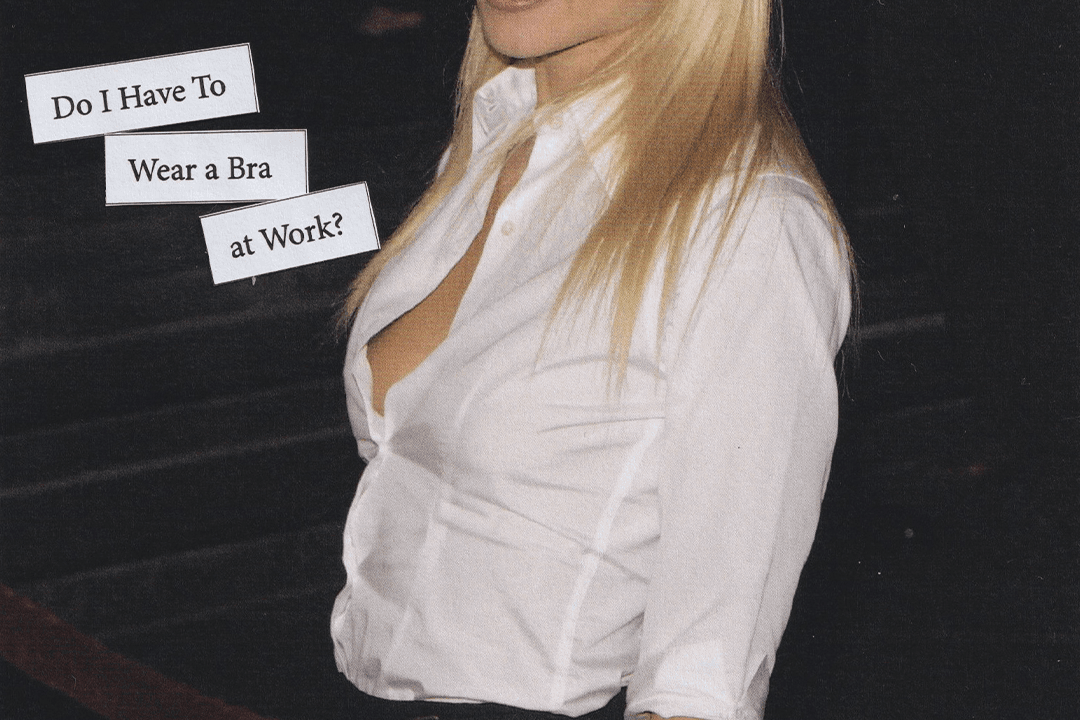
Every few years, headlines pop up about women boldly going without bras. Lately, it’s whispers about Gen-Z bidding farewell to annoying underwires or ditching bras entirely. Could this renewed rejection be tied to confusion over return-to-office dress codes after the big work-from-home shift during COVID? Maybe. But leaving the bra in the drawer isn’t new. Back in the 2010s, it was all about #freeingthenipple, with celebrities like Kendall Jenner and Rihanna wearing sheer tops. Or ask your mothers or grandmothers about the late ’60s, when second-wave feminists, fed up with restrictive cups, bands, and hooks, held a wave of “I-am-woman-hear-me-roar” bra burnings.
So, how does the bra debate play out in the workplace? It varies. When I worked in magazines, I rarely wore a bra; my small chest hardly showed through the thin cotton or silky viscose I wore. I also worked mostly with women—no spreadsheets or straight men in sight. If a hint of an areola showed, I never heard about it.
Before magazines, though, I had jobs with unspoken dress codes. Prior to Vogue, I was a young woman sitting at a desk, wearing a plain beige bra from TJ Maxx, my breasts supported by underwire. I sold business memberships for a soft-spoken Hasidic man in Chelsea and later translated foreign commodities news for a startup. Never a trace of a nipple or visible flesh.
Why did I follow this unspoken rule in a corporate setting? As I mentioned, I’m very flat-chested, so a bra isn’t always necessary. But subconsciously, I must have felt I needed to wear one because everyone else did.
I reached out to Batsheva Hay, a designer known for frilly dresses who used to be a lawyer. She gave a straightforward answer: “The job is about being acceptable, pleasant, and unnoticeable. No body shapes that aren’t perfectly rounded. It’s weird that many bras are meant to perfect, but it’s really about erasing. You don’t want to be noticed.” Her response felt outdated. I wondered, what if the air conditioning is blasting? Is a little nipple really that bad? Hay told me to grow up: “You want to focus on your work. We work for the man. You don’t want people staring at your nipples.” I asked, “Do you mean ‘the man’ or ‘a man’?” She replied, “Corporate, but usually, the man is a man… that’s the reality.” So much for my idealistic vision of a women-led workplace!
As a lawyer, Hay rarely left her desk (or her Blackberry), and if she wasn’t wearing a bra, she’d always put on a “forgiving blazer.” The only time she escaped her demanding job was an annual La Perla sample sale. She’s been out of the corporate world for ages, so has it changed? She suggested I call her accountant, Zellerita St. Louis, a mother of three who has been in the business since the 2000s. St. Louis said, “It’s very subjective and depends on personal taste. In corporate America, we all know what’s presentable and when. You dress differently based on where you’re going or who you’re meeting.”
St. Louis also noted that bra-wearing is cultural. “I’m a first-generation American. My mother is from Panama, and appearance was everything to her. She was very old-school, so I was raised to always wear a bra. It became innate.” She added, “As an Afro-Latina and Black woman, I feel even more pressure to be perceived a certain way. It was important for me to fit the professional image, which, according to society, included wearing bras.”
Looking for another perspective, I called up my former Vogue colleague.Emily Farra, who now works in-house for a New York brand, has always represented the height of professionalism in my view—and yes, she definitely wears a bra to work. “Putting body politics aside, it comes down to the double standard in how women are perceived and the pressure to look ‘presentable,’” she explains. “In a typical office, if your hair is messy, your nails are chipped, or you’re noticeably not wearing a bra, it might be noted or judged, even subconsciously. Meanwhile, a man can wear a wrinkled shirt or ill-fitting pants and it hardly matters as much, because as a society we aren’t conditioned to prioritize evaluating their appearance above all else.”
Braless at Tory Burch, fall 2026
Photo: Daniele Oberrauch / Gorunway.com
Read More: Why Are Climate Activists So Upset About Kim Kardashian’s Nipple Bra?
By Rachel Cernansky
How frustrating for those who dream of going braless at their desk! A bit of cleavage? A visible nipple? What’s the issue?! Billionaire Kim Kardashian—herself an aspiring lawyer—released a bra with perky, built-in nipples last year, after all. Though, as Hay noted, “that makes no sense to anyone who actually works in the corporate world.”
Yes, the bra question is personal. They’re your breasts, your body! But we also have to consider the reality of others and avoid causing distraction, however minor. When unsure, it’s safer to fasten your bra. You never know when the air conditioning might be cranked up.
This column focuses on the art of getting dressed. If you have a pressing style question, ask us! Download the Vogue app and visit the Style Advice section to submit yours.
Frequently Asked Questions
FAQs Do I Have to Wear a Bra to Work
Beginner General Questions
Q Is it a legal requirement to wear a bra at work
A No there is no general law that requires anyone to wear a bra Workplace dress codes must be reasonable nondiscriminatory and applied equally
Q Can my employer make me wear a bra
A They can include dress code requirements for professional appearance or modesty which may be interpreted to include undergarments like bras However such policies should be clearly communicated jobrelated and consistent for all employees in similar roles
Q What if my workplace has a formal dress code
A Formal or business professional environments often have stricter unwritten expectations about appropriate undergarments Its best to review the official policy or observe what is standard for your office
Q I find bras uncomfortable What are my options
A You have several comfortable alternatives including
Bralettes or Sports Bras Often made from soft stretchy fabric
Camisoles or Tank Tops with Builtin Shelves Provide light support and coverage
Nipple Covers or Petals Offer discreet coverage under clothing
Going Braless If your clothing and workplace culture allow it
Advanced Specific Questions
Q What if a bra requirement feels discriminatory or targets women unfairly
A If a dress code policy is applied inconsistently or creates a hostile environment it may be considered discriminatory You can discuss this with HR framing it as a question of equity and professional standards
Q How should I handle it if a manager or coworker comments on me not wearing a bra
A If the comment is inappropriate or makes you uncomfortable you can respond professionally My attire meets the companys dress code Id prefer to keep the focus on my work Report any harassment to HR
Q Are there industries where going braless is more accepted
A Yes Creative fields casual retail or remoteworkfromhome roles typically have more flexible relaxed dress codes where personal choice is more common