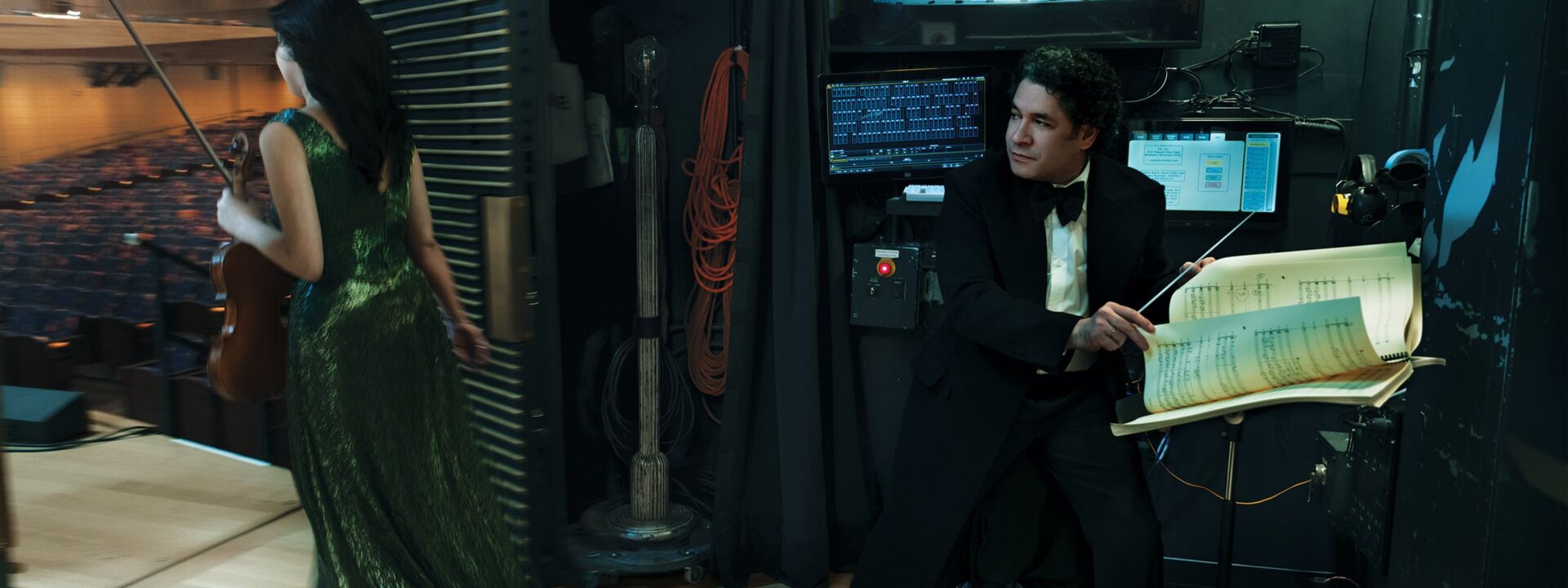
The rain is unpleasant, but it feels fitting that the skies have opened just as Gustavo Dudamel’s car pulls up outside New York’s historic United Palace theater. Sunshine is sweet and silent. Storms can keep a beat.
It’s spring, and the former child prodigy conductor—now a respectable 45—is still a few months away from becoming the music and artistic director of the New York Philharmonic. Since the appointment was announced in 2023, he has been making a long and joyful first impression on his new city. In April, at an annual fundraising gala, philanthropist Barbara Tober called Dudamel “our gift from God.” A few weeks later, a friend whose musical tastes lean more toward Shaboozey than Schubert posted a selfie from Lincoln Center for the Performing Arts, with Dudamel’s signature curls bouncing in the background. At the end of a concert I attended this spring, women with hearing aids cheered and shouted. A man in a tuxedo stomped his feet. After a required encore, crowds spilled out onto the plaza at Lincoln Center, buzzing about the ethereal arrangements of Igor Stravinsky.
Today, at the United Palace theater in Washington Heights, Dudamel is greeted by a more composed audience of staff members. “Hola, maestro,” says a porter as Dudamel strides across the lobby. The Venezuelan-born conductor greets him in return. He has arrived to rehearse the first-ever joint performance by the 184-year-old New York Philharmonic and the 25-year-old Spanish Harlem Orchestra. Dudamel will hold the baton, blending classical and salsa music with the loving skill of a musician raised on both. The conductor has long enjoyed genre mash-ups that might otherwise sound like AI prompts. What would a collaboration between Foo Fighters and Beethoven sound like? His repertoire at the Los Angeles Philharmonic, where he spent the past 17 years, included stirring performances of Mahler and Philip Glass, as well as the Star Wars score. He has conducted at Coachella, voiced a character named Trollzart for the Trolls World Tour movie, and is said to have inspired the book and series Mozart in the Jungle. This past summer, he conducted the Muppets in a version of “Seven Nation Army” at the World Cup Halftime Show.
Later tonight, the two orchestras will perform Leonard Bernstein’s Times Square: 1944 (“New York, New York! / It’s a helluva town!”) and Brazilian composer Heitor Villa-Lobos’s lively Toccata. Dudamel and I meet before the rehearsal in his dressing room—stocked with Brazil nuts and popcorn—where a group of assistants and publicists awaits his instructions. Still, he brushes off reports of Dudamania. “It’s not only that I move beautifully my hands in front of an orchestra,” he says, using the lilting phrasing of someone who still translates from Spanish to English. “It’s that we have to go deep, and they have to feel that it’s honest.”
Dudamel was born in Barquisimeto, one of Venezuela’s larger cities. His father, Oscar, is a classically trained trombonist and sometimes performs with him. (He’ll be among the musicians at the United Palace.) His mother, Solange, sang. He picked up his first instrument as a preschooler, tapping out a rhythm on a güira, a percussion instrument, while his father was playing. “Who’s that?” his father asked, hearing the beat.
He insists he showed no extraordinary talent then, but his interest was clear, and Oscar decided to enroll his son—now with a violin—in El Sistema, Venezuela’s beloved and famous nationwide music program for children. His grandparents adored Gustavo, but they worried about his future. “Who will be able to stand all the noise in the house?” his grandfather once asked. A professional musician uncle was more encouraging, introducing him to the organ and the cuatro, a Latin string instrument. “He said, ‘Look, son, you’re going to play all of this music around the world,’” Dudamel recalls.
At El Sistema, intensive rehearsals were held over the weekend, and DuDudamel made his closest friends in the program. One morning, when their conductor was running late, Dudamel stood in front of the group and mimed the motions. His peers responded to him—he had a natural ability to command a room. José Antonio Abreu, the founder of El Sistema, took Dudamel under his wing, moving him to the first chair position in the violin section and then encouraging him to conduct. Abreu told his student he had duende, a Spanish word that literally means “goblin” but is more poetically used to describe the force that drives great artists. “It’s this kind of instinct,” Dudamel recalls Abreu telling him. “That’s duende.”
Dudamel was only 23 when he burst onto the international scene, winning a prestigious conducting competition in Germany and immediately radiating the kind of star power usually linked to pop stars and athletes rather than classical musicians. Orchestras worldwide began inviting him to perform, and his appearances drew both media attention and speculation about his future.
The praise was so glowing that Matías Tarnopolsky, now the president and CEO of the New York Philharmonic but then its newly appointed artistic administrator, asked Dudamel if he could visit him in Caracas. “I got on a plane in 2006, within weeks of starting the job,” Tarnopolsky recalls. Dudamel drove him around in a Mustang, and the two quickly hit it off—Dudamel played folk music for Tarnopolsky, who was born in Buenos Aires, tunes he hadn’t heard since childhood, while his passenger gripped the dashboard. (“I thought, Oh my God, I’m going to die here,” Tarnopolsky remembers.) Dudamel made his New York debut in 2007.
He performed in Chicago around the same time, and during the audition process, he was whisked away after his first rehearsal on the private plane of Deborah Borda, then president of the Los Angeles Philharmonic, who was eager to sign him. She flew him back to Chicago the next morning, with the unsuspecting orchestra having no idea he’d been hired out from under them. Dudamel officially joined the LA Phil at 28 and went on to hire nearly half of its current musicians during his time there. The orchestra’s feel quickly changed. He was loved “from day one,” says Julie Andrews, who happens to be on the board. “They moved, and they swayed, which they had never done before. He freed them up.”
One achievement that especially heartens Dudamel, though, is his role in creating the Youth Orchestra of Los Angeles (YOLA), which he modeled on El Sistema. The group provides instruments and music education to children from across Los Angeles, including its poorer neighborhoods. Not long after it started, Jamie Bernstein, daughter of the iconic composer-conductor Leonard Bernstein, came across a clip of Dudamel conducting YOLA’s rendition of the mambo from West Side Story. “Some of them looked like they couldn’t have been more than 14,” she recalls of the musicians, “and they were just playing the daylights out of it. I thought, Wow, I’ve never seen anything like this before. And then I thought, Oh, it’s the same vibe as my dad.” She went to Venezuela to meet Dudamel, and the two have been friends ever since. Years ago, she surprised him with one of her father’s vests. “He just put it right on,” she remembers.
Jamie isn’t the first to compare Dudamel to Bernstein, a towering predecessor and the only other conductor whose name might reasonably appear as a Jeopardy! clue. Bernstein understood that classical music needed an evangelist and a face; it’s Dudamel’s charisma—not his skill at interpreting Chopin—that makes a lunch table of high school students look up from their sandwiches when he walks past them at Lincoln Center during the photo shoot for this profile and shriek. His signature hair helps too. (He confirms he’s never used gel or mousse, but he does make an effort to visit salons familiar with its texture. Once, in Sweden—land of the tall and blond—a hairdresser refused to touch a single strand. “I think he saw an alien,” Dudamel says.)Dudamel is humble, but he’s not blind. “Artists have an ego, and it’s natural,” he says a few days later. We’re talking about the highs and lows of Los Angeles, where stars and their self-importance can easily get out of hand. Dudamel inherited his mentor Abreu’s belief that music can build bridges and point toward a better world. “What happens in an orchestra is fascinating,” he says. “Different instruments, different cultures, different visions. Different people with different political views. That’s what we need in the world.”
At times, Dudamel’s steady optimism has looked to his critics like willful ignorance. In past years, he faced sharp criticism for continuing to work in Venezuela while its then-president Nicolás Maduro silenced dissent and pushed the country into a series of humanitarian crises. Even though he was one of its most visible, if unofficial, cultural ambassadors, Dudamel stayed quiet as Venezuela fell apart. He resisted the pressure until 2017, when he finally broke with the regime in an op-ed denouncing its anti-democratic crackdown. The government then made it clear he shouldn’t return. When Abreu died in 2018, Dudamel missed the funeral. Even now, he avoids commenting on Venezuela’s political situation, saying instead that his focus is on El Sistema—which depends on government funding—and on humanitarian aid. In August, his final performance with the Los Angeles Philharmonic will be a benefit concert for earthquake relief. “There’s still a lot of hope there,” he says.
He’s not naive, just disciplined and decades older than when classical music first hailed him as a savior. His wild curls have started to gray. Sometimes it’s his teenage son, Martín, who introduces him to new music. (Martín’s mother is Dudamel’s ex-wife, Eloísa Maturén; he married Spanish actress and director María Valverde in 2017.) Midway through our conversation at the United Palace, it occurs to Dudamel that he should be exercising more, to keep up with his frantic schedule. More than once, his emphatic gestures have given him tennis elbow.
With more perspective now, he thinks a lot about where orchestral music is headed. “We have to break the idea that classical music isn’t connected to the present,” he says. He can’t resist pointing out that Timothée Chalamet—who overshadowed his own Oscars campaign last year by saying he didn’t want the film business to become something “no one cares about anymore”—was in the audience when Dudamel brought the LA Phil to Coachella. “It’s important to show that classical music, ballet, all of these art forms are alive,” he says with a grin. “It’s our responsibility as a new generation of artists to understand that we can’t be lazy.”
Change is inevitable, even when it’s hard. He feels that as he prepares to wrap up his long farewell to Los Angeles, where he’s made an incredible number of friends and worked with several of them, including Natalie Portman, director Alejandro González Iñárritu, chef and philanthropist José Andrés, and Bradley Cooper and Cate Blanchett—each played conductors in Maestro and Tár, respectively. Blanchett tells me she has “never been in the presence of an artist who leads with such joy, such love.” He’ll miss LA, though pieces of it—and people from it—are coming with him. He and his wife have been renting an apartment on the Upper West Side and plan to stay near Lincoln Center. Julie Andrews laughs when she tells me she just moved from Los Angeles to Sag Harbor, New York. Not for Dudamel, she assures me, but it does mean she’ll still be able to see him in concert.
When I ask whether it’s hard to get used to New York’s unpredictable weather after decades in temperate LA and tropical Caracas, he thinks for a second and then smiles. Dudamel is tuned to a different kind of atmosphere. During one of last winter’s blizzards, he took shelter at Tarnopolsky’s place.The president and CEO was at the stove, cooking. “Yes, it was snowing, but it was so warm inside.” In this story: grooming by Levi Monarch; tailoring by Tae Yoshida for Carol Ai Studio Tailors. Produced by Boom Productions Inc.
Frequently Asked Questions
Here is a list of FAQs about Gustavo Dudamels performances with the New York Philharmonic written in a natural helpful tone
General Questions
Q Who is Gustavo Dudamel
A Hes a worldfamous conductor from Venezuela known for his incredibly energetic and passionate style on the podium Hes been the Music Director of the LA Philharmonic and is about to take over the same role at the New York Philharmonic
Q What does freespirited and freewheeling mean in this context
A It describes Dudamels conducting style He doesnt just stand stiffly and beat time he moves fluidly dances and uses his whole body to draw intense emotion and sound from the orchestra Its a very exciting and unpredictable way to watch music being made
Q Is this his first time conducting the New York Philharmonic
A No he has conducted them many times before However this particular concert series is special because its part of his final appearances before he officially becomes their next Music Director
Q When will he officially become the Music Director
A He begins his tenure as Music Director in the 202627 season
Q What kind of music does he usually conduct
A A little bit of everything Hes famous for his interpretations of the big Romantic symphonies but hes also a huge champion of new music and loves to program works by Latin American composers
About the Concert Program
Q What pieces will they be playing at this specific concert
A Programs change but for this specific series he is leading the orchestra in a performance of Gustav Mahlers Symphony No 1 often nicknamed the Titan Its a massive emotional work that perfectly showcases his dramatic style
Q Is this a good concert for someone who has never been to the symphony before
A Yes absolutely Mahlers First Symphony is incredibly accessible It has famous soaring melodies a very dramatic middle section and a huge triumphant finale Plus seeing Dudamels energy live is a spectacle in itself
Q How long is the concert