Intimate Audrey, a new biography of Audrey Hepburn now available from Grand Central Publishing, features images that feel instantly recognizable. There’s Audrey with the French writer Colette, whose novella Gigi gave Hepburn her first Broadway role; Audrey in the garden of her Swiss home, La Paisible; and Audrey greeting director William Wyler as Gary Cooper watches during the filming of Love in the Afternoon. These are the pictures that have cemented her in our collective memory as a poised, luminous, fully formed star.
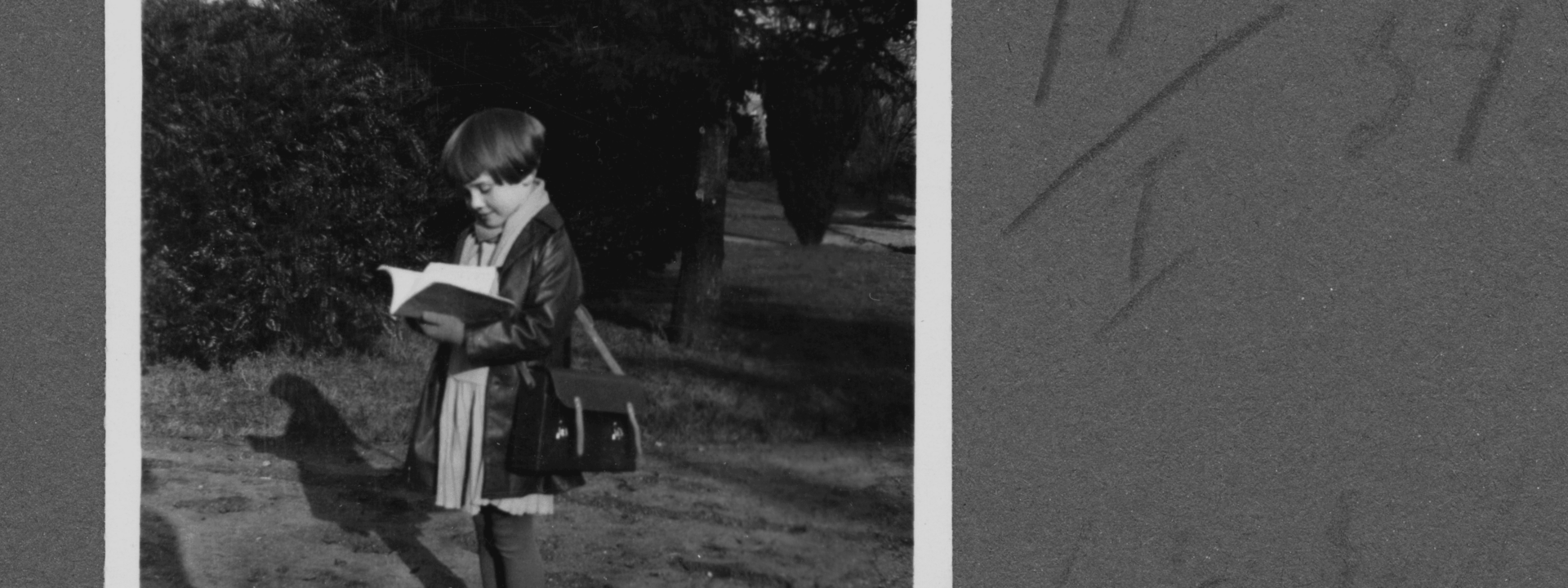
But what truly lingers—what will make even the most devoted Hepburn admirer pause—are the book’s childhood mementos. A photograph taken shortly after her birth in Brussels. A snapshot of a small girl standing alone, absorbed in a book. And, most unexpectedly, a series of delicate drawings: dresses sketched with careful strokes, Christmas scenes imagined in soft watercolors, children gathered in quiet anticipation. These are not the work of a future icon, but of a child—one whose life, as her son Sean Hepburn Ferrer emphasizes, was shaped as much by absence and hardship as by her own imagination.
Intimate Audrey, co-written with former war correspondent Wendy Holden (no relation to actor William Holden), is Ferrer’s second book about his mother, following 1999’s Audrey Hepburn: An Elegant Spirit. While he describes that first work as “an emotional… a spiritual biography,” this new volume aims to be more definitive.
“Every year people would ask, ‘When are you going to publish the ultimate, the authorized, the real biography about Audrey Hepburn?'” he explains. “Finally, I thought, if I’m going to do this—because, like the Hippocratic Oath, you don’t treat your own family members—I needed someone to be a filter, to be the liver of this book.”
The structure quickly took shape, beginning with the Second World War and concluding with Hepburn’s work as a UNICEF ambassador. “We sat down and started creating a spine—a skeleton for the book,” he says. “You realize very quickly that everybody knows the films, and there’s not much new to tell there. She was a professional, she was nice to the crew, she showed up on time, she didn’t make scenes.” What interested him instead were the quieter, more difficult truths. “Through the little things, you get to realize who the person was,” he notes. “Because she’s becoming—or has become—such a legend, she’s sort of floating away like a balloon at a birthday party, and I wanted to bring her back and ground her again.”
Those “little things” are not always gentle. Hepburn’s father left when she was six, walking out of her life without warning—an event she later described as the most traumatic of her childhood. She cried for days, and the loss stayed with her well into adulthood. It is this kind of intimate, destabilizing, deeply human detail that Ferrer returns to again and again, not to diminish the myth, but to contextualize it.
The drawings included in the book, many of which survived the war tucked into family albums, offer a glimpse into her interior world. One, dated 1944, shows children watching a puppet show—an image of innocence created in the midst of wartime. Another depicts a lit and decorated Christmas tree, at a time when such abundance would have been out of reach. “They really had nothing during the war,” Sean says. “So it’s a child’s hope of what the world will be like when things go back to normal—the expectation, the dream.”
That tension—between austerity and imagination, between hunger and beauty—would come to define Hepburn’s adult life as well. “I wanted to say to people, she’s a real story, she’s a real person,” Ferrer says. “She had to struggle—and yet she became this extraordinary figure.”Audrey Hepburn remained a lovely, decent, and humble person, even after becoming an iconic star.
Through this book, Ferrer aims to create a kind of guided album: part memory, part interpretation, and part quiet act of preservation. Below are some of the images—and their stories—that left the deepest impression on him.
Audrey as a baby, Brussels, 1929
Photo: Courtesy of the Hepburn family collection
“This was taken right after her birth in Brussels, while her parents were still together. She looks about 10 to 12 weeks old, so it was likely the summer of 1929. They must have propped her up on a pillow shortly after bringing her home. Someone had a camera, or they asked someone to take the picture.”
Audrey with a book, Belgium, early 1930s
Photo: Courtesy of the Hepburn family collection
“Here she is holding a book. Based on her passport photos and another picture of her on a bench with French writing, I’d guess she was either going to or coming from school in Belgium. This was before she went to the UK and before she returned to Holland during the war.”
Audrey with her Father, Brussels
Photo: Courtesy of the Hepburn family collection
“She was six when her father left. They were still in Belgium at the time, so this must have been taken before he walked out… This would have been at their house outside Brussels—a slightly greener area just outside the city center. They lived first where she was born, then moved to this home.”
Drawing of dresses and a Christmas scene, c. early 1940s
Photo: Courtesy of the Hepburn family collection
“These are wonderful illustrations she made—pretty dresses, inspired by Christmas, with a Christmas tree and mistletoe. She always had a natural ease for drawing. She never pursued being an artist professionally, but she had the skill… and my daughter has inherited that talent. Later, while working on films, she made lovely sketches of her costumes with little fabric samples attached, showing what each dress would look like.”
Drawing of a child at Christmas, c. 1940s
Photo: Courtesy of the Hepburn family collection
“They had almost nothing during the war, so this reflects a child’s hope for what the world would be like when things returned to normal—that sense of expectation. We weren’t an American family, so Thanksgiving wasn’t part of our tradition. Christmas was when we all came together as a family… we would gather for about 10 days or two weeks, from just before Christmas until after New Year’s. It was a time to reconnect and share what everyone had been doing.
She was a wonderful cook. She loved preparing desserts—pavlova, her French chocolate cake, things she enjoyed making. And in the European tradition, you eat fish at Christmas, so our Christmas dinner would be wild salmon or roasted fish with baby potatoes, tartar sauce, cucumber salad—dishes like that.”
Drawing of children watching a puppet show, 1944
Photo: Courtesy of the Hepburn family collection
“That’s from 1944, near the very end of the war. She painted this as a kind of dream of what life would be like after the war—since for them, the war didn’t end until May 1945. This drawing is really about imagining a better future.”
Save to wishlist
Intimate Audrey: An Authorized Biography
$28 | BOOKSHOP
Frequently Asked Questions
Of course Here is a list of FAQs about Audrey Hepburns childhood framed around the theme of Six Heartfelt Moments in a natural conversational tone
FAQs Audrey Hepburns Childhood in Six Heartfelt Moments
BeginnerLevel Questions
Q Why is Audrey Hepburns childhood considered so difficult
A She lived through World War II in the Netherlands during the Nazi occupation She experienced nearstarvation witnessed violence and her family was deeply affected by the war
Q What was the Hunger Winter and how did it affect her
A The Hunger Winter was a famine during the war Audrey like many Dutch survived on very littleoften tulip bulbs and nettle soup This caused lifelong health issues like anemia and shaped her empathy
Q I heard she was a dancer as a child Is that true
A Yes She trained in ballet secretly during the war performing to raise money for the Dutch resistance It was a passion and an escape though malnutrition prevented her from becoming a professional prima ballerina
Q Did her childhood influence her work with UNICEF later in life
A Absolutely She said her own experience of being a starving child rescued by UNICEF aid made her dedication personal She understood the trauma and need of children in crisis firsthand
Advanced Detailed Questions
Q How did her fathers absence shape her childhood
A Her father Joseph Ruston left the family when Audrey was six She described it as the most traumatic event of her life creating a lasting wound and a deep longing for a stable family which she later sought with her own children
Q You mention heartfelt moments Whats an example of a positive one from that dark time
A One powerful moment was her work for the Dutch resistance As a young girl she would deliver secret messages or perform silent dances to raise funds It was a moment of bravery and using her talents for good amidst the fear
Q What are some common misconceptions about her early life
A People often think she was from a wealthy aristocratic English family In reality her childhood was marked by poverty war and instability in the Netherlands and Belgium Her elegance later in life was in stark contrast to her difficult youth