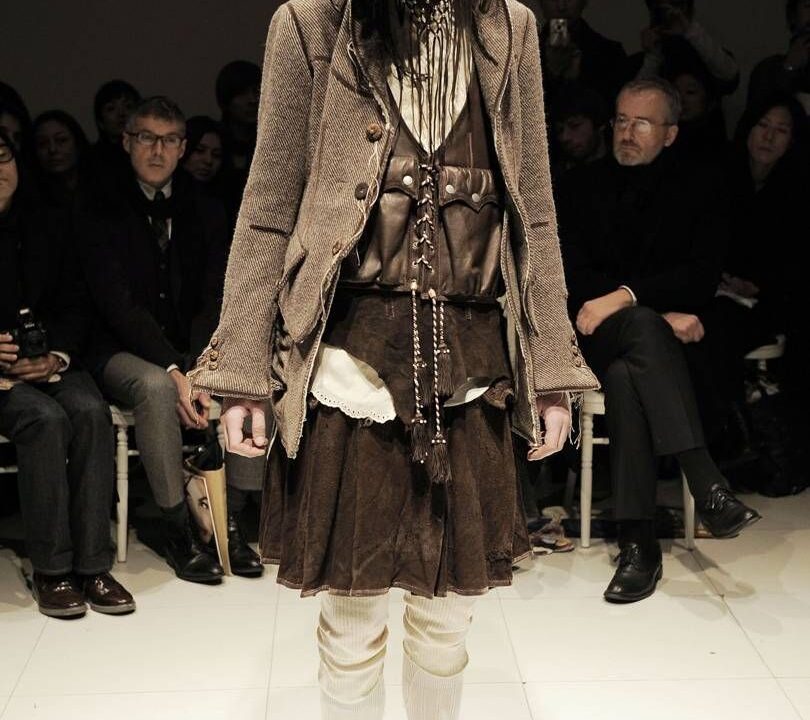
Takahiro Miyashita has a talent for breaking up and making up, much like a rebellious band member or an unruly lover. The 53-year-old Japanese designer, who founded the cult label Number (N)ine in 1997, is relaunching the brand 15 years after stepping away.
After leaving, he started TakahiroMiyashitaTheSoloist (or The Soloist), but departed last year with a cryptic Instagram post: “Rock and Roll never dies… The music keeps on playing, louder and louder. Just on a different stage. A new band, a new noise, catch me there.” It was a teaser for his return to Number (N)ine—though the details were as mysterious as the designer himself. So I went to meet him.
On a rain-soaked day in Tokyo, I arrive at a boardroom in his PR’s office, unsure what to expect. Miyashita is known for being guarded, and interviews with him are rare, as are photographs. His reticence once earned him the nickname Taka the Oyster. Eugene Rabkin, founder of the magazine StyleZeitgeist and one of the few journalists to have met Miyashita, says the designer was cautious during their first interview in 2017. “I think that’s because he is careful that his work is precisely understood, but we bonded over our mutual love of youth culture, and we have kept in touch,” Rabkin says. “He is one of the most genuine people I know.”
When Miyashita arrives, he is dressed head to toe in black. Spectacles hang from a thick black chain around his neck, and he wears a nylon Patagonia windbreaker. He is known for sensitive designs and a deep, melancholic love for music and poetry, but his first impression is confident—even tough. “I don’t open up easily,” he says. “I’m a closed-off person. I’ve always said that what I want to communicate is expressed through my designs, so I don’t think interviews are important.” Under his left eye is a small teardrop tattoo—a symbol I’ve heard gang members in the U.S. get after committing murder. Gulp. But Miyashita’s reason is innocent. “I didn’t know the meaning when I got it,” he laughs. “I haven’t killed anyone. I just think shedding tears is an important, beautiful thing.”
The most dangerous thing about Miyashita is his knack for leaving audiences stunned—or even weeping—at his runway shows, which often feature waifish models in romantic clothing. He is fashion’s original sad boy. His designs over the past three decades, spanning gorpcore to grunge, are crafted with masterful sensitivity, an intoxicating balance of punk and poetry. Even the simplest garments are enlivened with delicate details: a whisper of lace on a hemline or an edged neck on a tank top. Romance appears in dandyish jackets with panels of brocade and Americana inspired by Miyashita’s formative travels to the States as a teen. I remember, after one of his Paris shows for The Soloist in 2018, a usually stern buying director, sparing with her praise, reverently whispered: “It’s absolutely incredible what he does.”
Number (N)ine’s relaunch has been brewing for years. “I started thinking a lot about the future during the pandemic,” Miyashita says. “I’d never really heard of a fashion brand reuniting, restarting, or reviving [from the owner], so I thought it might be fun to try it.” Though he publicly announced his departure from The Soloist in July 2025, he had actually become an external contractor for the company four years earlier, significantly scaling back his involvement. “I’m sorry to my fans, but the truth is that four years ago, my feelings drifted away from it,” he says.
His first label’s history is also long and complex. When Miyashita left Number (N)ine, the brand continued, albeit in a much-reduced capacity, with a differentThe logo does not involve any creative input from Miyashita himself. He retains sole ownership of the scripted logo bearing his name. “I just want to quietly resume Number (N)ine on my own,” he says. A simple way for fans to tell the difference is the font: “You can assume that anything that doesn’t have my handwritten cursive name isn’t my Number (N)ine.”
Long after Miyashita’s departure, the original label has enjoyed remarkable longevity and cultural relevance as an archive fashion brand. It has gained clout among young millennial and Gen Z fans who missed it the first time around. EsDeeKid, the anonymous Liverpool rapper who sat front row at Gucci this season, even has a freestyle named after the brand: “Number (N)ine on me top, it cost a pretty penny.” Grungy sweaters, T-shirts featuring skulls and Mickey Mouse, and cargo sweatpants from Miyashita’s early collections routinely sell on platforms like Grailed for hundreds or even thousands of dollars.
Miyashita says the audience will always be a big part of Number (N)ine, but the former chapter is done. The new iteration will not be an archive rehash. “I should apologize from the start to anyone who is expecting something like what we made in the past,” he says. “It won’t be anything like that at all. I’d like the world to have forgotten about me for a while and then see me with fresh eyes.”
As our chat continues, the Miyashita I discover is not prickly or intimidating, but charming, opinionated, and unapologetic—Japanese fashion’s answer to a Gallagher brother. A lanyard from last year’s Oasis tour hangs around his neck. “The most perfect reunion I’ve ever seen,” he says. “And to be honest, when the rumors of it first started circulating, I thought a Number (N)ine comeback was on the cards too.” Lately, he’s been enjoying the Irish folk-punk band The Cardinals: “It feels like we’re finally seeing a real rock band again.” An avid cyclist, Miyashita regularly zips around Asakusa on an electric bike that he’s been modifying in his spare time. “That’s what a true fashion designer is!” he says. “Creative directors just have other people make things for them, but you can’t call yourself a fashion designer unless you can turn zero into one and take it to 100.”
Though the brand officially launches today (aptly on the ninth), fans will have to wait longer before Miyashita releases a full collection; he makes no promises about when that may be. Instead, the brand will relaunch with a simple T-shirt, printed with the handwritten Number (N)ine logo and excerpts from various poems by Arthur Rimbaud.
“It’s a way to say hello,” says Miyashita. And what can we expect next? “It’s definitely going to be different from The Soloist—something more impulsive that will bring out more of my inner self. Number (N)ine is my life, after all.” He intends the brand to operate largely on a made-to-order basis, unbound by seasons, and be initially available only for purchase in Japan; exclusivity is baked in. “I can’t stand the idea of things I’ve worked so hard to create being posted all over social media,” he says. “Clothes aren’t easy to make, so they shouldn’t be easily consumed.”
What about a return to the runway? “Right now, Paris is a school play and I’d be embarrassed to be part of it,” he says. “Unless someone comes along who I think is the real deal, someone I’m willing to take on, I have no intention of showing there.” He has choice words for our current era of quiet luxury too: “I belong to a different world. I prefer the idea of a quiet riot.”
He is equally unenthused by the idea that a fashion brand should reach everyone. “It’s no good just trying to be popular,” he says. “You have to give them a little middle finger. That’s fashion.””You can’t get along with everyone.” However, Miyashita is no cynic and holds great hope for the next generation. “I’m really interested in new designers, and I want to challenge someone young and powerful. People have always told me that fashion is not a competition, but I don’t want to lose to anyone.” He leans back. “For me, it’s a battle.”
Number (N)ine by Takahiro Miyashita launches today.
Artwork that will appear on a T-shirt for the new Number (N)ine collection, launching today. Courtesy of Takahiro Miyashita.
Frequently Asked Questions
Of course Here is a list of FAQs about You Have to Give Them the Finger Takahiro Miyashita on His Fashion Comeback designed to be clear and conversational
General Beginner Questions
Q What does You Have to Give Them the Finger refer to
A Its the title of a major interview or profile piece about the celebrated Japanese fashion designer Takahiro Miyashita discussing his return to the fashion industry after a hiatus
Q Who is Takahiro Miyashita
A He is a highly influential Japanese designer best known as the founder and former creative director of the cult fashion label Numberine and later his own label Takahiromiyashita TheSoloist Hes known for his poetic dark and musicinspired designs
Q Why was this interviewarticle so significant
A Because Miyashita is a revered but somewhat reclusive figure His direct thoughts on his past work his break from fashion and his motivations for coming back are rare and highly anticipated by fans and the industry
Q What does give them the finger mean in this context
A Its a metaphor for his design philosophy It suggests a rejection of commercial trends industry expectations and compromise Its about staying true to a singular uncompromising artistic vision even if it means being confrontational or difficult
Advanced IndustryFocused Questions
Q What led to his fashion comeback He never really stopped did he
A While he continued designing for TheSoloist he stepped back from the traditional fashion calendar and spectacle for a period The comeback refers to a renewed engagement with the industryperhaps through highprofile collaborations presentations or a clarified vision that has regained widespread attention
Q How does his work with TheSoloist differ from his iconic work with Numberine
A Numberine was deeply rooted in 90s rock nostalgia and a specific raw aesthetic TheSoloist is often seen as more mature conceptual and personal focusing on meticulous tailoring unique fabric development and a more abstract poetic narrative Its an evolution of his core themes
Q What are the key themes or inspirations he discusses in the interview
A While