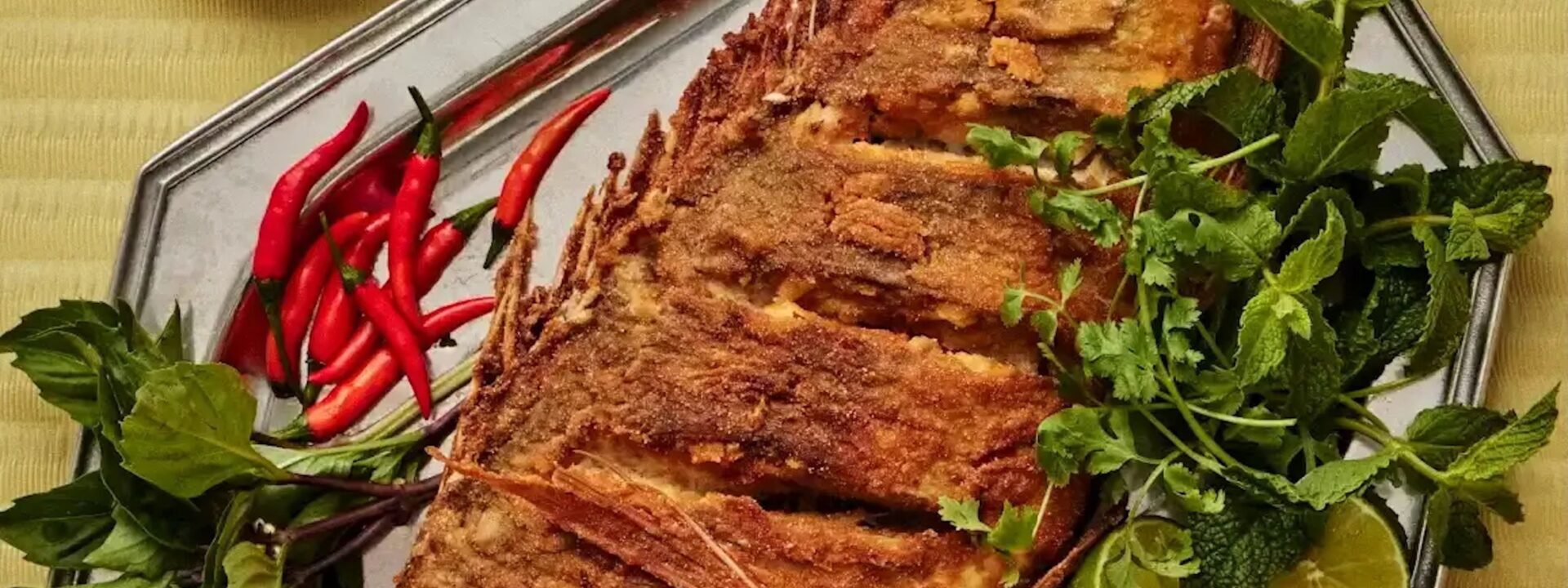
Chef Rachel Gurjar, who grew up in India and now lives in Brooklyn, has written a tribute to the food of both places with her book East to East: Recipes and Stories from Mumbai to New York. With 101 recipes, from spicy butter masala pasta to dirty chai espresso martinis, the cookbook celebrates what happens when cultures mix in the kitchen. This week, Vogue talked with Gurjar—formerly an associate food editor at Bon Appetit—about Mumbai’s fast-growing food scene, traveling to Queens for regional South Asian specialties, and the books that inspired her while writing East to East. Read the conversation below, along with a fried-fish recipe that will impress with very little effort.
Vogue: How did this project first come together for you?
Rachel Gurjar: I started writing the proposal in 2019. Then I set it aside because of the pandemic, job changes, and other things that came up for a couple of years. I picked it up again after I joined Bon Appetit, because I felt creatively stable and I was cooking again. I started working on the proposal again and took a few meetings with agents. My eventual agent and I refined the proposal a bit more and sent it out in early 2024. We sold it in January, and then I didn’t work on it for another eight months because I was working full-time at BA and doing union stuff. After I left BA, I dove back into the book.
I love how you talk about living between cities and cultures in East to East. Is there anything from New York you crave that you can’t get in Mumbai, and vice versa?
I love Sichuan food, and that’s something I miss a lot in Mumbai and India. Thai food often gets lumped together, but it’s so regional—Lao food, Cambodian food, northern and southern Thai—and I crave those flavors deeply, but I can’t really find them in Mumbai. Mumbai’s restaurant scene is changing so much and has grown a lot in the past five years, so you can get really good Korean and Japanese food. Sushi is big right now, and a few Southeast Asian restaurants are opening. But I haven’t seen a Cambodian or Laotian place there. Even in New York, Lao food is mostly pop-ups. I also feel like there’s really great Mexican food here that India is missing. Tex-Mex is big there, but not Mexican.
Eating a cuisine in the country where it was born is a completely different experience, and there are so many things I can’t find in New York, like regional Maharashtrian food. A lot of regional restaurants have opened in New York in the last three or four years, but the food my neighbor auntie makes that is hyper-regional to her community just isn’t here. When it comes to street food, there’s no comparison to Mumbai, or honestly, any region of India.
Is there a favorite area of New York you rely on for Indian food?
Jackson Heights comes close, but a few different diasporas from the Indian subcontinent live there and have restaurants and businesses there, and what happens is that South Asian food and Indian food all get rolled into one. It’s a mix of Pakistani, Bangladeshi, all delicious foods that I love. I love a puchka, but a puchka is different from a panipuri you would get in Mumbai, and even within that, a panipuri or puchka you would get in Kolkata is different from a golgappa you would get in New Delhi. Jackson Heights has my heart, and I do go there when I’m craving things, but it’s a different experience.
Are there cookbooks you love that helped inspire East to East?
The design part of this book was very important to me, and one book that inspired me was Andy Baraghani’s The Cook You Want to Be; I loved so many little elements from it, and it was in my inspiration deck. Zaynab Issa’s book Third Culture was on there, and Alison Roman’s NNothing Fancy was on there. I also love the Night + Market cookbook. I just made a salad from that cookbook! It’s the best. The Sofreh cookbook is also so good and robust, and I love the Gjelina cookbook; it’s older, but the ingredients are so fresh and seasonal. A lot of the recipes have a 360 approach, which I like to do too. I want flavor but I also want texture. I want it to look pretty and I want to teach somebody something new, whether it’s a technique or about an ingredient or as simple as how to plate something or cut something. I like using a multipronged approach in my recipes, and I like having a balance of things that are accessible to everyone. That’s where recipe developers who work at magazines or in food media come into play, because my entire job for the past six or seven years has been to make sure that recipes work for the home cook. When I was thinking about the kind of recipes I wanted to include in this book, there are projects, but they will tell you they are projects. I won’t say, “Oh, this recipe only takes 45 minutes,” and then two hours later you’re still doing it. It’s like: “This recipe is going to take two hours. It’s going to take some patience and time, but the flavor payout is going to be huge, and I won’t make you waste your ingredients or time.” If you were cooking dinner from East to East tonight, what would you make? I think I would make the whole rava fried fish with two sauces and marinades and crunchy veg. I love that this dish is very interactive and looks really grand and big and feels like a feast, but it really is very easy to pull off. This conversation has been edited and condensed. Rachel Gurjar’s whole rava fish with tamarind and garlic-ginger sauce Photo: Courtesy Chronicle Books The first time I ate real Thai food in New York, I couldn’t believe what I’d been missing. The explosion of flavor and the effortless complexity floored me—all the things I grew up with, just expressed in a completely different way. One dish that left a permanent impression on me was the pla tod samun prai, a whole fried fish served with a vibrant herb salad. Back in India, we love frying things too. My father, an occasional but enthusiastic cook, used to make surmai fry—a type of mackerel coated in a spiced rava (semolina) crust, deep-fried until crisp, and served with bright green chutney. So, naturally, I wanted the best of both worlds (as I usually do). Why settle for one when you can have it all, right? My version brings together the freshness of Thai herbs—mint, cilantro, and Thai basil— with a bold Indian marinade of ginger-garlic paste and warm spices. Here’s how to build the perfect bite: Grab a lettuce leaf, add a spoonful of rice and some of the crisp fried fish, drizzle with both sauces, and pile on the herbs. The flavors sing in harmony. It also makes a showstopping party dish served family style—interactive, messy, and completely worth it. Ingredients: Tamarind Sauce ¼ cup [60 ml] tamarind purée (such as Cock or Wang Derm) or one 2 in [5 cm] round tamarind pod 3 red or green Thai chiles, stemmed and chopped 2 garlic cloves, peeled and thinly sliced 1 Tbsp fish sauce 1 Tbsp lime juice 2 tsp sugar ½ tsp fine sea salt Marinade 7 red or green Thai chiles, stemmed 1 garlic head, cloves peeled 1 small red onion (7 oz [200 g]), roughly chopped 3 in [7.5 cm] piece of fresh ginger, roughly chopped 2 Tbsp lime juice 1 Tbsp Kashmiri red chili powder 1 tsp fine sea salt ½ tsp powdered turmeric Fish One 1½ to 2 lb [680 to 910 g] whole fish, such as black sea bass or red snapper, cleaned Fine sea salt 6 cups [1.4 L] vegetable oil or avocado oil ½ cup [70 g] all-purpose flour ½ cup [80 g] sooji or coarse semolina flour Garlic-Ginger Sauce ¼ cup [60 g] reserved marinade 1 Tbsp hot oil (you can use the oil from the wok before cooking the fish) 1 tsp lime juice ½ tsp fine sea salt For Serving 2 cups [240 g] steamed jasmine rice Lime wedges 4 or 5 red Thai chiles 1 bunch Thai basil (about 2½ oz [70 g]), leave½ bunch mint (about 1 oz [30 g]), leaves only
½ bunch cilantro (about 1½ oz [40 g]), leaves only
Crunchy lettuce or cabbage leaves
Instructions:
To make the tamarind sauce, if using a tamarind pod, place it in a small bowl and pour ½ cup [120 ml] of hot water over it. Let it steep for 10 minutes, then squeeze the pod with your fingers to separate the pulp from the pod. Discard any seeds and fibrous parts. You should be left with the pulp. In a small bowl, combine the tamarind purée, chiles, garlic, fish sauce, lime juice, sugar, and salt and stir to combine. Set aside until ready to serve.
To make the marinade, add the chiles, garlic, onion, ginger, lime juice, chili powder, salt, and turmeric to a blender and blend into a smooth paste with no chunks. Transfer ¼ cup [60 g] of the paste to a small heatproof bowl and set aside.
To cook the fish, place it on a cutting board and pat it dry with paper towels. Using a sharp knife, make crosswise slashes every 2 in [5 cm] along the body, cutting down to the bone. Flip the fish and repeat on the other side. Generously season with salt, including inside the cavity and slashes. Rub the remaining marinade all over, making sure to tuck some into the slashes and under the cheeks. Cover and refrigerate for at least 30 minutes or up to 8 hours.
In a large wok or skillet (make sure it’s large enough to fit the whole fish) over medium-high heat, warm the oil until it reaches 365°F [185°C] on an instant-read thermometer.
To make the garlic-ginger sauce, add 1 tablespoon of the hot oil from the wok to the ¼ cup [60 g] of reserved marinade, followed by the lime juice and salt. Stir to combine and set aside.
Spread the all-purpose flour and sooji on a rimmed baking sheet or large plate and mix to combine. Dredge the fish evenly, making sure all of it is covered in the flour, shaking off any excess.
Holding the fish by the tail, carefully lower it headfirst into the oil, laying it down away from you before gently releasing. Fry until the skin is deeply browned and crisp, 4 to 6 minutes per side, using tongs and a fish spatula to turn and a spoon to baste the top of the fish with hot oil a few times. Carefully transfer the fish to a wire rack to drain, then transfer to a large platter.
Serve with rice, lime wedges, whole red chiles, basil leaves, mint leaves, cilantro leaves, lettuce, the tamarind sauce, and the garlic-ginger sauce. Make little parcels with the fish and all the accompaniments to make a perfect bite. Store leftovers in an airtight container in the refrigerator for up to 2 days.
Recipe excerpted from East to East: Recipes and Stories from Mumbai to New York, out now from Chronicle Books.
Save to wishlist
Save to wishlist
East to East: Recipes and Stories from Mumbai to New York
$33
BOOKSHOP
Frequently Asked Questions
Here is a list of frequently asked questions about Rachel Gurjars cookbook East to East
What is East to East about
Its a cookbook that explores how flavors travel It connects the cooking of the Eastern Mediterranean and South Asia showing how similar ingredients and techniques appear in both regions
Who is Rachel Gurjar
She is a recipe developer and food writer Her work focuses on the intersection of her Indian heritage and the flavors of the Middle East where she has lived and cooked
What does the title East to East mean
It refers to the journey of flavors from one East to anotherspecifically from the Eastern Mediterranean to South Asia It highlights the shared culinary history between these regions
Do I need special ingredients to cook from this book
Not necessarily Most recipes use accessible ingredients like yogurt chickpeas rice and common spices The book also includes a pantry guide to help you source or substitute items
Is this book good for beginners
Yes The recipes are clearly written with stepbystep instructions There are simple dishes for weeknights and more involved projects for weekends
What are some example recipes
Youll find dishes like spiced lamb meatballs with tahini masala chickpeas with yogurt and saffron rice with crispy onions There are also chapters on condiments and flatbreads
What is a common problem when cooking these cuisines
Balancing spices A common issue is adding too much of one spice or not toasting whole spices before grinding The book gives tips on layering flavors gradually
How does the book handle spice levels
It offers guidance on adjusting heat You can often add chilies at the end or use milder varieties like Kashmiri chili for color without intense heat
What is a practical tip for using this cookbook
Read the recipe fully before you start Many dishes have components like a yogurt sauce or a quick pickle that you can make ahead This makes cooking smoother
Does the book include vegetarian or vegan options
Yes There are many vegetableforward dishes lentil curries and grain bowls Some recipes include notes on how to make them vegan like swapping yogurt for coconut yogurt
What is a benefit of cooking from East to East
You learn how to use similar ingredients in different