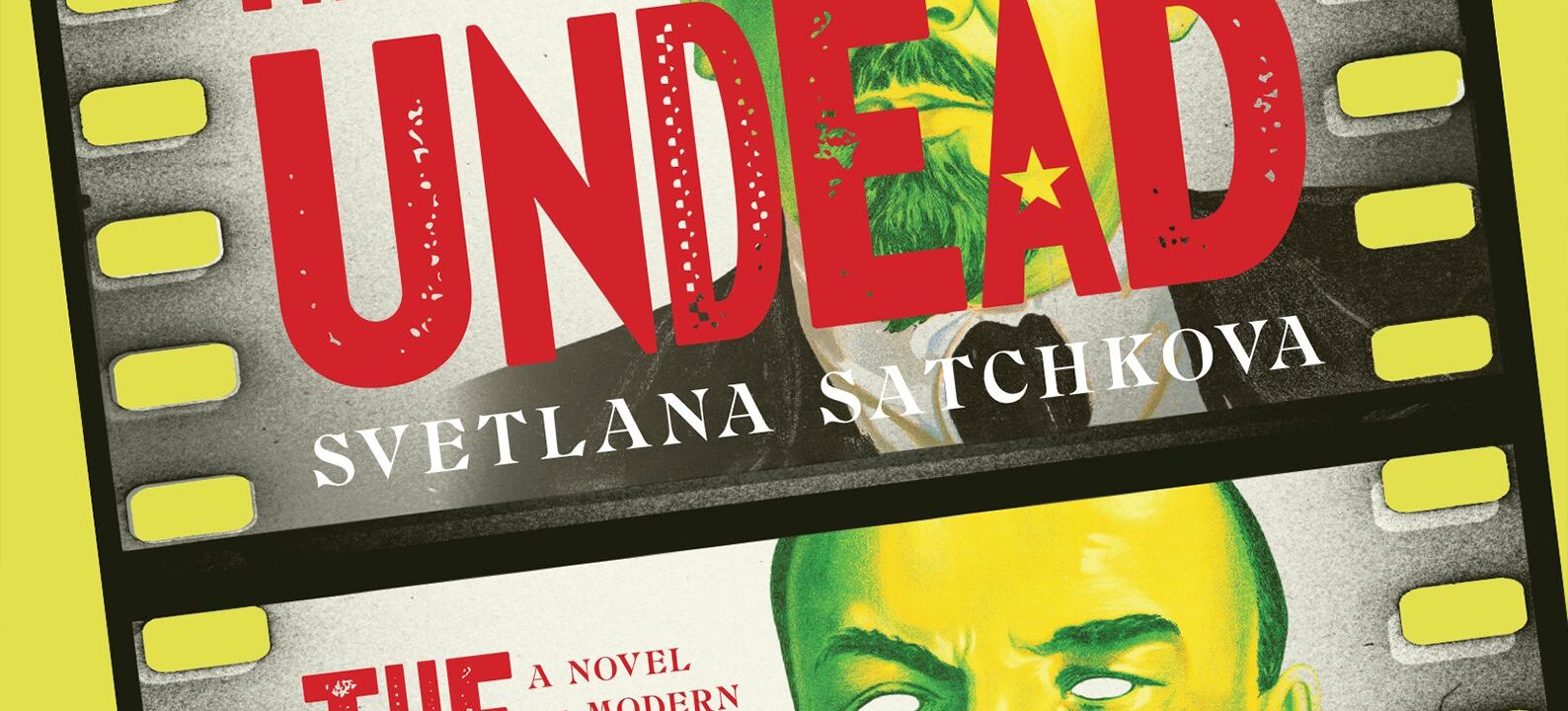
The opening lines of Svetlana Satchkova’s debut English-language novel, The Undead, introduce the protagonist Maya—an unassuming woman in her 30s making her directorial debut with a horror movie—as she eats a delicious fig. “[It] felt like pure happiness, making her forget, at least for the time being, that life was full of disappointments and nasty tricks,” Satchkova writes.
This exquisite balance between contentment and foreboding, tranquility and chaos, defines the rest of the novel. The Undead—out January 13 from Melville House—follows Maya’s personal and political journey after her film inadvertently arouses the ire of Vladimir Putin’s repressive government in the years following Russia’s invasion of Crimea. Maya’s initial apathy toward the crackdown on dissent among politicians and creatives reflects a prevailing early sentiment in Russia: she sees instances of repression as anomalies rather than the norm, and at first cannot imagine that her film—in which Lenin’s revitalized mummy attempts to take control of Moscow, zombie apocalypse-style—might be viewed as controversial by the state.
Part coming-of-age artist story and part thriller, deeply grounded in psychological realism, The Undead is dedicated to political prisoner Alexei Navalny and other victims of Putin’s regime. It explores what it means to be an artist in a country inching from authoritarianism toward totalitarianism and veering toward a second Cold War.
As a journalist and writer who left a lengthy career at Condé Nast in Russia to rebuild her life in the United States, Satchkova aimed to embrace her Russian sensibilities while making her ideas accessible to American readers. She had experimented with writing in English before, translating parts of her novel Teeth while taking a class at the Fine Arts Work Center in Provincetown, Massachusetts. But while Teeth—the story of a Russian dentist raising two daughters alone—received enthusiastic responses from agents, they ultimately struggled to find a niche for it in the U.S.
The experience of translating Teeth inspired Satchkova to write her next novel, The Undead, in English. The mindset the process put her in appealed to her. “When I first started writing in English, I felt like a completely different person,” Satchkova says. “Your whole mentality changes with the language that’s inside your head.” By that point, Russia had invaded Ukraine; the repression of dissidents had intensified; and independent news outlets had been forced to close as Putin forbade criticism of the war.
Satchkova took a journalistic approach to researching The Undead, especially when it came to depicting Maya’s new world of horror filmmaking. The field offered wide avenues for exploring the heightened emotions and friendships that blossom on film sets, as well as the sacrifices artists make under Putin’s regime. Satchkova based many details on information she had gathered about the Russian film industry as a culture journalist. “People who get into filmmaking fall in love with it completely, and they find it very hard to leave that world, along with the intense intimacies they develop on set,” she says.
Above all, The Undead examines the gray areas ordinary Russian creatives face: given that most of the country’s films are state-funded and all require government permits to be shown, the question is not whether an artist cooperates with the regime, but how much.
“I was interested in exploring the different choices people make under these conditions,” Satchkova says. “There are different degrees of collaboration. Some people find it cringeworthy to have anything to do with the state and basically go underground; some take state money and stay silent because they can make a living that way. And others take the money gleefully…”I had to write war movies that glorified the Soviet Union. As a writer, this made me wonder: How do you live under an authoritarian state? What compromises do you make? How do you choose to live your life? I had to make those compromises myself when I lived in Russia.
Eventually, Satchkova grew too frustrated with Putin’s shift toward authoritarianism to stay in her home country. While many in Russia’s cultural elite were enjoying the new opportunities in Moscow, she found it harder to ignore the country’s darker side—from corruption to the silencing of critics. She moved to the United States in 2016 and settled in Brooklyn.
“Most people know what’s happening,” Satchkova says. “But the reality is so frightening that they can’t confront it. Your mind adjusts. You tell yourself that if you keep your head down, you can live your life and avoid drawing attention at work or in private. But then something might happen to you, like it does to Maya, and suddenly that person is forced to face a new reality. That’s where the change begins.”
The Undead: A Novel of Modern Russia is available for pre-order and will be released on January 13.
Frequently Asked Questions
Here is a list of FAQs about Svetlana Satchkova and her debut novel The Undead
About the Book Author
Q Who is Svetlana Satchkova
A Svetlana Satchkova is a RussianAmerican writer and journalist The Undead is her first novel written in English
Q What is The Undead about
A Its a literary horror novel set in 1990s Moscow It follows a young woman Margarita who works at a postSoviet tabloid and becomes entangled in a supernatural mystery involving a vampirelike figure from Slavic folklore all while navigating a crumbling society
Q Is this a vampire book
A It uses vampire mythology but its not a traditional vampire story Its more of a literary and psychological horror that uses folklore to explore themes of trauma memory and societal decay
Q Why did she write her debut in English instead of Russian
A Satchkova has lived in the US for many years and is fluent in both languages Writing in English allowed her to reach a wider international audience and perhaps process her crosscultural perspective on the postSoviet experience
Themes Context
Q What are the main themes of the book
A Key themes include personal and national trauma the haunting legacy of the Soviet Union the struggle for identity the nature of memory and how myths reflect realworld horrors
Q How important is the 1990s Moscow setting
A Its crucial The chaotic lawless atmosphere of postSoviet Russia acts as a parallel to the supernatural horror making the setting itself a kind of character It explores a specific historical moment of transition and disillusionment
Q This is described as literary horror What does that mean
A It means the book uses the tools and atmosphere of horror to explore deep character psychology and complex social themes with a focus on elegant prose and layered meaning not just scares
Q What is the upir mentioned in the book
A The