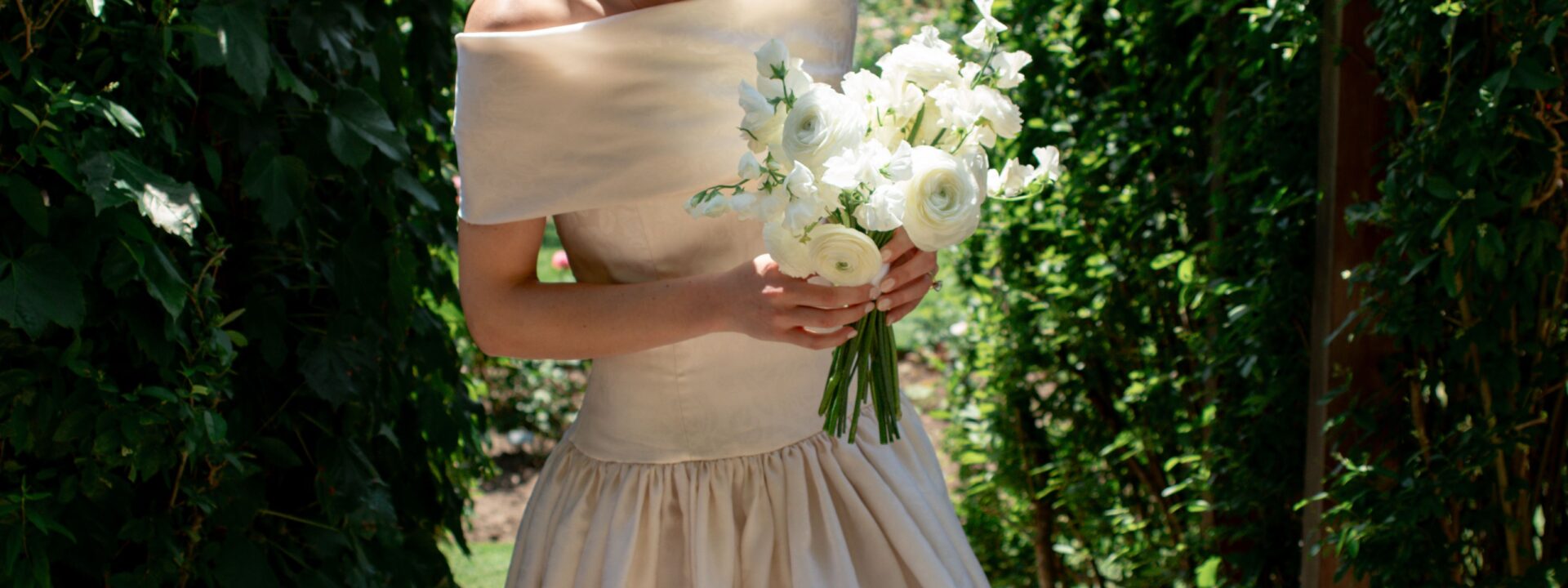
“I love vintage, I love antiquing, I love anything old,” Lizzie Nelson tells Vogue. So it’s no surprise that when choosing her wardrobe for her New Hampshire wedding to Samuel Cox, she decided to wear three vintage bridal outfits on her big day. Two were heirloom pieces worn by family members at their own weddings, while the third was carefully selected from a vintage bridal shop.
Lizzie grew up surrounded by fashion—her mother designed menswear for Timberland, and her aunt worked at Ralph Lauren Purple Label. “Playing dress-up was a regular activity for my sister and me,” she says. “But it was real clothes we played in—not costumes from Party City.” She remembers running around in Ralph Lauren runway samples, mink scarves, and her grandmother’s wigs as a child, as well as watching her mother sketch designs.
With that fashion sense already a part of her, she was ready to take on the challenge of curating and redesigning vintage pieces for her wedding. The ceremony and reception were held at a club in her coastal hometown in New Hampshire. “It felt like a private house with a very intimate tent overlooking the ocean,” Lizzie describes. “We both like to dress up and have fun, but we’re also pretty low-key, so the venue felt like the perfect blend of both.”
Lizzie found her main wedding dress at Cha Cha Linda, a Brooklyn-based vintage store specializing in restored, one-of-a-kind pieces. Before her first appointment, she invited her recently engaged bridesmaid to join and take half the time for herself. While her bridesmaid found a dress that day, Lizzie needed to keep looking. She visited another vintage wedding salon, Happy Isles, and also tried on new gowns by major bridal designers. “I probably tried on at least 50 different dresses but just didn’t have that special moment with any of them,” she shares. One day, her bridesmaid sent her a direct message with a dress posted on Cha Cha Linda’s page, and Lizzie knew she had to try it. She texted the store’s owner, Eva Lopez, who managed to fit her in before her appointments the next day.
The dress was by Carolina Herrera, from the designer’s first bridal collection in 1987. The deep ivory gown with a faint floral print featured a sweetheart neckline, a dropped waist, and a removable shawl with a rosette at the front. Lizzie wasn’t sure she would love it when she arrived and saw it on the hanger with Lopez. However, she recalls, “We put it on, looked at each other, kind of laughed, and said, ‘Wait, it’s really good.'”
They experimented with the look and discovered they loved it when the shawl was flipped backward to hang off the shoulders, with the rosette at the back. “I had very little time to think about it and knew I wasn’t going to find anything else like it,” Lizzie remembers. “So I just went for it and have no regrets.”
One aspect of her wedding dress vision Lizzie didn’t want to compromise on was having a long train. She was referred to Ann Hamilton, a New York City seamstress who specializes in recreating vintage bridal looks, to create a detachable train that worked perfectly with the gown. The trickiest part was finding the right fabric to match the 1980s cream dress. “Ann went through dozens and dozens of different fabrics, and she couldn’t find it,” says Lizzie. Three weeks before the wedding, Hamilton found the perfect match and constructed the train in time for the celebration. “She has such a fantastic eye, is so creative, and is great at problem-solving,” says the bride. To complete the look, Hamilton added buttons to the back of the bodice and crafted a veil for Lizzie to wear down the aisle.
After cocktail hour, Lizzie removed both the train and the rosette shawl to give herself more freedom for dancing. A final sentimental touch Lizzie added…What gave her look that unique blend of old and new? A pair of custom earrings by Larkspur & Hawk, featuring a piece of lace from her grandmother’s wedding dress. “The owner is a family friend of Sam’s family and had just started doing bridal work,” Lizzie explains. The earrings use an 18th-century foiling technique that adds shine to the fabric. She not only incorporated her grandmother’s lace but also added a bit of blue ribbon for a “something blue” touch in her ensemble. Lizzie loved that she could wear the earrings on her wedding day and continue to cherish the nostalgic piece for years to come. “It was a really special way to honor her legacy and keep a piece of her with me always,” she says.
The lace came from the first look Lizzie knew she would wear—her grandmother’s Priscilla of Boston wedding dress from 1958. The silk gown featured hand-beading, long sleeves, and a boat neckline. “It was kind of a running joke in our family that we always had grandma’s dress for when you got married one day,” Lizzie shares. Her mother also wore the dress as her “something old” on her wedding day, as did several aunts within a four-year span.
Originally, Lizzie wasn’t sure if she wanted to wear the dress too. “When I got engaged, I went home to see my parents for the first time, and my mom brought it out,” she recalls. “I remember putting it on and thinking it was pretty incredible. I couldn’t believe something from that long ago was still intact.”
Over the years, the dress underwent some alterations. One aunt let it out, and another removed the long sleeves. After Lizzie tried on the gown, her cousin decided to wear it for her 2023 wedding and—with Lizzie’s approval—gave the skirt a high-low hem. Lizzie says she decided, “We’re only going up from here.” Once again, she turned to Hamilton as her alterations expert. With her help, Lizzie transformed the dress into a two-piece set—a top and a mini bubble skirt—to wear for her reception.
“We kept the entire same structure of the top so it looks like a dress in person,” she adds. The bubble skirt idea came from the internal structure of the high-low version of the dress. She also liked how the bubble would give the look a slightly modern edge. “We keep joking that my sister is going to get a crop top out of it, because she’ll be the last woman in the family to potentially want to wear it,” she says.
When she went to put the look on inside with her sister, her seven-month pregnant cousin Cass—who had worn it previously—happened to run into them. “We grabbed her and said, ‘You have to come. We are putting on grandma’s dress,'” Lizzie remembers. When they arrived back at the tent, Lizzie asked Cass to join her on stage to explain the significance of the dress and their grandmother. “She was our matriarch and very special to us. We all had this very teary-eyed moment on stage where we felt like she was there,” she recalls. “It was just so nice.”
Another heirloom that made its way to her wedding after-party? A two-piece Donna Karan set that her mother wore as her own second look in the ‘90s. The cream silk ensemble featured a long button-down shirt and drawstring silk pants. Lizzie brought her mother along to Hamilton’s studio to get her permission on a new idea—transforming the pants into a more structured, tailored style and shortening the top to fit her height. “I wanted her approval because she worked in design and had a great eye for these things,” Lizzie notes.”There are a lot of opinions,” says Lizzie.
Lizzie’s mother originally wore the Donna Karan set in the ’90s.
Courtesy of Lizzie Nelson
Lizzie’s adaptation of the set for her wedding.
Photo: Parker Selman
Luckily, Lizzie got permission to change the silhouette. She also decided to wear the shirt loose and open, just as her mother did, pairing it with a silk camisole and a pearl choker. To achieve this, she needed a new layering piece. “The top was custom-made by Ann Hamilton using existing fabric from the set and silk we sourced to match,” she explains. Lizzie also notes that she never left the dance floor all night: “I actually think the outfits worked perfectly for that. I could dance the whole time and felt so comfortable.”
Photo: Parker Selman
Reflecting on her entire wedding wardrobe, Lizzie says, “I didn’t want it to feel like I was doing vintage just for the sake of it. I wanted it to be a recreation of something from my family, something with history—but that also felt like me.”
Frequently Asked Questions
Of course Here is a list of FAQs about a bride choosing vintage wedding dresses from the 1950s 1980s and 1990s for her New Hampshire celebration
General Beginner Questions
Q What does vintage wedding dress actually mean
A Typically it refers to a dress that is at least 2030 years old from a specific past era In this case the dresses are original pieces from the 1950s 1980s and 1990s
Q Why would someone choose multiple vintage dresses
A Many brides do this to have a different look for different parts of the day or to honor different eras they love Its a way to showcase personal style and history
Q Isnt it risky to wear an old dress What if it falls apart
A It can be a concern but a reputable vintage seller or a skilled seamstress specializing in vintage clothing can assess the fabrics strength reinforce seams and make necessary repairs before the wedding
Q Where do you even find vintage wedding dresses
A Common sources include specialized vintage bridal boutiques online marketplaces estate sales family heirlooms and consignment shops
Specifics About the Eras
Q What are 1950s wedding dresses typically like
A They often feature a fitted bodice a cinched waist and fuller skirts sometimes with layers of tulle or crinoline Think elegant and structured reminiscent of Grace Kelly
Q What defines a 1980s wedding dress
A The 1980s are known for bold drama puffed sleeves large bows lots of lace elaborate beading and voluminous skirts Its a very more is more aesthetic
Q And what about 1990s styles
A 1990s dresses often shifted towards simplicity and sleekness Youll see slip dresses minimalist sheaths bias cuts and simpler satin or crepe fabrics influenced by styles like Carolyn BessetteKennedys famous gown
Q How did she make dresses from such different decades look cohesive
A She likely tied them