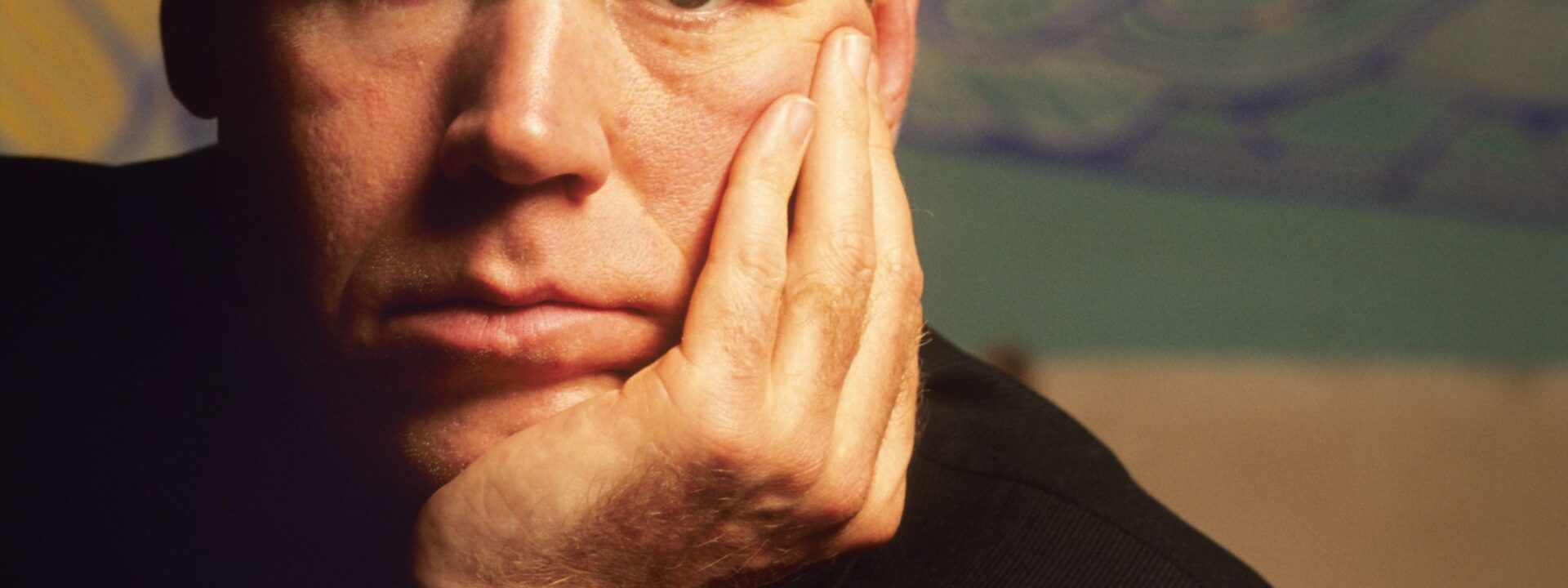
In 2003, I had just graduated from college and was living in New York. During the day, I worked as a grant writer for a nonprofit, and at night, I worked on my first novel—which, unsurprisingly, was about recent college grads living in New York. The way I met Bret Easton Ellis was as ordinary and predictable as most first drafts of first novels. My boss at the time knew the author of Less Than Zero and American Psycho socially and had invited him to a fundraising event that spring. Near the end of the party, my boss, a bit tipsy, introduced us and suggested that maybe I could send Bret my unpublished, unagented manuscript. Bret was heading out of the crowded venue, and I stood there, shrugging and nodding, trying to look casually confident rather than starstruck and shy. Bret wore the dark overcoat that had become a staple of his media appearances over the previous two decades. While profiles often painted him as a serious, elusive artist, in person he was surprisingly warm. He said yes with a graciousness that caught me off guard, as if he genuinely wouldn’t mind reading the half-baked draft of an employee of an acquaintance.
The next day, I attached the work-in-progress—a sort of love quadrangle loosely based on former college classmates—to a humble email, and he replied, “Happy to take a look. B.” I didn’t expect to hear from him again, but I still felt a real thrill at having a true literary figure’s name in my inbox. I was 22 and had been writing since I was 14. Even that brief exchange felt like a step forward in the city’s mysterious publishing world.
I also remember feeling guilty. If you were a young person in New York hoping to write fiction, you were absolutely expected to read Bret Easton Ellis—not just Less Than Zero and American Psycho. If you were serious, you should be familiar with The Rules of Attraction, The Informers, and Glamorama. But I’d only read Glamorama, which I’d picked up at Housing Works one rainy afternoon. While I was gripped by the book—its long, controlled sentences and endless pop culture references—what I remember most is that the cultural critique running through its pages felt beyond my understanding. My own writing lacked it entirely.
Astonishingly, Bret did read the draft I sent him. He wrote back that while the novel wasn’t good yet, he could tell I was obsessed with the story and that its characters represented parts of early adulthood that confused me. He offered to help me shape it into something publishable. Over the better part of a year, he treated me like an editor would, giving me pages of brutal, sometimes crushing line-by-line feedback. Having a writer of his generation’s stature take my work even semi-seriously filled me with gratitude and gave me the motivation to spend hundreds of hours laboring over every word. Those hours often ended with Bret telling me, without any softening, that my writing had no style, was often idiotic, and that one scene I kept clinging to was so absurd it left him cross-eyed with confusion. Bret didn’t believe in a gentle approach, and he pushed me to set the story in the city as it really was, not as I wished it to be.
Every couple of months, we’d grab a meal. These meetups were stressful because he was picky about where he ate—not just the food, but the service, the noise level, the space between tables, and even the angle of the tables relative to the windows. We went to The Harrison in Tribeca a few times (it’s since closed) and Pete’s Tavern in Gramercy Park. During those hours away from the manuscript, he somehow managed to show a gentler, broader belief in the novel’s potential—and maybe in mine. We talked about where we grew up, family dynamics, regrets, aspirations, books we’d read, movies we’d seen, why people write, and what it means to desperately want to accomplish this one thing and nothing else.
The lesson…Common advice in how-to books and MFA classes—that you need to be a reader to be a writer, that you should be able to explain any sentence’s purpose, that structure, character, and voice really matter—he took as given, not worth debating. What he really talked about, in long, serious monologues, was how a novel could transport you like nothing else, and how it came from a kind of punishing obsession and attention to detail. But at the same time, a novel was a dream. More precisely, a great novel was made of layered dreams: the author’s, the people in the author’s life and mind, the characters’, the readers’—dreams shaped by the wild experience we all share. He considered Jonathan Franzen’s The Corrections the great novel of his generation, and James Joyce’s Dubliners influenced everything he wrote, since he believed the last sentence of The Dead was the definitive ending in all of art. Over a meal, he might bring up a dozen books: old and new, fiction and nonfiction, famous and obscure. I learned he spent much of each day just reading. The key point was that a novelist sorts through the mess of living—often clumsily, sometimes painfully—and in doing so creates a mix of selfishness and generosity. In what we write, we find ourselves and what we care about.
We talked about where we grew up, family dynamics, regrets, ambitions, books we’d read, movies we’d seen, why people write, and what it means to desperately want to achieve this one thing and nothing else. I remember realizing during those talks that it must be hard—a huge amount of work, effort, and strain—to be as smart, perceptive, and sensitive as Bret is.
What drives someone, already stretched thin by success and ambition, to spend so much time on another person’s work? How does the person on the receiving end measure that kind of giving? How do you pay it back or pay it forward when you have neither the resources nor the influence? Bret himself would get annoyed and lose interest whenever I kept bringing up these questions, so I stopped asking them out loud.
But maybe as a way of showing gratitude, I read his books carefully and in order that year. Doing that created a strange disconnect. Scenes of rape, dismemberment, and a constant focus on guts were what many reviewers and angry op-eds focused on, but that content clearly served a purpose in his storytelling and didn’t bother me. What I struggled with was the cold, cruel way many of his characters treated each other. That clashed with the gentle, thoughtful guy I now knew. I wanted to push my way into literary circles and say that the writer who came up with the monstrous Patrick Bateman was a considerate listener who opened up conversations, and that you could read Less Than Zero and see not just Didion and Delillo but also Dickens and Nabokov. That urge was self-serving, of course—especially since Bret himself didn’t seem bothered by the fuss over his work.
He and I moved to Los Angeles around the same time, over 20 years ago, and lived about a mile and a half apart. We had dinner a few more times, once at a small Italian place in Sherman Oaks. I can’t remember the restaurant’s name, but he’d grown up right around the corner on Valley Vista, and I remember being touched by how he described Los Angeles as sprawling and beautiful. The last gift he gave to my first novel was its title, The Tourists. I worked hard on the dedication to him, and maybe that’s why he didn’t like it—too wordy and earnest, he said in one final editorial note, which was probably the only one I didn’t follow.
And then we mostly lost touch. My own career shifted to nonfiction when my college roommate died tragically, and telling his story seemed like the right thing to do.To honor him, I wrote that book, got married, and raised young kids—those things took up all my remaining time and energy. Every now and then, I’d reread Bret’s books. They reveal new truths as you get older, and they hit harder with time. I’d pick up his newest novels as they came out, like Lunar Park and Imperial Bedrooms. I realize I’m now older than Bret was when he took me under his wing, but even a random errand in LA that takes me past an intersection he wrote about still gives me that same thrill—lighthearted and youthful, just like when I got his first email. When I’m driving west on Ventura Boulevard from Laurel Canyon toward Encino, I’ll blast “Don’t Change” by INXS as loud as I can stand, and I’ll remember reading Less Than Zero for the first time.
A couple of years ago, while killing time in a bookstore at the Hartford airport, I spotted The Shards prominently displayed by the register. The striking cover showed a man’s eye tinted crimson in a series of images that grew more intense. I felt a bit embarrassed that I hadn’t known a new Bret Easton Ellis novel was coming out. It wasn’t until after I bought the book that I realized the eye on the cover was actually his.
I started reading at my departure gate, finished about half of the 600-plus pages on the plane, and wrapped up the rest within a few days. This meditative thriller moved me with its focus on what we carry, what we let go of, and what shifts, expands, and cracks along the way. The scenes that gripped me most weren’t the bloody or cruel ones. Throughout the book, its narrator—a teenage character named Bret Easton Ellis who dreams of being a writer—keeps pulling away from all the drama around him to work on his novel in solitude. That person, I felt, was someone I knew.
Frequently Asked Questions
Here is a list of FAQs about Bret Easton Ellis written in a natural tone covering everything from his background to his controversies
General Background
Q Who is Bret Easton Ellis
A Hes an American author and screenwriter best known for his dark satirical novels about consumerism alienation and violence among the wealthy and privileged He was a major figure in the literary movement called Brat Pack literature in the 1980s
Q What is he most famous for
A His 1991 novel American Psycho Its a controversial cult classic about a wealthy New York investment banker who is also a serial killer The movie adaptation starring Christian Bale in 2000 is also a huge hit
Q What is Brat Pack literature
A Its a term coined in the mid1980s for a group of young authors who wrote about the cynical disaffected youth of that era Ellis was the most prominent figure alongside authors like Jay McInerney and Tama Janowitz
Q Where did he grow up and does it influence his work
A He grew up in Sherman Oaks a wealthy neighborhood in Los Angeles Yes massively The sterile materialistic and superficial environment of 1980s LA is a constant backdrop in his early novels like Less Than Zero and The Rules of Attraction
Q Is he still writing
A Yes While he hasnt published a traditional novel in a while he writes a popular Substack newsletter and podcast called The Bret Easton Ellis Podcast where he talks about movies culture and politics
His Books Writing Style
Q What is the best book to start with if Im new to him
A It depends on what you like If you want a short punchy and iconic read that captures his style start with Less Than Zero If you want his most famous and controversial work go straight for American Psycho but be prepared for graphic violence
Q What is the main theme in his books