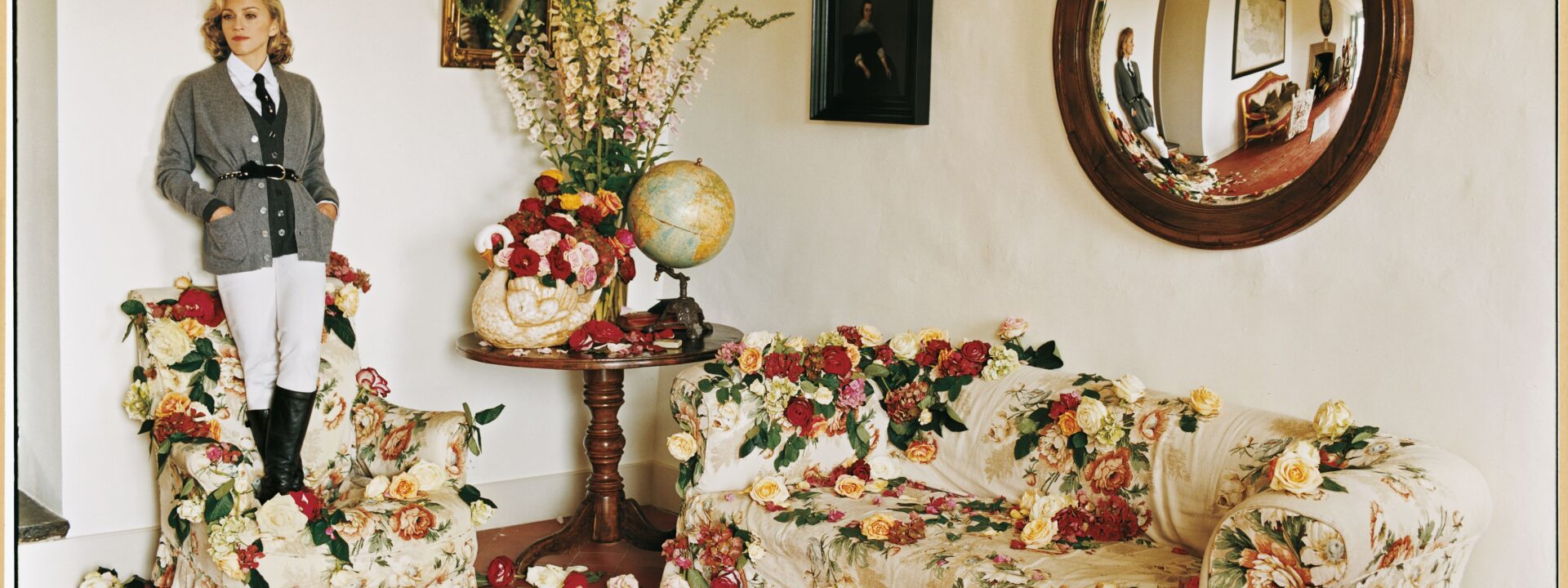
“Like a Duchess,” by Hamish Bowles, was originally published in the August 2005 issue of Vogue. For more highlights from Vogue’s archive, sign up for our Nostalgia newsletter here.
“Who would have thought it?” says Madonna with a laugh. “The last thing I expected was to marry some laddish, shooting, pub-going nature lover—and the last thing he expected was to marry some cheeky girl from the Midwest who doesn’t take no for an answer!”
In the warm ivory sanctuary of her office in her grand Georgian townhouse in London, Madonna is on the latest twist of the roller coaster that is her thrilling, adventurous, and creative life. The room, with its expensively cracked walls that look like broken eggshells and pale taffeta curtains blowing in the cool English breeze, feels more like a Hollywood boudoir than an office. Leaning against the fireplace, newly arrived from her sprawling 1920s hacienda in Los Angeles designed by Wallace Neff, is Frida Kahlo’s Self-Portrait with Monkey. Madonna wanted to enjoy it privately for a few days before sending it to Tate Modern as a highlight of their major Kahlo exhibition. On the mantelpiece, nestled between two glamorous portraits by Francis Picabia, is Kahlo’s unsettling My Birth. “She’s a bit shocking, that one,” says Madonna, who clearly isn’t afraid of disturbing images. Elsewhere in the room is Helmut Newton’s photo of a perfectly groomed glamazon with a large gun in her mouth. On an art tour of the house, Madonna points out photographer Collier Schorr’s life-size portrait of a beautiful blonde boy in a Hitler Youth costume. “People don’t know what to think when they come here and see this photograph,” she tells me. “I’ll let them be… confused.” Does Madonna, who presented the prestigious Turner Prize at the Tate in December 2001 (where she introduced herself as Mrs. Guy Ritchie), also collect British art? “I have a Francis Bacon,” she says coyly. “Does that count?”
Speaking in carefully controlled tones, dressed with a fake upper-class modesty (this afternoon in Issa’s prim satin blouse with a print of flying ducks, black Kate Hepburn pants, and Marc Jacobs teal lizard shoes), with a team of charming, quiet assistants nearby and a polite but distracted husband making small talk, she has the air of an Edwardian dollar princess—the wealthy American beauties who married poor British nobles in the golden age—along with the fragile beauty and substantial property to match. But no one understands change better than Madonna; she even named her 2004 tour “Re-Invention.” That tour is the subject of Madonna’s documentary I’m Going to Tell You a Secret, directed by Jonas kerlund and set for release later this year. In some ways, the new film is a companion to 1991’s Truth or Dare, which a more mellow Madonna now admits “in some ways is hard for me to watch. I was a very selfish person. You go through periods in your life where the world revolves around you, but you can’t live your whole life that way. On the other hand, I kind of admire my spunk and directness!”
The new movie “starts with the struggle of a dancer trying to get into a show” and ends with Madonna’s controversial trip to Israel (to visit Rachel’s tomb as part of a Kabbalah experience) and a sweetly naive vision of peace in our time, shown in footage of a Palestinian and an Israeli boy walking together in friendship. “If I’m going to take people through a journey of my life, they are going to see all my journeys, and I hope they will also be moved by it,” she explains.
“The feeling in Israel is like no other place,” says Madonna. In Jerusalem, she had “a sense of really going back in time… that I was being pulled into something. I felt very comfortable there. It’s weird; on the one hand, it’s a very desperate place that could erupt at any time… it’s also very special—that’s why everyone wants it.”I wanted to claim it as my own. It’s not the kind of place that appeals to everyone, but I’m a bit of an adrenaline junkie.
Aside from Jerusalem and the risks that come with it, Madonna’s movie takes you on a journey through some of the key cities on her tour—Los Angeles, New York, Las Vegas, Dublin, and Paris, among others. It’s a dizzying mix of athletic performances and lightning-fast costume changes. For these movie-inspired outfits, Madonna worked with Christian Lacroix for the first time, creating embroidered corsets with a coat-of-arms look that she loved. Meanwhile, Karl Lagerfeld designed beautiful Weimar-style Kabaret costumes, but they turned out to be too delicate for attaching her monitoring system. “I was really disappointed because I loved what he did,” she says. “But I still have them—they might show up somewhere!” Her friend Stella McCartney designed the “Savile Row three-piece-suit number.”
McCartney also made Madonna’s wedding dress in 2000. “Do you want to see it?” she asks in a secretive tone, struggling with a large ivory book filled with photos the world’s media never got to see. “No one has seen these pictures except my closest friends.” For the record, McCartney created a remarkably classic dress made of ivory duchesse satin, with an hourglass 18th-century corset bodice (“a real boob squisher!” Madonna laughs) and layers of crinoline skirts that billowed into a long train. The 19th-century lace veil was found at an antique market and held in place with Grace Kelly’s Cartier tiara. Mr. Ritchie wore a kilt. “You can’t get married in Scotland and not wear a kilt,” says Madonna, who later included kilted pipers in her show. “It’s like, don’t show me things—you never know what might end up in one of my shows!” she laughs. “But I love working that way.”
Since her marriage brought her here, Madonna has become England’s latest national treasure. The country even has a nickname for her—Madge—similar to how the satirical magazine Private Eye calls Queen Elizabeth “Brenda.” “I really hated it when they first started calling me that,” Madonna admits, “but then a friend told me it was short for ‘Your Majesty,’ so I was okay with it. I like it! Well, anyway,” she adds, “they’re stuck with me!”
It wasn’t always a love story. Madonna’s first trip to London in 1982, with her friend and dancer Martin Burgoyne, was paid for by their bartending jobs at Lucky Strike, a bar in New York’s East Village. “We used to steal from the cash register all the time!” she says matter-of-factly. When they saved enough to visit London, “we went to some nightclubs, and I met Boy George wearing Vivienne Westwood’s World’s End stuff. He was such a force to be reckoned with, and I was really intimidated,” Madonna recalls. “He was really mean to me… he’s still mean to me!”
Still, Madonna “found the whole experience quite thrilling. I couldn’t believe how seriously everyone took their looks, fashion, and all that—it was very exciting and, to some extent, influential.”
But by the time Madonna returned a year later, she was riding the wave of her first success, and her relationship with the country started to fall apart. “Once I became famous, I couldn’t stand London because the press was so horrible to me,” she explains. “I didn’t understand the whole tabloid mentality. I thought, God, they’re so vicious. And this place was really different 20 years ago. Everything was closed. The streets were dead on Sundays. There were no good restaurants. It was a very, very different place, and I had no idea I would have the life I have here now.”
Since meeting Guy Ritchie, the “scope of my world has changed,” she continues. “At the time, I didn’t see the funny side of it, but now I love England and want to be here, not in America. I see England as my home. And now I know how to handleI know how to shoot. I know how to fish. I could be a connoisseur of ales if I wanted to—I never used to like the stuff, but when you’re married to Guy Ritchie, you spend a lot of time in pubs, and I learned to like it!” About her marriage, she says, “The whole point of being in a relationship and having children is that you learn to love unconditionally. That’s the best way to make the world a better place. Sometimes it’s so nice just to go into my children’s bedrooms and listen to them breathe. It has forced me to step outside myself.”
It was Trudie Styler who played matchmaker when Madonna was invited for tea at her Jacobean mansion in Wiltshire. She remembers the “long, sweeping staircase… where all of her children were lined up—like the von Trapp family! I went down the line meeting them all, and at the end of the line was Guy.” Madonna was stopped in her tracks by the strapping 30-year-old director of the new-wave gangster movie Lock, Stock and Two Smoking Barrels, an eye-catching directorial debut. (This, along with his occasional Mockney accent—think Michael Caine in Alfie—hides a respectable upper-class background. Ritchie has fond childhood memories of Loton Park, his stepfather Sir Michael Leighton’s estate on the Welsh border, where he developed his love for hunting and fishing.) Of that first electric meeting, Madonna simply admits, “My whole life flashed before me. It did.”
Madonna never planned to become a classic British lady of the manor, until fate stepped in when she was introduced to Hugo Vickers, Cecil Beaton’s smooth biographer, through a mutual friend in 1998. They talked about his Beaton books, including one about the unlikely romance between Beaton and Greta Garbo (“Good and juicy,” says Madonna). They kept in touch by email, and later Vickers sent one asking if Madonna remembered Beaton’s beloved house, which was now for sale. Madonna told Guy, who, as she says, “has always wanted to live in the countryside. He’s the country person—not me. He loves nature and animals.” So, thinking it might be a fun day out, with no intention of buying anything, they arranged a visit.
Ashcombe, however, casts a very powerful spell. Nearby are the ancient worship sites of Avebury and Stonehenge, and a Celtic burial ground hidden in one of Ashcombe’s deep, romantic valleys. “That part of the world has something very mystical about it,” says Madonna. “There was a reason those Druids dragged those stones there! That area has some kind of pull for both of us.”
The house sits in a landscape of almost unimaginable beauty, nestled in the warm embrace of its own green valley, with dramatic hills rising steeply on all sides but parting ahead to reveal distant fields. Cecil Beaton recalled that he was “almost numbed by my first encounter with the house. It was as if I had been touched on the head by some magic wand.”
Madonna and Guy were similarly enchanted. They sat beneath the ancient ilex trees that shade the house; Madonna photographed Guy there, surrounded by wild grasses, and the dreamlike result now sits on her office desk. “We just fell in love with it,” Madonna explains. “In the summertime, it’s the most beautiful place in the world.” The memory of their day at Ashcombe “just stayed with us, haunted us for a really long time,” she remembers. Eventually, they could resist its lure no longer, and Ashcombe was theirs.
Although the estate covers more than 1,000 acres of rolling hills and valleys, nothing remains of Ashcombe House itself, a grand mansion built in 1686 but taken down for its brick and stone two centuries later. Half of the elegant stable block (converted into a studio by Beaton) and a cozy dairy house were left. Beaton’s playful decorating at Ashcombe was legendary, and he deliberately ignored the building’s honest farmhouse character. The carousel bed thatThe neo-Romantic artist Rex Whistler had a piece made for him that is now long gone, but the beautiful Palladian stone door frame he designed is still there, cleverly turning the house from a cottage into a mansion.
By the time the Ritchies arrived, the house was “pretty much in ruins. The kitchen was tiny, like a shoebox, and the top floor was just an attic full of rats and mice.” They created a maze of charming attic bedrooms and added an extension that matches the elegance of the stable block. It looks like an 18th-century orangery or a French pavilion, but inside it’s a huge open space that works as a kitchen, casual dining room, and living room—perfect for a modern family.
“To me, Ashcombe reflects me and my husband in many ways because it shows our willingness to commit,” says Madonna. “Not necessarily to each other, but to the idea of having a home somewhere, instead of living like nomads.” The house also stands as a physical symbol of their unlikely partnership. Here, classic England meets pampered Hollywood—a place where cozy kilim-covered sofas, family silver, and sporting prints sit alongside silky oyster-colored carpets, top-of-the-line sound systems, and lush hothouse flowers. Cecil Beaton’s brilliantly designed diaries share shelf space with the 22 volumes of the Zohar, the couple’s Kabbalah reading material.
Cecil Beaton loved the place with “blind devotion.” When his 15-year lease ended and he was forced out to make room for the landlord’s son, he wrote a heartfelt book to ease his loss—a postwar tribute to the carefree, wild thirties, a time of dressing up, masquerade, and make-believe. “We played; we laughed a lot; we fell in love,” he wrote. For Beaton, the house was “essentially an artist’s home,” and he invited the great creative minds and style icons of the day to share his paradise: writer H.G. Wells, artists Salvador Dalí, Augustus John, Christian Bérard, and Graham Sutherland. They were joined by the era’s flamboyant trendsetters, like the Marchesa Casati, Lady Ottoline Morrell, Mona Harrison Williams, and Diana Vreeland.
When Madonna is staying there, she plays “a lot of guitar; I go for long walks, ride my bike. It’s a very physical place, a place for adventure. You can choose to go there to work without distractions, in a very thoughtful way, or you can go there and just get lost in the surroundings. I always feel really sad when I’m driving away. I think if you’re a photographer, a painter, or a writer, it’s the perfect place,” says Madonna. “You feel protected because you’re tucked into that valley, and as far as you can see, there’s not another house. It’s like a shield from the world.” Right now, Madonna is busy working on her new album (“mostly dance music”) with collaborator Stuart Price, which she hopes to release by the end of the year. She’s also planning a tour for summer 2006 and writing children’s moral stories. Her latest children’s book, Lotsa de Casha (Callaway), is about the richest man in the world who loses everything but gains a friend (“There’s more to life than fame and fortune—something much deeper and more meaningful,” says Madonna). It follows The English Roses, her first children’s book, which is the first of eight planned volumes. “The English Roses are going to take over the world!” Madonna says, laughing. Madonna’s own charming children—Lourdes (Lola), eight, who has the natural grace and poise of a girl who takes her ballet lessons very seriously, and Rocco, four, a mischievous mini-version of his dad—have “never watched television,” their mom says firmly. “They’re fine. I don’t think they miss it… my daughter is a voracious reader, and I’m really happy about that.”
“Do you actually read the newspapers here?” MadonLater, when asked about what she reads, she says: “What do you read here? I don’t read newspapers. We don’t read magazines… and no television. At the end of the day, it’s all just noise.”
The Ritchies prefer to create their own fun. To celebrate their fourth wedding anniversary, Madonna decided to “recreate a Cecil Beaton-style weekend of playful chaos. I invited all my friends, and we all had to put on a show, basically. It was so much fun—we moved all the furniture around in the Studio, built a stage, and hung red velvet curtains. Gwyneth, Stella, and Chris wrote a song together, which was brilliant—a spoof of American Life called American Wife. Gwyneth did an amazing rap, Stella sang backup, and Chris played the piano. Tracey Emin [the anarchic British artist] and Zoë Manzi [the beautiful art consultant] wrote a poem and took turns reading stanzas. Sting played the lute, and Trudie read a sonnet. David Collins [the witty interior designer] sang ‘Don’t Put Your Daughter on the Stage, Mrs. Ritchie’ [a twist on Noël Coward’s ‘Mrs. Worthington,’ a sharp warning to a pushy stage mother and her untalented child]—and my daughter was in it too, playing the little girl!”
For the Guy Ritchies’ contribution, Madonna found a copy of the mock Restoration play The Town Wench or Chastity Rewarded, which British film producer John Sutro had written for Beaton’s famous 1937 garden party, and performed a scene from it. “It’s really funny—and so bawdy,” Madonna laughs. For Madonna, Ashcombe is “one of those places that really brings a group of people together. I’d love to do it more often, but it’s incredibly hard to get all my friends free on the same weekend!”
According to Alek Keshishian, the director of Truth or Dare, what Madonna “really has is the confidence to pull off whatever she decides to wear—it’s a childlike confidence, like playing dress-up in the attic.”
Though still playful, Madonna’s relationship with fashion has matured. “I connect with fashion when I need to collaborate with someone on a project. I really admire people like Galliano, Gaultier, and Olivier [Theyskens]. I think they’re true artists. I’d go to them. You can tell the difference between craftsmanship, artistry, and just a facade. We live in a culture obsessed with surface appearances. I’ve worked with all those photographers—I know how much they love to retouch!”
These days, Madonna’s interest in her clothes and costumes feels more like that of a curator. A team of experts is working on cataloging and preserving her vast collection, currently stored in a Los Angeles warehouse. “I’ve kept everything,” Madonna says. “The ‘Like a Virgin’ dress. Pieces Gaultier made for the Blonde Ambition tour. All the costumes from all my shows, the dancers’ costumes, everyone’s costumes.” She has ruthlessly destroyed all duplicates and triplicates (“Because we didn’t want anything to end up on the Internet. When you don’t want anyone else to have it… you burn it”). “My goal is a traveling exhibit, like the Jackie Kennedy show,” she says. “Not just costumes, but video imagery, film, interviews, and concert footage—so it’s a multimedia journey you go on.”
Today, her many closets are filled with country clothes instead of the designer extravaganzas of the past. Even her city wardrobe, heavy on Prada, Miu Miu, and McCartney, often has a rustic touch. “Lots of tweeds, lots of caps, and sensible walking shoes—it’s hopeless to walk around that estate in heels!” says Madonna. “I don’t shoot anymore, but I had a lot of suits made for it.” The estate is run as a highly successful shooting ground—one of the top five in Britain. Pheasants and partridges wander out of every copse and thicket, strolling lazily by; a bold cock pheasant might even join Madonna for breakfast.Beloved chickens scramble for the feed scattered across the stableyard’s cobblestones. After the chaos of her public life, Ashcombe offers the perfect escape. “It’s like a big vortex; it sucks me in,” says Madonna, who dreads the moment “when you leave that bowl of comfort and go back into the big bad world. And it’s just so full of life,” she adds. “There’s a pigeon that keeps flying back—for years now, like a carrier pigeon. He keeps showing up in our backyard.” Madonna has been thinking about this homesick bird, because later in our conversation she says, “Maybe that’s Cecil Beaton? He did show up just in time for the Vogue shoot, I have to say! I’m sure Cecil would be very happy to know that I lived in his house. He probably does know.”
Frequently Asked Questions
Here is a list of FAQs about From the archives A visit to Madonnas English country home written in a natural conversational tone with clear answers
General Beginner Questions
1 What is From the archives A visit to Madonnas English country home
Its a feature that takes readers inside the country house Madonna owned in England It shows the decor gardens and how she lived there
2 Where was this English country home located
The home was Ashcombe House a historic estate in the Wiltshire countryside near the village of Tollard Royal
3 When did Madonna live there
She owned the property from the late 1990s until around 2004 when she sold it after moving to London and later the US
4 Is this a tour of her current home
No The from the archives part means its a look back at a past home She no longer lives there but the article captures what it was like when she did
5 Why is this home famous
Because its a rare glimpse into Madonnas private life It shows a very different side of hermore rustic romantic and traditionalcompared to her popstar image
Style Decor Questions
6 What was the interior style of the home
It was a mix of English country charm and Madonnas eclectic personal taste Think antique furniture floral prints gothic touches and a lot of dark moody colors
7 Did she decorate it herself
Yes largely She worked with interior designer Rose Tarlow but the look was very much Madonnas own visiona blend of oldworld elegance and her love for spiritual and religious art
8 What kind of art and objects were in the house
There were antique paintings religious icons gothic crucifixes vintage furniture and personal mementos It wasnt modern or minimalist at all
9 Was there a specific room that stood out
The dining room was famous for its dramatic dark red walls and a long wooden table The master bedroom also had a huge ornate fourposter bed and a cozy almost medieval feel