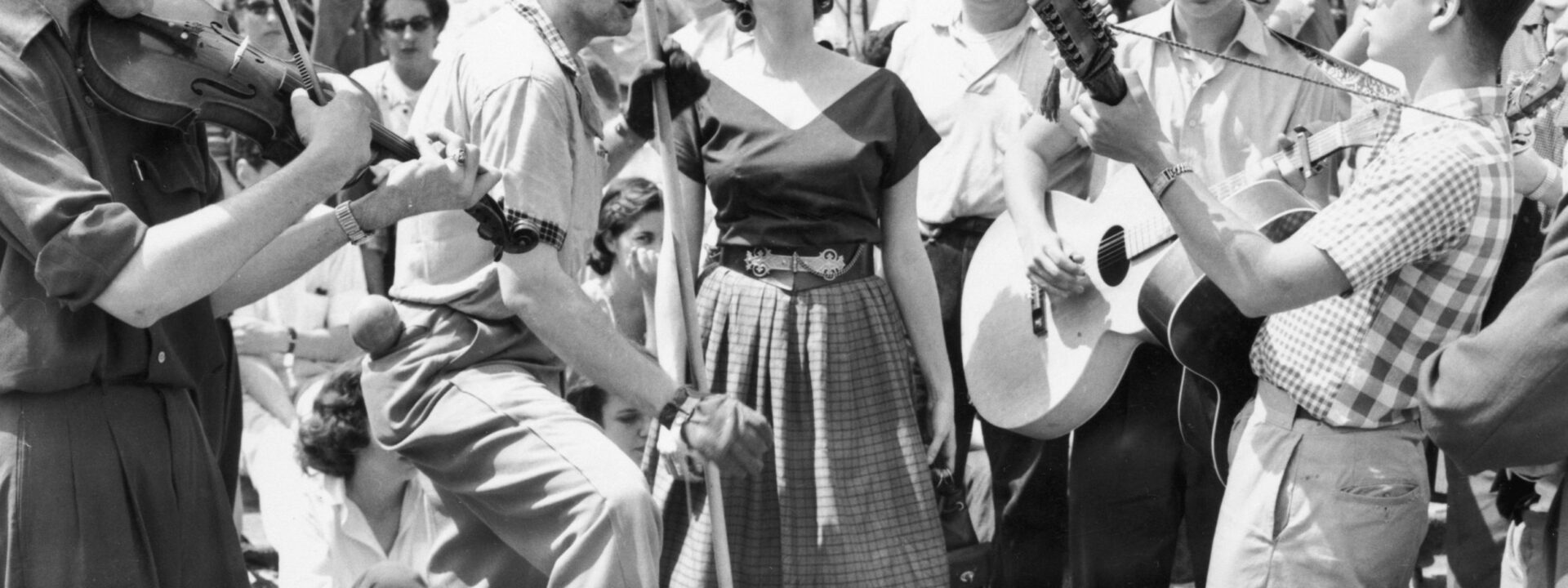
Tad Friend’s essay “On the Road Again” originally appeared in the October 1995 issue of Vogue. (For more highlights from Vogue’s archive, you can sign up for the Nostalgia newsletter.)
In 1984, I attended William Burroughs’s seventieth-birthday party at the Limelight, a huge nightclub in Manhattan, and found myself talking with Allen Ginsberg. A decade earlier, Ginsberg had pessimistically declared that “there is no longer hope for the Salvation of America proclaimed by… our Beat Generation.” But that night, surrounded by celebrities like Sting, Lou Reed, and Kurt Vonnegut—all more focused on Burroughs’s pale face than on dancing to “Beat It”—Ginsberg seemed cheerful. I reminded him that he had visited my college a few months before to teach us meditation (amid a haze of marijuana smoke) and mentioned that I had just read On the Road. And that I had, you know, dug it.
“Yes,” Ginsberg said with a smile. “The Beat influence will come around again. It’s only natural after years of the Reagan-Nixon ugly spirit…Listen,” he added, reciting a Kerouac haiku: “Useless, useless,/the heavy rain/Driving into the sea.”
Off the point? No, Beat.
Ginsberg was right: the Beats are back, embraced by a new generation. New York University recently held major conferences on the Beats and on Kerouac; 70 percent of attendees at the Kerouac event were under 25. Beat ideas are debated on a website called Literary Kicks, new editions of Kerouac’s letters and fiction have just been published, and in November, the ultra-trendy Whitney Museum of American Art will open an exhibition titled “Beat Culture and the New America: 1950-1965.”
Next year, Francis Ford Coppola plans to film Kerouac’s 1957 novel On the Road, likely in black and white, portraying Sal Paradise and Dean Moriarty as they drive endlessly across the country, entangled with women, alcohol, and the law, always searching for bigger thrills. When Coppola held an open audition in New York last February, over 5,000 hopefuls lined up in the snow, flakes dusting their berets. Coppola shook hands with each one, “paying attention to their aura.”
Beat nostalgia is evident in many trends: rising heroin use, the return of surly goatees and Vandyke beards (sported by Dan Cortese, Ethan Hawke, Nicolas Cage, Michael Stipe, T. Coraghessan Boyle), Ivy League literature majors dressed in black and cultivating poetic melancholy, the Zen-like revival of long-board surfing, the boom in coffeehouses where the resident cat is named Ferlinghetti, and even Volkswagen’s plans for an updated Beetle. “The Beats are everywhere,” says Bill Adler, president of NuYO Records, which specializes in spoken word. “It’s undeniable. It’s like mold.”
“There’s a real Renaissance on,” agrees Anne Waldman, director of the Jack Kerouac School of Disembodied Poetics in Boulder, Colorado. “The young are drawn to the Beats’ camaraderie, the idea of travel, the experiments with drugs and consciousness—the whole desire to go off track.”
“Beat style is the primary influence in the East Village,” the poet Sparrow wrote to me recently. His eight-page handwritten letter, amusingly smeared with salad dressing by his daughter, described that style as “people in shapeless clothes drinking coffee in cafes and writing in their spiral notebooks while listening to jazz—modern jazz…” Sparrow’s anarchic poetry group, the UNbearables, decided the Beat thing to do was to picket NYU’s Kerouac conference for turning the outsider myth into a commodity. He was especially proud of his ironic slogans: “We’re a Bunch of Juvenile Idiots” and “They’re Right and We’re Wrong.” He noted, “I read my poem ‘Poem’ (‘This poem replaces/all my previous/poems’) to thunderous applause.”
Calling me “Pops” and dressed head-to-toe in denim with a large beaded necklace, Beat musician David Amram welcomed me into his Village apartment (filled with unmade beds, jazz posters, and bongo drums) for a “cosmic rap” about his friend Kerouac, who had often visited him there. He wanted me to feel the angels of the place. More than 200 pilgrims from the Kerouac conference…The same worn-out stairs had been climbed by a succession of visitors, each following in the footsteps of the last. “They felt the magic in these walls,” Amram says, “and left beaming.” In short, strange ideas are circulating again: passion, sincerity, whimsy, a search for belief. Jaded irony is fading along with David Letterman’s ratings. “No parody, no irony; we’re trying to be very sincere,” says director John Carlin of the upcoming CD-ROM “The Beat Experience,” where the main setting is a Beat “pad.” “They invented the counterculture, and you can’t make fun of that.” You can, of course, but the Beats themselves rejected irony as a dry, empty pose. “First thought, best thought” was Ginsberg’s rule for spontaneous creation—advice that in the eighties was mainly followed by Jeopardy! contestants.
The Beats captivate with their feverish call to life. As Kerouac famously wrote in On the Road, “The only people for me are the mad ones, the ones who are mad to live, mad to talk, mad to be saved… [who] burn, burn, burn like fabulous yellow roman candles exploding like spiders across the stars.” The Kerouac who pounded out On the Road on a single, continuous roll of paper in three weeks fueled by Benzedrine, and who ultimately died from alcoholism at 47, still burns brightly as an alluring legend.
“I love it when Kerouac’s name comes up in connection with the idea of traveling around and living life as it comes,” says artist Jack Pierson, whose photos and collages evoke road trips and lonely motels. “Like Kerouac, I think of my art on the wall as just a postcard from life—which is the real art.” Yet Pierson is clear: “It’s not like I want to sit down and read his books.”
Many of Kerouac’s 25 books are, in fact, unreadable; at his worst, as Truman Capote sniped, he wasn’t writing but typing. Despite the lasting impact of works like Burroughs’s Naked Lunch, the Beats have triumphed less as literature and more as a powerful metaphor for… something.
What we think of as “Beat” is really a jumble of misconceptions. Like Johnny Depp, who recently bought Kerouac’s worn raincoat for $15,000, we often prize the artifacts of this original youth culture over its actual ideals. “I was trying to wear my black dress every day, being confident with my style like a real Beat,” says X-Girl designer Daisy von Furth with a touch of disappointed reverence, “but then it got too hot.”
Fashion is especially quick to attach random ideas to the Beats. Donna Karan’s fall collection was all black—lots of skinny pants worn with flats; Ralph Lauren’s Ralph line often includes berets and blue-and-white-striped T-shirts; and Miuccia Prada opened her fall show with a Beat-inspired segment featuring black pencil pants and boxy coats. “Our fisherman’s T-shirts and black leggings are definitely a Beat appropriation, style over content,” says von Furth. “We’re aiming for an international-beatnik-and-Godard-film vibe, but a lot of people have confused it with the Jackie O. look.”
Whatever. As musician Amram notes, the look’s origins aren’t even Beat: “The whole beret-and-dark-glasses thing actually came from Dizzy Gillespie and Thelonious Monk, who wore them in the early forties to show solidarity with Sartre and the Europeans.”
The Gap also tried to borrow some of the Beats’ appeal with ads proclaiming that both Kerouac and Ginsberg “wore khakis.” In reality, both men’s khakis came straight from the Salvation Army. “Jack just wore whatever he could manage to find,” says writer Joyce Johnson, Kerouac’s former girlfriend. “He had the most horrible, gaudy Hawaiian shirts.” Robert Frank’s quirky 1959 film Pull My Daisy, featuring Kerouac, Ginsberg, Amram, Gregory Corso, and Larry Rivers, shows what they actually wore: nubby sweaters, threadbare khakis, and flannel shirts. In other words, the Beats invented grunge.
Pretty cool. But we need the Beats to be cooler than we are, so we make them cooler than they were. We don’t want to hear that Kerouac lived most of his adult life with his mother, Mémêre, and only allowed visiting friends to sleep together in his guest room if they were married.If they were married, Jack Kerouac would have disapproved and spoken out against hippies. His biographer Ann Charters adds, “Jack would hate Clinton and Hillary because he didn’t like women in positions of authority, and he supported the Vietnam War. He’d probably think Newt Gingrich was an interesting guy.” In the mid-1950s, Kerouac drunkenly helped write a message to President Eisenhower: “Dear Eisenhower, We love you—You’re the great white father. We’d like to fuck you.” The note is clearly angry, immature, and male-dominated, but it also carries a tone of admiration.
What kind of rebellion was this, and where has it led us?
Allen Ginsberg recalls first hearing the term “beat,” a word Jack Kerouac adopted in 1948 to describe feeling “exhausted, at the bottom of the world… rejected by society, on your own, streetwise.” In the 1950s and early 1960s, the Beats were a loose group of men in New York and San Francisco who celebrated spontaneity, Zen Buddhism, drugs like marijuana and peyote, drinks like gin and coffee, wild road trips, the underworld, and a raw honesty about turning personal emotions into art. They also loved playful, quirky phrases like “peanut-butter cockroaches” and “fried shoes.” (Try it yourself: shadow juice… sordid egg… lethal marmalade. It’s kind of fun.)
The Beat movement drew inspiration from the rhythms, long breath lines, and lively lifestyles of bebop musicians like Charlie Parker and Dizzy Gillespie. Like Elvis, the Beats used black music as the foundation for a new—though arguably diluted—aesthetic. Primarily a literary movement, Beat later expanded to include new art forms like Assemblage, happenings, and independent cinema.
The Beats were searching for an America far removed from the era of Joseph McCarthy, bobby socks, and suburban conformity. Their free-spirited quest alarmed the mainstream: even Playboy criticized them as “modern-day nihilists for whom it was enough, apparently, to flout and deny.” The media also watered down the Beats’ appeal by creating the beatnik stereotype—a mumbling, bongo-playing, bearded slacker, epitomized by Maynard G. Krebs on TV’s The Many Loves of Dobie Gillis. By 1959, you could hire a “beatnik” for your party, and comedians like Johnny Carson were making jokes about “cats” and “chicks” sharing a “pad,” smoking “weed,” and “wigging out” all the “squares.”
That caricature of the turtleneck-wearing impostor is hard to shake. Artist Jack Pierson says, “More than the actual Beats, I like the whole idea of the Beats you see in The Lucy Show, when Lucy and Vivian go to a beatnik club and try to fit in as hip chicks.” But Beat style without Beat spirit isn’t truly Beat. Compare Allen Ginsberg’s iconic 1955 poem “Howl”—”I saw the best minds of my generation destroyed by madness, starving hysterical naked, / dragging themselves through the negro streets at dawn looking for an angry fix…”—with 10,000 Maniacs’ 1987 song “Hey Jack Kerouac”: “cool junk-booting madmen, street-minded girls in Harlem howling at night…” Similarly, Madison Avenue has produced weak, beatnik-inspired ads for products like Cappio cappuccino, Pepe jeans, the Wendy Melt, and McDonald’s (“I unwrap / The bad boy / Oooh… / The joy / Of Mickey D’s / Egg McMuffin sandwich”).
Even genuine Beat qualities have often been passed down in isolated, exaggerated forms. Beat influences are visible in the dark, aimless wanderings captured by Larry Clark in his photo books Teenage Lust and Tulsa and his film Kids; in the confessional style of talk shows like Jenny Jones and Ricki Lake; in the New Age spirituality of Shirley MacLaine; and in the gay pride movement—William S. Burroughs and Allen Ginsberg were pioneers in being openly gay.
Joyce Johnson points out that the Beats could be so adaptable “because the women [in their lives] had the jobs and kept things going.” Yet feminist thinker Barbara Ehrenreich suggests that the Beats unintentionally helped the women’s movement by challenging both the traditional family and the appeal of consumerism, like buying a new refrigerator. She writes that their “two strands of male protest—one directed against the white-collar work world and the other against the suburbanized family life that work was supposed to support—come together into the first all-out…”The Beat movement is open to interpretation because it’s an internal state of mind. Unlike mod, punk, or disco, it isn’t tied to specific physical objects, and our culture tends to understand things visually (we’ll think we truly know the Beats once Coppola’s film comes out). “We’re taking the Beats’ intangible ideas and trying to create tangible goods inspired by them,” explains interior designer Jeffrey Bilhuber, whose work channels an early James Bond bachelor-pad aesthetic. “Their stream of consciousness and simplicity,” he adds, “is like having a consistent point of view from the entrance hall all the way to the attic.” Well… maybe.
Beat influences are widespread across the arts, especially in pop music. Bob Dylan credits Kerouac and Ginsberg for his hallucinatory language and his reluctance to do multiple recording takes. Ray Manzarek of the Doors says the band wouldn’t have existed without Kerouac. Kurt Cobain released a CD with William Burroughs, who was also revered by punks (Patti Smith called him “up there with the pope”), David Bowie, and Steely Dan—whose name comes from a dildo in Naked Lunch.
“We’ve been very influenced by the Beats in how we play with language,” says Sonic Youth guitarist Lee Ranaldo. “Also in using our lives as material and in our disenfranchised view of modern life.” The Grateful Dead’s relaxed, drug-friendly, improvisational ethos—never playing a song the same way twice—is pure Beat, and surprisingly mainstream, as seen in the massive media mourning after Jerry Garcia’s death.
The work of Beat filmmakers like Bruce Conner, Kenneth Anger, and Stan Brakhage now feels strangely familiar. If you fast-forward through Anger’s Scorpio Rising—with its quick cuts of skulls, a man buckling his jeans, cigarette butts, motorcycles, and James Dean photos—you suddenly see its legacy: the nonlinear, image-driven editing style of MTV and Oliver Stone. (It’s fitting that Hank Corwin, who worked on Stone’s JFK and Natural Born Killers, is editing the “Beat Experience” CD-ROM.) As writer Rick Woodward noted, “Tune into any beautifully bleak, high-grain, low-definition MTV video and you’re probably watching the influence of Beat photographer and filmmaker Robert Frank.”
MTV has tried to capitalize on the neo-Beat spoken-word trend with specials, a regular Fightin’ Wordz segment, and airtime for beat-rap group Digable Planets. VH1’s Naked Cafe is set in an L.A.-style coffeehouse and even features a talking coffee cup. Both networks miss the point: every minute they’re on air, they’re commercializing the Beat style.
Robert Altman’s seemingly spontaneous, meandering films owe a debt to the Beats, as do Jim Jarmusch’s black-and-white reflections (Stranger than Paradise, Down by Law) and Richard Linklater’s clever, detached Slacker. And every road movie, from the vibrant (Thelma & Louise, Something Wild) to the dull (Kalifornia), faithfully follows the picaresque, two-person journey blueprint of On the Road.
“Burroughs is a building block in my writing,” says writer-director Gus Van Sant. “When I spliced three completed screenplays together on the computer to make My Own Private Idaho, that’s something he would have done. It’s sort of magical—like throwing chapters into a bin and pulling them out one by one. It lets the universe dictate, instead of your logical mind.”
Even the sincere, communal ideals of the Beats have seeped into the often insincere, isolated world of stand-up comedy. “We invite comics not to do their act,” says founder Kathy Griffin of her “Hot Cup of Talk” series at Los Angeles’s Groundling Theatre. It’s essentially an evening of impromptu storytelling. “Quentin Tarantino talked about his fear of rats and how women love him, I talked about my date with Quentin and how women love him, and Janeane Garofalo has done a lot of ranting. We rely on word of mouth and charge only $3, which keeps it accessible.”The Beat spirit feels very tired. When someone tries to force in a joke from their old routine, there’s a lull—the audience is waiting for something fresh, something of the moment.
In literature, interestingly, true followers of the Beat movement are hard to find. The Whitney Museum describes Paul Beatty as a “younger poet influenced by Beat culture,” but Beatty himself says, “The movement didn’t influence me.” The poet Sparrow is similarly hesitant. “I worked hard to rebel,” he says. “I value clarity and brevity, not their rambling style. But editors keep telling me I’m too Beat. Maybe they’re right; I might be a third-generation Beat poet. It’s a terrible fate.” Modern poets, according to Ron Kolm, need to “clear away the overwhelming psychic space of the Beats, kill off Daddy a little”—just as the Beats themselves rejected literary modernism in favor of jazz.
Writers also grow uneasy when irony is taken from them. “This magazine was meant to build a new, Beat-like sense of community,” says Daniel Pinchbeck, cofounder of the literary journal Open City (and son of Beat writer Joyce Johnson). “But young writers today seem more comfortable telling jokes than staying up all night creating spontaneous poetry. They’re too conscious of their role in the marketplace to search for deeper meaning. Sometimes it makes me want to give up.”
“Poets today don’t aspire to the Beat lifestyle or being outsiders,” agrees Bob Holman, who runs the Nuyorican Poets Cafe. “They want to be at the center—on TV, publishing books like everyone else.”
In truth, though, the Beats themselves often wanted to be at the center. That William Burroughs now appears in Nike ads, that Allen Ginsberg sold his archives (including beard clippings and old sneakers) to Stanford for about $1 million, or that Jack Kerouac hung around literary conferences seeking acceptance—none of this should surprise us. The Beats were the first movement to use the media to craft their own image, to turn themselves into a generational legend. (Kerouac wanted to rename On the Road as The Rock and Roll Generation, and Robert Frank’s film Pull My Daisy was almost called The Beat Generation.) John Clellon Holmes, who wrote the first Beat novel, Go, in 1952, later reflected that they made a mistake by polishing their legend so aggressively. “Probably all that will last… are a handful of airy stories and the few solid works that were produced,” he wrote. “We’ve paid for the boldness of calling ourselves a ‘generation.’”
And though the Beats were free-spirited, they were never truly anarchic. “It was a nationalistic, patriotic rebellion,” says art critic Peter Schjeldahl, who still considers himself a Beat. “Today’s reaction is against the righteous liberal values of the sixties, just as the Beats opposed the accepted values of FDR liberals. They were the voice of the free citizen proving his freedom—Huck Finn was the original beatnik.”
Fittingly, Beat composer David Amram’s A Little Rebellion: Thomas Jefferson, premiering this month at the Kennedy Center, will end with narrator E. G. Marshall reading from On the Road. Thomas Jefferson and Jack Kerouac: two great patriots. Seeing the Beats this way elevates them: they aimed to remind America of its origins, of its true self.
Fragments of the Beat influence are everywhere, and that’s a good thing. As cultural critic Dave Hickey points out, it’s encouraging that boredom has replaced apathy—boredom is at least the longing for longing. But anyone trying to copy the Beat lifestyle today is decades too late and doomed to unintentional parody; revolts are revolting the second time around. Smoking pot is now less an act of rebellion than something a future presidential candidate might admit to.
In fact, if we look for a modern follower of the real Beats—a conservative patriot who challenges today’s orthodoxies, unsettles well-meaning liberals, is childish, spontaneous, unable to commit to one woman, a funny, language-obsessed performer and clever self-promoter—the person who fits the bill shows just how much times have changed.
Rush Limbaugh: the Beat we deserve.I reserve.
Frequently Asked Questions
Of course Here is a list of FAQs about From the Archives The Enduring Legacy of the Beat Generation designed to sound like questions from real visitors or readers
Beginner Definition Questions
Q What was the Beat Generation
A It was a literary and cultural movement of the 1950s centered around a group of American writers who rejected mainstream values championed personal and artistic freedom and explored spirituality drugs and sexuality in their work
Q Who were the main Beat writers
A The core trio is Jack Kerouac Allen Ginsberg and William S Burroughs Other key figures include Lawrence Ferlinghetti Gregory Corso and Diane di Prima
Q What does Beat even mean
A It has a few meanings Jack Kerouac said it meant both beaten down and beatific It also connects to the musical beat of jazz which heavily influenced them
Q What are their most famous works
A On the Road by Kerouac Howl by Ginsberg and Naked Lunch by Burroughs
Legacy Impact Questions
Q Why is the Beat Generation still important today
A Their legacy is huge They paved the way for the 1960s counterculture free speech movements and modern ideas of personal liberation Their spontaneous writing style and challenging of social norms continue to inspire artists and activists
Q How did they influence music and pop culture
A Directly and profoundly Bob Dylan The Beatles and Jim Morrison cited them as major influences Their embrace of Eastern spirituality rejection of conformity and on the road ethos became central to rock n roll and hippie culture
Q Whats the connection between the Beats and modern social movements
A They were early voices against censorship for LGBTQ visibility for environmental awareness and in questioning materialism and warthemes that resonate strongly in todays social justice movements
Q Were the Beats problematic What are the common criticisms
A Yes and this is a key part of understanding their full legacy They are often criticized