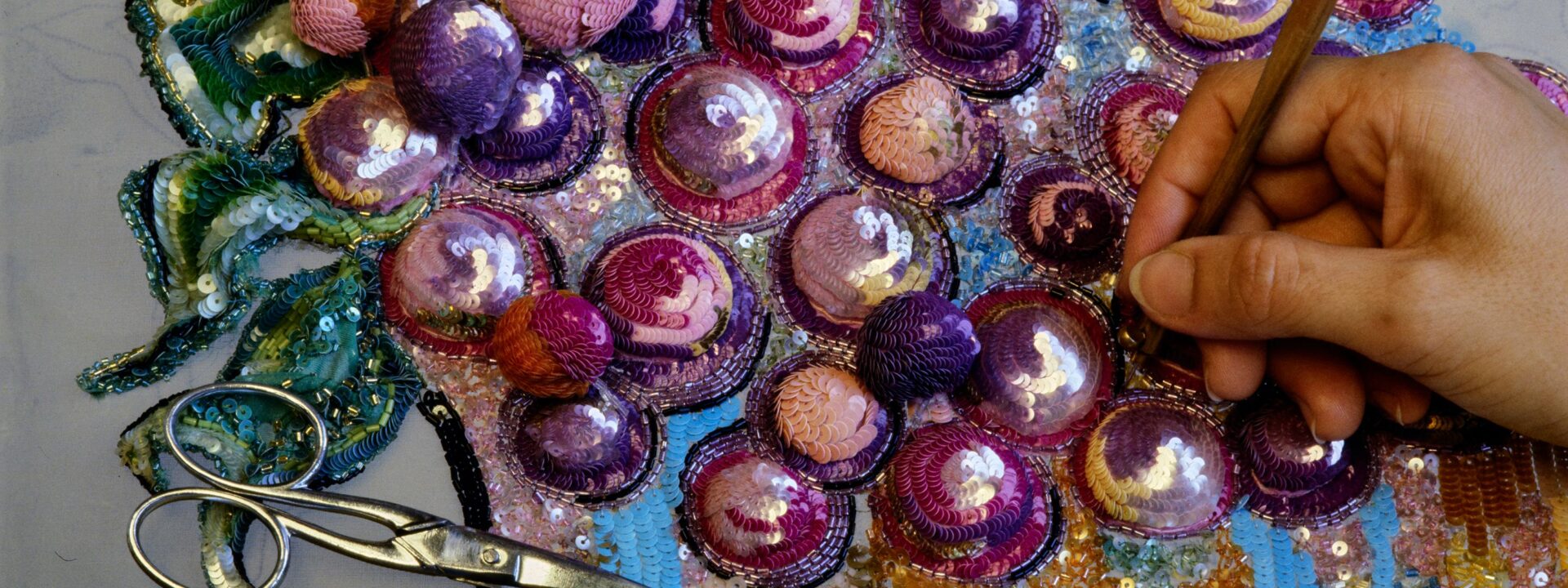
“The Glorious Tradition,” by Katherine Betts, first appeared in the December 1995 issue of Vogue. For more highlights from Vogue’s archives, sign up for our Nostalgia newsletter here.
The images are iconic: Lisa Fonssagrives posing for Irving Penn in Balenciaga’s petal dress. The designers are stars: Karl Lagerfeld striding triumphantly down the runway as cameras flash; the media frenzy when John Galliano took over the legendary House of Givenchy. And the debate is both inevitable and endless: a constant stream of stories questioning the future of haute couture, along with complaints about its frivolity, exclusivity, and cost. Ever since World War II, when Christian Dior shook Paris fashion out of its wartime slump with his New Look, couture has repeatedly had to fight for survival. Its death was first predicted when French ready-to-wear hit the market in the 1960s. Later, during the oil crises of the 1970s, Time magazine announced that couture wasn’t dead but “breathing very hard.” Most recently, The Wall Street Journal warned that many of France’s remaining eighteen couture houses probably “won’t survive in the face of growing international competition.”
If there were ten commandments for couture, this would be number one: Fabric should dictate form. Here, breaking from his signature rococo style of heavy embroidery or ruffles, Christian Lacroix creates a duchesse satin dress for a new era of couture.
So what keeps this craft alive? Who provides the emergency rescue at every economic downturn? Aside from rare moments like the birth of a new house (think of Christian Lacroix in 1987), couture survives on its own mystique—a visual, oral, and tactile history passed down through generations of artisans since Frederick Worth first opened his shop in 1858. This history is partly wrapped in secrecy, as each couture house, like a tribe, maintains a code of silence. Designers protect their clients, who, in turn, are reluctant to reveal what they pay for a dress. And even the seamstresses and craftsmen—the real backbone of the business—are hesitant to share the details of a meticulous tradition: one year to create the fabric, 160 hours to make a jacket, 55 hours to sew a skirt, 30 hours to craft a silk corsage, 150 hours for a dress, 45 hours for a pair of shoes, 100 hours for a hat.
At a time when couture is under attack once again, the voices that echo in the workrooms, studios, back rooms, and fitting rooms—the sewers, the craftsmen, the designers, and the clients—speak up in defense of their craft.
Exaggerating a woman’s curves from shoulder to toe, on this page, Karl Lagerfeld wraps her in midnight-blue satin. Off-shoulder evening dress worn with a corset from Chanel Haute Couture.
The collections of Spanish-born designer Balenciaga were often cut away from the body in a line that abstracted the curves of the female form. “Balloon” dress and cape in black faille, Paris, 1950.
Life in the Atelier
François Lesage, embroiderer: The premiers—or sewers—are like the Jean-François Champollion of haute couture. He was the guy who taught the Egyptians how to read hieroglyphics. The sewers interpret the designers’ sketches; they bring them to life.
Cécile Ouvrard, head of a Christian Lacroix atelier: A sketch is just a feeling; it shows only the attitude. After that, it has to be built. I remember when I first got here, Mr. Lacroix gave me a sketch to make a pattern, and I said, “Oh my God, what is this?” It was unreadable; the lines were flying in every direction. I asked him, and he said, “Make your interpretation, and then we’ll see.”
Jeaninne Ouvrard, head of a Christian Lacroix atelier: With Mr. Lacroix, we work more with cultural images and gestures than with sketches. I remember we were working on a dress, and he said, “In the back, it should go up like this.” And I said…”Oh yes, like a nineteenth-century washerwoman pulling her skirt up around her in the river.”
Lagerfeld: What happens inside the garment matters more than what’s on the outside. With modern couture, you put on a show on the runway, and the real work happens in the workshop. It’s an inside story.
A craftsman in the atelier of shoemaker Raymond Massaro practices an art rooted in couture, building a shoe form entirely by hand.
Cécile Ouvrard: The first wedding dress I worked on, Jeaninne came out of the studio and said, “OK, I’ve got the wedding dress.” I asked, “Where’s the sketch?” She said, “There’s no sketch; we’re just making a meringue!”
Paule Gayrard, Chanel seamstress: It’s not easy to find work in haute couture now; only Chanel really has any. For seamstresses, if you’re 40 and out of a job, forget it. It’s over. In Mademoiselle Chanel’s time, there were so many of us—six ateliers, even one for hats! And the work was very flexible. It was just wool tweed, no lining or canvas facing. She liked it that way; it was easier to wear. Now everything is difficult—satin, velvet, chiffon linings. It’s a matter of fashion; Mr. Karl likes his fashion more fitted.
“The mood happens on the runway. The rest happens in the atelier. Couture is an inside story.” —Karl Lagerfeld
Karl Lagerfeld: The challenge is to make couture techniques modern. Some seamstresses are old-fashioned. They stick to very conventional ways of doing things—how a jacket falls, how it’s built. I’m trying to change that.
Paquito, head of Chanel atelier: We have so many orders that we sometimes have to hire temporary workers, but it’s hard to find people who do this work well. You have to really love this craft to sit there sewing all day. Without the seamstresses, though, what would we do? They have hands of gold.
Christian Lacroix: Couture risks dying more from a lack of craftsmen and seamstresses than anything else.
When shipped abroad, a Christian Lacroix wedding dress travels upright in a cloth case, each layer resting on a bed of tissue. Such extraordinary care and attention to detail is the foundation of couture.
Colette Maciet, head of a Givenchy atelier: I started working for Mademoiselle Chanel when I was fourteen. There were 1,500 seamstresses working in the ateliers, and there were ten to fifteen ateliers. Now when a seamstress retires, she isn’t replaced. And young people aren’t interested. They have no patience. They all want to be designers.
Paule Gayrard: At Chanel, the workers stay a long time. We’re part of the furniture.
Christian Lacroix: Couture is a story of tribes—families, really—groups of people who get along and are friends. For me, it’s the theater that has helped me find the artisans who make my craft modern. The link between theater and couture is obvious because, like theater, couture is a preparation for an exceptional moment.
Creativity Then And Now
Paquito: When I came to France, couture was very elaborate. There was Balmain, who made the tight suit, and Jacques Fath. And Balenciaga—he was the king. Couture clients were much more precious back then. Now they’re more modern, like everyone else. Now it’s still Chanel, but modern. The proportions, the form—it’s not the little boxy jackets; Karl changed all that.
Her friendships with avant-garde artists Dalí, Man Ray, and Cocteau encouraged Elsa Schiaparelli to defy tradition by using bright colors, rough fabrics, and a natural shoulder line to shock the public. Coat by Elsa Schiaparelli, Paris 1950.
Colette Maciet: Every couturier has a different way of working. Chanel never worked with sketches, and Lagerfeld does. Mr. Givenchy worked only on fitting models. Every house is different. I remember working for Chanel; it was terrifying. We’d come back from lunch and see her on rue Cambon coming out of the Ritz, and we’d hide! We were scared to see her.She didn’t like seeing pregnant women or women in pants. And she was so humiliating to the seamstresses. The night before a collection, she would make us cry; she would make us change everything on a finished suit. It would be perfect, but not for her.
Sophie Veron, couture fabric manufacturer: Mademoiselle Chanel was tough. I would go see her, and she would say, “I want it like this.” And you had to do it. Christian Lacroix is the same. He says, “No, don’t show me this.” We give them what they want. We have to—it’s a service business.
Christian Lacroix’s Goya-inspired dress, on this page, is a modern example of how well couture and art can come together. An ecru lace and tulle Empire coat worn with an ivory satin corset over a lace skirt in moss green to rose pink graduated chiffon.
Cécile Ouvrard: When I came to Lacroix in 1987, Christian had just opened the house. There was nothing, not even a box of pins. But that first couture collection is engraved in my memory. It was so extraordinary; it was the moment couture was reborn. It was like a shock compared to other houses, where couture collections were nice but not wild. Lacroix’s dresses are like paintings—they’re incredible, like museum pieces. I’ll always remember he once said, “For me, too much is never enough.”
Philip Treacy, couture milliner: Karl Lagerfeld has the same fearlessness in fashion that Elsa Schiaparelli had. She had wit and light-heartedness that very few people have. It’s hard to make a lamb chop look glamorous, but she did. Karl is very clever. I love the idea of a little originality on the runway.
Constantly exploring the limits of couture, Gianni Versace uses unconventional fabric—or, in this case, plastic—for his signature sexy shapes. With its hand-beaded Austrian crystals, the dress weighs sixteen pounds.
Gianni Versace: Every couturier thinks couture dies when they die. That’s ridiculous. As long as people want quality and refinement, couture will last. I think it’s ridiculous to have the equivalent of the Concorde in fashion and not use it.
Karl Lagerfeld: There’s a mystique about haute couture. But you should never analyze the unnecessary, just enjoy it. As Voltaire said, if you have to explain it, it’s not worth explaining.
John Galliano: Couture isn’t about overdone beading. It can be the most beautiful simple black dress, perfectly cut and feeling divine on the body, without costing as much as a rhinestone bustier.
Christian Dior, whose “New Look” made headlines around the world in 1947, struck again with what Vogue called the “Now Look” in 1949. A navy-blue silk taffeta dress worn by Dorian Leigh.
Gianni Versace: Couture doesn’t have to be all done by hand. You can use a machine too. Paris is full of taboos. They resist: “Oh, it’s plastic, it can’t be couture.” That mentality isn’t modern.
Sophie Veron: What’s extraordinary is how couturiers transform fabrics. Like a chef who creates a new recipe by mixing unusual ingredients and flavors. It’s how they make the fabric speak that makes it couture.
The Future of Craftsmanship
Anne Corbière, hand-weaver: There’s a stigma attached to fashion, especially couture. People think you have to justify it all the time. Americans either accept it or reject it, but in France, people actually express themselves through it.
François Lesage: There’s only one city in the world where you can pick up the phone and get a 1930s embroidery by Vionnet in 48 hours. Couture isn’t made only by the couturier and the first assistant. There are the craftsmen, and if they disappear, couture disappears. Unfortunately, these people are old. The new generation is there, but budgets are smaller. Where we once made 150 pieces a year, now we only make 50 or 60.
Raymond Massaro, shoemaker: I’m very happy to have lived in both the old system and the new system. I like couture, noBecause it moves so fast creatively. It’s exhausting, but much more exciting. Twenty years ago, everything started changing with planes, travel, and transport. Maybe in 20 years, we’ll move even faster. People like Karl Lagerfeld push us to renew ourselves faster and faster.
Balenciaga, one of the first true architects of fashion, never strayed from his commitment to clean lines and structural decoration. This slim-fitting dress is made with cocoa-colored Pétillault muslin petals. Balenciaga, Paris, 1950, worn by Lisa Fonssagrives.
Philip Treacy: When people buy a hat, they can’t explain why they want it, but they do. It’s like chocolate. It’s just an expression of what a person wants to say about herself. Hats make you stand out, and that’s why people wear them. They have an allure, something intangible. Can you imagine Henry VIII without a hat?
François Lesage: I think it’s a sin if you have a certain talent and don’t pass it down to the next generation. My parents bought the House of Lesage in 1924; I took over when my father died in 1949. I’ve made over 27,000 embroidery samples here.
Pearl, corsetmaker: This craft isn’t taught anymore. Unfortunately, we don’t have the materials or machinery from the nineteenth century. All that knowledge has been lost, so I had to teach myself.
André Lemarié, feather craftsman: This house was founded by my grandmother 115 years ago. She worked with her hands. I’m the third generation. In the beginning, it was just feathers; then my mother started making feather hats, then flower hats. We made the first camellia for Chanel in 1960. Mostly we do feathers. We curl them, sew them, glue them. Like all crafts, this one goes in cycles. Every two years, feathers come back into fashion.
François Lesage: Our craft is like being kids in a candy store. It’s as if we went to Braque’s studio when Saint Laurent made his Braque collection in 1987, or to India with Ungaro, or to El Escorial with Balenciaga.
You have to look at couture from the inside out to see the foundation on which a designer builds a design. An embroidered and patinated silver satin corset is worn with a long lace-covered metallic-satin skirt lined with ribbons. Christian Lacroix Haute Couture.
Gustav Zumsteg, president of Abraham fabrics: Now couture is a media spectacle to fill magazines and TV screens. Designers still need to promote their licensees and perfumes, but the material producers—what we are—with all the craftsmanship behind us, are victims of the situation.
Raymond Massaro: Chanel was the first to do accessories in haute couture, but I also worked with Grès, and my father worked with Vionnet before the war. My father was one of four brothers, and they were all shoemakers.
Couture and Its Clients
27-year-old European client: I bought my first couture ball gown when I was 20. I only buy for big occasions, two or three gowns a year. For everyday, it’s too expensive. At $15,000 to $20,000 for a dress, I don’t think anyone can afford a whole wardrobe anymore. It gets more expensive every year, too. That’s why if you’re young, you go to someone who will give you a good price.
Parisian client: I borrow dresses for big occasions, but I buy for dinners and very dressy lunches. I’m a writer, so I don’t need many day clothes. I buy one or two a season. Couture is an immense luxury, but once you get used to it, you can’t wear anything else.
John Galliano: Couture can be more affordable, depending on the fittings, fabrics, and finish.
Carrying the great traditions of couture into an uncertain future, John Galliano will unveil his first collection as the new couturier for the House of Givenchy next month.
Paquito: The clients are very demanding; they know what they want. They say, “Paquito, no, the shoulder is too high, too tight here.” There’s an intimate trust between us. There’s this whole system of flattering theWe adjust the fit to flatter the client. If she has wider hips, we let the fabric out so it doesn’t pull. If she has a hunched posture, we square the shoulders. It’s like plastic surgery.
27-year-old European client: The exciting part is that it fits perfectly. Couture clothes highlight your best features and hide the flaws.
John Galliano: Women today understand that couture is about working with a woman’s body—being her ally. It can hide a larger bottom or lift the bust.
At just 29, Irish-born hat designer Philip Treacy has already created hats for John Galliano, Karl Lagerfeld at Chanel, Gianni Versace, and Valentino.
Sophie Veron: The problem with haute couture is that it no longer fits women’s lives. Who has time for three fittings?
27-year-old European client: I don’t like the fittings. They take too long. But I do enjoy giving my input on colors and fabrics.
Colette Maciet: Some clients need seven or eight fittings. They’ll change something by a millimeter, then change it back at the next fitting. Luckily, there aren’t many like that.
Raymond Massaro: Barbara Hutton would order 150 pairs of shoes at once. She had a whole room at the Ritz just for her trunks of clothes, shoes, and jewelry. Times have changed—orders like that don’t happen anymore.
Treacy’s birdcage hat for Chanel Haute Couture.
Janine Ouvrard: I’ve traveled as far as Los Angeles to deliver wedding dresses. We make special crates to ship them so we don’t have to fold the dress. If the train is longer than eight meters, two of us have to go to iron it. Once, the crate wouldn’t fit through the airport doors, so we had to call the police for a special escort onto the runway.
Cécile Ouvrard: When we deliver dresses to the Middle East, it’s ten times more work because everything is so grand there. One bride had a silver lamé dress, and it started pouring rain. The silver threads in the train began to shrink from the humidity. I thought, “Oh my God, 700 hours of work disappearing before my eyes!”
Philip Treacy: Last week, someone came by in a chauffeured limousine. She had 20 sketches from the couture collection and wanted 20 hats. That’s the old way. Very few people do that anymore. There used to be 7,000 hatmakers in London; now there are only seven.
“Without haute couture, the corset and the craft of making corsets would never have existed.” —Pearl
Colette Maciet: There’s a certain closeness during fittings, especially when we go to a client’s home to deliver clothes. Queen Noor was a client, and she was completely different at home—so open and warm. We’re close to our clients; they ask for our advice. And once they’re used to a particular fitter, they don’t like to switch.
Cécile Ouvrard: We know everything. I made Sigourney Weaver’s Oscar dress. It took 150 hours. I know because we record everything on a special piece of paper—the exact measurements, how much fabric, which buttons, the pattern, the hours worked, and the fabric manufacturer.
Colette Maciet: Clients are curious about Mr. Galliano coming to Givenchy, but what they’re really worried about is whether we’re staying. They come to the couture houses for the designer, but also for the seamstresses. Plus, they’re a bit shy, you know. They live in a bubble and like to be pampered.
Catherine Delondre, head of a Givenchy workshop: I’ve been at Givenchy for 33 years, and not much has really changed. We have clients who have been coming for 30 years. We’ve had such loyal customers here. Audrey Hepburn, of course, but also Rose Kennedy and Jackie before the White House. With Galliano, it will be different, that’s for sure. Different clients, but also different techniques.
Rich treatment of luxurious fabrics is the essence of both couture and Christian Lacroix. Each of the five layers of this wedding dress has a different…Rent lace; the velvet scarf-bolero is carefully hand-beaded, embroidered with flowers, and finished with lace trim. A honey antique faille wedding dress features asymmetrical gold guipure, lace organza ruffles, and sequins.
François Lesage: In the eighties, women wanted to be noticed; now they hide themselves. They show up in these minimal clothes. Today, the snobbery is about buying cheap. If we keep going this way, your kids won’t even know what leather soles on shoes are—there will only be Nikes.
Gianni Versace: It can be minimal and still be couture, of course. Remember, Balenciaga was the greatest couturier of this century, and his work was so pure. Fashion follows life. We simplify our lives now, so we simplify couture too.
John Galliano: Our generation does understand the cut of a great jacket. We go to flea markets or buy a Vionnet dress at a secondhand store. Couture is just as relevant to us as a white T-shirt.
Frequently Asked Questions
Here is a list of FAQs about The Glorious Tradition the 1995 couture feature with a special portfolio by Irving Penn
Beginner Questions
Q What exactly is The Glorious Tradition
A Its a famous fashion feature published in Vogue in 1995 It highlighted the artistry of haute couture with a special section of photographs taken by the legendary photographer Irving Penn
Q Who is Irving Penn
A He was one of the most influential photographers of the 20th century known for his minimalist elegant fashion photography and portraits
Q Why is this feature so famous
A Its famous because it combined Penns stunning simple photography with the most extravagant handmade couture garments of the time Its seen as a perfect meeting of high art and high fashion
Intermediate Questions
Q What was special about Irving Penns photography style in this feature
A Penn used his signature style a plain neutral backdrop and direct natural lighting This made the intricate details and textures of the couture dresses the absolute focus without any distracting props or settings
Q Which designers were featured in the portfolio
A The portfolio included iconic houses like Chanel Dior Yves Saint Laurent Givenchy and Balenciaga among others
Q Was the feature just about the clothes or did it have a deeper message
A The title The Glorious Tradition was a tribute to the dying art of haute couture In the mid90s readytowear was becoming more dominant so the feature was a celebration and a lament for the craftsmanship and artistry of custommade fashion
Advanced Questions
Q How did Penns lighting technique affect the perception of the fabrics
A He used a soft even light that minimized shadows This allowed the viewer to see the exact weight sheen and texture of heavy silks delicate lace and intricate beadwork making the garments feel almost threedimensional
Q Is there a specific image from the portfolio that is considered the most iconic