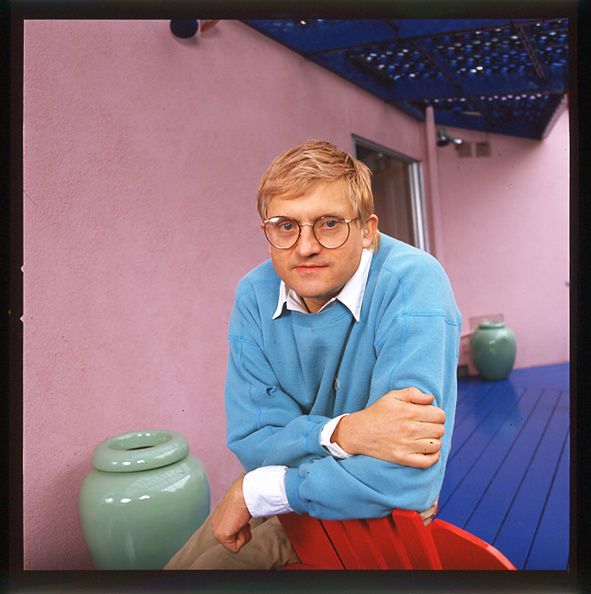
David Hockney’s first solo show opened in London in 1963. It was called Pictures With People In—a boldly figurative title for the poster boy of Pop Art, a new and challenging style of painting. He had recently left the Royal College of Art, almost without his degree, because he refused to draw a nude model from life, which was required. In the end, though, they gave him a gold medal.
That same year, Hockney appeared in Vogue for the first time, in a group portrait with fellow painters Howard Hodgkin, John Howlin, and Ian Stephenson. Vogue called them “The Impact Makers.” Three of them showed up dressed soberly. Hodgkin, in a black suit, folded his arms and stared glumly ahead. Stephenson and Howlin looked just as uncomfortable. Only Hockney, standing apart from the others, seemed unfazed. His hair was already blond thanks to “Champagne Ice”—“You see, I came home slightly drunk one evening and saw an ad on TV saying blonds have more fun.” His casual, slightly disreputable style set him apart even more: a pale-blue seersucker blazer and a fuchsia-pink tie. And then there were those iconic, owl-like glasses with rims as big as bicycle wheels.
Hockney was born in Bradford in 1937. He was the second youngest and the most famous of the four, the most used to being photographed, and the most publicly celebrated. Ahead of him lay California, its swimming pools, and A Bigger Splash; later came opera and stage sets, Mr and Mrs Clark and Percy, Stanley the dachshund, multi-print Polaroid collages, research into lenticular devices, mind-bending iPad pictures, and late-in-life “fully immersive” exhibitions. But for now, he leaned on a large canvas, casually smoking a cigarette.
In 1964, he moved to Los Angeles. “I used to think London was exciting,” he said. “Well, it is compared to Bradford; but compared with New York or San Francisco, it’s nothing.” But London wouldn’t let him go so easily. He found himself part of its cultural elite, a leading figure in “Swinging London”—even though he was on the other side of the world. Still, for all his time on America’s West Coast, he never lost his Northern accent, which made him almost impossible for Vogue’s Cecil Beaton to understand. But as his friend and contemporary RB Kitaj noted: “Northern England is his native strength—and he knows it.”
By then in his 60s, Beaton—a Vogue star for decades—saw Hockney and his colorful circle as natural successors to the “Bright Young Things” of the 1930s. “I feel completely at ease with him and inspired by his enthusiasm, because he has this golden ability to enjoy life,” Beaton said of the younger man. In 1968, he photographed Hockney in his west London flat, completing the first and one of the most famous of his grand double portraits, Christopher Isherwood and Don Bachardy. The great English novelist had been living in Los Angeles since World War II, and Hockney sought him out as soon as he arrived, admiring Isherwood’s gay-themed writing and sexual openness.
Lord Snowdon first photographed Hockney in 1963 for The Sunday Times. Fifteen years later, in 1978, he photographed him again, this time for Vogue. “Hockney at Home” showed the painter in a new studio on Powis Terrace in Notting Hill. “I’m always complaining about London, but I keep coming back,” Hockney told Vogue. Not long after, he decided to make Los Angeles his permanent home.
“David was rather fun,” Snowdon recalled. He admired Hockney’s canary-yellow trousers and mismatched socks, but took even more delight in the studio’s pinboard, which prominently featured naked snapshots of his former partner, model, and muse, Peter Schlesinger.Snowdon didn’t manage to sneak the photos past the editor-in-chief and into the magazine, but the Hockney bathroom made it in—complete with his latest hair dyes in shades like “Happy Honey” and “Winsome Wheat.”
Everyone thought David was fun. “Los Angeles should have a Piranesi,” he told Vogue as the Tate’s David Hockney: A Retrospective opened in 1988. “So here I am!” By then, his image was carefully crafted as he wandered around his sun-filled house in the Hollywood Hills (once owned by Anthony Perkins, star of Psycho), with Stanley the dachshund and a pink (or blue, sometimes red) hearing aid. “Everyone gets the publicity they want. David would put on a green and yellow dress to get it,” said Lucian Freud, possibly with admiration.
Hockney at home in Los Angeles, 1987.
Photo: Anthony Barboza/Getty Images
A 50th birthday tribute published in 1987 showed Vogue’s readers how far he had come. “There’s no trace of pomposity or self-importance about him—and what success!” declared Stephen Spender. “A line in his work is like a line in a tune…” A celebratory, sunlit picture showed him in his swimming pool (of course), but he always remembered where he came from—where it all started with pictures of his earliest model, his father, an office clerk in a small office and a keen amateur painter. “I’ve got Bradford. They can’t take that away from me.”
And so David Hockney’s presence in Vogue echoed through the years. In 1992, he was “Our Man in Malibu”—the man who invented California for the British imagination: palm trees, swimming pools, lawn sprinklers, boys in briefs in showers, and pastel-colored low-rise modernist bungalows. “As I flew over San Bernardino and looked down and saw the swimming pools and the houses and the sun,” he recalled, “I was more thrilled than I’ve ever been.”
Hockney and the edition of Vogue Paris that he guest edited.
Photo: Getty Images
By 2006, now heading toward 70, Vogue found him back in his native Yorkshire, near Bridlington, where he had taken a studio to paint the expansive landscape outdoors. He had first seen the seaside town from a train window as a child in the 1940s, and here he was, full circle, temporarily away from sunny LA. “The first winter I spent here… I began to see how beautiful winters were.”
When Tim Walker made an 80th birthday portrait on the eve of another Tate retrospective—was it his third?—his old friend Peter Blake, who first exhibited with him in 1961, led the tributes with a challenge: “Stay ahead of the avant-garde.” He added, “Of course, it’s impossible, but if anyone ever did it, it’s David. He’s always ahead of people’s perception of him.” (By then, Peter Blake was Sir Peter Blake. Hockney himself had turned down a knighthood in the early ’90s but accepted the Order of Merit in 2012.)
LITTLEROCK, CA – AUGUST 4: English artist David Hockney on Pear Blossom Highway, the scene of one of his famous montages, during the taping of an upcoming BBC television documentary. August 4, 2001, Pear Blossom Highway, Littlerock, California. (Photo by Paul Harris/Getty Images)
Paul Harris/Getty Images
In August 2020, another milestone: his first cover for British Vogue. (Vogue Paris had gotten there first, giving him the cover and guest editorship of an entire issue at Christmas 1985.) Hockney was now based in Normandy, but he contributed Wheat Field Near Fridaythorpe for the cover—about as Yorkshire as you could get. The world was just starting to emerge from enforced hibernation, and he was as irrepressible as ever. “It’s quite fantastic. The other night I got up to pee at 4 a.m. and saw the largest and brightest full moon in a long time… I recorded it on the iPad. Photography is useless for this—it pushes everything away, including the moon.”
In 2023, on the eve of his National Portrait Gallery retrospective, Drawing from Life, Vogue got a first look at his latest portrait of pop star Harry Styles. “I’m in awe of the man, with enough one-liners for a lifetime.”“Me,” said his spellbound sitter. “David Hockney has been rethinking the way we see the world for decades.”
Hockney paints Harry Styles in the artist’s studio in Normandy, in an image shared exclusively with Vogue.
Photo: JP Gonçalves de Lima
When a huge exhibition of nearly 400 works opened in spring 2025 at the Fondation Louis Vuitton—Frank Gehry’s “cloud of glass,” now a true Paris landmark—Hockney was nearly 87. The biggest show of his long career sparked an almost unmatched excitement. The critical praise and public admiration for one of the greatest painters of our time, whose life spanned from one century into the next, remained as strong as ever. Nearly a million people visited.
David Hockney lived long enough to see the art market explode, especially the sky-high rise in the value of his own work on the secondary market. “Portrait of an Artist (Pool with Two Figures),” which sold in 2018 for $90.3 million, still holds the record for the highest price ever paid at auction for a painting by a living artist. “It’s an absurd world, isn’t it?” Hockney told Vogue in 2025. “And it looks like it’s getting even more absurd.”
There’s a lot that made him unique as an artist, but as a person? Celia Birtwell, likely now his oldest living friend and one of the three figures in the famous painting “Mr and Mrs Clark and Percy” (1971), maybe put it best when she told Vogue in 2017: “He thinks if you laugh every day, you’ll probably live forever… Of course I don’t believe him. But it’s a nice thought.”
Frequently Asked Questions
Here is a list of FAQs regarding the passing of David Hockney written in a natural tone with clear answers
BeginnerLevel Questions
1 Is it true that David Hockney has died
Yes David Hockney passed away at the age of 88 His death was confirmed by his representatives
2 Who was David Hockney
He was a famous British artist best known for his colorful paintings of swimming pools California landscapes and portraits He was a key figure in the Pop Art movement
3 What is he most famous for painting
His most iconic work is probably A Bigger Splash which shows a diving board and splash in a pool He also created a famous double portrait called Mr and Mrs Clark and Percy
4 Was he only a painter
No He was also a skilled draftsman printmaker photographer and set designer In his later years he created huge colorful landscapes on an iPad
5 Where was he from
He was born in Bradford England in 1937 He lived and worked in Los Angeles for many years which heavily influenced his art
Advanced Questions
6 How did he die
The official cause of death has not been publicly released by his family They have asked for privacy at this time
7 What made his style so unique
He was famous for his bold use of color flat perspectives and the way he played with light and reflection especially in water He also loved to experiment with different technologies from photocollages to digital drawing
8 Was he still working at 88
Absolutely He was incredibly productive right up until his final days He had even been preparing for new exhibitions and posting new drawings on his social media
9 What is his legacy in the art world
He is considered one of the most important and influential British artists of the 20th and 21st centuries He helped break down the barrier between high art and popular culture and his joyful optimistic work is loved by millions
10 Are there any major exhibitions of his work coming up
Its likely that many museums will plan retrospectives or tributes However as of now no specific posthumous exhibitions have been announced Check the websites of major museums