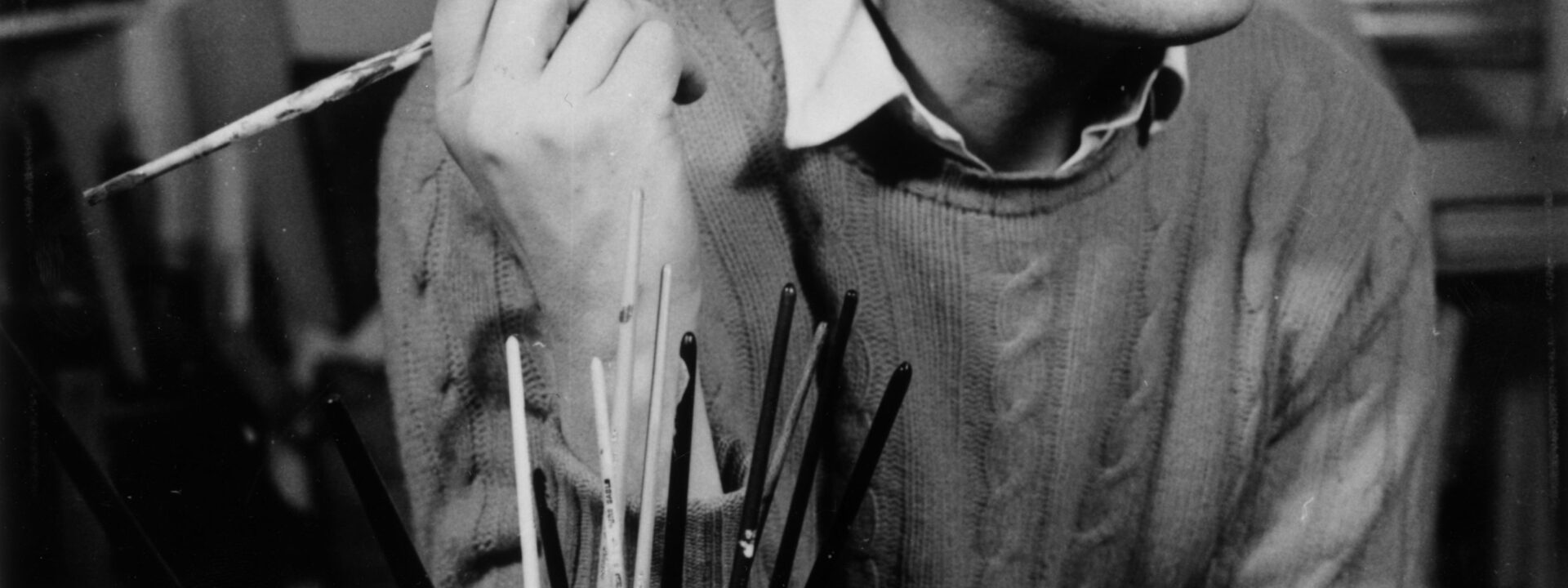
Almost ten years ago, ahead of his 80th birthday and a major exhibition of his work, friends and fans of David Hockney shared their thoughts on one of the world’s most beloved artists in British Vogue. Following Hockney’s death in June 2026 at the age of 88, revisit what some of his many admirers—from Erdem to Ian McKellen—had to say in the February 2017 issue.
Bella Freud
There’s something secretive about David Hockney’s paintings. When you look at his swimming pools, you feel like you’re getting a small glimpse into another world, and you can’t stop thinking about it afterward.
I look at his pictures for mood and color, and I’m amazed by how fast and directly he seems to work. I remember when I was about 19, sitting for my father [Lucian Freud], Hockney had a show at Riverside Studios. I saw him as a different kind of painter—someone very connected to modern life as it happened, in a way that was completely different from my father.
When Hockney asked to paint my son Jimmy, I was so happy that he’d get the experience of sitting for a real painter. My father had been dead for five years, so going back into an artist’s studio felt really special to me—to have that kind of experience again, which I’d only ever had with Lucian.
Hockney has the same quality my father had: being interested in people and making them feel special. I wasn’t there for the actual sitting, but we had a huge pot of very strong tea and a big cake. Being in California, on that lush, leafy hillside, and having a proper old-school Yorkshire tea with him—it was brilliant.
Caroline Lundin
When my creative partner and I first talked about ideas for Pomona’s—the Notting Hill restaurant our design studio worked on—we were at the Roosevelt Hotel in Hollywood, which has an amazing swimming pool designed and painted by Hockney. As a result, all my Pantone colors and material samples for the restaurant’s interior matched the colors from A Bigger Splash. It was subconscious. The more we read about him and immersed ourselves in his work, the more we felt his influence.
I know he spends very long days in the studio and is relentless when he paints. I love his passion and ambition, but also how relaxed the final result can feel. We spent a huge amount of time on this project, but we also wanted to create something vibrant and inspiring—so people feel like they’re coming home.
Erdem Moralıoğlu
The Hockney pieces I’ve always been drawn to are the ones with a narrative and a story—as if something is about to happen, or has just happened. It’s that fleeting moment that has always fascinated me, and something I’ve tried to explore in my own work.
Think of Portrait of an Artist (Pool with Two Figures)—the painting of Peter Schlesinger looking into the pool, with a swimmer below, underwater. He captures a moment, with that Californian sun you can almost feel. It’s a depiction of a relationship and what might happen to it.
I started collecting photography about ten years ago. A few years ago, one of his photo collages came up at an auction in New York—a picture of a boy named Ian at Fountains Abbey in Yorkshire. I fell in love with it and bought it. The photo collages feel so personal; he builds them himself. What’s wonderful about this one is that you can see Hockney’s feet at the bottom of the photo, so you’re seeing from his eyes, from his perspective. I have it in my shop, but I could just as easily have it at home—I rotate pieces between the two.
Paul Smith
My wife was at the Royal College of Art and remembers him graduating, causing an absolute scandal because instead of wearing a mortar board and gown, he had a gold lamé jacket on and had dyed his hair blond. The first work we got of his was a print called Pretty Tulips—some very relaxed tulips in a Lalique vase. I can’t remember how much we paid for it, but I know it was either the gas bill or the print, and we chose the print.He prints. I think we approach the way you dress in a similar way. I have a suit at the Victoria & Albert Museum — it’s a navy-blue pinstripe, a classic businessman’s fabric, but it’s cut in a very loose style and worn with white plimsolls and a white T-shirt. We used Hockney’s irreverence as a reference, his way of pairing unusual colors together. I remember once running into him in town. He was wearing a pinstripe suit, but in an interesting shade of blue, and he paired it with a teal shirt and an emerald-green tie — very tonal colors that clashed with each other and looked really lively together.
Photo: Getty Images
Christopher Bailey
David Hockney’s permanent exhibition was just around the corner from where I grew up, so his work was really part of the background of my youth. Hockney has been an inspiration ever since I started appreciating art, design, and aesthetics. I feel a natural connection to him because we both have strong Northern roots and a deep love for Yorkshire’s beautiful landscape and culture. The Student: Homage to Picasso is one of my favorite pieces — it’s humble and full of admiration, and it reflects his own deep respect for an artist.
Both his body of work and his unique personal style, wit, character, and intellect are constant references for me. One of the things I’m most drawn to in Hockney’s work is the life and energy that seems to flow through every splash, brushstroke, and swipe. His subjects, his landscapes, his self-portraits — they all seem alive with character. And David’s style completely reflects his character — colorful, eclectic, a bit undone, and distinctly British. The way he mixes and combines colors with such confidence, ease, and playfulness is wonderfully refreshing and inspiring.
Photo: Getty Images
Peter Blake
I have two mottos. One is “Living well is the best revenge,” which is about going through tough times and coming out the other side. The other is “Stay ahead of the avant-garde.” Of course, it’s impossible, but if anyone ever did it, it’s David. He’s always ahead of how people perceive him.
Whatever new thing comes along, he embraces it and masters it. I remember when the Quantel — one of the first computers — came out, we both tried it out. I stuck with cutting out pictures and pasting them down, and didn’t really explore the technology until much later. But David did, and he moved on, and now, of course, he works with an iPad. Still, I love his early life drawings. I always say David can do the best kind of quick drawings — he captures a lightness of line when someone is sitting in front of him.
Photo: Getty Images
He’s still a great friend. My daughter was probably eight when we stayed with him at his beach house in California. He took us on one of his wonderful musical tours. You start at a certain time, and the music is timed so that when you’re on the highway, it’s Elgar, then it turns into Wagner as you go up into the hills, and then it’s very sentimental music as the sun goes down. My daughter remembered it forever.
Giles Deacon
I’m a big fan of people who do their own thing and stick with it. One of the words I hate most in fashion is “trend,” so it’s refreshing to see someone who stays on his own path — even though, at the same time, Hockney is always experimenting and pushing himself in new directions.
When I was studying art history in school, I was especially interested in the fact that he was from the north of England — he was one of us. There’s a clear Northern pragmatism that comes through in Hockney, a toughness and a drive. And the way he’s embraced technology has been really inspiring. A lot of people would just keep doing the same thing over and over, but he’s very forward-thinking — fax machine, Polaroid camera, iPad… he was on it. And he did serious work with them, it wasn’t just something to mess around with in the studio. We’re always trying to keep things relevant with the couture pieces we make, exploring a mix of modern materials and laser-cutting technology.Techniques with traditional making.
My all-time favorite picture of David Hockney is him sitting with Cecil Beaton at Reddish House, in the conservatory. It’s just the two of them together, both looking absolutely incredible. If I could be transported into that room, I’d go there in a heartbeat.
Photo: Getty Images
Sophie Hulme
Hockney’s work instantly creates a mood—there’s something so captivating about his confident use of color and line. I’ve always loved his swimming-pool series, but it was in 2010, when I saw the revival of his first stage set designs at Glyndebourne—The Rake’s Progress—that his work really connected with me. His sense of proportion and perspective is so precise. He seems to create his work by blending a technical approach with a playful touch—it really matches my own philosophy in designing accessories.
Jasper Conran
It’s easy to talk about David and his influence, because he’s so woven into people’s lives. He changes, explores, and experiments as we change, explore, and experiment, and you find that his work has become part of your soul.
I was just eight years old when I first met him. My mother took me to his studio, where he was working on a large painting. I can’t remember what it was, but I knew he was a great artist. He drew me once in New York, but he couldn’t get my nose right, which really frustrated him. When he’s drawing you, it’s serious—it’s not about having a drink and having fun, not at all. But it’s an honor, and you can feel that. So you try to give him your best.
He’s been a constant in my life. Once, I was driving him back from Paris to catch a boat, when suddenly a truck came from the other side of the road, straight at us. I swerved wildly across the road and back again, skidding around the truck. He turned to me and said, “You see, that’s what I like about you. You use your eyes.” I was panicking, having nearly killed the world’s greatest living artist, but he was completely calm.
Photo: Getty Images
Ian McKellen
David sees things so clearly from his own perspective. One reason he didn’t like living in England was the anti-gay laws he had to deal with, which didn’t apply when he moved to California. He was a pioneer and a hero, really—comfortable with being gay and not putting up with any nonsense about it. There were other gay painters of his generation who weren’t nearly as relaxed or forward-thinking. But then, he’s from Yorkshire. I say that as someone from Lancashire. The stereotype is that Yorkshire people are very open, blunt, and speak their minds—well, that’s him.
We got in touch with him when we were starting [LGBTQ rights charity] Stonewall and needed to raise funds to hire staff. I think he was half amused by the idea that Stonewall was necessary, but he was just as outraged as everyone else. He gave us a painting, a flower painting, which was crucial; every penny mattered back then. Someone got it pretty cheaply, I think. It was worth several thousand.
What I really admire about David is his constant search for new ways to explore what paint can do. There’s always some new idea he’s picked up on, which usually ends up in an exhibition and a book. So you always think of David as being present—he’s not a figure from the past at all, not an old man whose glory days are long gone.
There’s nothing dull about David’s views or his paintings. And some of his paintings are hugely theatrical. When I first saw the Grand Canyon, it was from the same spot where he’d painted those massive canvases. I’m not saying the real thing was disappointing—but David’s paintings are magnificent.
When his schoolfriend Jonathan Silver opened the Hockney archive in Salts Mill in Yorkshire, David had just discovered the fax machine. One day, in California, he had done a huge design of some kind, massive, and he’d split it up into several sheets of A4 paper, each numbered. He faxed these to Jonathan, who, seconds later, received them at the other end.He was taking what David had put into his machine and, using a pre-set numbering system, putting them up on the wall one by one in front of an audience. An hour later, a complete Hockney had come through. It was a typical, witty, and purposeful theatrical event. Nobody uses them anymore, but that was a glorious day for the fax.
John Kasmin
I was David’s first art dealer. My wife had inherited a bit of money from her grandmother—a small windfall—and I bought a picture by a guy I’d never heard of called Hockney for £40 at a student show. A few years later, when I decided to open a gallery, it was mainly because I’d fallen in love with a type of American abstract painting that wasn’t really being shown in England. Hockney was the odd one out—the cheeky, amusing one. He liked playing that role and would sometimes make light of it. He painted a piece called Two Stains on a Canvas, making a joke about one of the American artists I showed.
He stopped being shy pretty quickly. Some people blossom with publicity, and he did. David had a flamboyant side that made him a favorite of the press. He’d walk around in a gold lamé jacket with a gold lamé shopping bag—they picked up on him right away. He often said he liked the quiet life, but there wasn’t a subject he wouldn’t talk about if someone asked. I got a reputation as the dragon guarding the door.
Photo: Getty Images
Our social lives were intertwined—we were like a family. My artists used to play poker, croquet, and ten-pin bowling against other galleries’ artists. David was one of my better bowlers. Of course, he had his own ball, custom-made in gold.
Lindy, Lady Dufferin
My late husband [Sheridan, the Marquess of Dufferin and Ava] was one of Hockney’s first patrons. I met David in 1962. He had just left the Royal College, and there was a lot of excitement about him because he had defied all the rules—he refused to write a dissertation, saying his work was more important. By then, he was already a fully formed character.
He loves teaching me, so I sometimes have little lessons with him. You give him a piece of paper, and within minutes, he’ll draw the glass in front of you or the pen sitting there, placing it on the paper in a way only David can. I think that’s the root of all his work—this extraordinary ability to draw. He’s done quite a few portraits of me, and when he’s drawing you, he’s intensely focused. Everything is in it: his mind, his hands, his deepest concentration.
He smokes an awful lot, so you have to be ready for that. You come away gasping for air, but because you’re with such a star, you pretend it’s fine.
Photo: Getty Images
We had A Bigger Splash in the house for years; I think we were the first owners. What David did was reinvent how we see the world. Before that, a splash went unnoticed—we’d focus on the pool and the people around it, not the splash. So, typical of David, he made a deep philosophical point—that everything is fleeting and temporary—in a humorous way.
I used to stay with him in Bridlington, and there you saw how fierce and daunting his work ethic is. When he was working on those big paintings—which were shown in A Bigger Picture at the Royal Academy in 2012—he’d get everyone up for a cup of tea while it was still dark. His argument was, the sun doesn’t wait for you. That’s what his life is like.
Zandra Rhodes
David became a cult figure at the Royal College, but that’s probably because he was already selling work. He was a third-year student when I was a first-year, and when I decided to focus on pop art and medals, it was really inspired by looking at his A Grand Procession of Dignitaries in the Semi-Egyptian Style. Along with the motifs, it had that painterly quality.
The most interesting thing is the way he thinks. His mind is so alive, and it’s as alive now as it ever was.I think the secret to staying with your work over the years is that you truly love what you do, and you tend to surround yourself with people who feel the same way. That’s definitely true of David. If you spend time with him, all you talk about is art.
Vic Reeves
Hockney is always playing with people’s expectations. Early on, he painted very grey scenes of Yorkshire—almost an ironic image he played up for the outside world. But later, he created those incredibly vibrant paintings of Garrowby Hill, with beautiful winding roads that could be in California but are actually in Yorkshire. His compositions are stunning—there’s a grandeur that feels almost religious.
You have to work with what you’ve got, use the world around you. When I was in art school, he was making his photomontages, and it felt like a complete reinvention of cubism. He got an iPad, and it became his art. If you’re always coming up with new ideas, you’ll always be in fashion somewhere.
Manolo Blahnik
I grew up with Francis Bacon—all those brutal, beautiful works. Hockney offered something different: fantasy. I had never seen such freedom, novelty, and freshness in England. I was crazy about the costumes and sets he designed for The Magic Flute at Glyndebourne in the late ’70s. Maybe it was partly because I love Mozart, but they were so whimsical and so beautifully made. The images were everything I like: dancing girls and boys with flower garlands, like illustrations any child of the ’40s or ’50s would remember, but done with real skill.
The Rake’s Progress was wonderful too. The sets were cross-hatched in green and red, with a beautiful temple and beautiful trees—even the curtain fringes were lovely. Somehow, he captured the flow of Stravinsky’s music, and I even designed some criss-cross shoes based on those sets. I also used some of the gorgeous colors from The Magic Flute: olive green, moss green, lettuce green, and forest green. There’s one thing I’ll always regret: Hockney drew me at Mr Chow’s, in a sketchbook belonging to Michael Chow. I asked a friend, “Do you think you could get me that page?” But it never happened. Maybe before I die, I’ll ask him to do it again.
Celia Birtwell
David has such enthusiasm for everything he does. Every time he starts something, it’s the most incredible thing he’s ever done. I think that’s what I love about him: he never stops moving on to the next thing, and age doesn’t slow that down at all. I think he was about 20 when he became successful. Before that, he had no money. He tells great stories about having to borrow sixpence from a colleague and hoping they wouldn’t ask for it back, just so he could eat.
I’m very proud of Mr and Mrs Clark and Percy, and people have never stopped asking me about it since it was painted. I remember him struggling with Ossie’s feet, and also Ossie’s face—which I think looks great. I don’t remember putting the dress on; I remember posing in a powder blue Moroccan djellaba with embroidery. When Ossie and I had to leave Cambridge Gardens and the bailiffs came in, I managed to save a rail of clothes that would have been lost otherwise. I never realized the dress was on that rail until years later, when I was clearing out my loft: there it was, in perfect condition.
Our friendship has been on and off, but he’s always there. His houses are full of my fabrics: curtains, sofas, cushions, and so on. I remember my youngest son learning to walk while David held his hands. Now we talk on FaceTime. I try to just use audio, but he won’t have it—he likes to look at you and laugh. He knows I don’t like it, so he does it on purpose. He thinks if you laugh every day, you’ll probably live forever. I don’t believe him, but it’s a nice thought.
Frequently Asked Questions
Here is a list of FAQs about From the Archive Fans and Friends on the Genius of David Hockney written in a natural tone with clear direct answers
BeginnerLevel Questions
Q What exactly is From the Archive Fans and Friends on the Genius of David Hockney
A Its a collection of old interviews articles and behindthescenes material where other famous artists critics and friends talk about why David Hockney is so brilliant
Q Who is David Hockney
A Hes one of the most famous living British artists known for his colorful paintings of swimming pools portraits and landscapes He also does photography and digital art on an iPad
Q Is this a new documentary or a book
A Its likely a curated series or feature pulling together archival footage or writings Think of it as a best of compilation of praise and analysis from people who knew him or his work
Q Do I need to know a lot about art to enjoy it
A No Its designed for fans and curious people Youll hear personal stories and simple explanations of why his work matters which makes it easy to follow
Q Is it about Hockneys whole life or just one part of his career
A It covers his entire career but focuses on the moments and works that other artists and friends found most impressive or influential
Intermediate Questions
Q Who are some of the fans and friends featured in the archive
A It includes other famous artists art critics photographers and personal friends who collaborated with him or followed his work closely
Q What makes this different from a standard biography of Hockney
A A biography tells his story This is a collection of other peoples perspectives Its like hearing a bunch of expert reviews and personal anecdotes all in one place
Q What are some of the genius qualities that people talk about
A His incredible use of color his ability to see the world in a unique way and his constant willingness to try new techniques