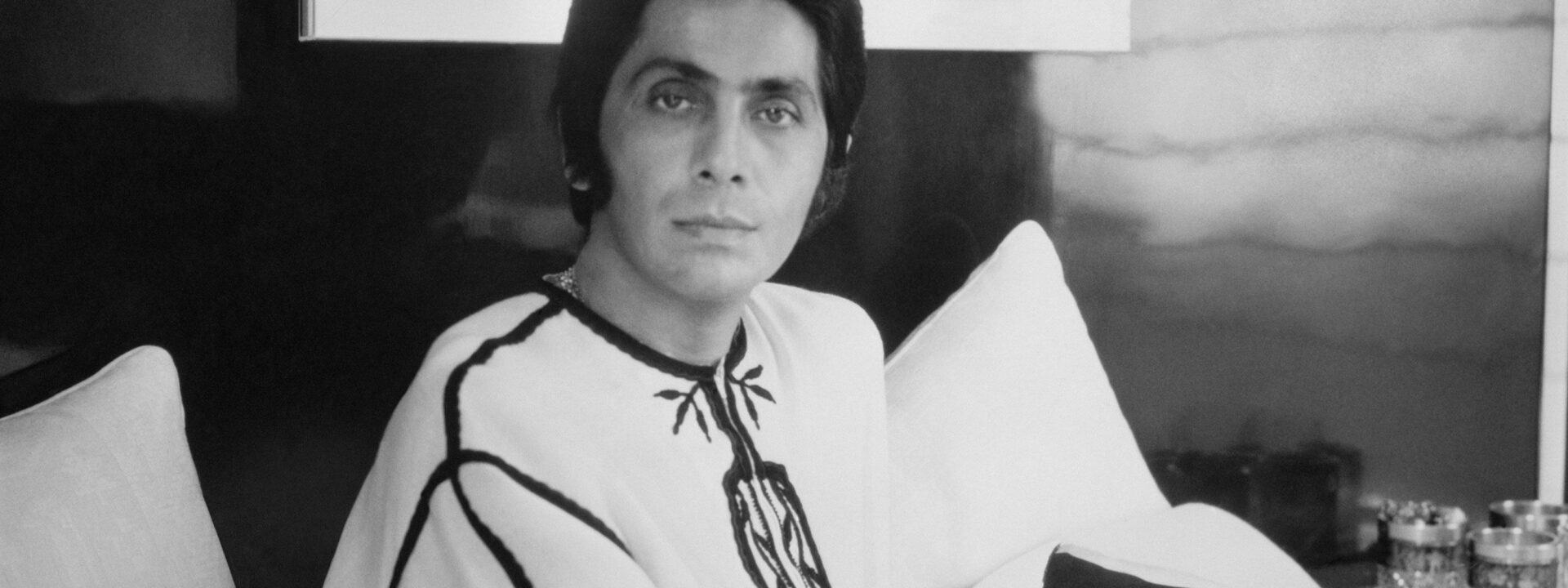
Valentino Clemente Ludovico Garavani, known simply as Valentino, was born on May 11, 1932, in Voghera, a quiet town between Milan and Genoa. By the time of his death at age 93 on January 19, he had conquered the world of fashion, bringing his vision of beauty—luxurious, glamorous, and impeccably feminine—to everything he created.
“I love beauty—it’s not my fault,” Valentino once said with a shrug. For him, fashion was a way to captivate women, who were his sole clients when he began before expanding his reach.
He studied French and fashion at the Accademia dell’Arte in Milan before moving to Paris at 17. There, he attended the École des Beaux-Arts and the Chambre Syndicale de la Couture. In 1951, he began an apprenticeship with the couturier Jean Dessès, known for his beautifully draped, vividly colored evening gowns worn by royalty and high society.
Jacqueline, the Comtesse de Ribes, was a client of Dessès. When designer Oleg Cassini asked her to create dresses for him in Paris, she confessed to Dessès, “I don’t know how to draw in a chic way.” Amused, Dessès replied, “I have an Italian illustrator who would be happy to earn a little extra after hours doing the drawings for you.” That illustrator was Valentino, and so began his friendship with Jacqueline.
While working for Dessès, Valentino sketched a series of lavish, draped, and embroidered dresses as a fantasy project. These included a blue chiffon day dress and an evening gown embroidered with cameos, featuring pink, yellow, and brown chiffon draped across the bust and flowing to the floor—clothes fit for a film star. Decades later, for his 30th anniversary in 1992, his workrooms secretly brought these “dream dresses” to life, proving they were just as stunning in reality as in his sketches.
When Dessès’s assistant, Guy Laroche, left to start his own house, Valentino joined him for a few years. He later worked briefly with Princess Irene Galitzine, known for popularizing palazzo pajamas. Then, in 1959, with support from his father and a family friend, Valentino founded his own fashion house.
Around this time, someone special entered his life. Giancarlo Giammetti recalled their first meeting in a Roman café, where he was sitting alone. A kind person approached and asked, “Are you alone? Do you mind if my friend and I sit here?” Valentino took the seat beside him. “I remember very deeply,” Giammetti said. Valentino, with dark hair framing his tanned face and striking blue eyes, began speaking to him in French. When Giammetti didn’t understand, Valentino explained, “I just arrived from Paris after seven years—my mind goes French.” As it turned out, Giammetti had studied French most of his life. Valentino declared, “From now on, if I see you again, we speak French.” And they did, for the rest of Valentino’s life, as lovers, intimate friends, and business partners.
Valentino soon found a lavish, frescoed apartment on the fashionable Via Condotti, butLess than a year later, he was facing bankruptcy. (Valentino blamed his “champagne tastes,” though someone had failed to pay the rent.) He and Giammetti simply moved the salon to a 16th-century palazzo on Via Gregoriana. (Incidentally, Giammetti recently acquired the Via Condotti apartment and had it transformed into his offices by Laura Sartori Rimini of Studio Peregalli. It is now a sumptuous series of rooms, with walls hung in silver tissue or silk velvet—some still bearing original frescoes—and filled with Hervé van der Straten furniture and antiques. What might have been considered “champagne tastes” in 1959 now feels sublime and definitive.)
Valentino gradually began to make his mark on fashion. His striking looks naturally attracted the press, but it was his clothes that captivated the stars passing through Rome. When Elizabeth Taylor, in town to film Cleopatra, chose his pleated, sleeveless white column dress—adorned with two bands of ostrich plumes at the hem—to wear to the premiere of Spartacus, everyone took notice.
As the sun sets in Piazza di San Giorgio al Velabro, Veruschka prepares for the evening’s festivities in Valentino’s sashed blue-and-white jumpsuit. (Photographed by Franco Rubartelli, Vogue, April 1, 1969.)
Shot in Cy Twombly’s Rome apartment, “Valentino’s white—the talk of Europe. The cleanliness and distinction of his crisp white, his lacy whites, his soft and creamy whites, all shown together white on white. And all triumphs,” reported Vogue, “for the thirty-five-year-old designer who, pouring out all this beauty, romance, and perfection, has become an idol of the young, a new symbol of modern luxury…”
Suddenly, his work was appearing in Vogue. Editor Gloria Schiff not only helped bring Valentino into the magazine’s world—she introduced him to Jacqueline Kennedy Onassis, who quickly became a devoted client, spending vacations in Capri with Valentino and Giammetti. In 1964, Valentino debuted his animalier motifs in the magazine with a boxy zebra-print jacket over a crisp white satin skirt. Then, in the fall of 1967, Franco Rubartelli photographed Veruschka walking Rome’s backstreets in a chocolate brown mid-calf sweater, gold-belted, over narrow tiger-stripe pants and a dramatic floor-length coat. There was also an evening coat in ostrich-feathered and beaded red tulle—when slipped off, it revealed a strapless red column dress with a daring, effortlessly draped bodice: pure jet-set chic!
Then came the wildly successful White collection for Spring 1968. Marella Agnelli ordered a dandyish white-beaded waistcoat and embroidered jacket over a gently A-line floor-length skirt. Meanwhile, Henry Clarke photographed Marisa Berenson (granddaughter of Schiaparelli, lest we forget) and Benedetta Barzini wearing the collection in Cy Twombly’s stunning Rome apartment for Vogue. In 1959, Valentino designed a vivid red dress called Fiesta, and from then on, red became a staple of his collections. His signature shade—bold and unapologetic—would soon become his trademark.
As Valentino became a name to watch, with icons like Audrey Hepburn, Sophia Loren, Jacqueline Kennedy Onassis, Nan Kempner, Lynn Wyatt, and Susan Gutfreund flocking to wear his designs, his residences grew ever more impressive. His Roman base evolved from a penthouse adorned with Persian miniatures and Turkish-style banquettes into a house on the Appian Way, decorated by the incomparable Renzo Mongiardino. I visited Valentino there in the late 1980s, and it was breathtaking. Its grandeur had only amplified since a few years prior.Years earlier, when Mongiardino first designed it, the space was an elaborate columned environment with pale green batiks and white upholstered Empire sleigh beds. By the time I saw it, chintzes and 1880s velvets competed for attention with large Chinese pots overflowing with arum lilies. Elaborate flower arrangements were everywhere, and if you looked past them, you might spot a painting or two by Fernando Botero.
When I first went to Rome for the couture in the mid-’80s, long before my Appian Way adventure, I gathered my courage and stepped into Valentino’s intimidating couture salon just off the Spanish Steps. It consisted of two modestly sized rooms that exuded recherché glamour. Hanging there were his immaculate suits, sumptuous ballgowns, and elegant evening dresses—everything one might need to lead that life, meaning a life with a chauffeur, living… well, living as Valentino himself did.
Of course, these two elegantly appointed rooms opened onto a veritable hive of industry spread across five floors of a vast palazzo. Here were the couture ateliers: room after room of industrious women and a few men—hundreds of them—working diligently in sunlit spaces. (Some years after my first visit to the salon, the place was subtly transformed by the English architects and designers Peter Moore and Peter Kent. They added silvered banisters, expanses of pale gray marble in the hallways, and paintings by Julian Schnabel, Keith Haring, and Francesco Clemente. The result was very, very chic.)
Valentino’s shows always concluded with music, just before the maestro emerged with a curious gesture, clapping his fingers against his palms with his arms in the air. It was triumphant; it was pure showbiz.
In 1991, I had an appointment with Valentino to discuss his entire career. We met in an elegant room overlooking the Piazza Mignanelli, filled with antiques and lush draperies that gave it a Cécile Sorel sort of look. Getting him to speak was not easy. Next door, in a vast room—and I mean vast—sat Giancarlo Giammetti, surrounded by Arte Povera pieces and 1940s antiques. He, by contrast, was very easy to get talking.
Of course, Valentino owned a number of other properties: in Capri, New York, and London. But in 1995, I was invited to the 17th-century brick-and-stone chateau he had acquired. The house was revealed to me only after I followed a long drive and dramatically turned a corner: there, plunging downhill and glimmering below, was the Chateau de Wideville, once home to Madame de la Vallière, mistress of Louis XIV (Versailles is conveniently nearby).
In the evening light, I explored the breathtaking gardens by Jacques Wirtz, where brilliant violet rosemary stretched across the fields and cut through the forests, while roses and fragrant high-summer flowers filled the walled garden. And then, the breathtaking house itself. Valentino had worked with Henri Samuel on the interiors. With emerald silk-velvet armchairs and a Chinoiserie motif, they brought a level of comfort—and a fanciful Palm Beach air—to the splendidly austere exterior.
I was amused to see that the enormous Francis Bacon painting in Valentino’s sitting room depicted an abstracted man sitting on a carpet of rose bouquets, unlike anything I had seen before in Bacon’s work—it was as Valentino-ish as a Bacon could possibly be.
As I headed in for dinner, deeply moved by the exquisite gardens, the ravishing interiors, and everything Giancarlo and Valentino had achieved in life, I said to Valentino, “What you’ve done is to create beauty.” He clasped my hand and, with tears in his eyes, replied, “It is beauty.”
Frequently Asked Questions
FAQs A Life Beautifully LivedHamish Bowles Remembers Valentino
General Beginner Questions
What is A Life Beautifully Lived
Its a tribute piece likely an article essay or interview where the renowned fashion journalist and historian Hamish Bowles shares his personal memories and reflections on the legendary fashion designer Valentino Garavani
Who is Hamish Bowles
Hamish Bowles is a highly respected fashion journalist historian and editoratlarge for Vogue He is known for his deep knowledge of fashion history his personal style and his close relationships within the industry
Who is Valentino
Valentino Garavani is one of the most iconic and influential fashion designers of the 20th and 21st centuries famous for his glamorous elegant designs signature Valentino Red and a clientele of celebrities and royalty
Why would Hamish Bowles write about Valentino
Bowles has moved in the same elite fashion and social circles for decades He likely has firsthand experiences personal anecdotes and a professional appreciation for Valentinos work and impact making his perspective uniquely valuable
Where can I find this piece
It was likely published in a major fashion publication like Vogue or on Voguecom It might also be part of a book compilation or a special editorial feature
Content Insights
What kind of stories or memories does Bowles share
Expect personal anecdotesperhaps about attending Valentinos legendary shows and parties insights into Valentinos creative process observations on his impeccable taste and reflections on key moments in his career
Does it cover Valentinos entire career
Its a personal remembrance not a comprehensive biography It will likely highlight specific eras iconic collections or memorable encounters that were significant to Bowles or emblematic of Valentinos world
Will I learn new things about Valentino
Yes Bowless insider access means he can share nuanced details behindthescenes moments and personal qualities of Valentino that arent widely known to the public
Is it more about fashion or about Valentino as a person
Its a blend of both It will discuss his fashion legacy but through the lens of personal interaction focusing on the lifestyle