Is this the back of a woman’s dress? I wonder, standing before a cherry-red painting by Domenico Gnoli at Lévy Gorvy Dayan.
It’s only when I step several feet back from the large, over-five-foot-square canvas that I realize the work depicts a tie knot, cropped and zoomed in so tightly it becomes nearly abstract. Up close, I’m captivated by the rhythmic, perfectly rendered lines of the ribbed fabric. Under the late Italian artist’s hand, this ordinary object takes on a sculptural quality, reminiscent of paintings by Park Seo-Bo, where repeated pencil lines are carved into a still-wet surface to create a three-dimensional texture.
That meticulous trompe-l’oeil effect is just one of countless techniques Gnoli mastered, as shown in this survey at Lévy Gorvy Dayan—the largest American exhibition of his work since 1969. In his short life (Gnoli was just 36 when he died from cancer in 1970), the Roman-born artist found great success as an illustrator for children’s books and magazines like Sports Illustrated and Life; as a costume and set designer; and ultimately as a painter with a unique, timeless style that draws from Surrealism, Pop art, and Arte Povera. Titled “The Adventure of Domenico Gnoli,” the exhibition presents 17 exemplary paintings, along with rarely seen drawings, etchings, notebooks, letters, and ephemera from the peak of his career between 1965 and 1969. With only 160 to 170 mature paintings in existence, most held in private collections, bringing these works together was no small task.
Domenico Gnoli, Red Tie Knot, 1969. Acrylic and sand on canvas. 63 ¹⁄₈ × 63 ¹⁄₈ inches (160.2 × 160.2 cm). Private Collection, courtesy of HomeArt.
© 2026 Artists Rights Society (ARS), New York/SIAE, Rome, courtesy of Lévy Gorvy Dayan, New York.
“Gnoli’s collectors are usually very reluctant to let his works go, even as loans,” Amalia Dayan, who runs the gallery with Dominique Lévy and Brett Gorvy, tells Vogue. Many of his pieces remain with their original owners or have been passed down through families. “There is a cult of Gnoli,” Dayan continues. “Once you delve in and understand his complex universe, it becomes an obsession.” Her own obsession began over a decade ago when she presented Gnoli shows in 2012 and 2018 at her former gallery, Luxembourg & Dayan (now Luxembourg + Co.).
Lévy Gorvy Dayan’s new exhibition required close collaboration with Gnoli’s estate, which includes the Domenico Gnoli Archives in Majorca—led by the artist’s widow, Yannick Vu, and her current husband, Ben Jakober, a fellow artist and close friend of Gnoli—and the Archivio Domenico Gnoli in Rome, led by the artist’s sister, Mimì Gnoli, and the Livia Polidoro-Gnoli Archive.
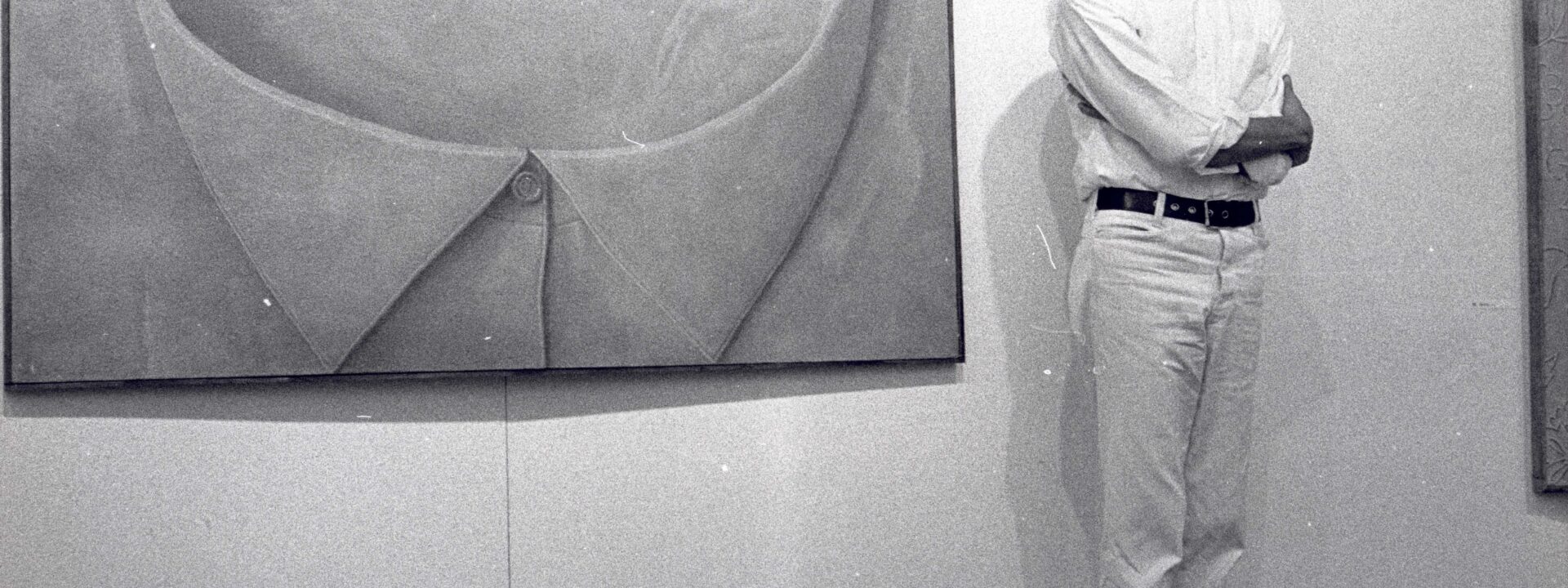
Installation view of “The Adventure of Domenico Gnoli,” Lévy Gorvy Dayan, New York, 2026. Left: Red Dress Collar, 1969. Acrylic and sand on canvas. 59¼ × 67 inches (150.5 × 170.2 cm). Right: Tour de cou 15½, 1966. Acrylic and sand on canvas. 47¼ × 63 inches (120 × 160 cm)
All works by Domenico Gnoli © 2026 Artists Rights Society (ARS), New York/SIAE, Rome, courtesy of Lévy Gorvy Dayan, New York. Photo: Elisabeth Bernstein
Reflecting on the show’s significance, Vu, a French-Vietnamese artist and daughter of the eminent Vietnamese painter Vu Cao Dam, tells Vogue how “vital” New York was for Gnoli. “It’s where he started his real career in the late 1950s and where it ended,” she says, referring to his 1969 solo show at Sidney Janis Gallery as a “consecration” for him. Despite coming from a family with a rich cultural background (his mother was a ceramicist; his father an esteemed museum curator and art historian; his grandfather, who shared his name, was a famous poet and friend of the FrencInspired by the French writer and politician François-René de Chateaubriand, Gnoli believed that New York and France were “the only places where one could develop as an artist,” says Vu.
Indeed, after moving to New York, Gnoli met someone who would change his life: Diana Vreeland. The former consultant for the Met’s Costume Institute and editor-in-chief of Vogue became a great friend and collector of his work. “She was the most generous, extraordinary person,” says Vu. In the summer of 1969, Vreeland visited Vu and Gnoli’s house in Majorca, where she saw the paintings he was preparing for his Janis gallery show (several of which are now on view in the Lévy Gorvy Dayan exhibition). She later published photographs from the Janis opening in the “People Are Talking About…” section of Vogue’s January 15, 1970 issue.
While in New York, Gnoli married model Luisa Gilardenghi, who introduced him to Richard Avedon, Bob Silvers, and other creatives and intellectuals in the city. After their bitter divorce, however, Gnoli moved to Paris in 1962 on the advice of his friend Jakober.
Gnoli and Vu met in France and married in 1965, spending much of their time afterward in Majorca, where several friends also had homes. The Spanish island is where Gnoli created many of his most magnificent paintings. “Domenico found the freedom to really express himself there,” says Vu. (Today, Jakober and Vu split their time between Marrakech and Majorca, where they run a museum and archive of their collection, the Museum Sa Bassa Blanca, which includes a gallery dedicated to Gnoli.) It was also there that he developed his signature technique of mixing sand from local beaches with vinyl glue and pigments to give his canvases a rustic, fresco-like texture. This grainy effect is especially visible in Il grand letto azzurro (1965), featured in the Lévy Gorvy Dayan show, where a close look at the teal bedspread reveals a tan floral pattern created from unpigmented sand.
“He was always looking for his own path,” says Dayan. “What makes Gnoli’s work so singular is this isolation of detail. That then touches on abstraction and minimalism because it’s so reduced and precise.”
Another signature of his work is depicting everyday items—especially clothing details like zippers, buttons, collars, or the back of a shoe—with a sense of gravity. “My themes come from the world around me, familiar situations, everyday life; because I never actively mediate against the object, I experience the magic of its presence,” the artist once said. And indeed, viewing a Gnoli painting is a meditative experience, where new details emerge both the longer you look and the further you step back from the canvas.
Throughout the Lévy Gorvy Dayan exhibition are Gnoli’s observations of the everyday, beginning with Striped Trousers (1969) and Curly Red Hair (1969). While the former is one of many tightly cropped sartorial images that brings Issy Wood’s grayscale paintings to mind, the latter closely resembles Anna Weyant’s portraits of young women with flowing locks.
“I’m drawn to his restraint—everything feels clear and deliberate—and his simplified, sculpted forms with subtle distortions,” Weyant tells Vogue of Gnoli.She counts him among her favorite painters. “He had a brilliant way of turning ordinary, familiar objects and scenes into magnetic and psychologically charged images.” She also enjoys the humor in his work, which is especially evident in an upstairs room dedicated to Gnoli’s drawings—like one sketch where emotive faces cover each breast of a bosom.
On the gallery’s first floor, a room displays examples of Gnoli’s more conceptual work: a trompe-l’oeil view of the back of a painting, a yellow armchair, a brick-wall corner, and one of Dayan’s favorites, an apple. “It touches on the history of still life, Surrealism, femininity, and womanhood without depicting a female figure. It’s got sexuality, it’s morbid—it has it all,” says the gallerist.
Gnoli’s manipulation of “presence and absence” also adds resonance to his works. One upstairs room features six of his bed paintings, most without any figures. “It’s very special because the whole cycle of life happens in bed: you are born in bed, you die in bed, and you make love in bed,” says Dayan. She describes the room as “spiritual,” an adjective Vu also uses to describe her late husband’s aura. According to Dayan, Gnoli’s beds were a key inspiration for Maurizio Cattelan’s All (2007), which consists of nine marble sculptures resembling sheet-covered dead bodies.
The final section of the show explores Gnoli’s preoccupation with clothing, influenced partly by his background in costume design and exposure to his first wife’s fashionable friends. From a crisp white collar to the maroon Purple Bust (1969), his color palette enhances the monastic quality of these paintings, which also serve as fabric studies. “He was a very elegant person with a magnetic personality, and he liked to dress well,” Vu says. Rather than painting from life, Gnoli painted from his “fabulous visual memory”: “He had incredible eyes and could see things other people didn’t.”
In 2021–22, Milan’s Fondazione Prada mounted a major retrospective of over 100 paintings and an equal number of drawings by Gnoli (Miuccia Prada and her husband Patrizio Bertelli are among the artist’s top collectors). Dayan hopes her show will continue to expand Gnoli’s legacy, which she believes deserves a proper museum exhibition in America. Thanks to Dayan’s spellbinding show, Gnoli’s cult following is sure to gain a host of New Yorkers.
“The Adventure of Domenico Gnoli” is on view through May 23.
Frequently Asked Questions
Of course Here is a list of FAQs about the exhibition at Lévy Gorvy Dayan designed to be helpful for both newcomers and seasoned art enthusiasts
General Exhibition FAQs
Q Who is the underappreciated Italian master featured in this exhibition
A The exhibition focuses on Giorgio de Chirico the pioneering founder of the Metaphysical art movement whose later work is often less celebrated than his early masterpieces
Q What is the name of the exhibition and where is it
A The exhibition is at Lévy Gorvy Dayan gallery You would need to check their website or announcement for the specific title of this de Chirico show as it may have a thematic name
Q Why is this exhibition such a big deal
A Its the most significant US exhibition dedicated to de Chirico in decades specifically highlighting his controversial and often overlooked later work offering a chance to reassess his full career
Q When is the exhibition and do I need tickets
A Gallery exhibitions are typically free and open to the public but hours and dates vary Always check the Lévy Gorvy Dayan website for exact dates times and any suggested registration
About the Art Artist
Q Ive never heard of Metaphysical art What does that mean
A Its a style de Chirico invented before WWI It features dreamlike empty city squares exaggerated shadows classical statues and strange illogical arrangements of objectsall meant to create a sense of mystery unease and philosophical depth
Q Whats so controversial about his later work
A After the 1910s de Chirico moved away from his iconic Metaphysical style He began painting in a more classical baroque or even neoromantic manner which many critics and historians at the time saw as a decline or a rejection of his early genius
Q Can you give me an example of what to expect in this show versus his famous work