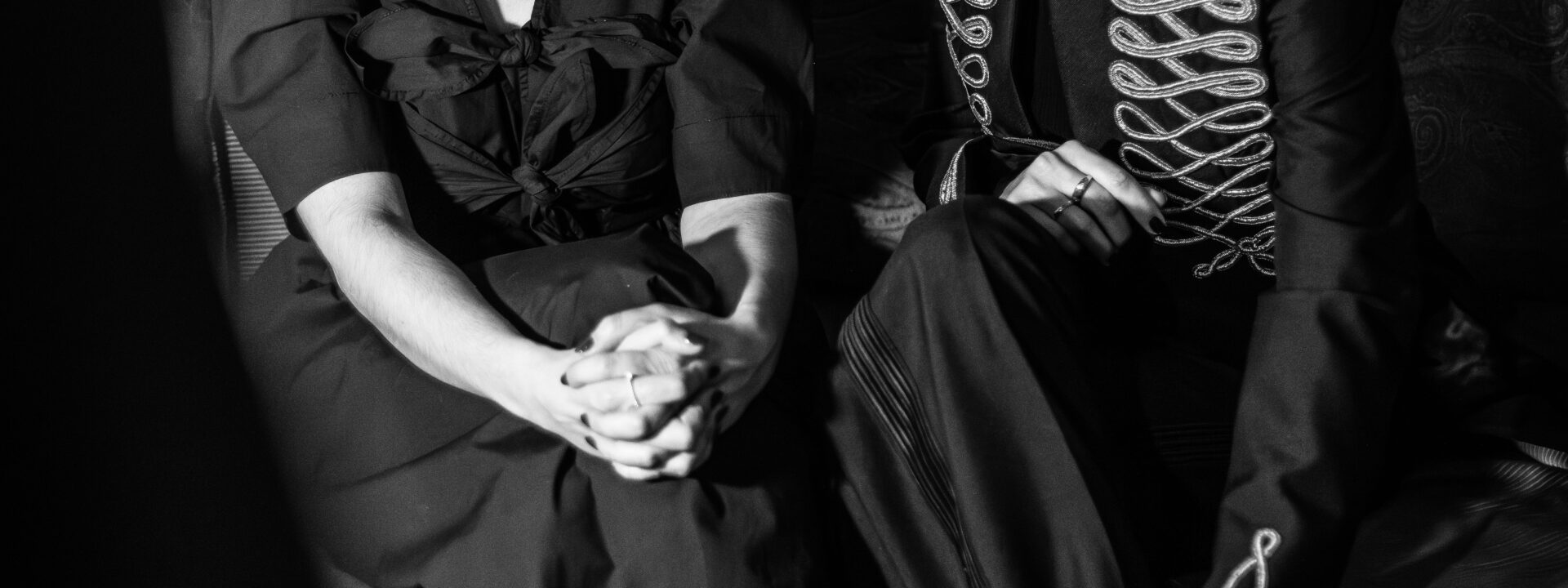
Set in Tudor England during Anne Boleyn’s arrest, 1536 has become the must-see show of the year. After its award-winning, sold-out run at the Almeida in 2025, the play—written by breakout playwright and screenwriter Ava Pickett and directed by Lyndsey Turner—has gained a new producer in Margot Robbie, moved to the West End, and will soon be adapted for the BBC.
Before it opens at the Ambassadors Theatre, where it runs until August 1, Margot called Ava to find out how and why a play about Anne Boleyn has become one of the biggest critical hits in recent times.
Margot Robbie: How are you, babe? Where are you?
Ava Pickett: I’m good, babe. I’m in Dublin. Where are you?
Margot: Well, I’m in LA. But I’m coming to London very soon for the opening night of 1536—I wouldn’t miss it! Ava, for people reading this who have never heard of 1536, can you give us a quick summary?
Ava: It’s a play about three young women living in Essex in Tudor England, set over one summer during Anne Boleyn’s arrest and eventual execution. But it’s about a lot of things. It asks if female friendship can survive in a patriarchal society that’s violent toward women. It’s about how what men do in the corridors of power—like when a king kills his queen—affects women everywhere. And it’s also about love, sex, friendship, dreams, and all that. And it’s very sweary.
Margot: It’s very, very timely. It doesn’t take much to connect what you’ve just described to what’s in the news every day. But it’s also so entertaining. How did you balance that?
Ava: I think they help each other. I love stuff that’s both really funny and really dark. It’s about letting the audience decide their own opinion. I feel like if you’re being told what to think, you just switch off. I know I would if someone was hammering home a point for an hour and a half on stage.
Photo: Helen Murray
Margot: For anyone reading this who is a writer, or has thought about writing, or wants to be a writer, tell us: what’s the process? Where do you write? What parts feel difficult? Because it’s a bit of an isolated craft, and then suddenly it’s incredibly communal. That must be a really strange shift, and you need a personality that can handle both.
Ava: I usually write in cafés. I like being around other people, and I like the noise. Sometimes I write by hand because I find it easier and quicker. Nothing is more daunting than that final draft when you’re three days from a deadline. Maybe I just feel more poetic writing by hand, who knows?
I’m a really ambitious writer and a really ambitious young woman. I can’t stand it when people don’t tell me what they actually think, even if it’s negative. I absolutely can’t stand it. I feel like people treat creatives like children all the time. And it’s like, “I know how to handle myself. Let me.” You do get some pretty brutal notes where you think, “Okay, that stung, but fine.” It’s really hard, and it’s a muscle, I think. You get better at it the more you do it.
Photo: Helen Murray
Margot: I’ve asked a few writers—really great writers—how they got so good. And it really comes down to discipline and just doing something a lot. I started on a soap opera. I did over 300 episodes of TV in three years. That must have something to do with why I can work the way I do on set. It was just doing it so much.
Ava: And you also learn how important everyone else is. You realize that part of your job is helping other people do theirs. You can’t just sit and think about a scene for three weeks—you need to get it out so they can do their job and we don’t lose or waste a lot of money. All of that stuff is really important.To know and to learn—I already feel empowered when people share that information with me. I don’t find it overwhelming.
I couldn’t agree more. I’m also really excited because one of your latest projects is with the iconic film director Baz Luhrmann. You’ve just written his next film, Joan of Arc. Every time you work with someone like screenwriter Tony McNamara or Baz (both Australians!), do you find yourself adjusting to their way of working? How do you handle that?
A lot of it comes down to chemistry, and I’ve been very lucky—I’ve never been on a show where I thought, “Oh no, I’m in the wrong room.” Along with chemistry, it’s about both of you being willing to give a little to meet the other person’s needs. And processes change too. When I was 23, I didn’t need any sleep. I could just walk into the office, but that’s not my life anymore!
Absolutely. Where did you gain all the knowledge you have? And can we talk about where the idea for 1536 came from? What inspired you to write that play?
Well, I started writing because I tried to be an actor and it went really badly.
Why did it go so badly?
I went to drama school, and I had been so loud about it to my family. I was like, “You’ll never see me again!”
“I’m off to Hollywood!”
Yeah [laughs]. Then I finally got into drama school, and it was great. But when I came out, I was one of the only ones who didn’t get an agent. I couldn’t even pay an agent to represent me. I was working at a cinema, and it was really bleak. So I wrote a 30-page pilot about moving back home, based on my life. I sent it to a producer who had auditioned me a couple of years earlier—he was the only industry person in my email contacts. I said, “You probably don’t remember me, but could you read this, and can I make you a cup of tea?” He read it that night and got back to me an hour later.
I met him, and he said, “You should be a writer. This is brilliant.” From there, that script got me an agent, and then that agent helped me get work on shows. I just learned by doing. I wrote a lot on my own time—I was always writing—and then I was lucky enough to land jobs that were really tough and quite big. It was sink or swim.
Photo: Helen Murray
When you went to drama school, had you learned any screenwriting? How did you know how to write that pilot? How did you even know how long a pilot should be or how to format it?
I Googled “screenplay format,” then downloaded Celtx because it’s free. I just wrote the dialogue and added stage directions. I didn’t get Final Draft for about 18 months—I think eventually someone told me, “You need that if you’re going to write.” And then that whole summer, he [the producer] had to kind of teach me how to format it properly.
With 1536, do you consider yourself a history buff, or did you just think, “I happen to like this one part of history, so I’ll dive deep and research it”?
I’m kind of a history buff. I love the Tudors, and I’ve always found that period really interesting. I’ve been low-key obsessed with Anne Boleyn. I don’t know why—I actually think a lot of women are.
What sparked the idea? I love the vibe of the play—that it’s about three women basically getting the celebrity gossip of the time, which then affects their lives in a crazy way. Why set it among these women instead of making it about Anne Boleyn herself?
I write from a pretty instinctive place—I’m not that intellectual. I knew I wanted to write about friendship, how hard it is to hold onto, and how volatile it can be. I also knew I wanted it to be set in a historical period, because that removes all the modern distractions. I’m terrible at writing social media. I’m terrible at writing things like, “I got a text.” I just can’t do it.
It’s not as cinematic, for sure.
Yeah [laughs]. I don’t like it.I like using the word “inspired” because it feels so positive, but when I was writing the play, I felt incredibly—what’s the word, “disaffected” or “overwhelmed”?—by everything I was reading in the news about women being attacked, going missing, or getting killed. There was just one article after another about these awful things happening to women, and nothing really changed. There’d be a vigil, a protest, a march, and an MP would say something about how things had to change, but they didn’t. My friends and I were having the kind of conversations you have when you’re terrified, like: “It wouldn’t happen to me, it wouldn’t happen to us. It wouldn’t happen here.” But it does. And I just couldn’t get it out of my head. Then there’s the fact that we’re living through a time when powerful men aren’t being held accountable. It’s all so public, and yet nothing happens. All of these things kind of came together, and it turned into the characters talking about Anne Boleyn. Then I immediately thought, “Okay, I know what I’m going to do here.”
Photo: Helen Murray
The cast is incredible. Can you tell us about our three main actresses?
I mean, I would do anything for these women. I think they’re so brilliant. All three of them—Tanya Reynolds, Siena Kelly, and Liv Hill—were amazing in their auditions. I just knew. They really make you believe they’ve been friends for twelve lifetimes. They’re great friends now, but they didn’t know each other before the run at the Almeida. They’ve created such a lively friendship that feels really dangerous and unpredictable. Whenever I watch them on stage, as an audience member, I feel left out. I’m like, “I want to be friends with you! Pick me, please!”
What they can do, which is such a skill, is make these women feel incredibly modern, but also like products of their time. And they have to do the Essex accent from 400 years ago. For that alone, they deserve all the praise. You know, some girls are doing bits of it on TikTok now?
Like performing the play on TikTok?
Yeah!
That’s so cool, I love that. Okay, if you weren’t involved in the project and you went to see this play, what do you think you’d say to your best friend afterwards?
I think my best friend and I would go for a big drink and argue about which version of the women we are.
I feel like my friends and I would do that. Like, “You’re her. No, you’re her.” It’s a sign that you’ve written really incredible characters, that you can truly identify someone you know as being a certain person in a play. There’ll be some heated debates after people see 1536.
Yeah.
It’s just so fun. Congratulations again, and as you know, I love the play, and I love you. I think you’re one of the greatest talents of our generation, and I can’t wait to see what you do next. Definitely no return to the acting dream? You’re leaving that behind?
I’m leaving that way behind.
Those dreams could still come true! Well, thank you for this. And to anyone reading this, I’m telling you, you don’t want to miss this play. See it with friends, have cocktails afterwards, and debate it. It’s a fun night out.
Thanks, babe.
This conversation has been edited and condensed for clarity.
Frequently Asked Questions
Here is a list of FAQs about the fictional meeting between Margot Robbie and Ava Pickett the writer of 1536
BeginnerLevel Questions
1 Who is Ava Pickett
Ava Pickett is the author of the historical novel 1536 a book that explores the political and personal turmoil of that specific year in Tudor England
2 Why would Margot Robbie be interested in meeting Ava Pickett
Margot Robbie is an actress and producer known for period dramas She might be interested in adapting 1536 into a film or TV series or she could simply be a fan of the book
3 Did this meeting actually happen
No This is a hypothetical scenario There is no public record of Margot Robbie and Ava Pickett meeting
4 What is 1536 about
The novel focuses on the year 1536 in England covering key events like the execution of Anne Boleyn the dissolution of the monasteries and the political rise of Thomas Cromwell Its a blend of historical fact and dramatic storytelling
5 Would Margot Robbie play a character in a movie adaptation of 1536
Possibly If a film were made Margot Robbie could play a major historical figure like Anne Boleyn or Jane Seymour depending on the scripts focus
IntermediateLevel Questions
6 What would Margot Robbie and Ava Pickett likely discuss in a meeting
They would probably talk about the books themes which characters are most cinematic and how to stay faithful to history while making a compelling movie They might also discuss the tonewhether it should be gritty like The Favourite or epic like Wolf Hall
7 What challenges would adapting 1536 into a film present
The main challenge is condensing a complex year of history into a 2hour film without losing nuance Another issue is balancing historical accuracy with dramatic pacing Also the story has many key characters which can be hard to juggle on screen
8 How might Margot Robbies production company LuckyChap Entertainment get involved
LuckyChap could option the books rights for development They are known for producing femaledriven stories like