A long time ago, an avant-garde filmmaker set out to make his third commercial movie, which he thought might be his last. His first film, a dystopian fantasy, had failed. His second, a nostalgic look at Northern California teenagers told in connected vignettes, was an unexpected hit. The profits and goodwill from that success gave him the chance to try again, even though he felt this third attempt could easily flop. With that in mind, he went all in on an experimental soundstage movie—one that might only matter to him. If it failed, he figured, he could go home and keep making the small, plotless, “pure cinema” films he loved.
For years, the filmmaker had been fascinated by how certain myths appear across cultures. In college anthropology classes, he learned that some stories show up again and again in different forms around the world. What if he took those stories, stripped them down to their core, and turned them into a movie? He was a child of the postwar Bay Area, living through the social upheavals of the 1960s. He felt torn between rebelling against authority and missing the stories that had held society together when he was young. For his film, he blended tales of good and evil on the battlefield, ordinary people in taverns setting out on adventures, and spiritual life forces into a single plot. He wrote about a fatherless young man raised by a kind farmer, dreaming of a world beyond his small town. And to match this mix of myths from nowhere and everywhere, he set his movie in a universal setting: outer space.
The project was high-concept, but he filled in the details—imagining space creatures, inventing names—and broke box office rules. The first 17 minutes focused on two slow-moving, expressionless robots. Characters communicated in beeps or growls, and many looked and dressed like the Bee Gees. When people saw the movie, some had hopes for it, but no one predicted how successful it would be. Within a year, Star Wars, as it was called, became the highest-grossing film in history worldwide.
For the filmmaker, George Lucas, this level of success was shocking and forced him to rethink his path. He never lost his love for what he called “nonstory, noncharacter movies,” but he also never went back to making pure cinema. His space-myth project showed him something strange and interesting: how popular stories—narrative—could organize experiences across time and culture, and how powerful that could be if you harnessed it. Over the following decades, he expanded his own studio and made more movies, some hugely successful. But the mystery of how stories touch different people and shape society never stopped being, in his mind, his main focus: the project of his life.
I meet Lucas, now 81, and his wife, Mellody Hobson—the CEO of an investment firm and former chair of Starbucks—in an area of south Los Angeles bordered by row houses and the sunbaked USC stadium. It’s a bright March morning with winds from the east; Hobson and Lucas squint as they step onto a stretch of lawn. They are visiting, for the umpteenth time, a construction site that has been their creative focus for the past decade—really, since Lucas sold his company, Lucasfilm, to Disney in 2012. The 11-acre Lucas Museum of Narrative Art, which features hundreds of illustrations from Lucas and Hobson’s collection and opens in September after lavish delays in time and budget, is the most ambitious project yet from a couple whose lives are full of them. But for Lucas, it’s also the culmination of his life’s study—an answer to the question he started with about 50 years ago. We haven’t waited long when an open vehicle pulls up, like a Star Wars landspeeder. (It’s actually a golf cart.)
“We’re like Disney—’Put down your rails!'” Hobson says as we get on. “No one fall out!”
We take off into a landscape of rolling grassy hills and well-pruned trees.Walking toward what looks like a giant alien spaceship. Every detail makes you want to look twice. The sprawling park, designed by Mia Lehrer of Studio MLA, doubles as the roof for two parking garages buried underneath. And the five-story building, created by architect Ma Yansong of MAD, is an unusual home for a museum full of eclectic art.
“George wanted the artists and the art to be in an important building,” Hobson says. “If the building looks important, people will understand that the art must be important too.”
When it comes to style, Hobson and Lucas—who met at a conference in 2006 and got married seven years later—seem like they could be from different planets. She wears a tailored Sacai jacket with short, puffy sleeves over a crisp white blouse and elegant black loafers. Lucas wears black sweatpants and a black T-shirt printed with a Formula 1 race car—an outfit that, except for his white sneakers, a child might wear to bed with the flu. As the golf cart hums and bounces along a winding path under a pedestrian bridge covered in vines, they murmur to each other—about travel, their middle-school-age daughter Everest, and their busy schedule for the day. Then suddenly we’re at the main building, looking up at its underside, which looks like the belly of a giant tortoise. A large fountain bubbles nearby, a decorative feature that, like the green roof, is part of the museum’s elaborate climate-control system. Hobson and Lucas hop out of the golf cart and lead me through a tall glass entrance into a reception lobby.
The space we enter is towering, with rich wood paneling and almost no right angles. The ceiling curves downward; the grand staircases twist. A set of central elevators runs through glass tubes. The museum’s outer shell—its carapace, really—was designed using a process called parametric modeling, which lets its shape be molded like Play-Doh. It was built around an internal skeleton using 1,500 fiberglass panels, each the size of a school bus, fitted into place like three-dimensional puzzle pieces by human crews. “It’s a piece of modern architecture so of its time that you couldn’t have built it 15 years ago,” Michael Siegel, a principal at Stantec architecture and a leader of the project on site, tells me. Yet the effect is classically Californian, balancing tech futurism with organic shapes, reminding me of Apple’s heyday designs: open and compact, cool and warm at the same time. The building looks like it might stretch and lumber off at any moment, like one of Lucas’s fantastical creatures.
In the press, the museum has been described as a gift to the city of Los Angeles—a polite way of saying that Lucas and Hobson are not just designing it but also paying for it, at a cost of around a billion dollars. Their friends say the money is the least of their commitment. “I know a lot of people who create—I guess most of my life has been around people who are creating—but I’ve never worked with people who have created something on this scale,” says designer Stella McCartney, who has known both Hobson and Lucas for years. “I wouldn’t even call it a project, because that word isn’t big enough. It’s like another limb for them.”
Lucas compares the museum to making a film. “It’s like making a movie—exactly the same thing,” he says. Sir Lewis Hamilton, the Formula 1 driver, who knows the couple well—Lucas is his pancake-eating and movie-watching companion on some mornings when he isn’t racing—describes the museum’s elegant, irregular interior as “like walking through George’s brain.”
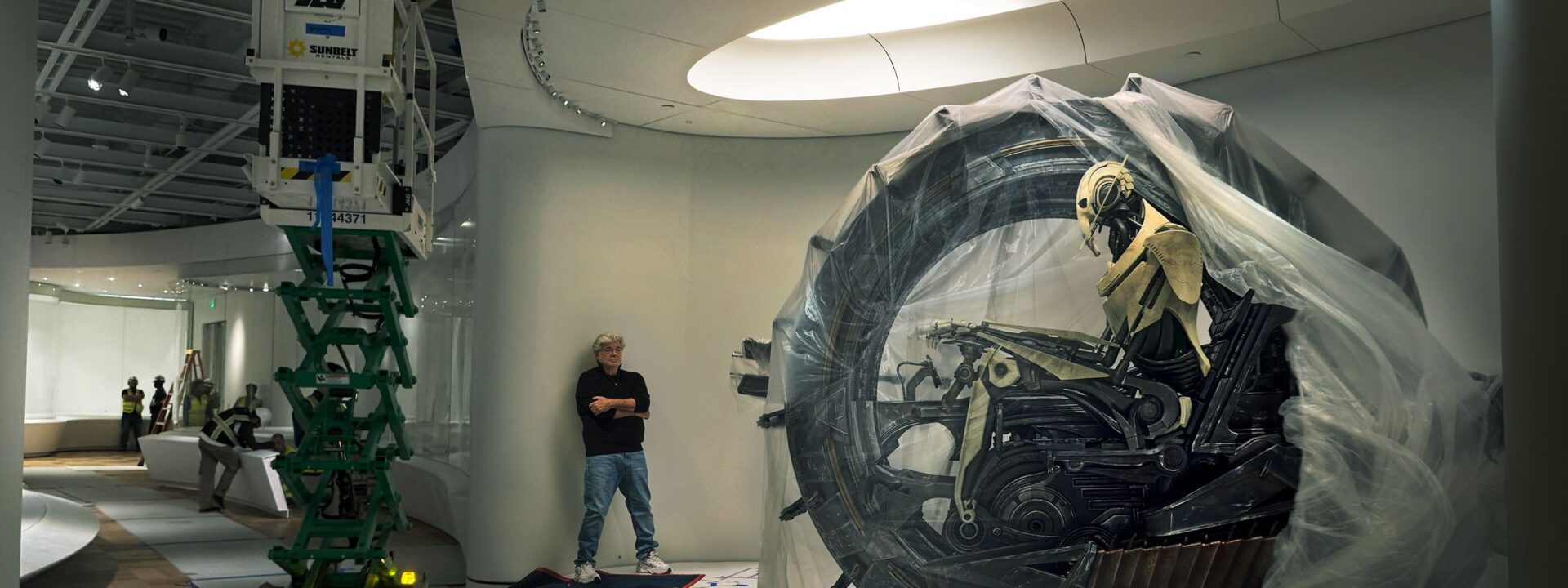
On the way to the first gallery, we stop by the gift shop, an irresistible-looking space with glowing shelves and tubular glass cases. It will sell T-shirts, books, and toys tied to the collection. (Lucas, who may be more in touch with the discerning eight-year-old inside him than most of us, tells me, “We’re only going to do stuff that’s good—I want to look at it and say, ‘That’s a great toy!'” Most museum gift shops, they were surprised to find, lose money. Lucas thought he could do better. “I know about licensing and merchandising,” he tells me in a quiet, almost secretive tone. Along with items tied to the museum’s collection, the shop will also sell Star Wars merchandise. The museum’s approach to the famous franchise could be called practical: It is definitely not a Star Wars museum, but it doesn’t shy away from using it to draw people in, so they might discover someone like the 20th-century illustrator Maxfield Parrish. One gallery will feature vehicles and models from the movies. (“I’m like, that’s the section I’ll be spending all my time in,” says Hamilton, who, at 41, is building a Lego Millennium Falcon and hopes to build a Lego Death Star soon.) The shop is designed to have something for kids from all backgrounds—a priority for Hobson, who grew up as one of six children with a struggling single mother in Chicago before making it to Princeton and eventually leading Ariel Investments, America’s best-known minority-owned value-investing firm.
“I thought, if I went to the museum with other people who had money and I had none, would I have to watch them buy things while I get nothing?” she says. Keeping her childhood self in mind, Hobson, now 57, insisted that the gift shop sell something desirable for just 25 cents. (She settled on a pencil that says “First Draft,” “Second Draft,” and “Third Draft” up the shaft.) In the sleek cafeteria across the entryway, with curved planter benches and seating that spills outside, she guided the menu toward a similar goal.
“They would say, ‘Here’s our grilled cheese sandwich. It’s on sourdough, with Gruyère and pesto!’ And I’m like, No, it’s on white bread, with Kraft American singles and butter,” Hobson says. To her amusement, Lucas kept insisting that the museum serve pancakes. “I’m like, ‘George! Do you understand breakfast?'” Hobson says. “Do you understand what time we would have to open the museum?”
Pancakes or not, there are more than a hundred schools within a 10-mile radius of the museum. That reality, along with shaping cheese preferences, inspired its education program. “I wanted the museum to be in a place where kids who don’t have a lot of the advantages that richer kids have can see stuff they can relate to and understand that these things are made possible by a common belief system,” Lucas says. From a curatorial standpoint, the museum is set up to reflect its founders’ view of what art in society should be. “We believe that art is in the eye of the beholder,” he says. “Nobody’s going to tell you that you have to like this. ‘But it doesn’t make any sense to me!’ ‘That’s what art is.'” He frowns in distaste. “My feeling is, art is emotional; it’s not intellectual,” he says. “Are you emotionally connected to it? If you’re connected, it’s art. And if you’re not, then it’s not art.”
Unusually for a museum collection, Lucas and Hobson’s focuses on illustration: 1,200 pieces of storytelling art that Lucas himself picked from a pool of 40,000 items. There are well-known oil works, like those by Parrish and Norman Rockwell, made for magazines and advertisers. But there are also comic strips, manga, movie art, and fantasy scenes of dragons and kings. The exceptional range reflects the owners’ particular taste. Lucas began collecting in college, when he discovered he could afford original drawings for comic strips he loved. “It was an underground thing—none of the auction houses handled that kind of stuff,” he says. “It was fanboys, and I could get a little Alley Oop for $35.”
His volume of material (and his budgets) grew from there. “We ended up with all this stuff in storage and our houses, and I thought, We have to do something,” Lucas says. “I’ve worked with hundreds of illustrators and they neverThey never get credit for anything. They won’t end up in museums, because the art world is elitist and illustrators are seen as lowly.” An idea started to take shape, eventually including more traditionally museum-worthy pieces from Lucas and Hobson’s collection—like JR’s first photograph or Robert Colescott’s George Washington Carver Crossing the Delaware. Stella McCartney says, “I mean, there’s a Frida Kahlo just sitting there, and Mellody and George are like, ‘Oh, yeah, that was in our bedroom.’ And I’m like, ‘You’re crazy not to wake up with that Frida Kahlo every day—what’s wrong with you, Mellody?’”
Still, the Lucas Museum’s collection as a whole remains unconventional. Every piece I saw on display was figurative: images of people, creatures, and things. (Lucas and Hobson do own abstract art, but those were the works they kept at home.) Since most accounts of 20th-century art progress through and against nonfigurative work, the focus on what Hobson and Lucas describe as art that tells a story has already sparked controversy. Critic Christopher Knight, writing in the Los Angeles Times, called the Lucas Museum’s “narrative art” premise “made-up”—a category with no widely understood definition or conversation around it. “Every time I ask artists what they think of a Museum of Narrative Art, the reply is some variation of ‘What’s that?’” he wrote.
To say Lucas shrugs off such criticism isn’t quite accurate. It actually fuels his view of himself as someone defending popular art’s legitimacy against the dark forces of the art historical establishment. “They want to do it the way they were taught in the university where they got the PhD,” he tells me. “I say that has nothing to do with art. I’m not in favor of telling people what they like.” It can be surprising to find the founder of one of the nation’s largest, most successful popular-creative empires engaged in what he sees as an underdog fight against a group of humanities academics. (You can hardly imagine Oprah or Taylor Swift losing sleep over scholarly criticism.) But Lucas has always stayed unusually hands-on in his work. Long after he could have stepped back into a management role, he surrounded himself with paper and pencils and kept obsessing over design details for his productions. Long after he’d started huge, thriving companies within companies—production, effects, sound, merchandising, gaming, education—he sat at a desk, as he always had, to write drafts of screenplays for his movies himself. His habits were no different with the Lucas Museum. If anything, they intensified.
“There’s a timelessness to this,” Hobson says. “We’re not telling you what to believe, only showing you what beliefs and myths have existed.”
“George is grinding every day in his 80s,” Lewis Hamilton says. “He’s up early, doing his exercises, and dealing with the museum, going through absolutely everything.”
“He spent years doing this on big pieces of paper on the dining room table,” Hobson tells me now, with visible restraint. “On the dining room table—years.”
“Yes, there were floor plans, elevations…” Lucas trails off dreamily. He had pored over the designs—and then, when they were done, pored over them again, deciding where every piece of artwork should go.
The result is a museum that, much more than most, follows a single vision, a unified point of view. We walk past two 299-seat movie theaters that, on their own, rank among the finest screening spaces in America. The screens are huge. The ambient lighting can be set to any color. Each theater is a separate acoustic structure, suspended on enormous springs and rubber isolators, so that the booming sound of an action scene in one won’t be heard by audiences enjoying a quiet moment next door. Lucas calls the theaters “galleries,” to put them on par with the other rooms; all throughThroughout a typical day, one screen will show documentaries about artists and filmmakers, while the other plays short films, some only a few minutes long.
“What’s the difference between the art in the other galleries and film?” he asks. “Film moves. And that movement creates emotion.” He often references the work of early Soviet filmmaker Lev Kuleshov, who demonstrated that viewers’ perception of emotion in a neutral face changes depending on the footage cut around it—a lesson Lucas carried into his own work. (“One thing I did in Star Wars was give C-3PO a very neutral face,” he says.)
Lucas, who still has vivid dreams almost every night, has a habit of making sudden connections between his many interests and different parts of his work. An associate tells me, “You’re watching him create something that he feels is completely normal”—even if it doesn’t seem that way to others. When Lucas decided to build a museum about myth in society, for instance, it seemed obvious to him that it should start with cave paintings.
“George calls them the first graffiti,” Hobson says. “They drew the animals figuratively, not literally. They were speaking to them mystically, saying, ‘Come back to us, so we have food.’”
“People, in the beginning, were asking, ‘Why does it get dark?’” Lucas explains. “‘The animals eat us at night—why does that happen?’ So they said, ‘I’ll tell you the story.’”
The first gallery in the Lucas Museum, introducing its central idea, opens with a scale reproduction of the cave paintings from Altamira, Spain, dating back at least 14,000 years. These were photographed with an ultra-high-resolution camera and displayed in close detail across the gallery walls.
“One of George’s friends, Caleb Deschanel”—the well-known cinematographer—“has been helping, because lighting is very important to how viewers visually receive it,” Hobson says. “George said, ‘I want you to feel like you’re looking out a window.’” From that window onto the Altamira paintings, viewers will move on to a reproduction of the Sistine Chapel ceiling. “George calls it ‘God’s comic book,’ because the panels tell the story,” Hobson says.
“The Church and the State used illustration to create the myths they wanted people to believe, since most people couldn’t read,” she continues. The Vatican gave Lucas’s team special permission to photograph the chapel ceiling with high-resolution cameras. “Not everyone can go to the Vatican,” she says. “And even when you’re in the Sistine Chapel, the visuals are so far away. You can’t see some of the details in those stories. We bring them closer.”
Before long, they’re walking through the museum’s more than 30 large galleries, most of which have been “paper-hung” with scale printouts of the artwork so Lucas can adjust their position and sequence. Hobson—who manages the couple’s schedule—moves ahead quickly, noting details, eager to get to their next appointment. Lucas moves slowly and thoughtfully, reexamining almost every piece, stopping to discuss its qualities, and making small sounds of frustration when he notices—apparently from memory—that one of the hundreds of pieces has been moved. The galleries are organized by myth. A Childhood gallery features artworks that, in Lucas’s view, build the myths that help children understand their place in the world. A Work gallery does the same for the idea of labor. There are galleries for Motherhood, Romance, Fantasy, Play, Sport, and more. Some artists, photographers, and illustrators have their own spaces. “The audience creates the story, but there are certain things you can put next to each other,” Lucas says. In his view—which might please both George Herriman and Roland Barthes—the galleries are documentary: examples of how humans have passed down the stories of their societies.
“What is illustration?” he continues. “You have to haveA story—and the story is the mythology of the society. It doesn’t have to be true. In fact, everyone knows it’s not true, but it’s emotional. It sticks. It becomes important to the society, to hold it together. Humans are a little dysfunctional.” He lifts his gaze. “You need something to get them to work together.”
The Lucas Museum opens at just the right time. Los Angeles, which was in flames less than two years ago, is now starting to rebuild. In 2028, the city will host the Summer Olympics. The huge new David Geffen Galleries at the Los Angeles County Museum of Art opened this past spring, with plenty of nonfigurative art. The Lucas Museum, with its lush grounds and educational programs, fills a different role: a place where a whole family can spend an afternoon. (Visitors under 18 get in free.) Its education wing includes a beautiful closed-stack library with a full-length window, lovely reading tables, and rows of bookshelves—curved, of course—climbing up a double balcony. The collection includes books about every artist featured, movie studio design archives that Lucas has spent years saving from the trash, and 2,000 art books from the collection of Hobson and Lucas’s friend Steve Martin. You can visit the library without a museum ticket, and kids over 12 can come alone. “Growing up, I lived in the library because my home was very chaotic,” Hobson says. She pauses, then adds quietly, “I pushed for 12.”
The basic idea for the museum goes back 25 years, when Lucas was negotiating development rights for about 20 acres of the San Francisco Presidio, a recently closed Army base where he wanted to bring together his companies’ growing offices. “They said, ‘Would you be interested in helping us build a museum out here?’” he recalls. He hadn’t thought about it, but he could feel his imagination stir. “I said, ‘Yeah, I’ll help you build a museum,’” he says. He put $10 million in escrow as a show of good faith.
But by the mid-2000s, when Lucas finished his offices and turned to the museum, the presidentially appointed Presidio board had changed, and enthusiasm for his museum had faded. Lucas spent the next few years looking for sites. For a while, he considered another closed Bay Area location, Treasure Island. A building was designed—an organic shape like fog on the water—but the only way to reach the island was by ferry or bridge, which made it impractical for a museum hoping to attract 1.5 million visitors a year. The city of Chicago, Hobson’s hometown, offered land on Lake Michigan, and a new design was made. But there was a lawsuit from the Friends of the Parks, and some people thought it was odd that the best view of the museum would be from a boat. Exposition Park in Los Angeles felt right. A project adviser notes, “We’re very close to USC, which is where George went to school.”
In its current location, the museum joins a growing group of institutions: The California African American Museum is nearby, as is the USC Fisher Museum of Art. From the windows of a large event space in the Lucas Museum, Hobson and Lucas have watched the construction of the shiny funnel of the Samuel Oschin Air and Space Center, a new wing of the California Science Center. Hobson, who still runs Ariel in Chicago, has visited the site with Lucas almost every weekend to show friends and community members around.
“I want them to feel connected,” she says with a grin. “I want it to be not ours but theirs.” And some connections have left their mark. A service elevator set up for travel between unfinished floors was signed, like a high school yearbook, with messages from well-wishers:
The Force lives in every non-corner!
Oprah Winfrey
Nancy Pelosi
Faith, Hope + Love
Narrate!
At a time when a lot in American society seems to be unraveling, it’s tempting—I was tempted, anyway—to see a gentle social mission in the Lucas Museum’s focus: Here are sStories have helped give society unity and structure—guidance we really need right now. “With these ideas of ‘work,’ ‘motherhood,’ ‘love,’ ‘home,’ and ‘community,’” I ask Lucas, “do you see yourself as trying to rebuild a certain story?” Lucas doesn’t like that idea. Neither does Hobson. “It’s not about the present moment—there’s something timeless here,” she says. “We’re not telling you what to think, just showing you what beliefs and myths have existed.” She adds, “We didn’t twist it to fit our agenda.”
By now, Hobson and Lucas are moving at very different speeds, two full galleries apart, and I’m running back and forth between them. Lucas keeps studying the art, noticing small details; Hobson is charging ahead, sticking to her schedule. “We’ve got to hurry,” she calls back briskly to her husband, who is finally nearing the sweeping curved staircase toward the exit. He’s lost in thought.
“It comes from my anthropology days,” he says again. “How do you build a society? The answer is, you don’t build a society. It comes down to community and family. Then it becomes nationhood. It depends on people being held together. And the glue is mythology—the stories people believe in because they’re emotional. Because they help people. Why does it get dark at night? I don’t like it. I don’t want to go out. We die. There’s God. There’s Apollo, in a golden chariot, on fire, with horses. They fly through the night and make it daytime.”
Lucas has come to think that his first film, the dystopian THX 1138, flopped because it focused on the problems and emptiness of the early 1970s. (“It was saying how terrible the world is and how we’re all on drugs,” he said.) His second film, American Graffiti, was a huge success because it responded to that same despair with a picture of the mythical postwar Golden State society. At least, that’s the story he tells himself about his own success.
“At night they put him in the stable, and Apollo goes to sleep,” he says, still talking about the ancient myths. He gives a little shrug, then a smile. “I mean, it’s just a story, and it’s not true, and they know it. But sometimes I remember that this started thousands of years ago.”
In this story: hair by Christol Williams; makeup by Mark Payne.
Produced by AL Studio.
Additional image credits:
Sixth image: Left painting: Lucas Museum of Narrative Art. Statue: Loan from a private collection. Far right painting: © Andy Thomas.
Seventh image: Background left: Loan from a private collection. Background left and right: © 2025 Banco de México Diego Rivera Frida Kahlo Museums Trust, Mexico, CDMX/Artists Rights Society (ARS), New York. Front left: Loan from a Private Collection. Artists Rights Society (ARS), New York.
Eighth image, in middle ground: Left painting: Artist unknown, Washington Crossing the Delaware, after Emmanuel Leutze, ca. 1851, oil on panel, 23 3/8 x 30 x 1/2 in. (59.4 x 76.2 x 1.3 cm). Lucas Museum of Narrative Art. Center illustration: Robert Colescott, George Washington Carver Crossing the Delaware: Page from an American History Textbook, 1975, acrylic on canvas, 78 1/2 x 98 1/4 in. (198.1 x 248.9 cm), Lucas Museum of Narrative Art. © 2025 The Robert H. Colescott Separate Property Trust / Artists Rights Society (ARS), New York. Right painting: Archibald Willard, The Spirit of ’76, 1912, oil on canvas, 48 1/4 × 33 5/8 × 1 1/4 in. (122.6 × 85.4 × 3.2 cm). Lucas Museum of Narrative Art.
Tenth image: Top: © Hearst Holdings, Inc., King Features Syndicate Division. Center: Loan from a Private Collection.
Frequently Asked Questions
Here is a list of FAQs about the Lucas Museum of Narrative Art in Los Angeles ranging from basic to more detailed
General Basic Questions
1 What exactly is the Lucas Museum of Narrative Art
Its a new museum in Los Angeles founded by filmmaker George Lucas Its dedicated to the art of visual storytellingnot just movies but also comic books digital art painting and illustration
2 Where is it located
Its in Exposition Park right next to the California Science Center and the Natural History Museum just south of downtown LA
3 When did it open
It officially opened to the public in early 2025
4 Is it just a museum about Star Wars
No While there are some Star Wars artworks the museum focuses on the process of telling stories through pictures Youll see works by Norman Rockwell NC Wyeth and contemporary digital artists alongside movie props
5 How much are tickets
General admission is around 25 for adults Children students and seniors get discounts Kids under 4 are free You need to reserve a timed entry online in advance
Exhibits What to See
6 What kind of art is inside
The collection is massiveover 100000 pieces It includes
Illustration Classic storybook art and magazine covers
Comics Manga Original pages from SpiderMan Tintin and Japanese manga
Film Costumes models and storyboards from movies like The Wizard of Oz and Star Wars
Digital Art Screens and installations showing how video games and CGI films are made
7 Is there a special exhibit right now
Yes the opening exhibit is called The Narrative Lens which explores how artists use light color and composition to tell a story They also have a rotating gallery focused on Japanese manga and anime
8 Is the building itself worth seeing
Absolutely The museum looks like a giant swooping spaceship made of white stone and glass It was designed by architect Ma Yansong The rooftop garden has amazing views