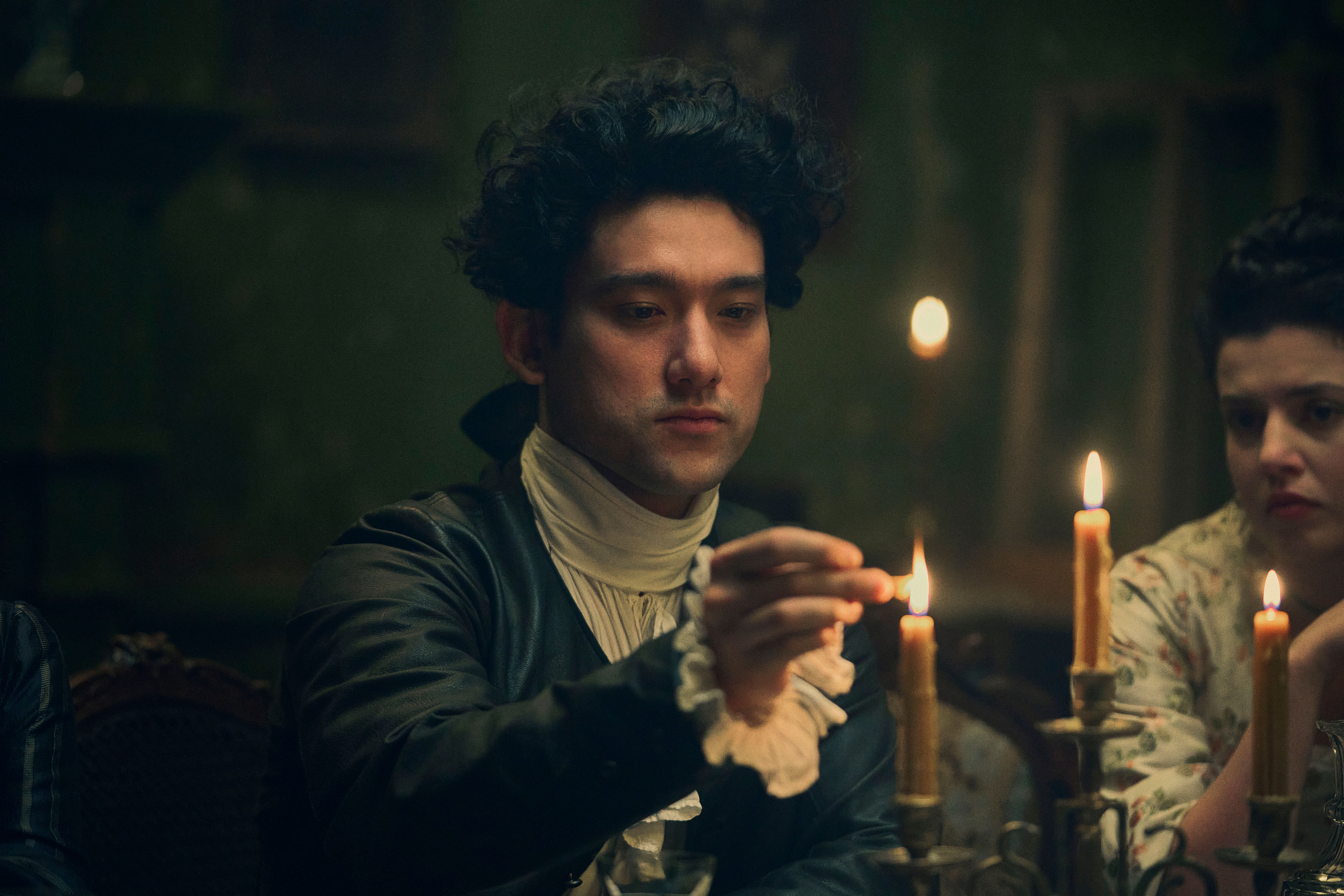
Onscreen, Will Sharpe has become especially skilled at playing men who seem to exist in several emotional states at once: charming yet distant, intellectual yet slightly chaotic. That slippery quality gave his Emmy-nominated performance in the second season of The White Lotus its strange magnetism—and it’s what makes him such a surprisingly perfect choice to play Wolfgang Amadeus Mozart in Starz’s lavish new adaptation of Amadeus.
The five-part series, which premiered last week, reimagines Peter Shaffer’s classic play—itself inspired by Alexander Pushkin’s 1830 short drama and later turned into an Oscar-winning 1984 film—as something darker, sexier, and more emotionally unstable: a powdered-wig fever dream driven as much by resentment and ambition as by music. Opposite Paul Bettany’s tightly wound Antonio Salieri, Sharpe’s Mozart is less a marble bust of a legend than an impulsive genius buckling under the weight of his own talent. The series follows the composer’s arrival in late-18th-century Vienna and Salieri’s decade-long obsession with him, as admiration turns into fixation. Tormented by what he sees as the effortless brilliance of Mozart’s genius, Salieri begins to see him as a threat—not just to his reputation, but to his faith and his sense of order.
Speaking to Vogue in New York last week, Sharpe was quick to complicate the myth around Mozart, focusing instead on the psychological cost of genius. “There were certain things in everyday life that other people find very simple that he finds quite complicated,” Sharpe said of his portrayal, describing Mozart as someone “run ragged” by the expectations tied to his gift.
That same tension shows up in the show’s visual style, with towering wigs inspired partly by rock-star looks, court costumes worn with deliberate looseness, and richly embroidered velvet jackets—plus one in punkish black leather—offset by an almost modern physicality. The result is an Amadeus that trades stiff period drama for something far more sensual, chaotic, and alive. “The ambition for the show,” Sharpe said, “was not to be too prim or uptight.”
Below, the British actor—who’s also an accomplished screenwriter and director—discusses stepping into one of history’s most mythologized figures and finding the deeply human chaos beneath the legend.
Photo: Adrienn Szabo
Vogue: What drew you to this project?
Will Sharpe: Having worked with Joe [Barton, writer of Amadeus] on [the 2019 BBC-Netflix miniseries] Giri/Haji, I was curious to see what he had done with it. And because the story is told over five hours, there’s more room to see it from different angles than in the play or the film. Mozart is portrayed as someone for whom music just comes easily, and I wanted to understand how others saw him. What does it actually look like to be that person in everyday life? He could write this incredible music but didn’t really seem to understand social rules and communicated in a pretty unusual way—which in the show often ends up offending people, and he can’t figure out why.
Did any part of Mozart feel surprisingly modern to you?
There’s a kind of punk quality to him. Back then, composers were seen as servants of the court, and from what we know, he didn’t like being viewed that way, so he tried to have more control over his position and his music. The Marriage of Figaro was based on a banned text, so he wasn’t afraid to challenge authority. Musically, too, you start to notice pop chord progressions in his work. You could really feel his influence on every genre today.
You’re probably the first actor of Asian descent to play Mozart, at least for English-speaking audiences. What did you first think when imagining yourself in the role, and what are your thoughts on diverse casting and period projects in general?
The story is so famously fictionalized—we’re playing a version of history, not history itself. So it felt like there was room to bring something new to it. I think diverse casting in period pieces can open up stories in ways that feel more alive and relevant. It’s not about ignoring history, but about reimagining who gets to be at the center of these stories and why.Versions of these characters aren’t always historically accurate. Even if they were, you could still make a case for it. I always think things like that should be taken case by case. Mostly, like with any role, I just tried to look at what was on the page, find my way into the character, and make him feel as human as possible. But one thing that was unusual was having access to his music, which was a great resource. It helped a lot, especially because the music was so diverse—just like the scripts, it reflected who he seemed to be as a person. Sometimes he’s silly, frivolous, and playful, and other times, especially as the series goes on, he has this grander, darker, operatic side. Trying to blend all that into one person, the music was really useful because it all comes from the real person. It’s not a tool you usually have, so I found it a great way to think about the character.
Photo: Adrienn Szabo
Did immersing yourself in Mozart’s work change how you listen to music?
I gained a deeper appreciation for how classical music is put together and how different instruments interact. I was really amazed by how mathematical and clever Mozart’s music is. I think he would have enjoyed all kinds of modern music. I could see him listening to prog rock, hip-hop, or jazz and finding something to like in all of it. His work was so varied, and he seemed curious and open to new ideas. He didn’t seem interested in tradition or doing things the “right” way. He might approach music on its own terms and judge it purely as music. In some ways, he’s a very empirical musical being.
When was the last time a piece of work really impressed you?
I find it incredible when I watch musicians play orchestral music. We’re in the middle of recording a score for a show I’m directing, and I’m always blown away by how quickly musicians can pick things up. There’s something special about a group of people working together to express something. It made me think about AI and AI-generated music. Can it ever match 20 people playing in unison?
Did the costumes affect how you carried yourself? Was there any piece you’d wear in real life?
When I think of Mozart, I think of his red jackets. All the costumes were beautifully made, and more than anything else, they were pretty historically accurate. They do make you hold yourself in a more courtly way, but Julian [Farino], the director, really wanted it to feel messy and lived-in. So I tried not to hold myself in a stiff, period-drama way, especially in the conducting scenes. Even though the velvet was thick, I tried to stay as loose as possible, almost fighting the material. One part of the costumes that might still work today is the shirts. The big sleeves and frilly cuffs could fit into a modern wardrobe.
What do you hope audiences understand more about Mozart after watching the series?
It’s such a mythologized, skewed version of history, so if anyone comes to Amadeus looking for facts, they’re in the wrong place. But there must have been something in the dynamic between Mozart and Salieri for this mythology to even exist. I read one theory that Mozart, as he became less sound of mind toward the end of his life, was the one who got paranoid that Salieri was out to get him. Then Salieri’s own confession near the end of his life and Pushkin’s fascination with it… There must have been something complex and interesting about their relationship for all of this to come about.
This conversation has been edited and condensed.
Frequently Asked Questions
Here is a list of FAQs about Will Sharpes portrayal of Mozart in the 2024 production of Amadeus
Beginner Questions
Q Who is Will Sharpe and why is he playing Mozart in different styles
A Will Sharpe is the actor playing Mozart The different styles refer to the fact that the play shows Mozart at different ages and emotional statesfrom a young goofy genius to a desperate dying man
Q Is this a new movie or a play
A Its a stage play not a movie Reviews often discuss Sharpes performance as a highlight
Q So does he change costumes or wigs between styles
A Yes The production uses quick costume changes wigs and changes in posture to show Mozart aging from a boyish 20something to a sickly 30something
Q Is the play funny or serious
A Both Sharpe plays Mozart as very funny and childish at first but the story becomes very serious and tragic as Salieris jealousy destroys him
Advanced Questions
Q How does Sharpes performance differ from the famous 1984 movie version
A Sharpe leans harder into Mozarts awkwardness and modern punklike energy He plays him as more deliberately annoying and less of a lovable goof which makes the tragedy feel more raw
Q The question mentions several different styles What are the specific styles or phases
A Mainly three 1 The Immature Prodigy 2 The Frustrated Artist and 3 The Tragic Genius
Q Does Sharpe actually play the piano or sing in the play
A Yes A key part of the performance is that Sharpe mimes playing complex piano pieces while the music plays He also sings to show Mozarts vulgar side and beautifully to show his genius
Q How does the director use lighting or sound to support these different styles
A The