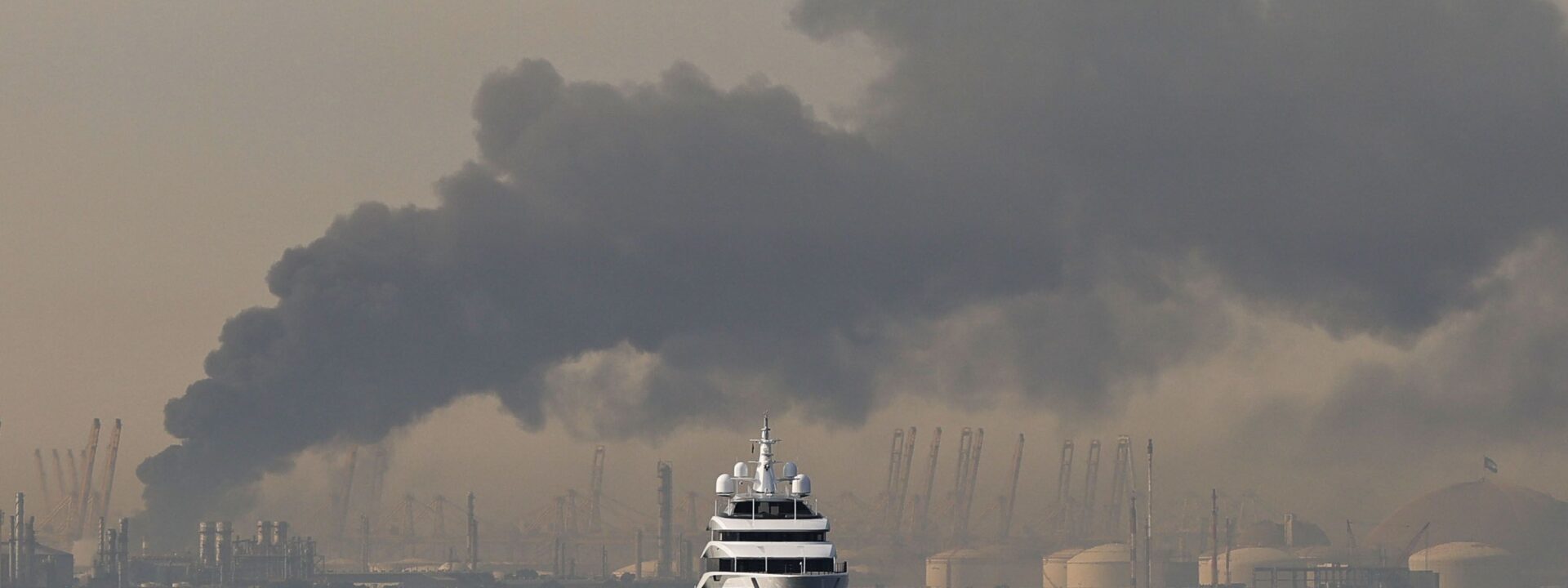
When US and Israeli forces struck Iran on February 28, attention quickly turned to the Strait of Hormuz. Within hours, Iran’s Islamic Revolutionary Guard Corps declared the waterway unsafe for commercial passage; by nightfall, vessel traffic had fallen by roughly 70%.
The closure of the Strait of Hormuz threatens to intensify pressures already mounting across the fashion industry. These include freight surges, unresolved tariff costs, a volatile trade policy environment, and the lingering impact of two years of disruption in the Red Sea shipping corridor. This escalation comes just weeks after a new US-India trade framework promised to reshape sourcing economics, highlighting how quickly geopolitical shocks can upend the industry’s strategic assumptions.
Approximately 20 million barrels of oil—around 20% of the world’s liquid petroleum—pass through the Strait of Hormuz daily. It is also a key outbound route for goods manufactured in major fashion-producing countries like Bangladesh, India, Pakistan, and Sri Lanka. These nations now find themselves at the intersection of two disrupted shipping corridors for the first time.
Fashion brands are now facing simultaneous shocks to supply chains, energy markets, consumer confidence, and luxury demand. This raises questions about whether an industry that has absorbed five major disruptions in five years has truly changed how it manages risk.
Who is most affected?
Dr. Sheng Lu, director of fashion and apparel studies at the University of Delaware, has mapped the EU export dependency of the world’s major apparel sourcing countries. Over 75% of Europe’s apparel imports from Asia typically pass through the Red Sea corridor. Türkiye, Bangladesh, and Pakistan are the most exposed sourcing countries.
Shipment-level data from ImportGenius adds more detail. Brands sourcing from Jordan, which normally export via Israel’s Port of Haifa, are trying to reroute through the overwhelmed Port of Aqaba. The Port of Salalah in Oman—a critical transshipment hub for garments from JCPenney, Banana Republic, Gap, Old Navy, and Levi’s—is also caught up in the conflict. This has led to higher insurance and fuel costs in the area. Oil storage facilities at the port were struck by drones on March 11, following attacks the previous week that hit fuel tanks at the terminal. While no merchant vessels were reported damaged, the strike shows how quickly logistics infrastructure in the Gulf is becoming part of the conflict zone.
For fashion supply chains that rely on the port as a staging point for cargo moving between South Asia, Europe, and the United States, the impact is immediate.
Records show Old Navy and Gap are the dominant US importers using the Pakistan-Salalah corridor—Old Navy alone accounts for more than 2,300 recorded shipments—with Levi’s, Walmart, and Banana Republic also heavily exposed.
Traffic through the region has already dropped sharply. According to Everstream Analytics, daily vessel calls at key Gulf hubs including Bandar Abbas (Iran), Jebel Ali (UAE), and Salalah (Oman) have fallen by more than 50% since early March, as carriers adopt a wait-and-see approach or divert cargo to other ports.
Steve Lamar, CEO of the American Apparel and Footwear Association (AAFA), notes that risk exposure is driven less by company size than by sourcing geography—and the compounding effect is severe.
“Apparel, footwear, and travel goods are low-margin products, meaning increases in transportation costs can significantly impact companies’ bottom lines,” he says, “especially as the industry is already managing new Section 122 tariffs while still awaiting refunds from the illegally collected IEEPA tariffs.”
Read More: Fashion’s New Trade Reality
Friday’s Supreme Court ruling struck down President Trump’s emergency tariffs, but within hours, the administration pivoted to new legal tools. For…The nature of fashion supply chains has evolved, but their vulnerability to disruption remains unchanged.
Myanmar adds another complication: military-imposed fuel limits are disrupting production for brands that still rely heavily on its garment manufacturing hubs. According to ImportGenius data, Adidas was the largest named U.S. importer from Myanmar ports in early March, ahead of H&M, L.L.Bean, and Cutter & Buck. All had shipments moving through Yangon, the country’s largest city. H&M, which sources a small portion of garments from Myanmar but is phasing out production there, says it is monitoring the situation but that it’s too early to gauge any supply chain impact. Adidas states its sourcing is currently unaffected, noting that Myanmar accounts for less than 1% of its global volume and that its local manufacturing partners remain operational.
“The Geography of Risk”
Beyond the physical threats to ships, electronic interference is worsening disruptions. Widespread GPS and Automatic Identification System (AIS) interference has been detected in the Arabian Gulf and the Strait of Hormuz, disrupting navigation and traffic management.
The Red Sea, blocked by Houthi attacks since late 2023, had already forced ships onto the longer route around the Cape of Good Hope. However, this disruption is not affecting all fashion logistics equally. The Asia-to-North America passage has been largely untouched aside from fuel surcharges. The real pressure is on two fronts: Asia-to-Europe air freight, and any cargo headed into the Gulf states themselves.
Since the Red Sea approach to the Suez Canal was effectively closed in 2023, most Europe-bound ocean cargo was already taking the Cape detour. Therefore, the recent Strait of Hormuz closure has not lengthened those journeys further, according to Sanne Manders of Flexport. Ships are simply continuing on the Cape route, bypassing the Gulf entirely.
The disruption extends to air cargo. Emirates and Qatar Airways are among the world’s top five air freight carriers and handle a significant share of Asia-Europe belly cargo due to traffic concentrated through Gulf hubs. Both airlines suspended or severely cut operations after the February 28 strikes, creating very limited capacity.
Emirates SkyCargo has begun a phased restoration of services following a partial airspace reopening, accepting bookings subject to capacity. Qatar Airways Cargo, however, remains fully suspended pending an official reopening of Qatari airspace, with only a few freighters operating outside Doha.
This has created a rapidly shifting rate environment. Spot pricing for Asia-Europe air freight has risen by roughly $1 to $4 per kilogram on top of a baseline of $3.50 to $4, though the lower end of that range is considered more reliable. A more immediate concern is jet fuel, which is repriced weekly, meaning rates can change before cargo even leaves. “If prices keep on rising,” Manders says, “I would assume that more and more shippers will start opting out of air freight.”Early data from Xeneta, a freight market intelligence platform, shows the extent of disruption some ocean shippers are facing. Spot shipping rates from China to Salalah have risen 28% compared to levels before the conflict, while rates from China to the UK are up 9%. Brands that secured rates before the conflict are shielded for now, but those contracts will expire, and the spot market is setting the new baseline.
More importantly, Xeneta’s chief analyst Peter Sand does not expect a full return to Red Sea shipping this year—the revised outlook points to normalization by mid-2027. Fashion brands are not dealing with a temporary disruption with a clear end date. Instead, they are managing a lasting rerouting of supply chains, made more severe by the closure of the Strait of Hormuz, whose duration remains highly uncertain.
The India Whiplash
Of all the ripple effects caused by the Hormuz closure, the impact on India is especially poorly timed.
In less than a month, the country went from celebrating what its apparel industry called the trade deal of a generation to facing a logistical reality that could undermine much of its newfound advantage.
The India-EU free-trade agreement was signed on January 27. An interim trade deal with the US followed on February 3, giving Indian apparel a meaningful tariff edge over competitors like Bangladesh and Vietnam. For brands reconsidering their sourcing after a year of tariff shifts, these deals briefly suggested India’s role in global supply chains could strengthen rapidly. Then the attacks began.
India’s main export route passes through the Arabian Sea and into the Red Sea, meaning shipments now face disruption across two troubled corridors at once. With ships avoiding both the Strait of Hormuz and the Red Sea, many cargoes are being rerouted around the Cape of Good Hope, adding roughly 15 to 20 days to delivery times. For an industry built on tight seasonal deadlines, these delays are significant. The longer routes also come with higher freight costs, which could eat into the tariff advantage Indian exporters had just gained.
In practice, however, the industry’s focus has shifted from long-term strategy to immediate operational concerns, says Sand. For many brands and logistics teams, the priority is simply tracking where shipments are and exploring what alternatives exist.
The Synthetic Trap
The crisis extends beyond freight rates. Polyester and nylon are made from petroleum—so volatility in crude oil prices directly affects raw material costs even before a container is loaded. For fast fashion and sportswear, which use the most polyester, the Hormuz closure is hitting both input costs and shipping routes at the same time.
Brands that rely heavily on synthetic fibers and source from factories dependent on Gulf petrochemical supplies face a lasting double exposure—not just a temporary shipping surcharge—notes Rita McGrath, a management professor at Columbia Business School. This exposure remains regardless of how quickly shipping resumes.
Dr. Lu’s analysis adds a pricing angle: because demand for items like women’s dresses is more price-sensitive than basics or children’s clothing, brands will struggle most to pass on higher input costs in the very categories that depend most on synthetic fibers. McGrath points out that reducing reliance on polyester—long promoted as an ESG goal—is now also a supply chain resilience imperative, and one this disruption makes harder to postpone.
The Recession Shadow
Perhaps the biggest broader risk from the Iran conflict is the potential to trigger a global economic slowdown.
“A prolonged closure of the Strait of Hormuz guarantees a global recession,” Bob McNally, founder of Rapidan Energy and a former White House energy advisor, told CNBC right after the first strikes.
Oil prices surpassed $100 per barrel in the days following the attacks, dipped briefly, and have since climbed back up.Beyond that threshold—a level of volatility that itself disrupts operations—the impact on fashion is multifaceted. Rising crude oil prices drive up the cost of materials like polyester and nylon before production even begins, while soaring freight rates add to existing tariff pressures. At the same time, weakening consumer confidence dampens spending on non-essentials. Dr. Lu points to Bureau of Economic Analysis data showing that apparel’s share of U.S. personal spending has already declined from 2.23% in 2021 to 2.08% in 2025, even without a recession factored in.
As Manders notes, freight costs alone are unlikely to be catastrophic—for example, doubling ocean shipping rates per item, say from 25 to 50 cents for a pair of shoes, is far less severe than a 30% tariff on a $20 bill of materials. “I don’t think doubling freight rates will put anyone out of business,” he says. The real existential threat comes from the combination of all three pressures, not any single one.
The Inflection Point
The fashion industry has endured five major supply chain shocks in as many years. Each time, it has emphasized resilience yet largely reverted to the same sourcing regions, the same transportation dependencies, and the same vulnerabilities. The gap between strategy and reality is clear: despite years of pledges to diversify, the Western Hemisphere’s share of U.S. apparel imports has continued to fall.
According to Dr. Lu, nearshore apparel exports to the U.S. dropped by 6.7% from CAFTA-DR nations and 0.8% from Mexico in 2025, despite preferential tariffs. The policy landscape offers little relief: on March 11, the U.S. Trade Representative launched Section 301 investigations into structural overcapacity across 16 economies, including Bangladesh, Vietnam, Cambodia, Indonesia, India, China, and Mexico. While no tariffs have been imposed yet, the probes suggest the current tariff structure may not be the upper limit.
Given this complexity, McGrath argues that what brands need is not resilience but continuous reconfiguration—building organizations capable of operating across a permanently wide range of conditions, rather than simply recovering from disruptions to a norm. This requires pre-approved decision frameworks that enable responses within hours, not days; working capital structured for disruption rather than lean efficiency; and a fundamentally different approach to uncertainty.
“The key question is whether a disruption exposes a hidden structural weakness or just imposes a temporary cost,” McGrath says. “A brand whose Asia-to-Europe supply chain now faces both a closed Strait of Hormuz and a hostile Red Sea is dealing with compounded chokepoint risks. That’s not just a freight issue to absorb—it’s a network architecture problem.”
McGrath offers a blunt assessment of the industry’s relentless cycle of disruptions: “Resilience is the wrong framework because it implies returning to a prior stable state. There is no prior stable state to return to.”
Update: This article was updated on March 16, 2026, to include comments from H&M and Adidas.
Frequently Asked Questions
FAQs Fashions New Supply Chain Disruption
Beginner Definition Questions
1 What is a supply chain disruption in fashion
Its a major breakdown or delay in the system that gets clothes from the initial design idea to the store This can involve problems with getting materials manufacturing shipping or delivery
2 Whats causing the current disruption
Its a combination of factors ongoing effects from the pandemic port congestion shortages of raw materials rising fuel and shipping costs labor shortages and recent geopolitical conflicts
3 Is this just about shipping delays
No its much broader While shipping is a big part it also includes shortages of fabrics and dyes factory closures unpredictable consumer demand and increased costs at every single step
Impact Effects
4 How does this affect the clothes I buy
You might see higher prices less variety or size options in stores longer wait times for online orders and sometimes a lower quality as brands rush to fulfill orders
5 Why are clothes getting more expensive
Every step now costs more raw materials factory labor shipping containers and trucking fuel Brands are passing some of these increased costs onto consumers
6 Are some brands affected more than others
Yes Fast fashion brands with complex overseas networks are highly vulnerable Smaller brands with less buying power also struggle Brands with local or nearshored production may be more resilient
7 Will this lead to more out of stock messages
Unfortunately yes Inventory has become harder to predict and manage so popular items may sell out faster and not be restocked as quickly
Advanced Industry Questions
8 Whats nearshoring or reshoring
Its the strategy of moving production closer to the brands main market This reduces long shipping distances and can increase control
9 How are brands trying to fix this
Smart brands are diversifying their supplier base ordering fabric and inventory much earlier investing in demand forecasting tech and exploring local manufacturing hubs
10 What is demand forecasting and why is it crucial now
Its using data and AI to predict