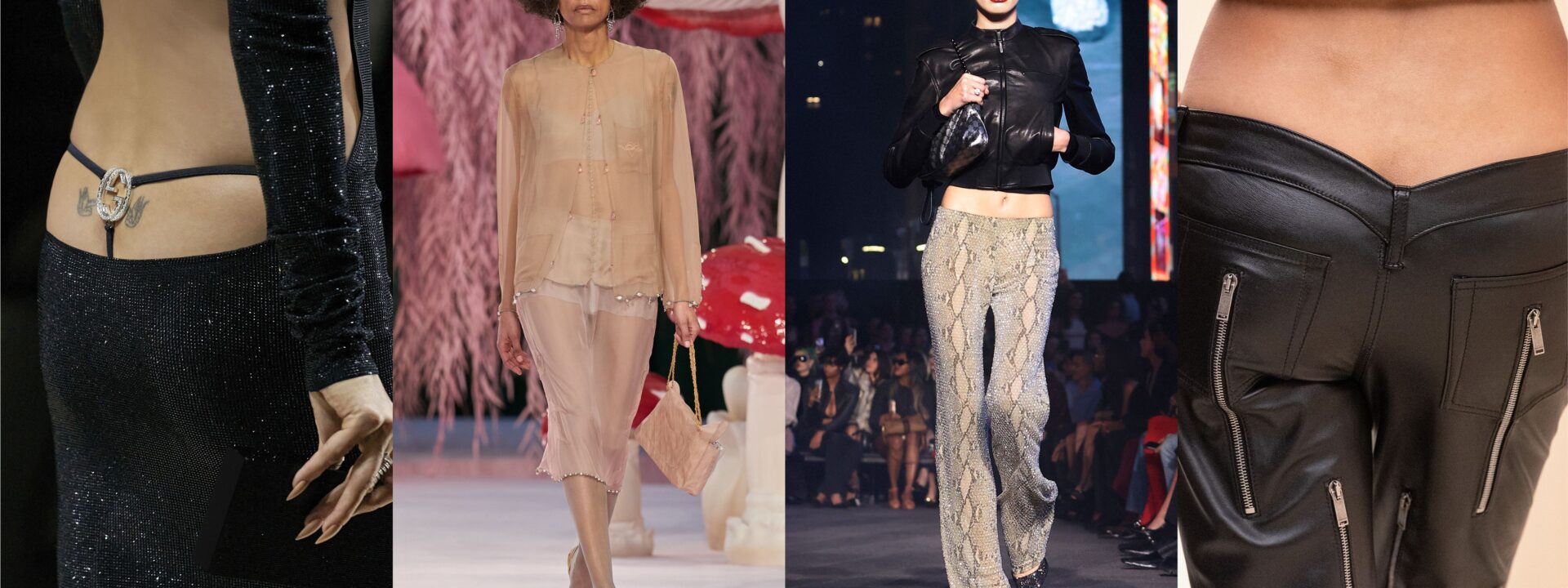
While scrolling through my phone in the back of a cab, I see sex everywhere. There’s a Gucci thong on a Tom Ford–era mood board, a debate about whether Zoë Kravitz might bring back the butt cheek, and those often-admired runway images of early Prada’s love of anything sheer. On my screen, the fantasy is polished and instantly readable—sex as something you can screenshot, share without context, and grasp in half a second. But then the car door opens, and I look up; the most alluring women I see in real life are dressed nothing like that.
This contradiction matters because clothes now have to work in two economies at once: the algorithmic economy, where obvious signals of sex appeal spread at lightning speed, and the lived economy, where women are still dressing for the texture of their actual lives, somewhere between the ordinary and the exciting. The question is: Does sex still sell if the version of sex that travels most efficiently online isn’t necessarily the version women want to live in?
Sex has never been more visible—on dating apps, social media feeds, television, music—yet real desire feels increasingly hard to find. The Atlantic called it a “sex recession.” Vice recently reported on “the great unwanting,” citing a RiseGuide survey in which most Gen Z respondents said they choose social media over sex at least sometimes, if not often. What we’re seeing isn’t a culture without sex, but one where sex is increasingly available as content and increasingly elusive as an experience.
Designers seem to be working both sides of that divide. At Gucci, Demna’s debut cruise collection translated sex into the language of Times Square: sleazy, low-rise snake-print trousers, crystallized surfaces, bare midriffs under cropped leather aviator jackets, and dramatically oversized suits that suggested they had been borrowed from the man you were with the night before, with lace lingerie still visible underneath. It was overt and slightly depraved—internet-core sex appeal as a signal you could understand instantly, and exactly the kind of Tom Ford–era Gucci “charge” that online purists are always waiting to recognize. (As Demna told Vogue, he wants Gucci to be sexy and hot, which are not the same thing; the former requires that you “show some body.”)
Conversely, Matthieu Blazy’s couture debut at Chanel went somewhere quieter: transparent silk mousseline in barely-there tans and pinks, and bags so gossamer they barely existed as objects. Both worlds sell desire, but in Blazy’s show, sensuality is about the rich interiority of a woman’s world.
For me, sexy is a twinkling Rene Barnes lariat necklace dipping beneath a crisp, creamy button-down from The Row, undone one button lower than would be appropriate for the office, with a beautiful French lace bra underneath that is visible to no one at all. I think of these as sex-neutral clothes: items that aren’t inherently loaded with the intent of seduction, but become sensual through lived context. In other words, the charge of the clothes depends entirely on the woman wearing them.
That may be why sex appeal has become much harder to track on the street than it is through our phones. Online, signals cluster quickly and repeat until they’re durable enough to become trends. In life, desire tends to disperse. One woman’s sensuality might be Pieter Mulier’s Alaïa, another’s Chemena Kamali’s Chloé, and another’s simply the right vintage Levi’s with the right white tee and a perfect pair of flip-flops. The same algorithm that makes sex feel omnipresent has also splintered taste into endless private systems of meaning.
So yes, sex still sells, but the fantasy has changed. In a culture saturated with sexual imagery but increasingly estranged from embodied intimacy, the most modern sex appeal isn’t necessarily the look that proves a woman can be desired. It’s the one that reminds her that she already is.
Save to wishlistSave to wishlistKhaiteToldo dress$3,600 KHAITESave to wishlistSave to wishlistValentinoGaravani lace midi skirt $2,700 NET-A-PORTER Save to wishlist Tom Ford skinny pants $5,590 NET-A-PORTER Save to wishlist Gucci Donna pumps $1,220 GUCCI Save to wishlist Gucci seamless stretch leggings $1,200 GUCCI Save to wishlist Alaïa mockneck gown $3,150 NET-A-PORTER Save to wishlist Saint Laurent laced camisole $2,650 SAINT LAURENT Save to wishlist Colleen Allen turtleneck gown $1,250 NET-A-PORTER
Frequently Asked Questions
FAQs About Does Sex Still Sell
Beginner Questions
What does sex sells actually mean
Its the idea that using sexual imagery attractive models or suggestive themes in advertising makes people pay more attention and buy products
Does sex still sell today
Yes but not as reliably as it used to It can grab attention but it often fails to build trust or make people actually buyespecially with younger audiences
Why did sex sells work so well in the past
Because it was shocking and taboo When society was more conservative sexy ads stood out and got people talking
Is sex sells the same as using attractive models
Not exactly Attractive models are common and often fine Sex sells usually means overtly sexual or suggestive content meant to provoke
Do companies still use sex in ads
Yes but more carefully Brands like Axe Calvin Klein and some fashion and alcohol companies still use it though often with more humor or irony
What kinds of products use sex appeal most
Fashion fragrance alcohol cosmetics lingerie and sometimes fast food or techusually products tied to identity confidence or status
Intermediate Questions
Why doesnt sex sell as well anymore
Three main reasons audiences are desensitized younger people value authenticity over shock and social media backlash can hurt a brand fast
Whats the biggest problem with using sex in advertising
It can attract attention but not the right kind People remember the sexy image but forget the productor feel annoyed offended or creeped out
Does sex appeal work for both men and women
It works differently Men often respond to visual sexual cues faster but women respond more to emotional connection and confidence Overly explicit ads can repel both
Can sex in ads ever backfire badly
Yes Examples include ads that seem to objectify women target teens or feel out of touch These can trigger boycotts viral criticism and lost sales
What is the attention vs persuasion problem
Sexy ads win attention but often lose persuasion You notice the ad but you dont remember or trust the brandso you dont buy
Is sex sells illegal anywhere
Many countries have rules For example ads with sexual content cant target children