Earlier this year, when LVMH started selling off parts of its global DFS business, including key assets to China Duty Free Group, many saw it as just a corporate restructuring. But inside the travel retail industry, it was seen as something bigger: a sign that the airport-focused, duty-free model that has shaped global travel retail for decades is now entering a period of reinvention.
For decades, DFS was one of luxury retail’s most powerful distribution systems. It was an empire built on airports, downtown duty-free stores, and the idea that travel itself could fuel a whole industry of spending. From Hong Kong to Guam, Okinawa to Hawaii, DFS once represented the glamour of large-scale cross-border luxury shopping.
Now, China’s new travel retail story is no longer about offshore tax savings, explosive demand from daigou resellers, or airport megastores full of beauty counters. The market is evolving into something broader and more complex: a hybrid system where tourism policy, domestic consumption strategy, infrastructure investment, and lifestyle-driven retail are increasingly working together. As a result, China is becoming a key testing ground for what travel retail could look like for the rest of the industry.
Read More: How to Win Back China
By Yiling Pan
China’s travel retail market is estimated to have reached between $15 billion and $19 billion in 2025, with forecasts suggesting it could more than double over the next decade. Much of that growth comes not just from luxury demand, but from the sheer scale of China’s mobility economy. The country’s civil aviation network carried around 770 million passengers in 2025, while inbound and outbound border crossings recovered to nearly 97% of pre-pandemic levels.
At the center of this ecosystem is Hainan, which has become both China’s largest offshore duty-free market and one of the most closely watched retail experiments in the world. Since the offshore duty-free policy launched in 2011, Hainan’s duty-free sales grew from about RMB 1.6 billion ($235 million) in its early years to RMB 43.7 billion ($6.4 billion) in 2023, before slowing to RMB 30.9 billion ($4.5 billion) in 2024 as Chinese outbound travel resumed and luxury spending cooled. Even after that drop, the island still accounted for nearly 30% of China’s total travel retail market in 2025, serving more than 5.6 million duty-free shoppers each year under one of the world’s highest offshore shopping limits: RMB 100,000 ($11,100) per person.
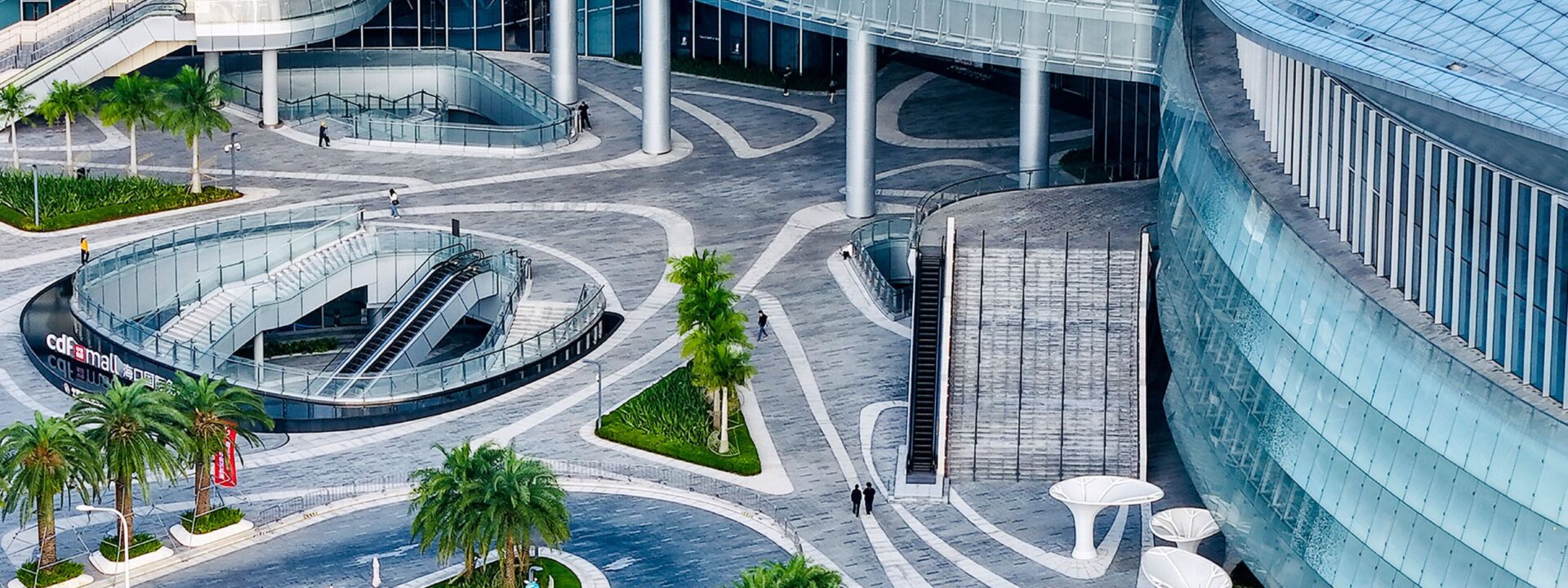
Visitors walk past the Saint Laurent pop-up store at Sanya International duty-free shopping complex, while others shop at the Haikou International duty-free shopping complex in Haikou.
Photo: Getty Images
Today, China’s travel retail market includes airports, offshore duty-free zones, downtown retail districts, outlet villages, and tourism destinations. What were once separate channels are increasingly merging into a broader consumer ecosystem, where shopping, leisure, hospitality, and travel all support each other. Retailers are no longer just competing for sales. They are competing for a traveler’s time, attention, and experience across an entire journey.
“China’s travel retail landscape is no longer defined by format, but by consumer intent,” says Desiree Bollier, chair and global chief merchant of The Bicester Collection, which operates 12 shopping villages worldwide, including Shanghai Village and Suzhou. “Boundaries between duty-free, downtown retail, and off-price have blurred into a broader ecosystem shaped by travel, leisure, and lifestyle.”
That blurring may become the defining feature of China’s next retail decade.
The Reinvention of Hainan
Unlike Europe or Southeast Asia, where travel retail grew mainly through commercial operators and airport concessions, China’s market has always been driven by policy.
The sector’s expansion cannot be separated from government decisions and regulations.This shift is closely tied to Beijing’s broader economic goals: boosting domestic consumption, bringing overseas luxury spending back into China, turning Hainan into a global free-trade port, and speeding up the development of regional tourism infrastructure.
In this sense, China’s travel retail system works less like a typical retail channel and more like a form of economic infrastructure.
Nowhere is this clearer than in Hainan. In 2011, when China’s central government launched Hainan’s offshore duty-free program, the goal was simple: encourage Chinese consumers to spend more of their shopping budget at home instead of abroad. Over the past five years, the island has grown from a niche offshore duty-free experiment into one of the world’s most closely watched luxury retail testing grounds. The expansion of offshore duty-free quotas, combined with free-trade port policies and major tourism investment, turned Hainan into a strategic consumption gateway—just as international travel collapsed during the pandemic.
But according to Eudes Fabre, general manager of Hainan Tourism Investment Duty Free, the market in 2026 no longer runs on the same logic that drove Hainan’s early boom. “Hainan is moving from being a story of expansion to becoming a long-term ecosystem. Growth today may be less explosive,” he says. “But it is becoming more balanced, resilient, and fundamentally sustainable.”
For Fabre, the key feature of China’s travel retail market today is its relative stability. “In a world full of surprises and instability, China still offers a remarkable level of visibility and strategic continuity,” he adds.
Customers shop at CDF Haikou International duty-free.
That difference matters. During Covid, Hainan became known for extraordinary luxury growth, much of it driven by daigou trading, wholesale stock movements, and aggressive brand expansion aimed at capturing trapped domestic demand. Today, the market is becoming more regulated, more focused on experiences, and—crucially—more tied to actual tourism behavior.
“The Hainan market has become much healthier and more transparent,” Fabre says. “Consumption is now driven by real end consumers, not daigou or parallel trading.”
This shift is also changing how brands view Hainan’s role in their China strategy. Instead of mainly serving as a tax-efficient sales channel, the island is increasingly seen as a way to attract new customers. “Hainan has become an effective customer acquisition platform, especially for brands looking to engage with emerging luxury consumers,” Fabre says.
The opportunity lies in the audience Hainan draws. Families and middle-class travelers from Tier 2, Tier 3, and Tier 4 cities arrive with time, curiosity, and growing purchasing confidence—consumer groups that many luxury brands have historically found hard to reach on a large scale.
At the same time, China’s broader travel infrastructure has quietly entered another phase of growth. Domestic tourism has rebounded well beyond 2019 levels. High-speed rail networks continue to expand. Regional governments are investing heavily in leisure economies. And visa relaxations are bringing international travelers back faster than many expected.
Read More: Navigating travel retail’s post-pandemic revival
This year, global air passenger numbers are expected to surpass 2019 levels, the year before Covid. For luxury brands, this puts the potential of travel retail and duty-free firmly back in the spotlight.
By Kapila Ireland
Fabre points to a notable shift in visitor demographics. Russian travelers, long important to Hainan, are now being joined by tourists from Central Asia, Southeast Asia, and the Middle East—many drawn not only by tourism but also by growing curiosity about the island’s free-trade port ambitions.
“Hainan is no longer seen just as a leisure destination,” Fabre says. “It is increasingly viewed as a strategic gateway for global brands looking to connect with both domestic and international consumers.”It is increasingly being recognized as a strategic gateway for trade, investment, and regional economic integration. This shift is also changing how competition works within the market itself. Although the sector is still dominated by state-licensed operators, consumers now have more choices than ever: they can shop abroad, online, in the city center, or in Hainan.
As a result, policy advantages alone are no longer enough. Operators now need to compete on experience, service quality, and brand discovery. “Consumers vote with their wallets,” says Fabre.
The airport is no longer the center of attention
For most of modern luxury retail history, airports were the heart of travel retail. That model is now breaking down in the Chinese market.
At several major airports in China, high-end luxury brands like Louis Vuitton, Gucci, and Celine have quietly reduced their presence or left entirely. Stores that expanded aggressively during the pandemic are now shrinking, consolidating, or disappearing.
“People no longer want to spend 20,000 or 30,000 RMB ($3,000–$3,500) in five minutes,” he says. “There is still a strong demand for accessible luxury and meaningful premium purchases,” says Fabre. This change in behavior is reshaping what sells in airports around the world, but especially in China. Ultra-high luxury has softened, while accessible luxury, lifestyle, and sportswear brands are doing better than expected.
Brands like Lululemon, Descente, Coach, MCM, and Hugo Boss have become more relevant in airports because they fit better with how people travel today: frequent domestic trips, buying gifts, and treating themselves to small luxuries.
The same shift is happening in beauty. Skincare is still important, but fragrance—which is more emotional, personal, and expressive—is growing quickly in Hainan and airports alike.
What is disappearing is the old idea that travel retail is mainly about moving inventory. More and more, brands see travel retail as a way to attract new customers and build their brand. It’s a platform where they can reach new consumers, shape how people see them, and build deeper connections throughout the travel experience.
Yann Bozec, co-founder and managing director of YB Stratis (and former president of Tapestry Asia Pacific), says the industry’s biggest structural mistake was treating travel retail as a short-term wholesale profit machine instead of a long-term brand environment. “If you see duty-free only as a commercial channel, you won’t make the right decisions,” he says.
Bozec speaks openly about the industry’s past reliance on gray-market wholesale practices, especially during Covid. At that time, travel retail revenues often seemed disconnected from actual passenger traffic, because a large share of goods weren’t being sold to individual travelers in airports. Instead, they were bought in bulk and resold through daigou and other parallel trading channels.
“The temptation was like a cookie jar,” he says. “Everyone knew what was happening.”
The result, he argues, was serious pricing problems. Products that appeared much cheaper through parallel channels hurt brand value in domestic markets and forced luxury groups into constant sales cycles.
Now, many brands are trying to regain control—not just by adjusting duty-free prices, but by tightening how products move through the channel. They are moving away from unclear wholesale allocations, reducing their reliance on gray-market middlemen, and shifting toward concession models where brands have more visibility into pricing, inventory, and customer data.
More and more, global luxury houses are moving away from wholesale inventory structures and toward concession models, revenue-sharing agreements, and tighter operational control.Rational oversight. The goal isn’t just to protect profit margins—it’s to protect the brand’s story. For Bozec, the real value of travel retail lies somewhere else entirely: in storytelling. “Duty-free is a captive audience,” he says. “People are bored. They have time. Use that moment to create emotion around the brand.”
That mindset helps explain why many of the most successful airport activations today focus less on size and more on being memorable: immersive pop-ups, seasonal experiences, single-category installations, and highly visual brand moments designed more for cultural visibility than for making a sale.
In other words, airports are turning from shopping centers into media spaces.
The rise of the travel retail destination
Perhaps the clearest sign that China’s definition of travel retail is changing can be found outside duty-free altogether.
According to Bollier from The Bicester Collection, at Shanghai Village and Suzhou Village, the company has spent years building something that blends off-price retail, tourism infrastructure, and lifestyle hospitality. The company avoids calling the Villages just shopping destinations. Instead, they are positioned as “experiential destinations” where fashion, food, art, architecture, and leisure come together for a full-day experience.
“People visit our Villages to live a lifestyle, not just purchase goods,” says Bollier. That approach aligns almost perfectly with how Chinese consumers themselves are evolving, as spending shifts away from purely price- or product-driven decisions toward experience, emotional value, and the quality of time spent in physical spaces.
As luxury products become universally available online, the competitive question for physical retail has fundamentally changed. Bollier points out that it’s no longer “what are you selling?” It’s “why should people spend their time with you?”
The Bicester Collection’s answer lies in emotional utility. European-style open-air architecture creates what Bollier calls a “micro-getaway.” AI concierge services personalize itineraries. Seasonal programming encourages repeat visits. Private hospitality space “The Apartment” caters to VIC customers. Tax refund systems are seamlessly integrated into the experience.
Even the Villages’ location strategy reflects this logic. They are placed not just near wealthy populations but also within broader tourism and travel corridors—typically within an hour of major cities, yet still feeling psychologically separate from city life.
“The ideal location,” Bollier says, “is where accessibility and aspiration intersect.” Importantly, these destinations are increasingly functioning as tourism anchors rather than retail add-ons.
Statistics show that during the 2026 May holiday, Suzhou Village saw double-digit growth in both foot traffic and sales, breaking its sales record twice on May 1 and May 3. Shanghai Village also saw double-digit growth in long-haul visitors, while sales driven by Private Client Services increased by 40%. Both Villages were recognized by the China Tourism Academy as pioneers in shopping tourism destinations.
China travel retail’s next decade will be about time
For years, the defining logic of travel retail in China was price. Today, it’s time.
“People now ask, ‘Is this worth my time?’ rather than ‘Is it cheaper?'” Bollier says. That shift may ultimately prove more disruptive than any policy change. Because once time becomes the core currency, every part of the travel retail ecosystem changes with it: airports can become experience-media channels, Hainan becomes a lifestyle discovery platform, off-price villages become tourism destinations, and downtown duty-free becomes urban hospitality infrastructure.
It’s clear that the industry’s next winners will likely not be the operators.It’s not about having the largest footprint or the biggest quotas, but about being the best at guiding movement, emotion, and memory through ever-changing consumer journeys.
Frequently Asked Questions
Here is a list of FAQs about Chinas travel retail industry moving beyond the dutyfree era written in a natural tone
BeginnerLevel Questions
1 What does beyond the dutyfree era actually mean
It means Chinas travel retail is no longer just about selling taxfree alcohol cosmetics and cigarettes at airports Now its a much bigger ecosystem that includes downtown shopping malls preorder online services and experiences like luxury brand events or popup stores
2 Is dutyfree shopping in China still a good deal
Yes but the value has changed The new phase focuses more on exclusive products limited editions and personalized services rather than just the lowest price You might not save as much on standard items but you can get things you cant find on the mainland
3 Can I still buy dutyfree goods if Im not flying internationally
Increasingly yes Hainan Province allows domestic tourists to buy dutyfree items with a quota even if they arent leaving the country This is a key part of the new phase
4 Whats the difference between dutyfree and travel retail
Dutyfree is a tax exemption for international travelers Travel retail is a broader term covering all shopping aimed at travelersincluding domestic tourists in Hainan airport shops downtown stores and online preorder services The new phase focuses on the whole travel retail experience
5 Why is China moving away from just dutyfree
To boost domestic consumption and tourism By creating a more sophisticated shopping experience China keeps spending inside the country instead of sending it abroad to places like Paris or Seoul
AdvancedLevel Questions
6 How are the offlinetoonline models changing the shopping experience
Travelers can now browse and reserve products online before they travel pick them up at the airport or hotel and even return them instore posttrip This blurs the line between ecommerce and physical retail making it seamless
7 What role do exclusive brand partnerships play in this new phase
Brands like LVMH and Estée Lauder are launching products in Chinas travel